 New Zealand
  United Kingdom
  Singapore
  Malaysia
  Canada (Français)
 Australia

The HR compliance guide for Australian businesses
Published
The HR compliance guide for Australian businesses
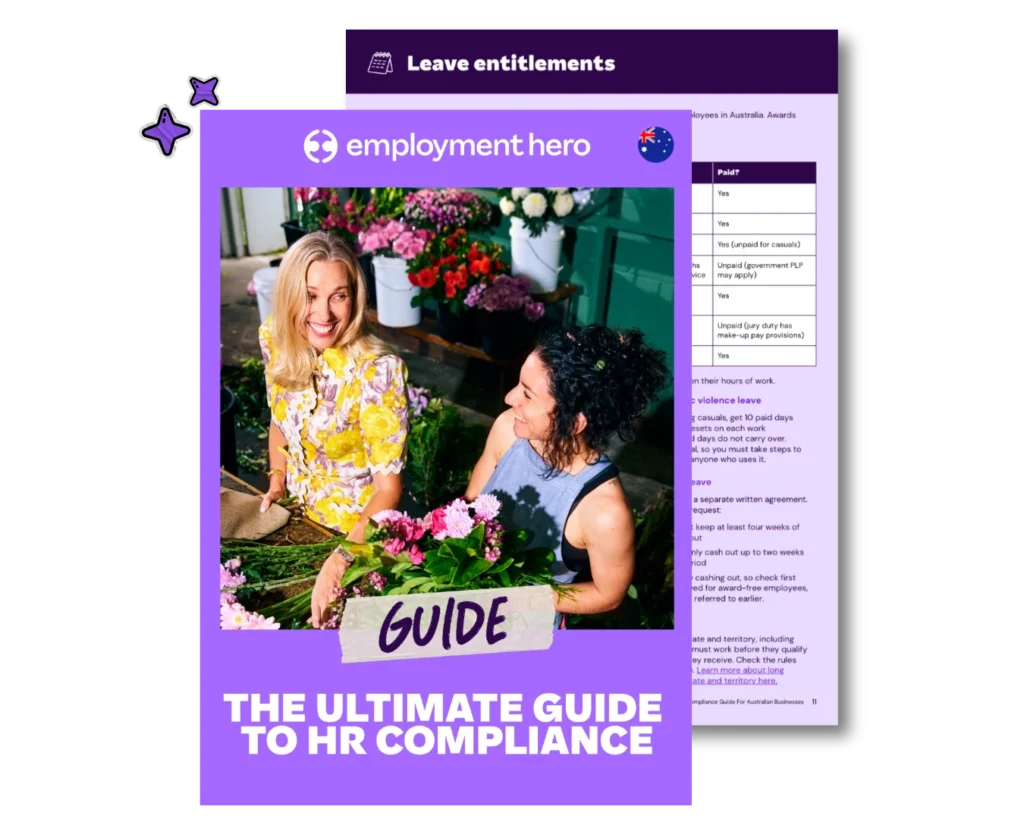
Employment law in Australia is complicated. Awards change, entitlements stack up and legislative deadlines arrive without much warning. The cost of getting it wrong, whether that’s an incorrect pay rate compounding over months or a dismissal handled without proper process, can quickly turn an admin oversight into a legal liability.
This guide covers every major compliance obligation for Australian employers, including what the law requires, what happens when things go wrong and the practical steps to protect your business and your people.
What’s in this guide?
- Minimum entitlements and employment types: the National Employment Standards, how to classify workers correctly, what a compliant employment contract must include and the risks of misclassification
- Modern awards, pay and superannuation: how to identify the right award for each role, minimum wage obligations, the 12% superannuation guarantee and what Payday Super means for your payroll
- Leave entitlements and flexible working: a full breakdown of every leave type under the NES, the rules most employers get wrong and how to handle flexible work requests lawfully
- Hiring, onboarding and casual obligations: every mandatory step before and on an employee’s first day, when to provide the Casual Employment Information Statement and how the Employee Choice Pathway works
- Termination, WHS and the right to disconnect: minimum notice periods, redundancy entitlements, your duty of care under work health and safety law and how the right to disconnect works in practice
We’ve touched on a few sections of the guide below. If you want the full details of everything you need to know, including how to reduce your risk, download the guide now by filling in the form on the side.

Understanding the National Employment Standards (NES)
The NES set the minimum entitlements for every employee in Australia. They apply regardless of what your award, enterprise agreement or employment contract says. Any clause that undercuts the NES is void.
The 11 NES entitlements every employer needs to know:
- Maximum weekly hours
- Requests for flexible working arrangements
- Offers and requests to convert from casual to permanent employment
- Parental leave and related entitlements
- Annual leave
- Personal/carer’s leave, compassionate leave and family and domestic violence leave
- Community service leave
- Long service leave
- Public holidays
- Notice of termination and redundancy pay
- The Fair Work Casual Information Statement (FWIS) and Casual Employment Information Statement (CEIS)
Employment types and contracts
Misclassifying a permanent employee as casual is one of the most common and costly mistakes businesses make. Courts and regulators look at the real substance of the working relationship, not just the label on the contract.
Full-time employees work 38 ordinary hours per week and are entitled to paid leave. Part-time employees work fewer than 38 hours in a regular pattern and receive the same entitlements as a full-time employee but on a pro-rata basis. Casual employees have no firm advance commitment to ongoing work or regular hours and receive a 25% loading in place of most types of paid leave. Fixed-term employees receive the same leave entitlements as permanent employees for the duration of their contract.
From 26 August 2024, courts assess whether a worker meets the casual definition by looking at the “real substance, practical reality and true nature” of the working relationship. A worker on consistent, predictable shifts may no longer qualify as casual regardless of what the contract says. Review work patterns regularly, not just contracts.
Modern awards
Most Australian employees are covered by one of more than 120 modern awards, which set minimum pay rates, penalty rates, overtime, allowances and loadings on top of the NES.
Use the Fair Work Ombudsman’s Find my award tool to identify the right award.
Pay and superannuation
Award-free employees must be paid at least the National Minimum Wage, employees covered by a modern award or enterprise agreement must be paid the minimum wages set out in the award or the agreement.
The superannuation guarantee rate is 12% of qualifying earnings per pay run, applying to all employees aged 18 and over (and employees under 18 who work more than 30 hours per week).
From 1 July 2026, Payday Super requires contributions to clear to the employee’s fund within seven business days of each pay run, replacing the previous quarterly system.
Pay slips must be issued within one working day of each pay run and include the employer’s ABN, pay period dates, gross and net amounts, hourly rate and hours worked, any loadings or penalty rates, deductions and their reasons and the super fund name and contribution amount.
Employee records, pay records and leave records must be retained for seven years. Records must be in English, accessible to the Fair Work Ombudsman on request.
Leave entitlements
Awards and enterprise agreements can provide more, but never less, than the NES.
Full-time and part-time employees receive four weeks of paid annual leave per year (five for certain shiftworkers) based on how many hours they work per week, 10 days of paid personal and carer’s leave (pro rata for part-time employees), two days of compassionate leave per occasion, up to 12 months of unpaid parental leave and 10 days of paid family and domestic violence leave. Casuals receive (unpaid) compassionate leave and paid family and domestic violence leave. All employees (even casuals) are entitled to paid long service leave, the rules for which vary between states and territories.

Casual employment obligations
Provide the Casual Employment Information Statement (CEIS) before or as soon as possible after the employee starts. Businesses with 15 or more employees must provide it again at six months, 12 months, then annually. Small businesses must provide it again at 12 months, but not again after that.
From 26 February 2025 (26 August 2025 for small businesses), eligible casuals can request conversion to permanent employment after six months of service (12 months for small businesses). You must respond in writing within 21 days. Refusals must be based on genuine, documented grounds.
Flexible working arrangements
Certain employees with at least 12 months of continuous service have a legal right to request changes to their hours, patterns or location of work.
Eligible employees include parents or carers of a child, employees with a disability, those aged 55 or over, employees experiencing family or domestic violence and those caring for a family member with a disability or serious illness.
You must respond in writing within 21 days and a refusal must be based on reasonable business grounds.
There is also a requirement to consult with employees about their request and strict rules about the information that you put in the written response to the request, such as the grounds for any refusal, any alternate arrangements you can agree to and the employee’s right to appeal a refused request.
Work health and safety
Every employer must ensure, so far as is reasonably practicable, the health and safety of workers, that the work environment does not pose risks and that adequate information, training and supervision are provided.
Since 2022, managing psychosocial hazards has also been a formal WHS obligation in most states and territories. These include high or low job demands, poor role clarity, lack of support, remote or isolated work, bullying and harassment.
If you want to learn more about HR compliance in depth, download our guide now by filling out the form on the right side.
FAQs
The NES are 11 minimum employment entitlements that apply to every employee covered by the national workplace relations system. No award, enterprise agreement or employment contract can undercut them.
Payday Super took effect from 1 July 2026. Employers must pay super contributions so they clear to the employee’s fund within seven business days of each pay run. The previous quarterly payment system no longer applies.
The SG rate is 12% of qualifying earnings per pay period.
Yes. Under the Employee Choice Pathway, eligible casuals can request conversion after six months of service (12 months for small businesses). Employers must respond in writing within 21 days and can only refuse on genuine, documented grounds.
Employees have the right to refuse to respond to or monitor for out-of-hours work contact unless that refusal is unreasonable. Employers cannot penalise employees for exercising this right. It has applied to all employers since 26 August 2025 (for larger employers from August 2024).
Sham contracting occurs when an employer knowingly misrepresents an employment relationship as an independent contracting arrangement. It is illegal under the Fair Work Act.
As of January 2025, intentional underpayment is a criminal offence under the Fair Work Act.
Sole traders and partnerships in Western Australia that are not incorporated may be covered by the Western Australian Industrial Relations System rather than the Fair Work Act. Check which system applies before assuming your obligations match the national framework.
Disclaimer: The information in this guide is current as at 30 July 2026, and has been prepared by Employment Hero Pty Ltd (ABN 11 160 047 709) and its related bodies corporate (Employment Hero). The views expressed in this guide are general information only, are provided in good faith to assist employers and their employees, and should not be relied on as professional advice. The Information is based on data supplied by third parties. While such data is believed to be accurate, it has not been independently verified and no warranties are given that it is complete, accurate, up to date or fit for the purpose for which it is required. Employment Hero does not accept responsibility for any inaccuracy in such data and is not liable for any loss or damages arising either directly or indirectly as a result of reliance on, use of or inability to use any information provided in this guide. You should undertake your own research and to seek professional advice before making any decisions or relying on the information in this guide.
Download the essential guide to HR compliance
Related Resources
-
 Read more: AI skills assessment template for your team
AI skills assessment template for your team
Help your team build their AI skills. Download our free AI skills assessment template for managers and employees.
-
 Read more: The AI Adoption Blueprint
The AI Adoption Blueprint
What does it take to embed AI across an entire team? We’re sharing our training, our policies, and the lessons…
-
 Read more: Employment Essentials: AI Best Practices
Employment Essentials: AI Best Practices
Learn how to use AI in HR without creating privacy, compliance or employment risks in our latest webinar.


