 New Zealand
  United Kingdom
  Singapore
  Malaysia
  Canada (Français)
 Australia


The ultimate work handover checklist for a smooth transition
Published
The ultimate work handover checklist for a smooth transition
Published
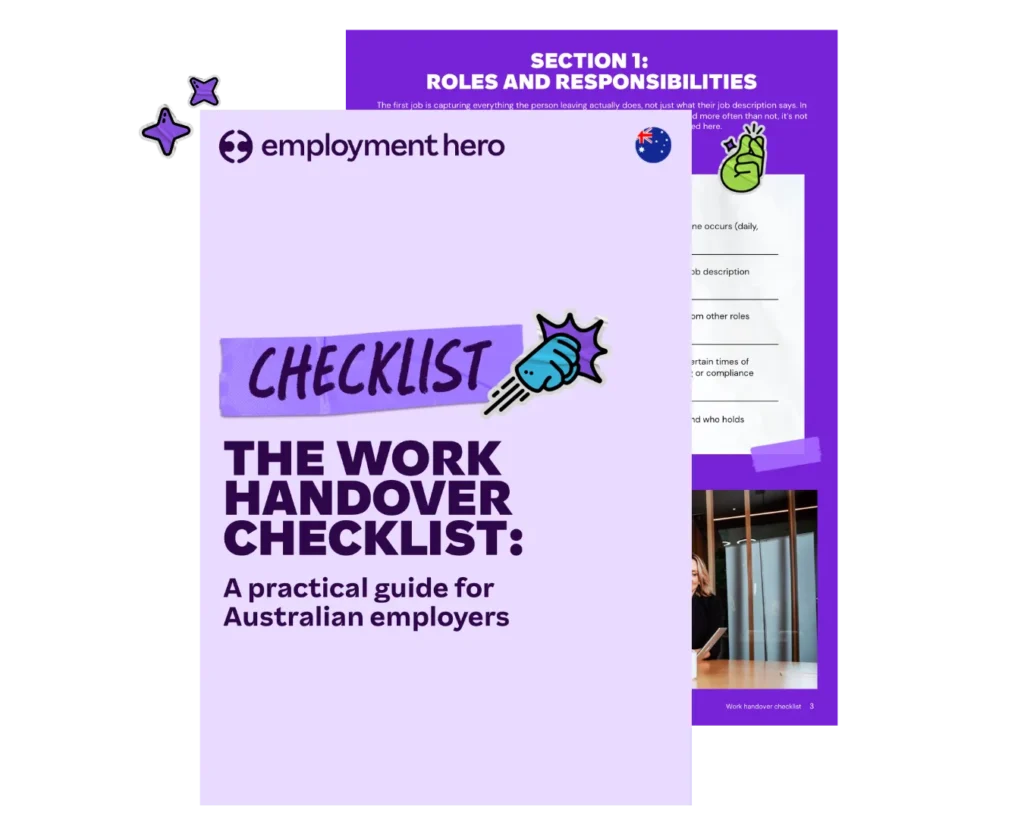
When an employee hands in their notice, most businesses turn their focus straight to finding a replacement, writing the job ad, briefing the recruiter and setting up interviews. This often means that the handover process gets squeezed into the final week, suddenly realising that the person leaving is the only person who knows how a key client relationship works, where the project files live or what the standing arrangement is with a critical supplier.
A structured handover protects your business from ending up in that situation. It helps keep projects moving, reduces the pressure on remaining team members and gives any incoming hire a real foundation to work from, instead of spending their first month trying to figure out what the role actually involves.
This walks through everything that needs to happen, with a practical checklist you can download and use straight away.
Why handovers are important
When knowledge isn’t captured before someone leaves, it could end up being completely gone. This could mean that clients get inconsistent service, projects stall while people try to piece together what was happening or team members who weren’t involved in a piece of work have to start from scratch.
The problem tends to be worse in smaller teams, where one person often carries an outsized share of institutional knowledge, but it affects businesses of every size.
A well-run handover gives you a window to transfer that knowledge deliberately, while the person still works for you. That window is shorter than most managers expect, which is why having a clear process in place before you need it is so important.
Essential elements of a good handover
Think of a handover document as a snapshot of everything someone carries in their head about their role, captured in a document that someone else can practically use. Here’s what needs to be in it.
Key responsibilities
Start with the core duties of the role. What is the person accountable for on a daily, weekly and monthly basis? Include recurring tasks that don’t appear anywhere on a project plan, like preparing the weekly report, checking in with a particular stakeholder or running the Friday team standup. These are exactly the things that fall through the cracks when nobody thinks to document them.
You should also capture any responsibilities that aren’t formally part of the job description but have become part of the role in practice. Often these carry the most risk if they’re not handed over properly.
Ongoing projects
For every active project, document where things currently stand. That means the current status, what’s been completed, what the next steps are, who else is involved and any blockers or risks that are already on the radar. Be specific about timelines and commitments, especially anything that’s been communicated to external stakeholders.
This section needs enough detail that someone coming in fresh can understand the context without having to track down three different people to ask basic questions.
Important contacts and key stakeholders
List every person the role regularly interacts with, internally and externally. For each contact, give a brief note on the nature of the relationship like how often they communicate, what the history is and anything important about how to work with them effectively.
This could be a client who prefers phone over email, a supplier contact who’s about to go on leave or an internal stakeholder who needs to be kept in the loop on a particular project. This kind of context only exists if someone writes it down.
Processes and tools
Be sure to document every platform, system and workflow the role relies on. Include login details or instructions for accessing credentials through your password manager, any tool-specific processes that aren’t intuitive and any integrations or automations that are running in the background. If there’s a particular way something needs to be done to avoid breaking a downstream process, write it down in detail.
Having a centralised employee management platform makes this significantly easier to manage. When documentation lives in one accessible place rather than scattered across personal drives and email threads, the handover process is faster and the risk of something being missed is lower.
Pending issues and loose ends
This is the section people most often skip and it’s usually the one that causes problems later. You want to flag anything that’s currently unresolved or take note if there’s something that needs attention in the first week after the person leaves.
The work handover checklist: tying it all together
Use this as the working document for both the departing employee and their manager. Go through it together rather than treating it as a solo task.
Responsibilities
- Core daily, weekly and monthly duties documented.
- Recurring tasks listed, including informal ones that have become standard.
- Any strategic responsibilities or informal accountabilities captured.
Projects
- All active projects listed with current status.
- Next steps and upcoming milestones documented for each.
- Blockers, risks and any pending decisions flagged.
- Other team members or stakeholders involved in each project identified.
Contacts
- Internal contacts listed with context on relationship and communication preferences.
- External contacts and clients listed, including relationship history.
- Any upcoming meetings or commitments with key contacts noted.
The format of your handover documentation is more important than most people realise. A document that lives on someone’s personal drive or that exists in three different versions across different folders, creates more confusion than it resolves.
Keep everything in one centralised, digital location that both the departing employee and their manager can access and edit. A shared drive folder with a clear naming convention works.
For project-specific handovers, you might want to create a separate document for each significant piece of work. It’s easier to navigate and easier to hand off to the right person if multiple team members are picking up different projects.
Write for someone who has no prior context. That means spelling out acronyms, explaining why certain decisions were made and being specific about things that feel obvious to the person writing. The test of a good handover document is whether a person new to the role could follow it without needing to ask clarifying questions every five minutes.
Best practices for an effective job handover
Start early
As soon as notice is given, the handover clock starts. A two to four week notice period sounds like a lot of time until you factor in ongoing work commitments, annual leave and the reality that most people underestimate how long it takes to document a role properly.
Starting in the first week of notice gives you time to do this thoroughly. Starting in the last three days means you get a rushed, incomplete version that creates problems for months.
Facilitate a handover meeting
A document covers the what, but a meeting covers the why and the how. Schedule a dedicated session between the departing employee, their manager and ideally their successor, to go through the handover documentation together. This is where nuances get explained and things that didn’t make it into the document surface.
If the successor hasn’t been hired yet, the manager needs to be across the details well enough to brief them when they start.
Focus on knowledge transfer
It’s important to remember that documentation is a starting point. For roles with significant complexity or institutional knowledge, a period of structured shadowing is worth the time investment. This means the incoming person working alongside the departing employee on real tasks before they leave, not just reading through a document on their own.
Pairing this kind of on-the-job knowledge transfer with a learning management system (LMS) gives new starters a structured way to build their understanding of systems, processes and compliance requirements at their own pace. It also creates a record of what training has been completed, which matters for compliance-sensitive roles.
How learning platforms support seamless transitions
A handover document gives your new starter the what, but a learning platform gives them a structured path through it.
Even a thorough handover pack can be overwhelming to land in front of someone on day one. An LMS lets you break that content into sequenced, role-specific learning paths so new starters build understanding at a manageable pace, covering systems, processes and compliance requirements in a logical order instead of all at once. Managers can track progress rather than assuming everything has been absorbed.
For HR leaders managing transitions across multiple teams or locations, this also solves a consistency problem. When individual managers are responsible for running the handover process themselves, quality varies. Building standardised onboarding and handover content in a central platform means the process works the same way regardless of who’s managing it.
If you’re thinking about how handovers fit into your broader workforce planning approach, this is worth building into your offboarding framework now, before you need it.
The checklist below gives you everything covered in this guide in one place. Download it, share it with your managers and use it as the starting point for every handover going forward.
The information in this checklist is current as at 25 May 2026 and has been prepared by Employment Hero Pty Ltd (ABN 11 160 047 709) and its related bodies corporate (Employment Hero). The views expressed in this checklist are general information only, are provided in good faith to assist employers and their employees and should not be relied on as professional advice. Some information is based on data supplied by third parties. While such data is believed to be accurate, it has not been independently verified and no warranties are given that it is complete, accurate, up to date or fit for the purpose for which it is required. Employment Hero does not accept responsibility for any inaccuracy in such data and is not liable for any loss or damages arising directly or indirectly as a result of reliance on, use of or inability to use any information provided in this checklist. You should undertake your own research and seek professional advice before making any decisions or relying on the information in this checklist.
Register for the checklist.
Related Resources
-
 Read more: AI skills assessment template for your team
AI skills assessment template for your team
Help your team build their AI skills. Download our free AI skills assessment template for managers and employees.
-
 Read more: The AI Adoption Blueprint
The AI Adoption Blueprint
What does it take to embed AI across an entire team? We’re sharing our training, our policies, and the lessons…
-
 Read more: Employment Essentials: AI Best Practices
Employment Essentials: AI Best Practices
Learn how to use AI in HR without creating privacy, compliance or employment risks in our latest webinar.


