 New Zealand
  United Kingdom
  Singapore
  Malaysia
  Canada (Français)
 Australia
How to automate employee onboarding with AI

Contents
The moment a new hire signs their contract, a clock starts ticking. What you do next in the hours, days and weeks that follow can determine whether that person becomes a long-term contributor or starts looking for their exit.
The stakes are higher than most businesses realise. Our Hiring Snapshot Report revealed that 60% of Australian businesses have had a new hire leave within their first month. That kind of early attrition stings financially, not to mention the disruption to your team and productivity, all while putting you right back at square one in the hiring cycle.
The culprit is often less visible than you’d expect… A slow, fragmented onboarding process could be leaving your new starters feeling lost before they’ve had a chance to settle in.
AI and automation give you a better way forward. By handling the admin, paperwork, system access, policy sign-offs and welcome comms digitally, you free up time to prioritise the human connection that makes someone feel like they’ve made the right choice joining your business.
In this guide, you’ll learn how to build an onboarding process that’s faster, smoother and built to retain your top people.
What is onboarding automation?
Onboarding automation is the use of software and AI to manage the admin tasks, communications and workflows involved in bringing a new employee into an organisation. Instead of relying on HR teams to manually send documents, chase signatures and track task completion, automation handles these steps systematically and on schedule.
When HR teams are already stretched managing existing employees, the admin burden of onboarding a new hire can quickly become a bottleneck. Roles that take longer to fill and longer to activate cost businesses more in time, productivity and the risk of losing a candidate who has already accepted an offer.
Automated onboarding replaces ad hoc email chains and spreadsheet checklists with structured, repeatable workflows that run consistently every time you hire. The result is faster time-to-productivity for new starters, a lighter admin load for HR and a more professional experience for everyone involved.

How to automate employee onboarding
Automating document collection and contract management
One of the most immediate wins from onboarding automation is the elimination of paper-based or email document management. With the right HR software, employment contracts, tax file number declarations, superannuation choice forms and workplace policies can be distributed digitally to new starters before their first day.
Employees can review and sign documents through a secure app, with e-signatures and completed documents being stored digitally against the employee’s record, creating a clean audit trail without HR needing to file anything manually.
This is important from a compliance standpoint. Under the Fair Work Act 2009, employers have specific obligations around providing employment contracts and the Fair Work Information Statement. Automating distribution means these obligations can be met consistently, regardless of who is managing the hire.
Setting up onboarding workflows and task management
Beyond documents, onboarding involves a long tail of tasks across HR, IT, payroll and the hiring manager’s team. Who sets up system access? Who orders the laptop? Who books the first-week induction sessions? Without a structured process, these tasks can fall through the gaps.
Automated workflow tools let you build onboarding checklists that are triggered when a new hire is added to the system. Tasks are assigned to the relevant person, with deadlines attached. Progress is visible in a central dashboard, so HR can see at a glance what’s been done and what’s outstanding, without chasing each responsible party individually.
This is especially valuable when you’re hiring frequently or across multiple locations. Instead of relying on individual managers to remember the steps, the system enforces the process every time.
Automating reminders and communications
Even the best-designed onboarding process breaks down when people forget to act on their tasks. Automated reminders solve this without requiring HR to police every deadline manually.
New starters receive timely nudges to complete their paperwork, set up their profiles or watch mandatory training modules. Managers get alerts when a task assigned to them is overdue and HR teams can configure milestone check-ins, such as automated messages at the one-week and one-month mark, to keep new employees engaged and informed.
This kind of systematic communication also reduces the anxiety that many new starters feel in their first weeks. Knowing what’s expected of them and receiving clear guidance on how to complete it, creates a more confident start.
The role of conversational AI in onboarding
Workflow automation handles the logistics. Conversational AI handles the questions.
New starters typically have a flood of queries in their first weeks. Some of the questions look like:
- How do I access my payslips?
- What’s the parental leave policy?
- Who do I contact about my super?
In a traditional setup, these questions land in someone’s inbox. With conversational AI, they’re answered instantly, at any time of day.
What are the benefits of using conversational AI in onboarding?
Conversational AI tools, often built as chat interfaces embedded in HR platforms, allow employees to ask questions in natural language and receive accurate, policy-specific answers drawn from the company’s own documentation.
The benefits for employers are significant. HR teams are freed from repetitive, low-complexity queries and can spend time on work that requires human judgement. New starters get faster answers, which reduces the frustration and confusion that can contribute to early turnover.
There’s also consistency. A conversational AI tool gives the same accurate answer every time, which is important when it comes to entitlements, policies or compliance-related questions where incorrect or inconsistent information can create real problems.
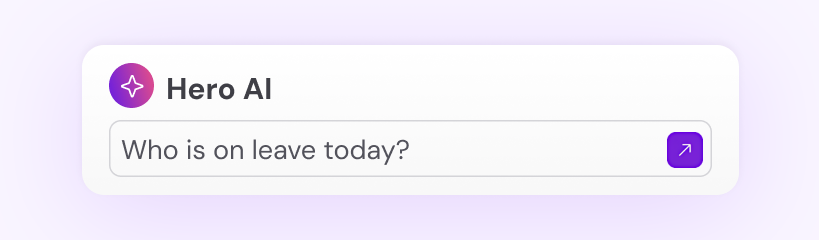
Employment Hero’s Hero AI is built directly into the platform for exactly this purpose. Employees can ask questions about their entitlements, HR policies and workplace documents and get instant answers, without needing to wait for a response from their HR team.

Improved efficiency and reduced manual work
Key benefits of AI-powered onboarding for employers
The administrative load of onboarding a single employee can run to several hours of HR time across document preparation, task coordination, system setup and communication. Multiply that across a business hiring at scale and the cost adds up fast.
Automation reduces this dramatically. Documents are distributed and tracked automatically, tasks are assigned and monitored by the system and HR time shifts from admin to the valuable work of helping new starters actually settle in.
Better compliance and audit trails
Compliance in onboarding is non-trivial. Employers are required to provide specific documentation under the Fair Work Act, ensure superannuation is set up correctly per ATO requirements and meet record-keeping obligations under Fair Work requirements.
Automated onboarding makes compliance easier to achieve and easier to prove. Every document sent and signed is timestamped and stored, every task is logged and if there’s ever a question about whether a particular policy was acknowledged or a form was completed, the record is there.
This audit trail is also important. If the Fair Work Ombudsman or the ATO requires evidence that an employer met their obligations during onboarding, a well-configured HR system provides that evidence automatically, without anyone needing to dig through old emails.
Enhanced employee experience
The onboarding experience shapes how a new employee feels about joining your business. A chaotic first week, where nothing is set up and no one knows who’s responsible for what, sends a clear signal about how the organisation operates.
Automated onboarding makes the first week a little more calm. New starters know exactly what they need to do and when. They have access to a consistent set of resources from day one. And if they have questions, they can get answers without waiting for someone to be available.
This is important because poor onboarding is more common than most employers realise. Our Employment Uncovered research found that one in four new starters rated their onboarding experience as bad, with part-time employees 35% more likely to report a poor experience than their full-time counterparts.
Communication breakdowns are often the root cause. Our 2025 Recruitment Report found that when employers were asked why candidates disengage during hiring, 18% pointed to slow or unclear communication. The same pattern shows up after someone is hired. New starters who are left guessing about what’s expected of them or who chase answers that never come, form their first impressions of the business accordingly.
Automation helps make the experience more predictable. Employees who feel informed and supported in their first weeks are more likely to stay, which makes a structured onboarding process one of the more cost-effective retention tools available to growing businesses.
Challenges and considerations when automating onboarding
Automation is not a set-and-forget solution and it’s worth being clear about where the risks sit.
Over-automation
If every interaction in a new starter’s first week is handled by a system, the experience can feel impersonal or cold. Onboarding still needs human touchpoints, particularly a genuine welcome from a manager and early check-ins that go beyond task completion.
Data privacy
Onboarding involves collecting sensitive personal information, including tax file numbers, bank details and identity documents. Any platform handling this data needs to comply with the Privacy Act 1988, which governs how personal information is collected, stored and accessed.
Integration issues
Integration issues can undermine the value of automation if your HR platform doesn’t connect cleanly with payroll, IT provisioning or other systems new employees need access to. It’s worth auditing your existing tech stack before implementing onboarding automation to make sure data flows correctly between systems.

Best practices for implementing AI onboarding successfully
Start with clear workflows and goals
Before you automate anything, map out your current onboarding process in full. Identify every task, who owns it, and when it needs to happen. Note where things currently break down, including the tasks that are forgotten, documents that arrive late or communication that falls through the gaps.
This exercise usually reveals that the problem isn’t a lack of automation, but how clear things are. Automating a poorly designed workflow just makes it fail faster and more consistently. You want to fix the process first, then automate it.
You’ll also want to define what success looks like before you start. Is the goal to reduce time-to-completion for onboarding paperwork? To improve the completion rate of mandatory training in week one? To reduce the number of HR queries from new starters in their first month? Clear goals help you choose the right tools and measure whether they’re working.
Choose the right AI tools for onboarding
Not all HR platforms offer the same depth of onboarding functionality. When evaluating tools, look for:
- Digital contract generation and e-signature capability
- Configurable onboarding task workflows with role-based assignment
- Automated reminders and communication triggers
- Integration with payroll so new employee data flows through without rekeying
- A conversational AI layer that can answer employee questions from your own documentation
- Reporting and audit trail functionality for compliance purposes
Employment Hero’s AI-enhanced HR platform covers all of these and so much more. The platform connects hiring, onboarding, payroll and employee experience in one place, so the information collected when someone is hired flows directly into their employment record without anyone needing to transfer it manually.
If you’re also looking to streamline how you find candidates in the first place, our AI recruitment tools use AI to match, screen and shortlist candidates before they reach the onboarding stage.
Balance automation with human interaction
The goal of onboarding automation is to make the experience better, not just faster. That means being deliberate about where humans need to show up.
Some interactions should never be automated, like the call from a manager welcoming someone before they start, the check-in at the end of week one or introduction that helps a new starter feel they belong. These are the moments that convert a new employee into a committed one and no workflow tool can replicate them.
The best use case here is to use automation to handle everything that doesn’t require a human. Use the time it frees up to make the human interactions more meaningful.
Ready to see it in action?
If your current onboarding process involves a lot of email threads, manual checklists and chasing people for signatures, you’re spending time on things you don’t need to.
Employment Hero brings together automated onboarding, AI-powered hiring and conversational HR tools in a single platform designed for growing businesses.
Book a demo to see how Employment Hero can take the admin out of onboarding, so you can focus on getting your new hires off to a great start.
The information in this article is current as at 30 June and has been prepared by Employment Hero Pty Ltd (ABN 11 160 047 709) and its related bodies corporate (Employment Hero). The views expressed in this article are general information only, are provided in good faith to assist employers and their employees and should not be relied on as professional advice. Some information is based on data supplied by third parties. While such data is believed to be accurate, it has not been independently verified and no warranties are given that it is complete, accurate, up to date or fit for the purpose for which it is required. Employment Hero does not accept responsibility for any inaccuracy in such data and is not liable for any loss or damages arising directly or indirectly as a result of reliance on, use of or inability to use any information provided in this article. You should undertake your own research and seek professional advice before making any decisions or relying on the information in this article.
Related Resources
-
 Read more: Changes to Junior Pay Rates in Retail, Fast Food and Pharmacy Awards from 1 December 2026
Changes to Junior Pay Rates in Retail, Fast Food and Pharmacy Awards from 1 December 2026
Junior pay rates for 18, 19 and 20 year olds in retail, fast food and pharmacy are changing. Here’s what’s…
-
 Read more: Build on Employment Hero’s HR API and get more out of every client relationship
Build on Employment Hero’s HR API and get more out of every client relationship
Learn how developers, consultants and software vendors build on Employment Hero’s HR API and earn recurring revenue through the Referral…
-
 Read more: Changes to the Health Professionals and Support Services Award from 1 October 2026
Changes to the Health Professionals and Support Services Award from 1 October 2026
The Health Professionals and Support Services Award changes from 1 October 2026. Here’s what employers need to know.


