 New Zealand
  United Kingdom
  Singapore
  Malaysia
  Canada (Français)
 Australia
The benefits of AI in HR: a practical guide for Australian employers

Contents
HR has always been a people-first function. The irony is that most HR teams spend the majority of their week doing everything but connecting with people. It’s usually spent screening CVs, scheduling interviews, chasing onboarding paperwork or answering the same payroll question 10 times over.
These tasks definitely keep the business running, but they don’t help move it forward.
For Australian employers dealing with tight talent pools and increasing compliance obligations, AI in HR changes the equation. Your team gets time back, your employees get faster support and your business gets an HR function that’s working at its potential.
Ready to see how adopting AI in your HR function can transform your business? We’ve wrapped up some helpful tips to get you on the right track.
Who is AI in HR for?
It’s for any employer, business leader or HR professional who’s ever wished there were more hours in the day. Whether you’re running a 25-person business with one overstretched office manager or leading a 300-person team that spends more time in its inbox than on strategy, the goal is the same. Less time on repetitive tasks, faster hiring, better support for your people and the ability to get ahead of workforce problems before they become expensive ones.
When looking holistically, the tasks worth automating first tend to happen often, follow clear rules and nobody enjoys doing them. “This could be interview scheduling, onboarding task management or employee query handling and it’s where most businesses see the fastest return.
Hiring: where AI makes the most immediate impact
Our 2025 Recruitment Report revealed that 37% of Australian businesses say time-consuming manual hiring workflows are one of their biggest challenges. Above that was 41% who say poor quality applicants are their top headache.
AI tackles both at once.
Natural language processing allows AI to read a CV the way a recruiter would by parsing experience, skills and role fit from unstructured text instead of keyword matching. It reviews hundreds of applications, scores fit against your criteria and surfaces the candidates worth a closer look before a human has opened a single document. Scheduling, communications and shortlisting run automatically in the background.
What changes when AI handles your recruitment workflow
|
Task |
The old way |
With AI |
|---|---|---|
|
CV screening |
Hours per role, variable quality |
Minutes, at scale, consistent criteria |
|
Interview scheduling |
Email chains that drag for days |
Candidate self-books via calendar sync or AI interview |
|
Candidate communications |
Drafted individually, often delayed |
Triggered automatically at each stage |
|
Shortlisting |
Subjective, depends who’s reviewing |
Scored consistently against set criteria |
It’s important to remember here that speed only matters if you’re moving toward the right person. AI contributes through predictive modelling, i.e., using patterns in your historical hire data to flag what correlates with success in a role. The output is a much better-informed starting point for a human decision. Keep a human accountable for the final call, always.
Say hello to Employment Hero’s AI Recruitment Agent
Employment Hero’s Recruitment Agent handles your first-round screening from end to end. It creates interview questions, evaluates responses and presents you with structured scores and video recordings to review. You stay in control and AI does the heavy lifting. Curious? Watch the video below to see it in action.
But don’t just take our word for it…
Take a look at the difference it’s made to hiring at Thermosash Group (550 employees)
“It used to take us a week to process and screen a single applicant. Now we can review 10 candidates in under 20 minutes. “By condensing scheduling, interviewing and note-taking into one workflow, I can make quality assessments in under 30 seconds, freeing up more time to focus on quality shortlisting, face-to-face interviews, candidate assessment and final selection.”
— Craig Gillett
Employee experience and 24/7 HR support
There’s an uncomfortable number in our Wellness at Work Report: 41% of Australian employees feel uncomfortable talking to their manager about mental health and wellness concerns. When HR is buried in admin, the formal support channels that carry this weight start to fall behind.
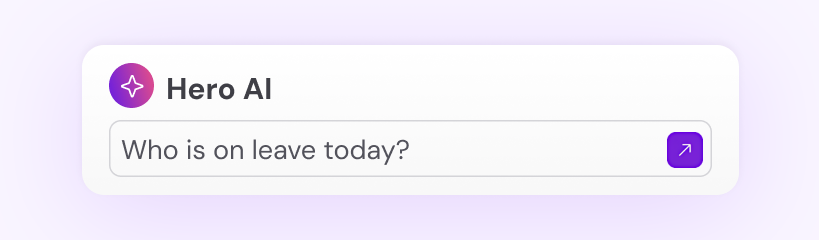
That’s where Hero AI earns its place. Built into our Employment Operating System, it handles the volume of leave queries, payroll questions and policy clarifications, so your HR team has capacity for the conversations that need a human. Employees get instant answers any time, sensitive cases escalate immediately and every interaction gets logged.
Over time, that interaction data becomes useful, giving you an overview of what your workforce is confused about, where policies need clearer communication and which processes keep generating the same question on repeat.
Onboarding and learning: fix the revolving door
First impressions are more important than most businesses realise. Our Hiring Snapshot Report revealed that 27% of Australian SMEs have had a new hire leave within their first six days and 60% have lost a new starter within the first month.
Every one of those early exits kicks off the full recruitment cycle again. This is where AI has the power to make personalised onboarding scalable, tailoring the journey based on role, location, team and skills gaps identified during hiring. A new sales hire gets a different path than a new engineer. Learning management systems recommend training based on each employee’s development needs and track completion automatically.
The technology builds the structure and your managers focus on building the relationship.
Workforce planning and compliance
Business leaders know that most workforce planning is reactive. Someone leaves and a backfill request goes up. Predictive analytics can change that. By analysing patterns in turnover history, performance data and engagement signals, AI can flag employees who may be considering leaving before they’ve handed in their notice.
Our Employment Uncovered research found that Australian workers are tired, restless and ready for change. Retention risk is elevated and that’s exactly why proactive planning is worth prioritising now.
Australia’s employment legislation is one of the most complex in the world and the margin for error is shrinking.
Getting award interpretation wrong, miscalculating leave entitlements or missing a super obligation is both a compliance and legal risk. AI reduces that exposure through automated payroll checks, real-time alerts when entitlements breach thresholds and documented audit trails that hold up to scrutiny.
Scalability without the headcount spiral
As you scale from 50 to 200 employees, HR workload doesn’t grow proportionally, it multiplies. More queries, onboarding cycles and compliance obligations is pushing your team to their maximum. AI can help you absorb that growth without burning out your team.
How to get started with AI in HR: a practical roadmap
The businesses that get the most from AI in HR don’t try to do everything at once. They start focused, measure obsessively and expand from evidence.
Phase 1: Pilot (months 1–3): Pick one high-volume, well-defined process. This could be candidate screening or an FAQ chatbot and baseline your metrics before go-live.
Phase 2: Measure and refine (months 3–6): Review outputs against your KPIs. You’ll want to audit for accuracy and fairness and fix what isn’t working before expanding.
Phase 3: Expand (months 6–12): Roll out to additional functions using pilot evidence to build confidence and make the case for continued investment.
Before you go live:
- Define which decisions AI informs versus which require human sign-off
- Document data sources feeding into AI tools
- Assign ownership for auditing outputs
- Establish escalation protocols for challenged decisions
One important thing not to forget is that AI that doesn’t connect to your existing HRIS, ATS and payroll systems creates a new silo you’re trying to avoid. Confirm the integration work before committing.
If you’re looking to roll out AI across to the broader business, download our AI Policy Template. It has everything you need for your team and business to use AI safely.
Measuring the right things
Every AI implementation in HR should have a defined set of KPIs before go-live, otherwise you have no baseline to improve against or a way to see if it’s working. Define your metrics first and then measure relentlessly.
|
KPI |
What to track |
How often |
|---|---|---|
|
Time-to-hire |
Days from role open to accepted offer |
Per hire cycle |
|
Employee satisfaction |
Pulse survey and happiness scores |
Monthly |
|
AI recommendation accuracy |
% of top-ranked candidates who succeed in role |
Quarterly |
|
Cost-per-hire |
Total recruitment spend ÷ hires |
Quarterly |
|
HR query resolution rate |
% resolved without human escalation |
Monthly |
What’s next for AI in HR
Generative AI is making personalised communication at scale incredibly practical for businesses. Think onboarding messages tailored to each new starter, learning content matched to individual skill gaps and performance feedback with real examples. The admin barrier to personalised experience disappears, but the human judgment that makes it meaningful stays put.
HR was always a people business. AI just means your people finally have time to do it properly.
See it in practice
Ready to see where the time savings are for a business at your stage? Book a demo and we’ll walk you through exactly how Employment Hero’s AI tools work across HR, recruitment and payroll with your specific challenges in mind.
Related Resources
-
 Read more: Changes to Junior Pay Rates in Retail, Fast Food and Pharmacy Awards from 1 December 2026
Changes to Junior Pay Rates in Retail, Fast Food and Pharmacy Awards from 1 December 2026
Junior pay rates for 18, 19 and 20 year olds in retail, fast food and pharmacy are changing. Here’s what’s…
-
 Read more: Build on Employment Hero’s HR API and get more out of every client relationship
Build on Employment Hero’s HR API and get more out of every client relationship
Learn how developers, consultants and software vendors build on Employment Hero’s HR API and earn recurring revenue through the Referral…
-
 Read more: Changes to the Health Professionals and Support Services Award from 1 October 2026
Changes to the Health Professionals and Support Services Award from 1 October 2026
The Health Professionals and Support Services Award changes from 1 October 2026. Here’s what employers need to know.


