 New Zealand
  United Kingdom
  Singapore
  Malaysia
  Canada (Français)
 Australia
AI in HR recruitment: a practical guide to skills-based hiring

Contents
Did you know that only 6% of Australian businesses rate their hiring process as excellent? For everyone else, their average hiring process can show up in a lot of ways… losing candidates to competitors who move faster, poor reviews via word of mouth or burning through budget on job ads that attract the wrong people.
AI in recruitment changes that equation. But for HR teams considering embedding AI into their process, the questions are what does it do, where does it fall short and how do you implement it without creating new problems?
This article answers all of that, with a focus on what’s working for Australian businesses right now.
What AI in recruitment means for Australian businesses
Artificial intelligence, in the context of hiring, refers to software that uses data and pattern recognition to make decisions or predictions. Machine learning is a subset of AI where systems improve their outputs over time by learning from new data.
In practical recruitment terms, AI can handle tasks like:
- Generating job descriptions from a brief
- Scoring and ranking candidates against a defined rubric
- Running structured video screening interviews
- Reaching out to matched candidates and checking their interest
- Scheduling interviews by integrating with calendars
- Transcribing and scoring notes from human-led interviews
Why HR professionals care about this right now
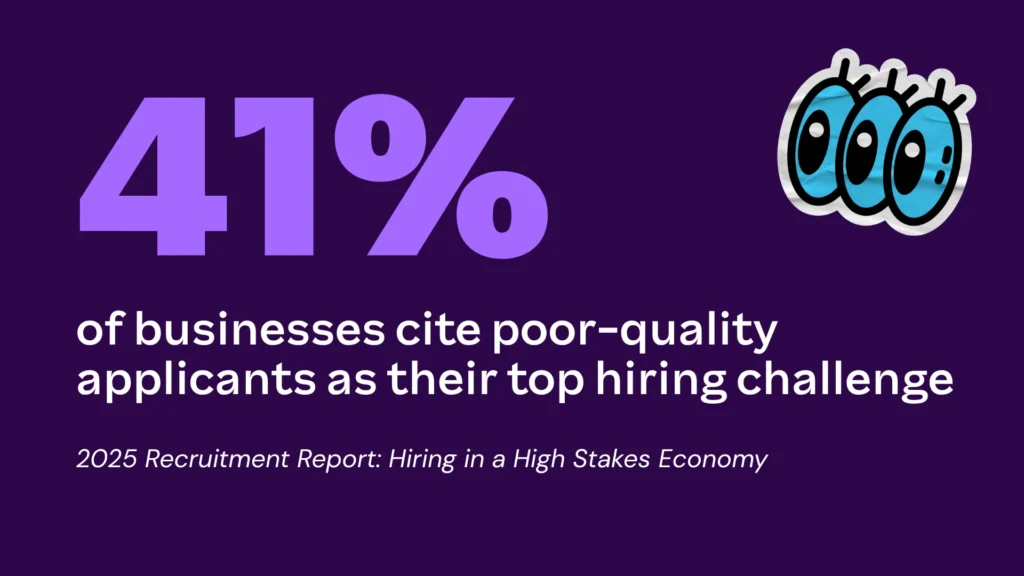
Our 2025 Recruitment Report: Hiring in a High Stakes Economy found that 41% of businesses cite poor-quality applicants as their top hiring challenge, while 40% say they simply cannot find enough qualified candidates. On top of that, 37% are stuck with slow, manual workflows that drain internal resources and push hiring timelines out.
Despite the efficiency gains on offer, a recent report by the Australian HR Institute and Queensland University of Technology found most Australian organisations are not yet using AI to screen, shortlist or interview candidates. This is a huge opportunity for businesses to upskill and automate their existing processes.
The current economic backdrop sharpens the urgency, with 78% of Australian businesses saying that hiring has become harder as a result of economic uncertainty. When every hire feels like a financial risk, a slow, inconsistent process turns frustrating and costly.
The benefits of AI in recruitment for HR teams
Speed at scale
The most immediate gain for HR teams is time. When a single recruiter is managing multiple open roles and hundreds of applications per posting, manual screening is a bottleneck that everything else waits on. AI tools that score every applicant against a defined rubric mean a ranked shortlist is ready before a recruiter opens their inbox on Monday morning.
Smarter candidate matching
AI goes beyond keyword matching by analysing skills, experience and contextual information to surface candidates a manual scan would miss. In a world where 40% of Australian businesses say they can’t find enough qualified candidates, missing a strong applicant because they used different terminology to your job ad is an expensive error.
Consistency
When every candidate answers the same structured questions and is scored against the same rubric, unconscious bias has less room to operate. This is important for skills-based hiring specifically, where the goal is to evaluate demonstrated capability instead of the name of a university or the familiarity of a career path. Consistent scoring creates a fairer process and one that is easier to audit.
AI recruitment tools: what to look for
The market has expanded fast. Here’s five key points to look out for:
- Does the platform manage the full hiring workflow in one place or will we need separate tools for screening, scoring and shortlisting that don’t talk to each other?
- Can the tool surface matched candidates from an existing talent pool before we post a job ad or does it only activate once we’ve already spent budget on advertising?
- Does the tool run structured screening conversations automatically and return scored results? Or does someone on the team still need to review raw video or responses manually?
- Does the platform keep a consistent scoring record across every recruitment stage? Or will panel feedback end up in separate documents and email threads that no one reconciles?
- Does the tool flag language in our job ads that is likely to narrow the candidate pool or does it only optimise for reach without addressing how the copy is written?
Data-driven recruitment: the metrics you need
AI in recruitment is only as useful as the data it generates. Key metrics to build into any recruitment dashboard include:
- Time to hire (from role opening to accepted offer)
- Cost per hire
- Quality of hire (measured at 90 days, six months, one year)
- Screening-to-shortlist conversion rate
- Offer acceptance rate
- Candidate drop-off rate by stage
Monthly review of these metrics against a baseline allows teams to identify where the process is working and where it’s not.
Implementation roadmap for HR teams
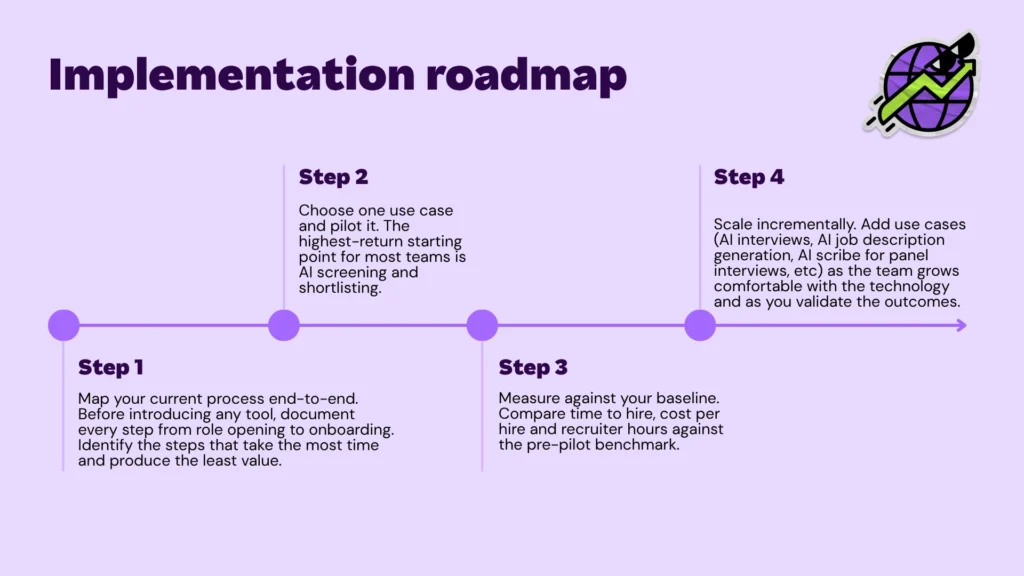
Step 1: Map your current process end-to-end. Before introducing any tool, document every step from role opening to onboarding. Identify the steps that take the most time and produce the least value.
Step 2: Choose one use case and pilot it. The highest-return starting point for most teams is AI screening and shortlisting. Run a pilot on a specific role type with a small group of hiring managers. Define the metrics you will use to evaluate the pilot before it starts.
Step 3: Measure against your baseline. Compare time to hire, cost per hire and recruiter hours against the pre-pilot benchmark. If the numbers move in the right direction, the case for broader rollout is clear.
Step 4: Scale incrementally. Add use cases (AI interviews, AI job description generation, AI scribe for panel interviews, etc) as the team grows comfortable with the technology and as you validate the outcomes.
Next steps for HR leaders
The businesses closing roles faster, with better-quality hires, are the ones that have moved away from purely manual workflows. The data on Australian hiring makes clear that doing nothing is not a neutral position. Every week a role stays open and every mis-hire has a cost. AI can help reduce both.
The practical starting point is to identify your one biggest recruitment bottleneck, find an AI tool designed to address it and run a structured pilot with clear success metrics. Our AI-enhanced HR tools are useful if you want to see how this fits into a broader HR technology strategy.
When evaluating tools, look for platforms that offer integrated AI across the full hiring workflow, instead of single solutions that create new handoffs and data silos. Employment Hero’s AI Recruitment Agent covers the end-to-end pipeline, from job description generation, candidate sourcing from a pool of 2.3+ million work-ready candidates, automated scoring, AI video interviews and AI scribe for human-led panel rounds. It’s designed so that every hiring decision stays in human hands while the admin runs itself. Take a look for yourself below.
Don’t just take our word for it…
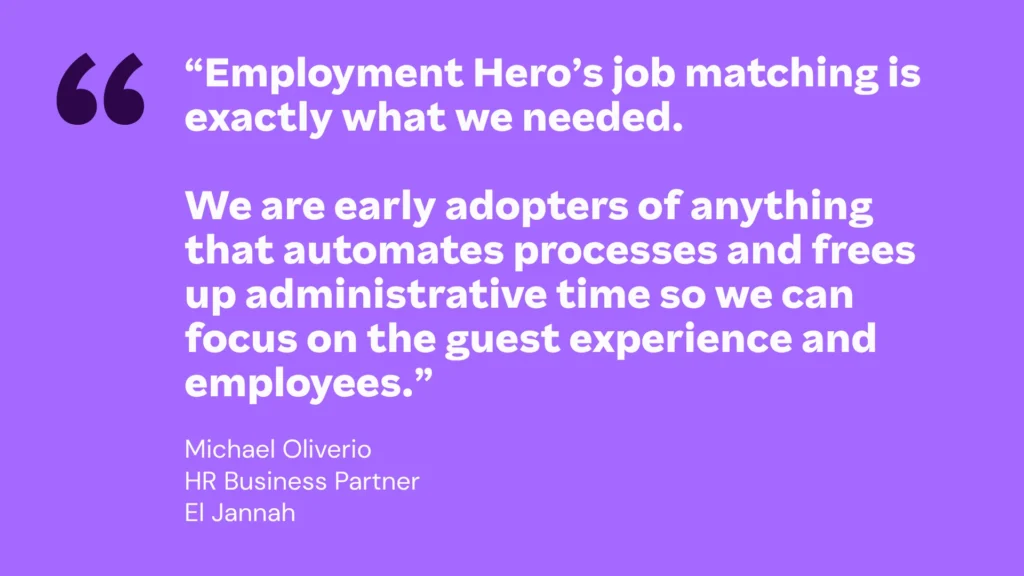
El Jannah is in the middle of one of Australian hospitality’s most ambitious expansions, scaling to 500 new restaurant locations. To hire and onboard at that pace without breaking their people processes, they turned to Employment Hero’s AI recruitment tools.
Read the El Jannah case study to see how they did it.
Want to see how our AI Recruitment Agent works for your team? Book a demo with Employment Hero and we’ll walk you through it.
FAQs from HR teams
No. AI removes the admin burden that prevents recruiters from doing high-value work. The decisions that require human judgement, empathy and context still sit with people.
In most tools, AI scores applicants against a predefined rubric (skills, experience, response quality, etc) immediately upon application, with the highest-scoring candidates surfaced first. Some tools also conduct automated screening conversations to confirm information and gather additional context before a shortlist is built.
Disclaimer: The information in this article is current as at 24 June 2026, and has been prepared by Employment Hero Pty Ltd (ABN 11 160 047 709) and its related bodies corporate (Employment Hero). The views expressed in this article are general information only, are provided in good faith to assist employers and their employees, and should not be relied on as professional advice. The Information is based on data supplied by third parties. While such data is believed to be accurate, it has not been independently verified and no warranties are given that it is complete, accurate, up to date or fit for the purpose for which it is required. Employment Hero does not accept responsibility for any inaccuracy in such data and is not liable for any loss or damages arising either directly or indirectly as a result of reliance on, use of or inability to use any information provided in this article. You should undertake your own research and to seek professional advice before making any decisions or relying on the information in this article.
Related Resources
-
 Read more: Changes to Junior Pay Rates in Retail, Fast Food and Pharmacy Awards from 1 December 2026
Changes to Junior Pay Rates in Retail, Fast Food and Pharmacy Awards from 1 December 2026
Junior pay rates for 18, 19 and 20 year olds in retail, fast food and pharmacy are changing. Here’s what’s…
-
 Read more: Build on Employment Hero’s HR API and get more out of every client relationship
Build on Employment Hero’s HR API and get more out of every client relationship
Learn how developers, consultants and software vendors build on Employment Hero’s HR API and earn recurring revenue through the Referral…
-
 Read more: Changes to the Health Professionals and Support Services Award from 1 October 2026
Changes to the Health Professionals and Support Services Award from 1 October 2026
The Health Professionals and Support Services Award changes from 1 October 2026. Here’s what employers need to know.


