 New Zealand
  United Kingdom
  Singapore
  Malaysia
  Canada (Français)
 Australia






How to pay super in Australia: A complete employer’s guide
Published
How to pay super in Australia: A complete employer’s guide
Published

Managing superannuation is a fundamental responsibility for every Australian employer. Getting it right is not just needed for compliance, but for the financial future of your team. This guide gives you a clear path to understanding your obligations and managing super payments with confidence.
A quick summary of what’s in this guide
For busy employers, here’s a quick overview of what’s in the guide:
- What you need to know about the Superannuation Guarantee (SG)
- An overview of Payday Super and how to get prepared
- Different payment methods you can choose
- Plus lots more.
Download the guide now by filling out the form.
Understanding superannuation obligations as an employer
Superannuation, or ‘super’, is money set aside during a person’s working life to provide for their retirement. As an employer, you’re legally required to make these payments on behalf of your eligible employees. Fulfilling your super obligations is a critical part of running a business in Australia and helps to support your team’s long-term financial security.
Who is eligible for super contributions?
Generally, you must pay super for an employee if they are 18 years or older, regardless of how much they earn. This applies to full-time, part-time and casual employees.
For employees under 18, you must pay super if they work more than 30 hours for you in a week. Eligibility also extends to certain contractors who are paid wholly or principally for their labour.
Residency status is generally not a determining factor. Super obligations apply based on whether a person is working in Australia with valid work rights, regardless of their visa category or citizenship status.
Latest changes on paying superannuation: Payday Super
The Federal Government has announced “Payday Super,” a major reform set to take effect from 1 July 2026. This change fundamentally alters how and when super is paid.
Instead of paying super contributions quarterly, employers will be required to pay super on payday, with contributions required to be received by the employee’s super fund within seven business days.
This move is designed to make sure employees receive their super more frequently and can track it more easily, reducing the risk of unpaid super. For businesses, it means your payroll processes must be sharp, efficient and capable of handling real-time transactions.
69% of employers are concerned about staying on top of evolving super requirements, so it’s important you know your obligations.
Calculating how much super you need to pay your employees
To correctly calculate super, you need to multiply an employee’s Ordinary Time Earnings (OTE) by the current Superannuation Guarantee (SG) rate.
Superannuation rates in Australia
The SG rate is set by the government and is currently 12%.
Staying on top of these scheduled increases is essential for accurate calculations.
Qualifying Earnings (QE) vs Ordinary Time Earnings (OTE)
Currently, the SG is calculated on an employee’s Ordinary Time Earnings (OTE). OTE generally includes what an employee earns for their ordinary hours of work, such as their regular salary, commissions, shift loadings and allowances. It typically does not include overtime payments.
With the introduction of Payday Super, the calculation base changes from OTE to ‘Qualifying Earnings’ (QE). QE includes OTE plus salary sacrifice amounts and all commissions. For most employers, this will not change the dollar amount of super owed; the concept of OTE itself is unchanged under Payday Super.
How to set up super payments for your employees
Establishing a streamlined process for managing super is crucial. Here’s how to do it step-by-step.
Step 1: Check employee eligibility
First, determine which of your team members are eligible for super contributions. This includes reviewing your full-time, part-time and casual staff. Don’t forget to assess any contractors who may be considered employees for super purposes.
Step 2: Calculate the correct SG amount
Using the current SG rate, calculate the correct super amount for each eligible employee based on their OTE for the pay period. Make sure your payroll system is configured with the correct rate to avoid errors.
Step 3: Get the employee’s fund details
Your employees have the right to choose their own super fund. When a new employee starts, you must provide them with a Superannuation Standard Choice Form. They can use this form to nominate their preferred fund.
Requesting a ‘stapled super fund’ from the ATO
If a new employee does not choose a fund, you must check with the ATO for their ‘stapled super fund’. This is an existing super account linked or ‘stapled’ to an individual employee that follows them as they change jobs. This prevents the creation of multiple unintended super accounts.
What to do if they don’t choose a fund
If the employee doesn’t nominate a fund and the ATO confirms they have no stapled fund, you can then pay their contributions into your business’s default super fund.
Step 4: Process the payment via SuperStream
All super payments must be made electronically through a SuperStream-compliant system. This standardises how money and data are sent to super funds.
This is where your choice of payment method becomes critical. Traditional clearing houses often use “batch payments,” where contributions are collected and processed in large groups. This can take 3-10 business days for the money to clear and reach the employee’s fund. With the upcoming 7-day payment window under Payday Super, this delay creates a significant compliance risk.
In contrast, modern payment solutions, like HeroClear, are embedded within the Employment Hero platform. When you process a pay run, the super payment is sent instantly via the New Payments Platform (NPP), allowing it to reach the fund almost immediately. This eliminates the timing gap and gives you confidence you’re meeting your obligations.
Step 5: Report via Single Touch Payroll (STP)
You must report superannuation information to the ATO through Single Touch Payroll (STP) on or before each payday. Your payroll software should be able to send this information, including the super liability or actual payments, directly to the ATO as part of your regular pay run reporting.
Super payment due dates and avoiding penalties
Understanding payment deadlines is essential to avoid significant penalties.
Current quarterly due dates (The old rules)
Until the new rules begin on 1 July 2026, super contributions are due quarterly. The deadlines are:
- Quarter 1 (1 July – 30 Sept): 28 October
- Quarter 2 (1 Oct – 31 Dec): 28 January
- Quarter 3 (1 Jan – 31 Mar): 28 April
- Quarter 4 (1 Apr – 30 June): 28 July
The Payday Super reforms (Starting 1 July 2026)
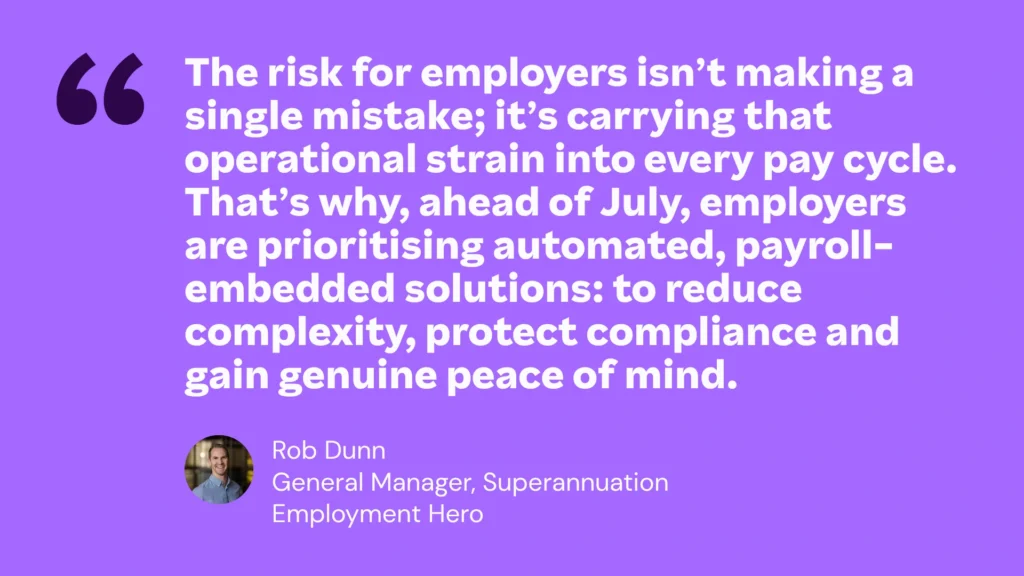
From 1 July 2026, these quarterly deadlines will be obsolete. You must pay an employee’s super on their payday, with the funds required to be received by their super fund within seven business days. This shift makes slow, batch-based clearing houses a risky choice for maintaining compliance.
When is a payment considered ‘received’?
This is a vital distinction. A payment is only considered ‘paid’ when it is received by the employee’s super fund, not when it leaves your bank account or is received by a clearing house. This “timing gap” is a major risk.
HeroClear solves this by providing near real-time payment confirmation, giving you proof that the funds have been received well within the new 7-business-day window.
How to pay super based on employment type
Super obligations can differ depending on the working arrangement.
How to pay super for yourself (sole traders)
If you’re a sole trader, you’re not legally required to pay super for yourself. However, it is highly recommended that you make personal contributions to a super fund to save for your own retirement. These contributions may also be tax-deductible.
How to pay super for a contractor
You may need to pay super for a contractor if their contract is wholly or principally for their labour. This is a complex area and it’s best to review the ATO’s guidelines or seek professional advice to determine your obligations.
Looking for a helping hand? Our HR Advisory service can help walk you through your obligations.
How to pay super for a director
If you’re a director of a company, your company is generally required to pay super contributions for you based on the salary and fees you receive.
Download the guide now by filling out the form.
FAQs on paying superannuation
Your employees have the right to choose their own fund. Your role is to provide them with the Standard Choice Form. If they don’t choose, you must check for a stapled fund before using your company’s default fund.
Getting super wrong can be costly. If you underpay or miss a deadline, you may be liable for the Super Guarantee Charge (SGC), which includes the unpaid super, interest and an administration fee.
Under Payday Super, contributions will need to be received by funds within tighter timeframes each pay cycle, increasing visibility and reducing the margin for delay. The ATO’s Practical Compliance Guideline outlines a risk-based approach during the first year, with employers who make genuine efforts to comply and fix issues quickly more likely to be treated as low risk. Repeated late payments or weak processes, however, may attract closer scrutiny.
If you underpay, you should pay the shortfall as soon as possible and may need to lodge an SGC statement. If you overpay, contact the employee’s super fund to discuss options for correction.
Payday Super will require changes to your cash flow management and payroll processes. You will need a reliable, SuperStream-compliant payment solution capable of meeting the new, faster deadlines. Adopting an integrated, real-time system now is the best way to prepare your business for a seamless transition.
The information in this report is current as at 15 February 2026 and has been prepared by Employment Hero Pty Ltd (ABN 11 160 047 709) and its related bodies corporate (Employment Hero). The content is general information only, is provided in good faith to assist employers and their employees, and should not be relied on as professional advice. Some information is based on data supplied by third parties. While such data is believed to be accurate, it has not been independently verified and no warranties are given that it is complete, accurate, up to date or fit for the purpose for which it is required. Employment Hero does not accept responsibility for any inaccuracy in such data and is not liable for any loss or damages arising directly or indirectly as a result of reliance on, use of or inability to use any information provided in this guide. You should undertake your own research and seek professional advice before making any decisions or relying on the information in this guide.
Register for the guide
Related Resources
-
 Read more: AI skills assessment template for your team
AI skills assessment template for your team
Help your team build their AI skills. Download our free AI skills assessment template for managers and employees.
-
 Read more: The AI Adoption Blueprint
The AI Adoption Blueprint
What does it take to embed AI across an entire team? We’re sharing our training, our policies, and the lessons…
-
 Read more: Employment Essentials: AI Best Practices
Employment Essentials: AI Best Practices
Learn how to use AI in HR without creating privacy, compliance or employment risks in our latest webinar.


