
 Australia
 New Zealand
 United Kingdom
 Canada
 Singapore
 Malaysia




Risk assessment guide and template for workplace safety
Published
Risk assessment guide and template for workplace safety
Last Updated
When you’re running a business, your attention is constantly pulled in different directions. One of those demands is health and safety, which can easily fall down the list, until an incident suddenly brings it into sharp focus.
The challenge is that managing health and safety often feels overly complicated and time-consuming. To make it simpler, we’ve put together a straightforward guide and a template to help you identify, manage and reduce workplace risks without drowning in paperwork.
What’s included in this risk assessment guide and template?
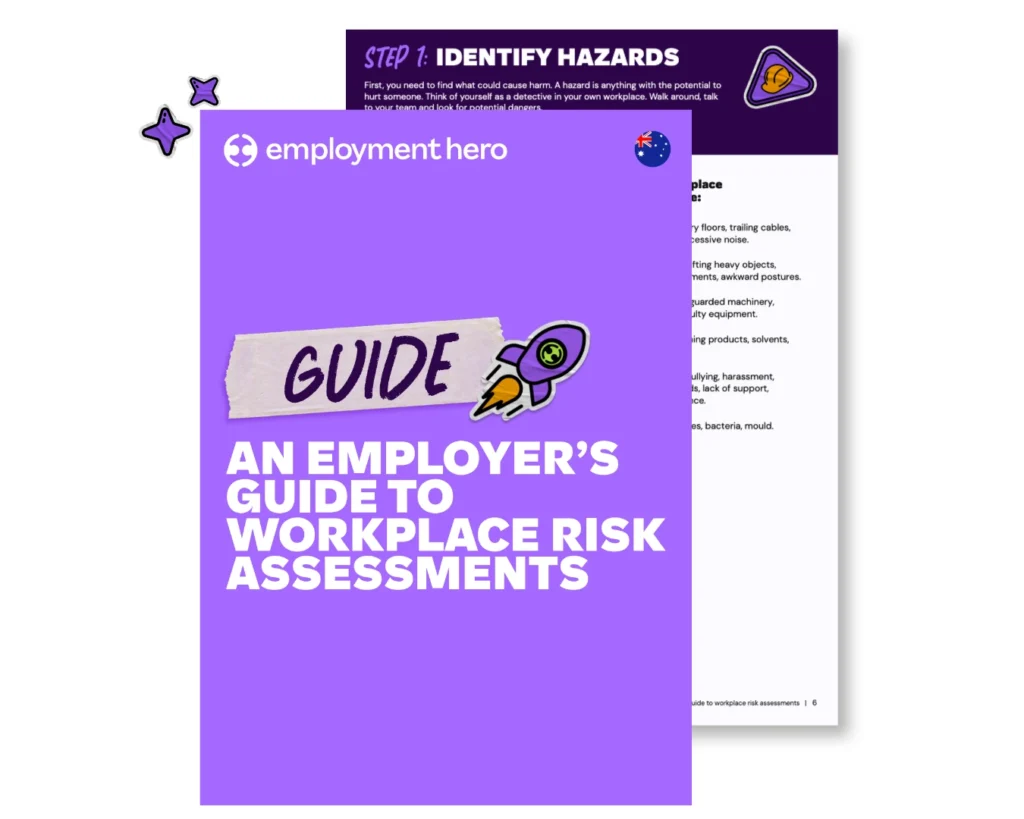
Our downloadable risk assessment guide for workplace safety is designed to be practical and easy to use.
In this guide, you’ll find:
- Your obligations under workplace health and safety laws.
- How to conduct a workplace risk assessment.
- A workplace risk assessment template.
Download the guide now by filling out the form on the right.

Why is risk assessment important for workplaces?
A risk assessment forms the foundation of your duty of care. Under Australian WHS laws, you are legally required to do everything reasonably practicable to ensure the health and safety of your workers.
Failing to manage work health and safety obligations can lead to severe penalties, but the human cost is higher. Workplace incidents can result in permanent disability or worse.
What is the purpose of a risk assessment?
The primary purpose is straightforward: to identify what could cause harm and do something about it. You want to be able to spot safety hazards before they become workplace injuries.
A robust assessment allows you to:
- Identify hazards in the workplace.
- Evaluate the likelihood and potential consequence of injury.
- Implement risk control measures to eliminate risks or minimise them.
- Review control measures to ensure they are working.
What are the benefits of doing a workplace risk assessment?
Beyond compliance, there are solid business reasons to get on top of WHS risks.
Preventing injuries and illnesses
The most obvious benefit is to prevent injuries. By identifying hazards early, whether it’s heavy loads, hazardous chemicals or slippery floors, you can stop accidents in their tracks.
Reducing legal risks and liabilities
If an incident occurs, you need to prove you took steps to prevent it. A documented risk management plan is your best defence. It shows you were proactive in managing health and safety obligations.
Building a safety-focused culture
When your team sees you taking safety risks seriously, they do too. It helps create awareness and encourages health and safety representatives and employees to speak up about potential severity issues.
Improving operational efficiency
Accidents stop work. They damage equipment, lower morale and increase insurance premiums. Safe work practices keep the gears turning smoothly.
How do you carry out a workplace risk assessment?
Here is some practical guidance on how to conduct a risk assessment.
Identify hazards
First, walk around and look for what could cause harm. Talk to your safety representatives and workers. They know the particular hazard spots better than anyone. Look for obvious issues like trailing cables, but also consider less visible health and safety risks like workplace stress or fatigue.
Assess risks
Once you’ve found the hazards, ask yourself; how likely is it that someone could get hurt? And if they did, how bad would it be? Use a risk matrix to rate the risk level (e.g. low risk, medium, high or extreme). This helps you prioritise which risks need immediate attention.
Implement control measures
Now, fix it. The best option is always to eliminate risks entirely. If you can’t, you must minimise risks as much as possible. Use the “Hierarchy of Controls”:
- Elimination: Remove the hazard completely.
- Substitution: Replace with something safer (e.g. swapping a toxic chemical for a safe one).
- Engineering controls: Isolate people from the hazard (e.g. installing guards on machinery).
- Administrative controls: Change the way people work (e.g. training or rotating shifts).
- Personal protective equipment (PPE): This is the last line of defense.
Monitor and review
The reality is that workplaces always change, meaning your safety reviews must too. New equipment arrives, new staff join and there’s new ways of working. Here, you need to be proactive in reviewing control measures to ensure existing ones are still effective.
Who is responsible for a risk assessment?
Ultimately, the business owner or employer (the person conducting a business or undertaking or PCBU) holds the primary duty of care. However, managing health and safety is a team sport.
Health and safety representatives play a crucial role in consulting with workers. Managers must make sure risk control protocols are followed, and employees have a responsibility to take reasonable care for their own safety and follow good practice guidelines.
Using HR software can help you track who has acknowledged safety policies and keep your records airtight.
When should risk assessments be carried out?
It’s not a “one and done” task. You should perform a risk assessment for workplace safety:
- Before starting any new work or project.
- When introducing new equipment or substances.
- When changing work practices or procedures.
- After any workplace incidents or near-misses.
- Whenever new information about safety hazards becomes available.
What is a manual handling risk assessment?
Manual handling involves lifting, putting down, pushing, pulling, carrying or moving a load. It’s one of the most common causes of injury.
A manual handling assessment looks specifically at risks associated with moving things. It considers the weight of the load, the posture of the worker, the distance carried and the environment. Control measures here might include using trolleys (engineering controls) or training staff on lifting techniques (administrative controls).
What is the difference between a hazard and a risk?
People often use these terms interchangeably, but in the world of WHS, they are different.
- Hazard: Anything that has the potential to cause harm (e.g., a knife, electricity, a bully, a wet floor).
- Risk: The likelihood that a hazard will cause harm combined with the potential severity of that injury.
For example, a shark in the ocean is a hazard. Swimming with the shark is a risk. Your job is to manage the interaction between the two.
For more on defining these terms within your company policies, check out our guide on understanding workplace policies.
Examples of workplace risk assessments by industry
While the principles of identifying hazards remain the same, the specific hazards vary wildly.
- Office: Hazards might include poor ergonomics, loose cables or stress. Controls involve adjustable chairs and regular breaks.
- Construction: High risks involve working at heights, moving vehicles and noise. Engineering controls like scaffolding and barriers are critical.
- Healthcare: Risks include biological hazards, lifting patients and violence. Personal protective equipment and strict protocols are vital.
- Retail: Hazards include slips, trips, falls and heavy loads in storerooms.
If you need help tailoring this to your industry, our HR advisory service can provide expert support to ensure you aren’t missing anything.
Download free workplace risk assessment guide and template
Don’t wait for an accident to happen. Get on the front foot with your safety obligations now.
We’ve created these templates to help you simplify compliance and protect your team. They pair perfectly with our WHS policy template and HR audit checklist to give you a comprehensive safety net.
For a broader look at managing compliance, take a look at our HR compliance essential guide.
Download the workplace risk assessment guide and template now by filling out the form on the right.
Disclaimer: The information in this guide is current as at 11 March 2025, and has been prepared by Employment Hero Pty Ltd (ABN 11 160 047 709) and its related bodies corporate (Employment Hero). The views expressed in this guide are general information only, are provided in good faith to assist employers and their employees, and should not be relied on as professional advice. The Information is based on data supplied by third parties. While such data is believed to be accurate, it has not been independently verified and no warranties are given that it is complete, accurate, up to date or fit for the purpose for which it is required. Employment Hero does not accept responsibility for any inaccuracy in such data and is not liable for any loss or damages arising either directly or indirectly as a result of reliance on, use of or inability to use any information provided in this guide. You should undertake your own research and to seek professional advice before making any decisions or relying on the information in this guide.
Register for the Workplace Risk Assessment Templates & Examples
Related Resources
-
 Read more: Navigating Global HR: Recruiting, Compliance, and Culture
Navigating Global HR: Recruiting, Compliance, and Culture
Cross-border HR shouldn’t mean cross-border confusion. Get practical tips on global recruiting, compliance and culture. Watch the free webinar now.
-
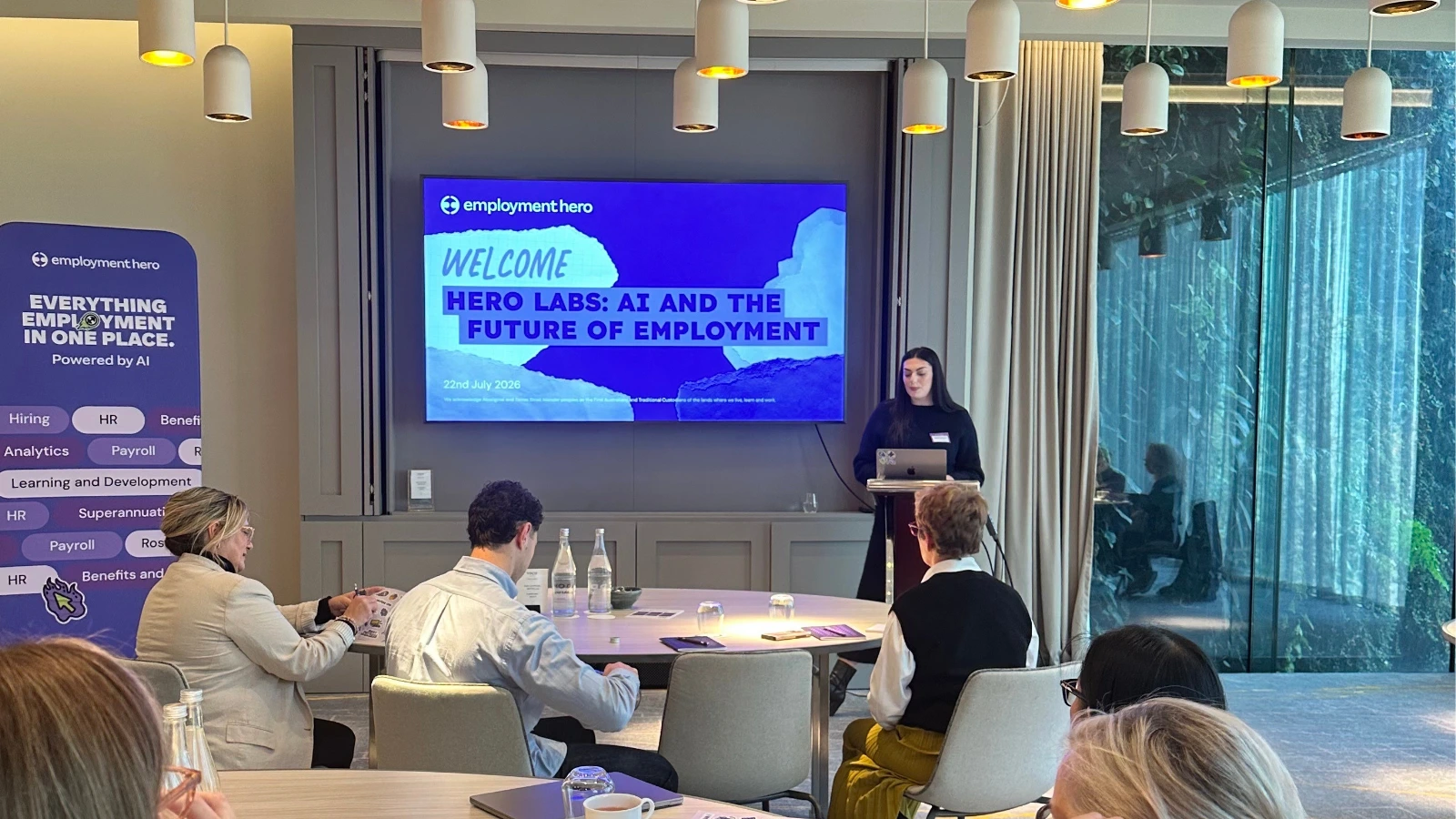 Read more: Inside our July 2026 events: Hero Hour Sydney and Hero Labs Melbourne
Inside our July 2026 events: Hero Hour Sydney and Hero Labs Melbourne
We ran Hero Hour in Sydney and launched Hero Labs in Melbourne. Here’s our monthly event wrap up and how…
-
 Read more: Understanding the SCHADS Award changes: What you need to know
Understanding the SCHADS Award changes: What you need to know
Three SCHADS Award changes land across 2026 and 2027. Download this free factsheet to understand what’s changed and what you…


