 New Zealand
  United Kingdom
  Singapore
  Malaysia
  Canada (Français)
 Australia

Understanding the SCHADS Award changes: What you need to know
Published
Understanding the SCHADS Award changes: What you need to know
Last Updated
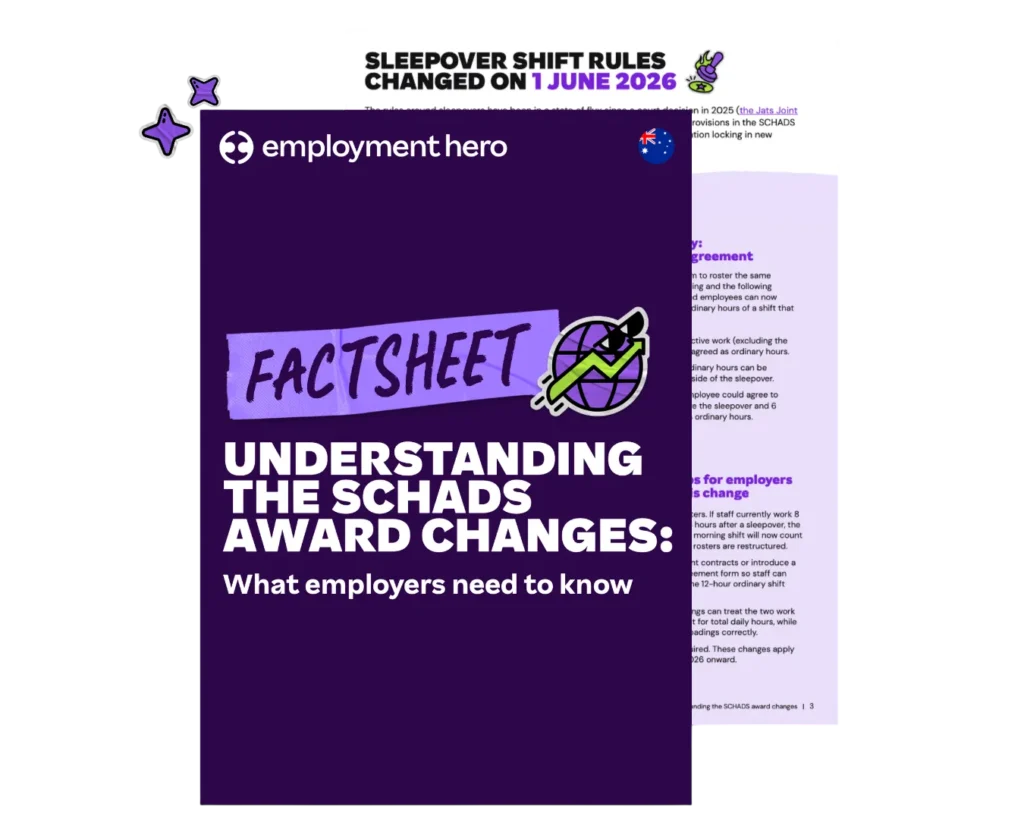
The Social, Community, Home Care and Disability Services Award (SCHADS) is going through its most significant overhaul in years. Three separate changes are landing across 2026 and 2027, and each one affects how you roster, pay and classify your team.
This factsheet breaks down what’s already changed, what’s changing and what you need to do now so you’re not caught off guard.
What’s in this guide?
Employers need to be aware of three award changes. Miss one and you could be underpaying staff, misclassifying roles or calculating overtime incorrectly.
This factsheet covers:
- The new sleepover shift rules and what they mean for your rosters (effective 1 June 2026)
- The 15% pay rise for home care disability workers and who it actually applies to (effective 1 October 2026)
- The new classification structure and how to transition your team (effective 1 October 2027)
Sleepover shifts: The rules have changed
From 1 June 2026, work performed before and after a sleepover is treated as one continuous shift, not two separate ones. The sleepover itself does not count as a break between shifts.
15% pay rise for home care disability workers
From 1 October 2026, minimum wages for employees under Schedule E of the SCHADS Award (those providing disability care in a home care setting) increase by 15%. The Fair Work Commission found these roles had been undervalued on gender grounds.
New classification structure from 1 October 2027
Almost every SCHADS employee moves to a single new classification schedule (Schedule A), based on years of experience and relevant qualifications rather than the more subjective criteria used today. Existing employees transition under set translation arrangements, with pay protections where the new level would otherwise mean a reduction.
Disclaimer: The information in this factsheet is current as at 22 July 2026, and has been prepared by Employment Hero Pty Ltd (ABN 11 160 047 709) and its related bodies corporate (Employment Hero). The views expressed in this factsheet are general information only, are provided in good faith to assist employers and their employees, and should not be relied on as professional advice. The Information is based on data supplied by third parties. While such data is believed to be accurate, it has not been independently verified and no warranties are given that it is complete, accurate, up to date or fit for the purpose for which it is required. Employment Hero does not accept responsibility for any inaccuracy in such data and is not liable for any loss or damages arising either directly or indirectly as a result of reliance on, use of or inability to use any information provided in this factsheet. You should undertake your own research and to seek professional advice before making any decisions or relying on the information in this factsheet.
Register for the Factsheet
Related Resources
-
 Read more: AI skills assessment template for your team
AI skills assessment template for your team
Help your team build their AI skills. Download our free AI skills assessment template for managers and employees.
-
 Read more: The AI Adoption Blueprint
The AI Adoption Blueprint
What does it take to embed AI across an entire team? We’re sharing our training, our policies, and the lessons…
-
 Read more: Employment Essentials: AI Best Practices
Employment Essentials: AI Best Practices
Learn how to use AI in HR without creating privacy, compliance or employment risks in our latest webinar.


