 New Zealand
  United Kingdom
  Singapore
  Malaysia
  Canada (Français)
 Australia


Free workforce planning template for HR leaders
Published
Free workforce planning template for HR leaders
Published
Most Australian businesses discover their workforce strategy is broken at the worst possible moment; when someone resigns. There’s nothing like an exit interview or an empty desk to expose the cracks in your hiring, training and headcount assumptions. Unfortunately, most teams don’t realise things are off track until the damage is done and the resignation is handed in.
Here’s how you get ahead of it.
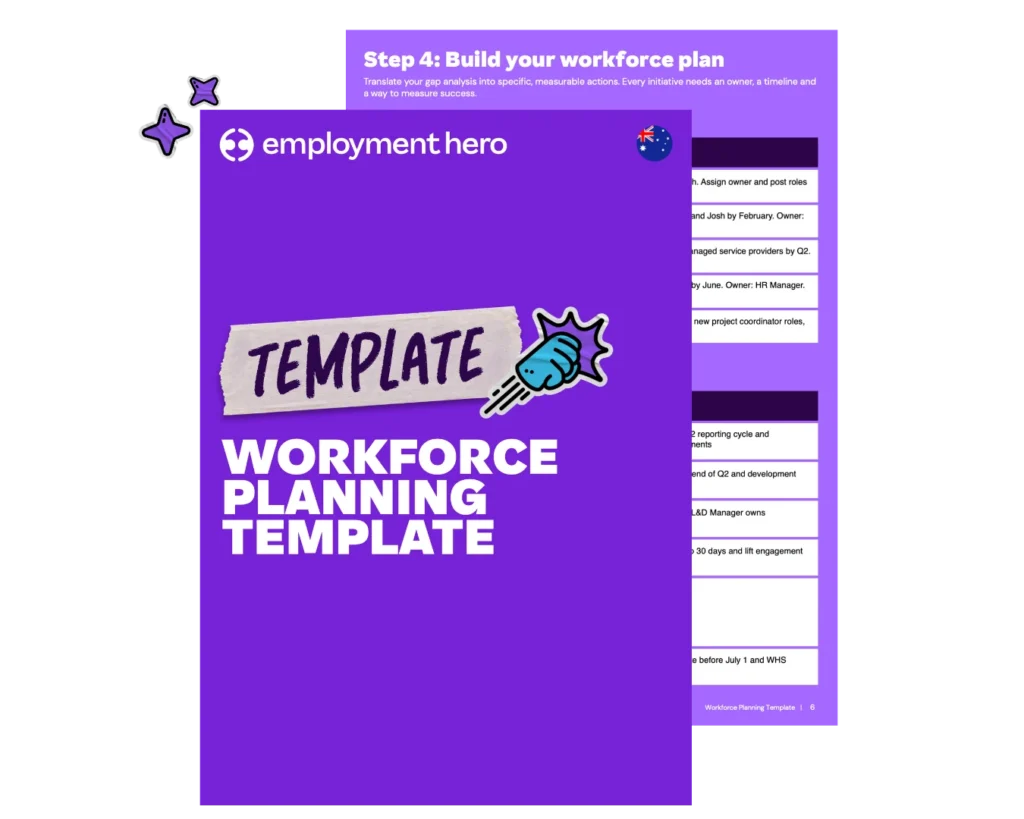
Our free workforce planning template gives you a clear framework to map your current team structure, spot critical skill gaps and build a people strategy that actually keeps pace with your business goals. Whether you’re scaling fast or streamlining for efficiency, this is your starting point.
What’s included in the workforce planning template
Built for growing Australian businesses, here’s what’s inside:
- Current workforce assessment: roles, skills, performance, engagement and turnover at a glance
- Future needs forecasting: headcount planning tied directly to your business goals and growth timeline
- Gap analysis: spot skills shortages, capacity issues and development priorities before they bite
- Action plan: hiring, upskilling and restructuring initiatives with owners, timelines and KPIs
What is workforce planning?
Workforce planning is the process of analysing your current team, forecasting what you’ll need in the future and building a clear path between the two. It’s how you make sure you have the right people, in the right roles at the right time.
At its core, workforce planning connects your people strategy to real business outcomes. If you’re planning to double revenue over the next two years, your workforce plan should show exactly how many sales reps, support agents and managers you’ll need to get there. It turns business ambition into a concrete hiring and development roadmap.
In Australia, this process carries additional weight. You’re navigating award rates, employee entitlements and a compliance landscape that shifts as your headcount grows. A strong workforce planning process accounts for growth, while building in the structure to stay compliant, manage attrition and develop the internal capability your business will need to stay competitive.
For a deeper dive into the fundamentals, our comprehensive guide to workforce planning is a solid next read.
Why workforce planning matters
Most workforce planning fails not because of bad data, but because HR isn’t in the room when growth targets are set.
When your people strategy gets bolted on after the business decisions are made, you end up reactive, often hiring in a panic, overpaying for talent and missing compliance obligations that crept up while you were focused elsewhere. The businesses that get workforce planning right treat it as a core strategic function, not an HR admin task.
Here’s what that shift looks like in practice. When HR is involved in growth planning from the start, you stop filling roles and start building capability. You anticipate leadership gaps before they become vacancies. You hire a season ahead instead of a crisis behind. Plus when the market shifts and you’re facing new regulation, a spike in demand or a competitor poaching your best people, you’re not caught flat-footed.
The alternative costs you twice in both dollars and in people. Understaffing burns out your best performers and overstaffing blows your payroll budget. Neither is a strategy but they are symptoms of planning that didn’t happen.

Benefits of effective workforce planning
Getting workforce planning right shifts HR from an administrative function to a genuine driver of business performance. Here are the outcomes you can expect:
- Reduced recruitment costs: proactive hiring means building talent pipelines before you’re desperate, cutting reliance on expensive recruiters and last-minute job board spend.
- Better financial forecasting: no more salary surprises. Accurate headcount planning keeps payroll costs, superannuation and training budgets predictable across the year.
- Stronger compliance management: award changes, certification requirements and payroll tax thresholds stop being ambushes when you can see them coming.
- Higher retention: invest in your current people early, promote from within and your best performers stop looking elsewhere.
- Faster, better hiring: when you know what you need months in advance, you can find the right person, not just the first available one.
Common workforce planning challenges (and how to overcome them)
Every HR leader hits obstacles. The difference is whether you flag them or fix them. Here’s what the most common ones look like on the ground and how to move past them.
Siloed data
Finance has salaries in one system, performance reviews live in a forgotten folder and hiring plans shift with every leadership meeting. Nobody owns the whole picture. The result? You’re asked how headcount is tracking and can’t give a straight answer.
Our template centralises everything in one place to start and when you’re ready to scale, Employment Hero brings HR, payroll and performance data together, including a Workforce Planning tool that mirrors your org chart, shows vacant positions alongside your existing team structure and lets you track budget details by role, all in one place.
Reactive hiring
When managers only raise a hiring request after someone resigns, you’re permanently playing catch-up. Rushed interviews lead to poor decisions and the real cost shows up in overtime, missed contracts and team morale.
The forecasting section of the template gets you hiring a season ahead by mapping projected turnover and growth so recruitment starts before the gap appears. Our headcount planning guide goes deeper on how to build this habit.
Gut-feel forecasting
Without a structured framework, headcount decisions rely on memory and instinct. That works until it doesn’t, usually around a peak period when you find yourself ten casuals short. Our template gives you a foundation for projecting needs based on real data, not best guesses.
Compliance complexity
As headcount grows, keeping across modern awards, certification requirements and Fair Work obligations becomes increasingly difficult. Planning your workforce structure in advance lets you see compliance requirements as part of your hiring routine, not a painful surprise after an audit.
Employment Hero’s built-in compliance tools help you stay across obligations automatically as your team scales, so nothing slips through the cracks between your next hire and your next review.
How to use the workforce planning template
The template is designed to be practical and straightforward. Here’s how to work through it effectively.
Step 1: Define business goals
Start with the end in mind. Before you open the template, sit down with your leadership team and get clear on what the business is trying to achieve over the next 12 to 36 months. Launching a new product line? Expanding into a new state? Targeting a 20% reduction in operational costs? Document these objectives first. Every hiring and development decision in your workforce plan should trace back to one of them.
Step 2: Analyse your current workforce
Before planning for the future, get an honest picture of where you stand today. Use the template’s workforce assessment section to capture every role, department and core skill set across your team. Write down your high performers who may be ready for leadership responsibilities and flag risk zones where you’re relying on contractors or agencies to cover capability gaps.
Step 3: Forecast future needs
Now translate your business goals into specific people requirements. If you’re opening a new site in Queensland, you’ll need a site manager, coordinators and operational staff. If you’re launching a new service line, what technical skills does that require? Enter these future roles into the template and factor in your historical attrition rate. Replacement hires need to sit alongside growth hires in your plan, not be treated as extras.
Step 4: Identify gaps and build a workforce strategy
This is where planning becomes action. Compare your current workforce snapshot against your future needs and the gap between them becomes your workforce strategy. Use the template to categorise each gap and decide your response. Build the capability through training, buy it by hiring permanently or borrow it through short-term contractors. Document each decision with an owner, a timeline and a measurable outcome. For more on building the broader strategy, see our HR strategy planning guide.
Step 5: Monitor, adjust and optimise
Workforce planning is never finished. Markets shift and business priorities change. Set a quarterly calendar reminder to review your plan, update your data and adjust timelines. Track HR metrics like time-to-hire, cost-per-hire and attrition rate to measure the return on your planning effort. As your business scales, consider moving this process onto a platform like Employment Hero to automate reporting and keep your strategy current without the manual overhead.
Example workforce planning scenarios
Sometimes the best way to understand a tool is to see it applied. Here are three scenarios that show how Australian businesses use workforce planning to solve real problems.
Scaling a national sales team
A SaaS startup has just completed their Series A raise with 40 staff and a mandate to expand nationally fast. The brief? Twelve sales reps across Melbourne, Brisbane and Perth, onboarded and hitting targets within eight months. With the workforce planning template, their people lead maps each role, builds out onboarding timelines and identifies exactly when a national sales trainer needs to join to support the influx. Instead of hiring in waves of panic, every appointment is sequenced and deliberate. Region after region, new hires ramp on time and revenue stays on track.
Planning for seasonal workforce changes
A boutique hospitality group running four beachside venues along the NSW South Coast knows the summer drill all too well. Every summer, customer numbers double. For years, October’s scramble for casual staff left shifts uncovered and revenue on the table. Last season alone, 12 uncovered shifts cost close to $8,000 in lost sales. This year, the HR lead used historical data to map exact headcount needs month by month, locked in RSA training dates and opened hiring in September. The result? Zero missed shifts, a smoother peak season and their highest Net Promoter Score on record.
Identifying future leadership gaps
A third-generation fabrication business in Geelong with 65 staff has a strong culture of promoting from within. Three senior floor managers are approaching retirement within three years which is a leadership cliff that could stall production and lose institutional knowledge built over decades. Using the succession planning section of the template, the owner maps every critical role, identifies the risk and sets a plan in motion. Three supervisors are fast-tracked through an internal leadership program. Two years on and there’s no production delays, no missed handovers and a clear pathway for the next generation to lead.
Tips for getting the most from your workforce planning template
Downloading the template is the start, not the finish. Here’s how to make it work harder:
- Run a future role session with your leaders: ask every department head what roles they’d hire if headcount constraints disappeared for a day. You’ll surface gaps and priorities that straight-line thinking misses.
- Challenge last year’s numbers: don’t copy-paste old assumptions. Ask your team, if we were designing this team from scratch today, what would it actually look like?
- Do a quarterly role audit: pick one position each quarter and ask what would break if it disappeared tomorrow. It’s the fastest way to find single points of failure before someone walks out the door.
- Get an outside perspective: share your plan with a trusted peer outside your organisation and ask them to poke holes in it. Someone outside your bubble spots the blind spots you can’t see.
- Treat it as a living document: set a recurring quarterly review, update your data and adjust your strategy as the business evolves. A plan that sits on a shelf isn’t a plan.
Integrating workforce planning with Employment Hero
Most businesses spend their first phase logging employees, mapping gaps and tracking hires in Excel and for a while, it works. But as headcount crosses 50 or 100, the cracks appear, with versions getting lost, updates getting missed and you ending up back guessing when you need clarity most.
That’s where Employment Hero comes in. Customers like Compendium Group have made the shift from manual spreadsheets to Employment Hero’s Employment Operating System and found the administrative fog lifting, with real-time headcount visibility, streamlined approvals and confidence that nothing is falling through the cracks.
From the moment you’re ready to execute your workforce plan, Employment Hero supports you. Instead of manually updating spreadsheets, you get automated insights into headcount costs and compliance obligations as they emerge, letting you focus on strategy while the platform handles the admin.

Download your free workforce planning template
You don’t have to navigate headcount forecasting alone. Having the right framework means you can stop reacting to workforce problems and start getting ahead of them before they become resignations, compliance surprises or growth spurts that catch you off guard.
Our free template gives you everything you need to assess your current team, map your future needs, identify the gaps and build a people strategy that actually works. It’s practical, flexible and designed specifically for the realities of growing Australian businesses.
Are you ready to lead or will you wait for the next resignation to find out what’s slipping through the cracks?
Download the workforce planning template now by filling out the form.
Disclaimer: The information in this template is current as at 27 April 2026, and has been prepared by Employment Hero Pty Ltd (ABN 11 160 047 709) and its related bodies corporate (Employment Hero). The views expressed in this template are general information only, are provided in good faith to assist employers and their employees, and should not be relied on as professional advice. The Information is based on data supplied by third parties. While such data is believed to be accurate, it has not been independently verified and no warranties are given that it is complete, accurate, up to date or fit for the purpose for which it is required. Employment Hero does not accept responsibility for any inaccuracy in such data and is not liable for any loss or damages arising either directly or indirectly as a result of reliance on, use of or inability to use any information provided in this template. You should undertake your own research and to seek professional advice before making any decisions or relying on the information in this template.
Download the Workforce Planning Template
Related Resources
-
 Read more: AI skills assessment template for your team
AI skills assessment template for your team
Help your team build their AI skills. Download our free AI skills assessment template for managers and employees.
-
 Read more: The AI Adoption Blueprint
The AI Adoption Blueprint
What does it take to embed AI across an entire team? We’re sharing our training, our policies, and the lessons…
-
 Read more: Employment Essentials: AI Best Practices
Employment Essentials: AI Best Practices
Learn how to use AI in HR without creating privacy, compliance or employment risks in our latest webinar.


