 New Zealand
  United Kingdom
  Singapore
  Malaysia
  Canada (Français)
 Australia


Building a corporate AI policy that actually works
Published
Building a corporate AI policy that actually works
Published
Corporate AI policies can be challenging to develop. While a normal policy sets rules from the ground up, AI use is now so widespread that a policy has to adapt and build on the current situation. Still, while the train has already left the station, you can at least decide the route and the destination.
If AI has been governed by nothing more reliable than individual judgment in your business so far, it’s time to set out a policy. The policies that actually work pair clear rules with a sanctioned tool that makes the approved path easier than the unapproved one.
This guide and accompanying policy template are designed to be used together: read the guide to understand the framework, then adapt the template for your organisation.
What’s in the guide?
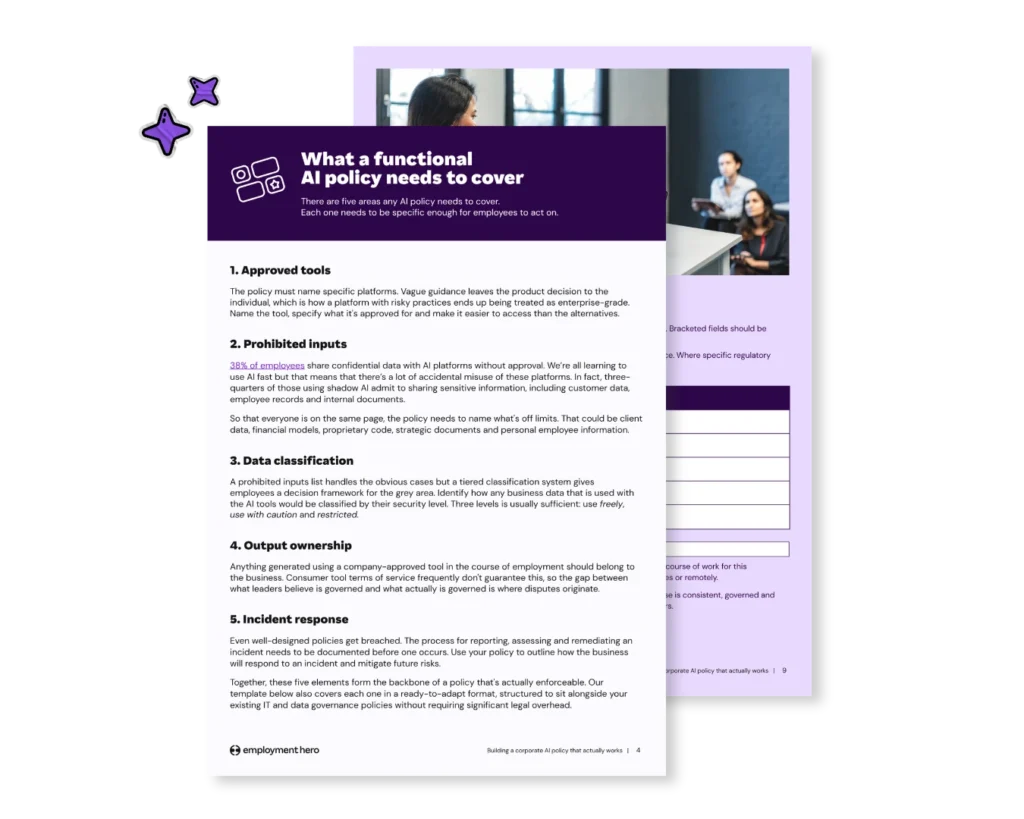
A practical governance framework covering the five things any enforceable AI policy needs to get right:
- Approved tools: why vague guidance leaves the product decision to the individual.
- Prohibited inputs: what needs to be named explicitly (and why a general warning isn’t enough).
- Data classification: a three-tier framework for the grey area between obvious and restricted.
- Output ownership: where the gap between consumer tool terms and enterprise agreements creates real exposure.
- Incident response: what needs to be documented before something goes wrong.
The guide also covers how to get the policy adopted across three different internal audiences, as well as what to measure at 90 days to know whether it’s actually working.
Fill in the form to download the guide, including the ready-to-adapt policy template.
The information in this guide is current as at 5 April 2026, and has been prepared by Employment Hero Pty Ltd (ABN 11 160 047 709) and its related bodies corporate (Employment Hero). The views expressed in this guide are general information only, are provided in good faith to assist employers and their employees, and should not be relied on as professional advice. Some information is based on data supplied by third parties. While such data is believed to be accurate, it has not been independently verified and no warranties are given that it is complete, accurate, up to date or fit for the purpose for which it is required. Employment Hero does not accept responsibility for any inaccuracy in such data and is not liable for any loss or damages arising directly or indirectly as a result of reliance on, use of or inability to use any information provided in this guide. You should undertake your own research and seek professional advice before making any decisions or relying on the information in this guide.
Download the Building a Corporate AI Policy that Actually Works Guide
Related Resources
-
 Read more: AI skills assessment template for your team
AI skills assessment template for your team
Help your team build their AI skills. Download our free AI skills assessment template for managers and employees.
-
 Read more: The AI Adoption Blueprint
The AI Adoption Blueprint
What does it take to embed AI across an entire team? We’re sharing our training, our policies, and the lessons…
-
 Read more: Employment Essentials: AI Best Practices
Employment Essentials: AI Best Practices
Learn how to use AI in HR without creating privacy, compliance or employment risks in our latest webinar.


