
 Australia
 New Zealand
 United Kingdom
 Canada
 Singapore
 Malaysia






Remote work policy template and guide for employers
Published
Remote work policy template and guide for employers
Updated
In just a few short years, remote work has gone from an experiment to a defining part of how we work. What many businesses first treated as a short-term fix has now become a long-term part of managing a team. And for Australian employers, that shift opens the door to exciting opportunities like broader access to talent and the kind of flexibility people genuinely value.
But it also brings new challenges. Leading remote teams, managing compliance and keeping culture strong all require intention and the right support.
Without clear guidelines, both employers and employees are left guessing. A well-crafted remote work policy helps set expectations, protects your business and shows your team you’re committed to making remote work, work.
This guide will walk you through everything you need to know about creating a robust remote work policy for your Australian business. We’ll cover the legal essentials, what to include in your policy and how to implement it effectively. Plus, we’ve got a free remote work policy template you can download on the right hand side to get you started.
What’s in the remote work policy template?
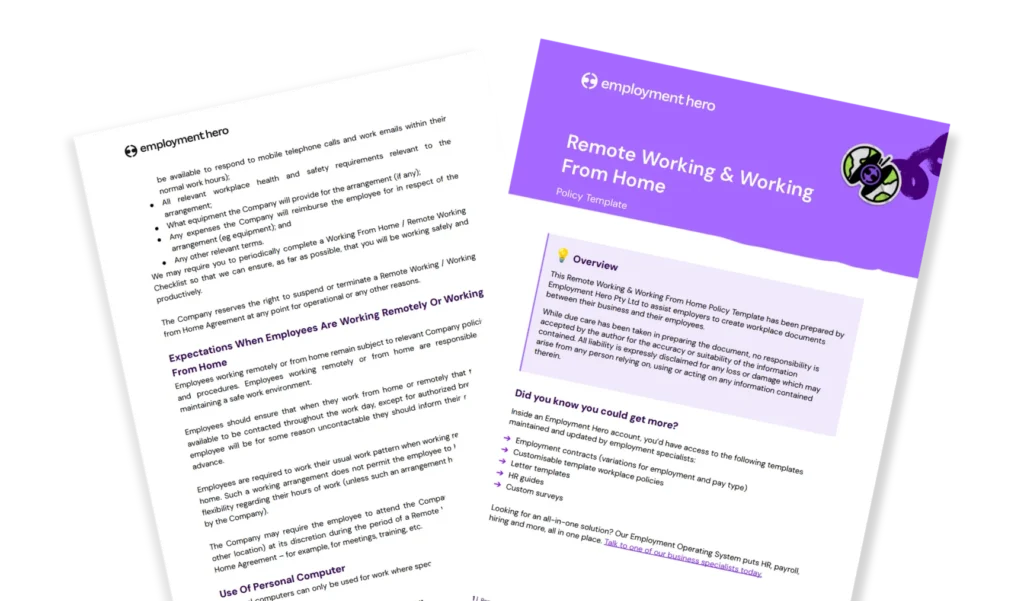
In the remote work policy template, you’ll find a:
- Remote and flexible working policy
- Remote and flexible working employee agreement
- Remote and flexible working checklist
It has everything you need to manage remote work with ease.
Download the remote work policy template now by filling out the form on the right.
What is a remote work policy?
A remote work policy is a formal document that outlines the rules, expectations and procedures for employees who work outside of the traditional office environment. It clarifies who is eligible to work remotely, the conditions of their employment and the responsibilities of both the company and the employee.
Your policy should cover all types of remote work arrangements that are relevant to your business, which could include:
- Hybrid teams: Where employees split their time between the office and a remote location.
- Fully remote teams: Where employees work remotely all the time.
- A temporary or ad-hoc remote work arrangement: For employees who occasionally need to work from home.
A comprehensive policy applies to all eligible employees, whether they’re full-time employees, part-time or casual, making sure that everyone is on the same page.
Why your business needs a remote work policy
Since 2020, remote and hybrid work has become a mainstream expectation in Australia. Our Wellness at Work Report revealed that remote employees have a greater sense of work-life balance and are overall happier, compared to hybrid and on-site workers.
This shift makes having a formal policy more important than ever. Here’s why your business needs a clear remote work policy:
It keeps everyone on the same page: It eliminates confusion by setting clear expectations for everyone. Employees know what’s expected regarding working hours, communication, productivity and performance.
Compliance and reduced legal risks: It helps you meet your legal obligations under Australian law, particularly concerning Work Health and Safety (WHS) and the Fair Work Act.
Enhanced employee wellbeing: A good policy shows you trust your team and are committed to their wellbeing, both in and out of the office. It provides the structure they need to succeed while working remotely.
Strengthened cybersecurity: With employees working from various locations, protecting company data is paramount. A policy sets clear guidelines for data security, use of company equipment and protecting sensitive company data. from the workplace.

Key legal considerations for employers
Navigating the legal side of remote working is crucial for protecting your business. In Australia, your obligations as an employer extend beyond the office walls.
Fair work and flexible working arrangements
Under the Fair Work Act, eligible employees have the right to request flexible working arrangements, which can include working from home.
As an employer, you have an obligation to genuinely consider and respond to these remote work requests in writing within 21 days. You can only refuse a request on reasonable business grounds.
Learn more about managing flexible working requests here.
Work health and safety (WHS) obligations
It’s important to be aware that you’re responsible for the health and safety of your employees, even when they’re working from home. This includes:
- Risk assessments: Making sure the employee’s home office environment is safe and free from hazards. Our Working From Home WHS Checklist can help you manage this process.
- Ergonomics: Providing guidance on setting up an ergonomic workstation to prevent injuries.
- Injury reporting: Having a clear process for employees to report any work-related injuries that occur at home.
Privacy and data security
When employees work remotely, the risk of a data breach can increase. You have obligations under the Privacy Act 1988 to protect personal information and company data. Your remote work policy should outline clear protocols for data security, including:
- Mandatory use of secure, encrypted communication tools.
- Rules for accessing and storing sensitive company information.
- Procedures for reporting any potential security breaches.
Equipment and expenses
Your policy should clarify who is responsible for providing and paying for necessary equipment and expenses. This includes laptops, monitors, internet and phone usage.
Clear guidelines prevent disputes and make sure employees have the necessary tools to perform their job duties effectively. Some expenses may have tax implications for both the company and the employee, so it’s important to clarify these.
What to include in a remote work policy
A comprehensive remote work policy should be detailed and easy to understand. Breaking it down into clear sections makes sure you cover all the bases. Here are the key components to include.
Eligibility and approval process
Not every role is suitable for remote work. This section should define the eligibility criteria. For example, it might depend on job duties, performance history or length of service.
It should also outline the formal process for employees to request a remote work arrangement and how those requests will be approved by human resources or management.
Working hours and availability
Flexibility is a major benefit of remote working, but you still need clear expectations around availability. This section should specify core work hours when employees must be online and available for meetings. It should also detail expectations for communication response times and how to log working hours.
Equipment, technology and security
This section details your policy on company equipment and technology. Clarify what the company will provide (e.g. laptop, monitor) and what the employee is responsible for (e.g. reliable internet). It’s also the place to reinforce your data security protocols for remote workers.
Health, safety and ergonomics
Outline your commitment to WHS for remote employees. This section should require employees to complete a home office safety assessment and provide them with resources for setting up an ergonomic workstation. Link to helpful guides like your WHS checklist to make it actionable.
Communication and performance expectations
Define how your remote teams will communicate and collaborate. Specify which tools to use for different purposes (e.g. Slack for quick chats, email for formal updates). It’s also important to state that employee performance will be evaluated based on output and results, not hours spent at a desk.
Confidentiality and data protection
Reiterate the employee’s responsibility to protect confidential information and company data. This includes securing their home Wi-Fi network, using company-approved software and locking their computer when not in use.
Policy breaches and review
Explain the consequences of not adhering to the remote work policy. It should also state that the policy will be reviewed regularly (e.g. annually) to make sure it remains relevant and effective.
Creating robust company policies from scratch can be a challenge, which is why using a policy template is a smart move.

How to implement your remote work policy effectively
A great policy is useless if it’s not implemented properly. A thoughtful rollout will drive adoption and make sure your transition to remote or hybrid work is a success.
Involve your team early
Don’t create your remote work policy in a vacuum. Involve your employees and managers in the development process.
Ask for their feedback on what works and what doesn’t. This not only leads to a better policy, but also creates a sense of ownership and buy-in from your team.
Train your managers and employees
Successfully managing remote teams requires a different skillset. Provide training for your managers on how to lead a distributed workforce, focusing on outcomes rather than micromanagement.
You’ll also want to make sure that all employees understand the new policy, including their responsibilities and the tools available to support them. Our Remote-First Workplace Playbook is a great resource for leaders.
Provide the right tools
To seamlessly transition, your team needs the right technology. This includes communication platforms, project management software and HR systems that support remote working.
An all-in-one platform like Employment Hero can help manage everything from digital onboarding to performance reviews, no matter where your team is located.
Review and adapt regularly
The world of work is always changing. Your remote work policy should be a living document. Schedule regular reviews to assess its effectiveness and make adjustments based on feedback and evolving business needs. What works for a team of 10 may need tweaking as you grow to 50. Be prepared to adapt.
Free download: Remote work policy template
Ready to create your own policy but don’t want to start from a blank page? We’ve done the heavy lifting for you. Our downloadable Remote Work Policy Template provides a comprehensive foundation for you to adapt to your business needs.
Who is it best for? This policy template is perfect for Australian small and medium-sized businesses, HR teams and business owners looking to formalise their approach to remote and hybrid work. It provides a solid framework you can tailor to your specific company culture and operations.
Disclaimer: The information in this article is current as at 27 November 2025, and has been prepared by Employment Hero Pty Ltd (ABN 11 160 047 709) and its related bodies corporate (Employment Hero). The views expressed in this article are general information only, are provided in good faith to assist employers and their employees, and should not be relied on as professional advice. The Information is based on data supplied by third parties. While such data is believed to be accurate, it has not been independently verified and no warranties are given that it is complete, accurate, up to date or fit for the purpose for which it is required. Employment Hero does not accept responsibility for any inaccuracy in such data and is not liable for any loss or damages arising either directly or indirectly as a result of reliance on, use of or inability to use any information provided in this article. You should undertake your own research and to seek professional advice before making any decisions or relying on the information in this article.
FAQs about remote work policies in Australia
Employers have the same WHS responsibilities for employees working from home as they do for those in the office. You must take reasonably practicable steps to make sure their work environment is safe, which includes conducting risk assessments, providing ergonomic advice and supporting their mental health.
This depends on your policy. It’s best practice to clarify who provides what. Many employers provide essential equipment like laptops and monitors to protect security. Your remote work policy should clearly state the responsibilities for both the company and the employee regarding equipment.
Yes. Under the Fair Work Act, eligible employees with at least 12 months of service have the right to request flexible work arrangements, including remote work, if they meet certain criteria (e.g. they’re a parent, a carer, have a disability, etc). You must respond to these requests in writing and can only refuse on reasonable business grounds.
It’s a good idea to review your remote work policy at least once a year or whenever there are significant changes to your business or relevant legislation. Regularly seeking feedback from your remote employees can also help you identify areas for improvement.
Register for the policy
Related Resources
-
 Read more: Managing cross-state workforce compliance: your complete guide
Managing cross-state workforce compliance: your complete guide
The complete guide to managing long service leave, public holidays, workers’ compensation and more across multiple states in Australia. Download…
-
 Read more: The guide to navigating modern awards with confidence
The guide to navigating modern awards with confidence
Download our guide to modern awards compliance. Learn where the risk sits at scale and get a practical checklist to…
-
 Read more: Navigating Global HR: Recruiting, Compliance, and Culture
Navigating Global HR: Recruiting, Compliance, and Culture
Cross-border HR shouldn’t mean cross-border confusion. Get practical tips on global recruiting, compliance and culture. Watch the free webinar now.

