

















Conducting a training needs analysis: Free template and guide
Published
Conducting a training needs analysis: Free template and guide
Published
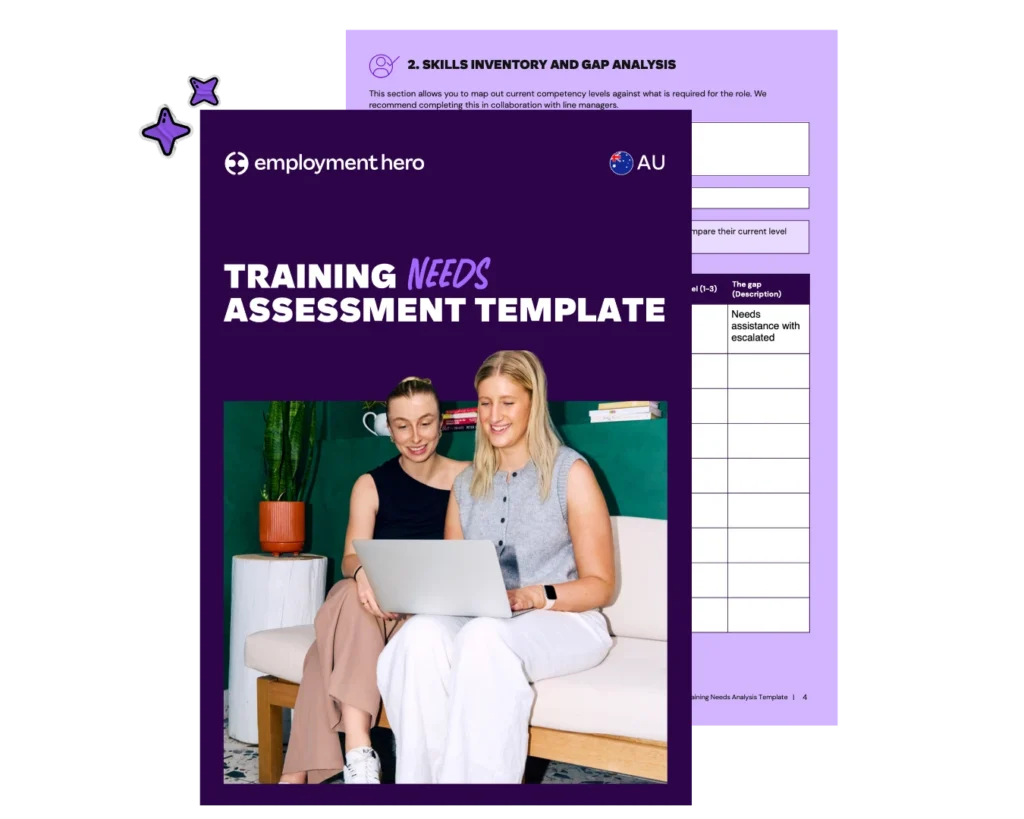
Every great leader knows that investing in targeted, strategic training is how you truly set your team up for success. When you get intentional about development, you empower your people to grow, solve real business challenges and drive performance that matters. If you want a high-performing team that consistently delivers results, a smart, focused development strategy is the way forward.
That’s where a training needs analysis comes in.
We’ve created an in-depth template, helping you get an overview of your needs, including:
- Business goals and capability alignment
- Skills inventory and gap analysis
- Compliance and safety checks
- Training action plan
Ready to get started? Download our free template now by filling out the form.
What is a training needs analysis?
At its core, a training needs analysis is a health check for your business’s capabilities. It’s a systematic process used to identify the gap between the skills your team currently has and the skills they need to achieve your organisational goals.
Think of it like a vehicle inspection. You wouldn’t drive a car across the Nullarbor without checking the engine, tires and oil levels first. Similarly, you shouldn’t try to scale your business without knowing if your team has the horsepower to get you there.
A training needs analysis helps you answer three critical questions:
- Where are we now? (Current competency levels)
- Where do we need to be? (Required competency levels)
- How do we close the gap? (Training and development interventions)
It moves you away from “gut feeling” decisions, like sending everyone to a generic leadership seminar because you read a LinkedIn post about it and towards data-driven strategies that solve actual business problems.

Why is a training needs analysis so important?
Skipping the analysis phase is the number one reason training programs fail. Without a training needs analysis, you’re essentially flying blind. Here is why it is non-negotiable for growing Australian businesses:
It identifies specific skills gaps
You might think your sales team is missing targets because they can’t close deals, so you book a negotiation workshop.
But a training needs analysis might reveal the actual problem is product knowledge or a lack of proficiency with your CRM software. Diagnosing the wrong problem means applying the wrong cure.
It prioritises resources effectively
You don’t have an unlimited budget. A training needs analysis helps you triage training needs. It highlights which gaps are critical mission-blockers and which are nice-to-haves.
This makes sure you’re spending your training dollars where they’ll generate the highest return on investment.
It aligns training with business goals
A training needs analysis makes sure every learning initiative is tied to a strategic objective. Whether you’re expanding into a new market or launching a new product line, the analysis ensures your team is equipped to execute that specific vision.
How do you use a needs analysis assessment template?
Starting a training needs analysis from a blank spreadsheet is a recipe for overwhelm. That’s why smart employers use templates. A good training needs analysis template provides a structured framework to collect data, organise insights and track progress.
Here is how to get the most out of one:
Step 1: Standardise your data collection
Use the template to make sure you’re asking the same questions across different departments. This allows you to compare apples to apples. If one manager rates skills on a 1-5 scale and another uses “Good/Bad,” your data isn’t comparable. A template enforces consistency.
Step 2: Categorise needs
Your template should allow you to bucket needs into three levels:
- Organisational level: Skills needed across the whole company (e.g. cybersecurity awareness).
- Operational/job level: Skills needed for specific roles (e.g. forklift certification for warehouse staff).
- Individual level: Skills needed for a specific person’s growth (e.g. public speaking for a new team lead).
Step 3: Track progress over time
Don’t just fill it out and file it away. Your template should be a living document. Use it to record when training was delivered and re-assess skills 3-6 months later to see if the gap has closed.
What are the best practices for conducting a training needs analysis?
You want to do this right the first time. Here are the strategies that separate a tick-box exercise from a transformative business process.
Involve stakeholders early
Don’t do this in a silo. Involve department heads and line managers from day one. They know the day-to-day reality of the jobs better than anyone. If they don’t buy into the process, they won’t support the training that comes out of it.
Integrate into broader processes
A training needs analysis shouldn’t be a standalone event that happens once every five years. It should be baked into your employee learning management system. When performance reviews happen, training needs should be flagged automatically.
How do you define relevant job behaviors for training?
This is where the rubber meets the road. “Communication skills” is too vague to train for. You need to break skills down into observable job behaviors.
Relevant job behaviors are the specific actions and tasks that drive results in a role. To define them, you need to look at your high performers. What do they do differently?
Example: Customer Service Role
- Vague skill: “Good customer service.”
- Relevant job behaviour: “Acknowledges the customer’s complaint within 30 seconds, uses active listening to summarise the issue and offers a solution before ending the call.”
By identifying these behaviors, you can design training that simulates real-life scenarios.
Mapping behaviours to KPIs
Once you’ve defined the behaviors, link them to Key Performance Indicators (KPIs).
- Behaviour: Accurately entering lead data into the CRM.
- KPI: Increase in qualified leads and decrease in bounce rates.
This connection makes the value of the training undeniable. It shifts the conversation from “We learned about the CRM” to “We improved data accuracy by 20%.”

What techniques can you use for training needs analysis?
There is no one size fits all method. The best approach usually involves a mix of quantitative and qualitative data. Here are the most effective techniques:
- Direct observation: Sometimes you just have to watch people work. This is highly effective for manual tasks or customer-facing roles.
- Skills audits: This is a formal assessment of current competency levels. You list the skills required for a role and rate each employee against them.
- Surveys and questionnaires: Best for gathering data from a large number of people quickly.
- Focus groups: Gather a small group of employees to discuss challenges in depth.
- Reviewing HR metrics: Look at the data you already have. High turnover in a specific department? High accident rates? Low customer satisfaction scores? These are all screaming indicators of training needs.
If your training strategy doesn’t support your business strategy, it’s just noise. Here’s how to make sure it drives real impact:
How do you align training with organisational goals?
1. Start with the strategy
Review your company’s 12–24 month plan. Launching a new product? Moving to remote-first? Rolling out new software? Tie every initiative to a clear training response.
Example: Launching a new SaaS product in Q3 requires product training for sales, technical support training for customer success and agile capability for developers.
2. Define the people impact
For every goal, ask: What do our people need to do differently to achieve this?
Example: To increase customer retention by 10%, your customer success team may need to shift from reactive support to proactive relationship management.
3. Run a gap analysis
Do your teams already have these skills? If not, that’s your training priority.
4. Measure business outcomes, not attendance
Don’t evaluate training on participation or feedback forms alone. Measure success against the original business goal. Did retention improve? Did the product launch succeed?
Keen to get your new starters set up for success from day one? Look at our onboarding software solutions that help align new hires with your organisational goals from the very start.
What is the role of non-training alternatives in skill development?
Before you book a course, consider these interventions:
- Job aids and cheat sheets: Instead of a 3-day course on the new CRM platform, give them a one-page PDF with screenshots of the top 5 tasks. It’s cheaper and often more effective.
- Mentoring and coaching: Pair a junior employee with a senior pro. The learning happens on the job, in real-time.
- Performance management: If it’s a motivation issue, clear feedback and accountability (not training) are the solution.
How does a needs analysis boost employee performance?
When employees struggle, they get frustrated, disengaged and then they eventually leave.
A training needs analysis boosts performance because it tells your team: “We see you, we know what you need and we are going to help you get better.”
It builds confidence
Targeted training gives employees the specific tools they need to win. When a sales rep learns a new closing technique and it works, their confidence skyrockets. Confidence breeds success.
It reduces frustration
Nothing kills morale faster than being asked to do a job you haven’t been trained for. A training needs analysis identifies these friction points and removes them.
It creates a culture of growth
When you regularly assess and address training needs, you signal that learning is a priority. This attracts high achievers who want to develop their careers.
It increases productivity
This is the bottom line. Trained employees work faster, make fewer mistakes and require less supervision.
Check out our guide to training employees for more insights on building a high-performance culture.

What’s the best way to assess your team’s current skills?
Assessing skills can be tricky. You want to be accurate without creating a culture of fear. The best approach is multi-source feedback like 360-degree feedback.
Don’t rely on just one person’s opinion.
- Self-assessment: Ask the employee. They often know exactly where they are struggling.
- Manager assessment: The direct supervisor should provide objective ratings based on outcomes.
- Peer assessment: Teammates often see things managers miss. “He’s great at code, but hard to collaborate with.”
Use competency frameworks
Don’t just ask “Are they good at communication?” Use a framework with clear descriptors.
- Level 1: Can communicate basic ideas clearly.
- Level 2: Can persuade others and negotiate simple outcomes.
- Level 3: Can negotiate complex contracts and resolve high-stakes conflict.
This removes ambiguity and gives you concrete data to work with.
Take a look at our learning and development guide to see how L&D strategies drive long-term business resilience.
Looking for a free template to get started?
We know you’re busy. You don’t have time to build a complex matrix from scratch. That’s why we’ve created a comprehensive, easy-to-use training needs analysis template designed specifically for Australian SMEs.
Download the free training needs analysis template by filling out the form on the right.
Ready to take the next step?
A spreadsheet is a great start, but it can’t automate your entire L&D strategy. If you’re ready to move beyond manual templates and build a truly scalable learning culture, it might be time to look at an integrated Learning Management System (LMS).
With Employment Hero, you can assign training, track progress and manage compliance all in one place. It’s less admin for you and a better experience for your team.
Explore Employment Hero’s Learning Management System or get in touch with one of our business specialists today.
The information in this template is current as at 30 February 2026, and has been prepared by Employment Hero Pty Ltd (ABN 11 160 047 709) and its related bodies corporate (Employment Hero). The views expressed in this template are general information only, are provided in good faith to assist employers and their employees, and should not be relied on as professional advice. Some information is based on data supplied by third parties. While such data is believed to be accurate, it has not been independently verified and no warranties are given that it is complete, accurate, up to date or fit for the purpose for which it is required. Employment Hero does not accept responsibility for any inaccuracy in such data and is not liable for any loss or damages arising directly or indirectly as a result of reliance on, use of or inability to use any information provided in this template. You should undertake your own research and seek professional advice before making any decisions or relying on the information in this template.
Register for the guide
Related Resources
-
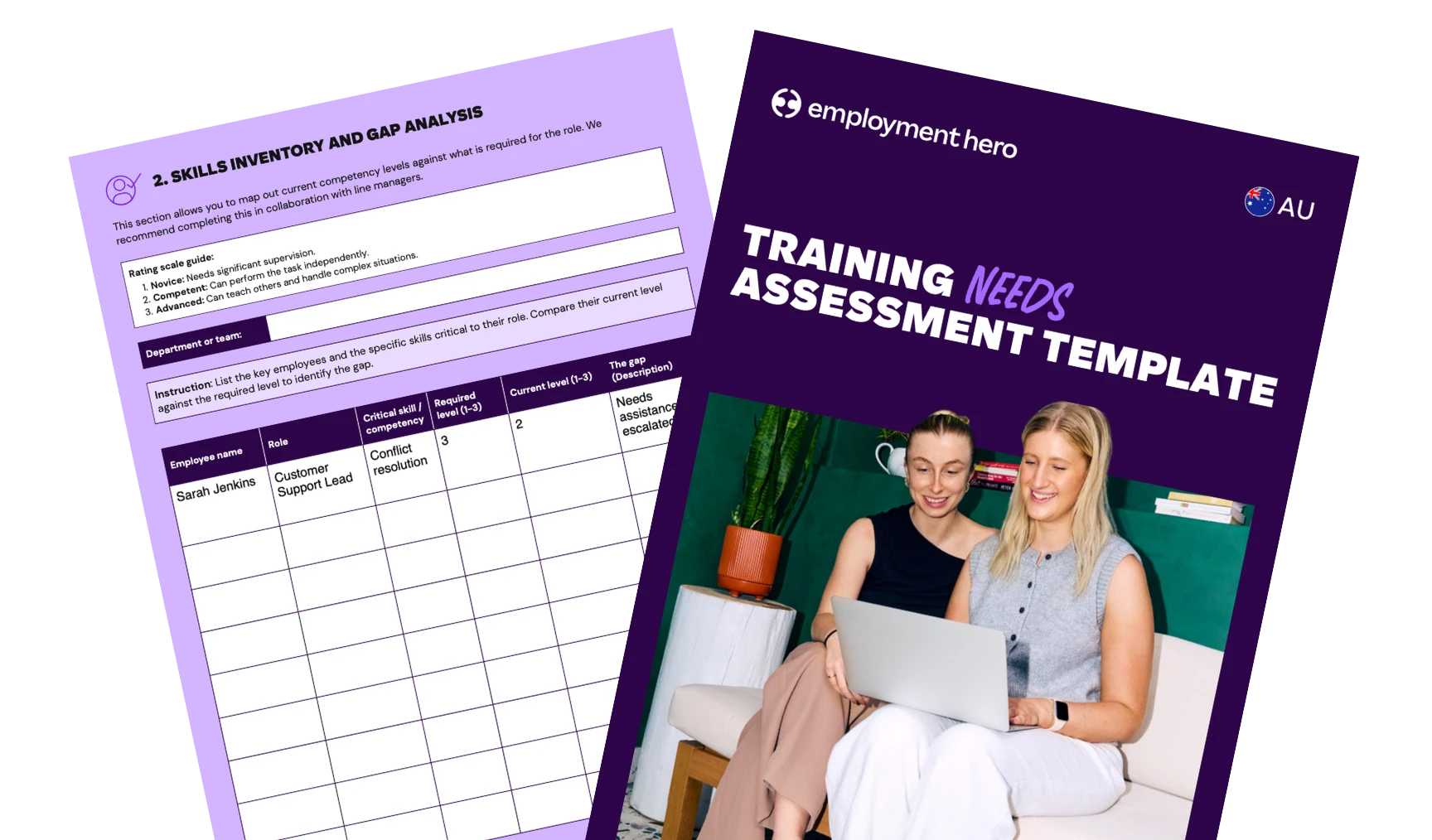 Read more: Conducting a training needs analysis: Free template and guide
Conducting a training needs analysis: Free template and guide
Unlock your team’s potential with a training needs analysis. Learn how to boost employee performance and align training with your…
-
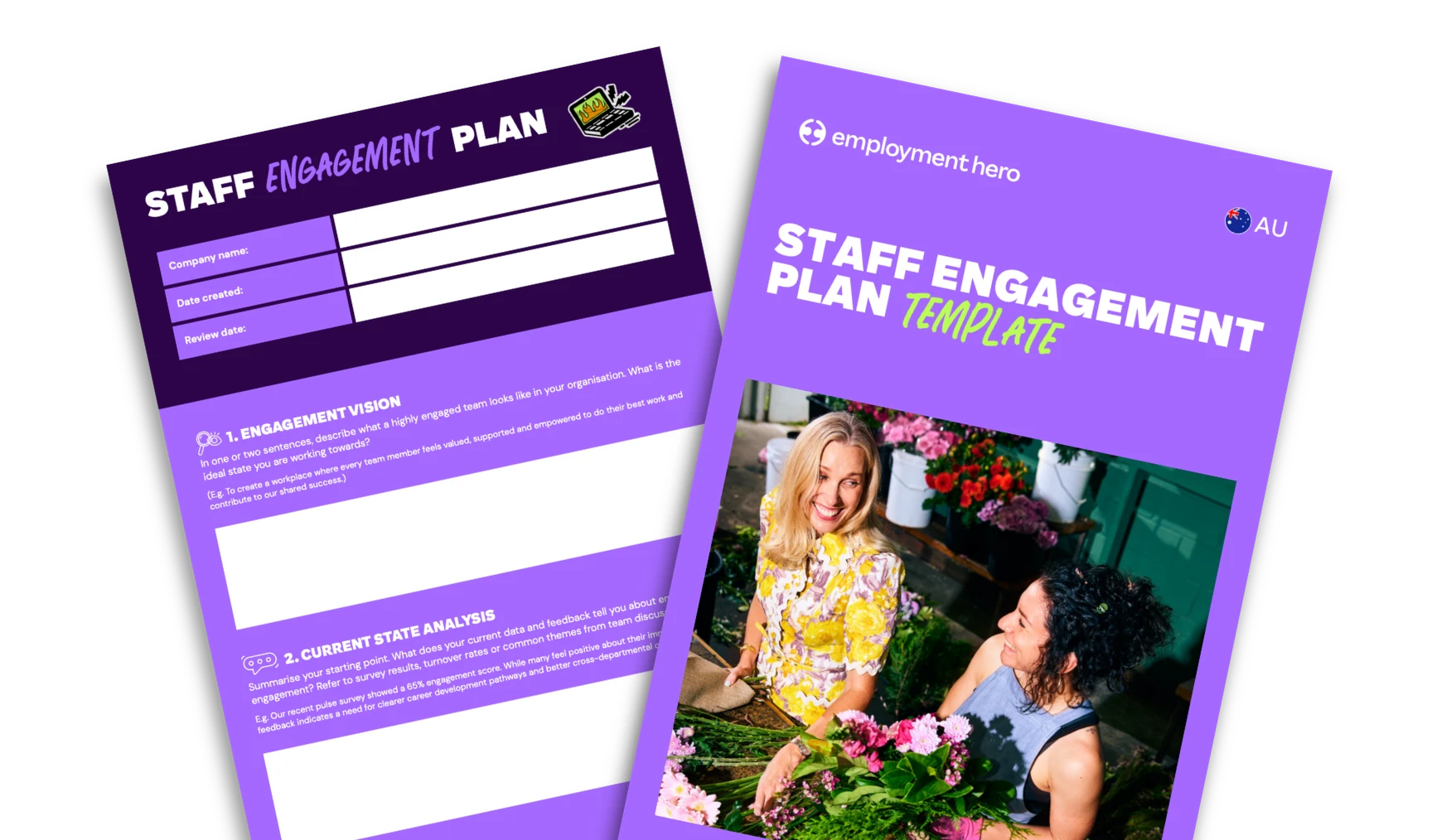 Read more: Staff engagement plan template and guide
Staff engagement plan template and guide
Discover effective strategies for creating a staff engagement plan that drives results. Download our template and guide.
-
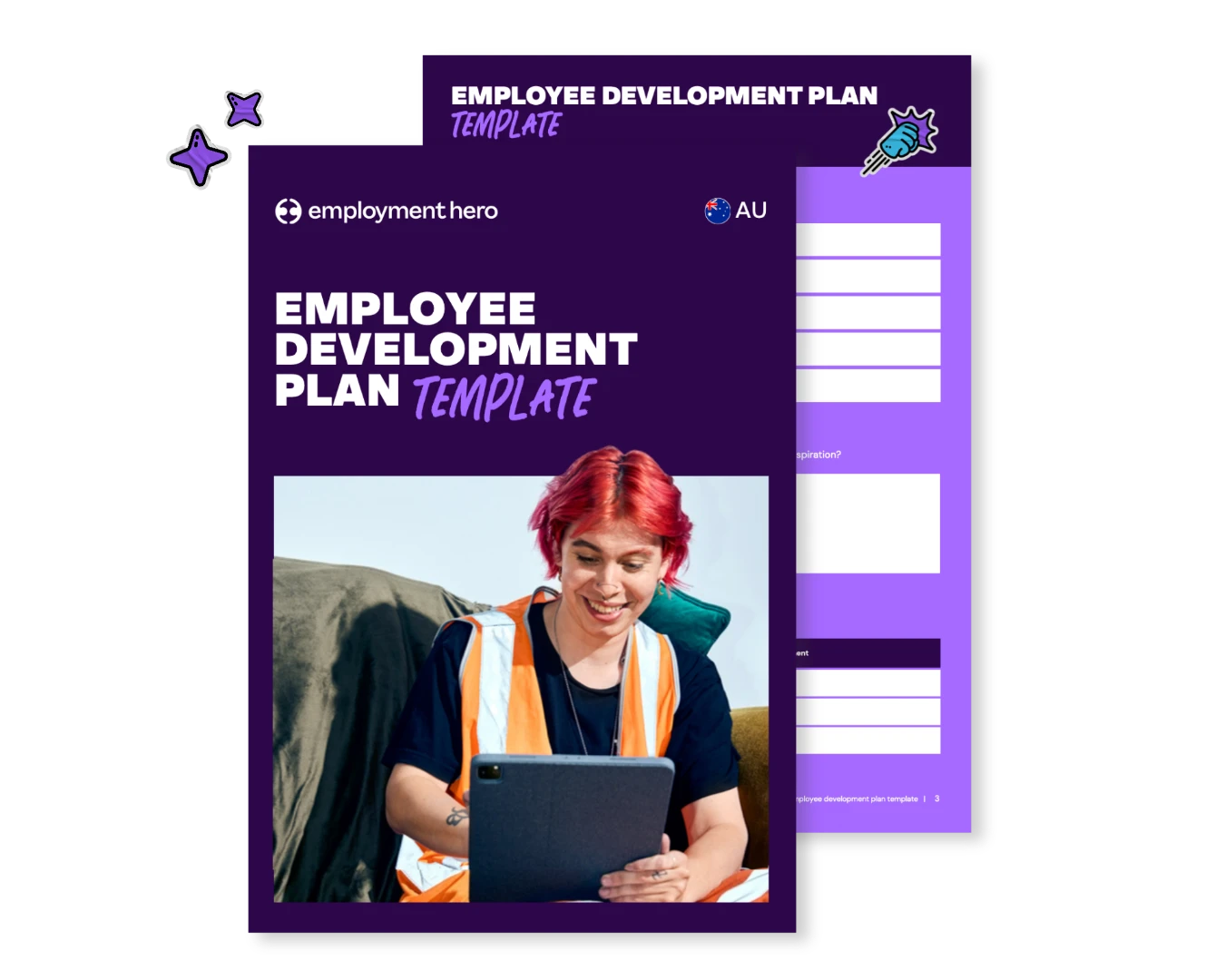 Read more: Employee development plan: Examples and template
Employee development plan: Examples and template
Discover real employee development plan examples, strategic frameworks and a free template to empower growth in your team.

