

















Employee development plan: Examples and template
Published
Employee development plan: Examples and template
Published
Every great employer knows that employees are looking for more than just a paycheck. They want to know that by investing their time in your business, you’re investing in their growth and professional development.
And at the end of the day, if you aren’t offering a clear path forward, someone else will.
For small and medium-sized businesses (SMEs) in Australia, this can feel like a heavy task. You’re already wearing ten different hats. Do you really have time to map out the career trajectory for every single staff member? The short answer is that you can’t afford not to.
In this guide, we’ll show you exactly how to build a development plan that works. We’ll look at employee development plan examples, the difference between professional development and employee development and give you the frameworks you need to scale this across your team.
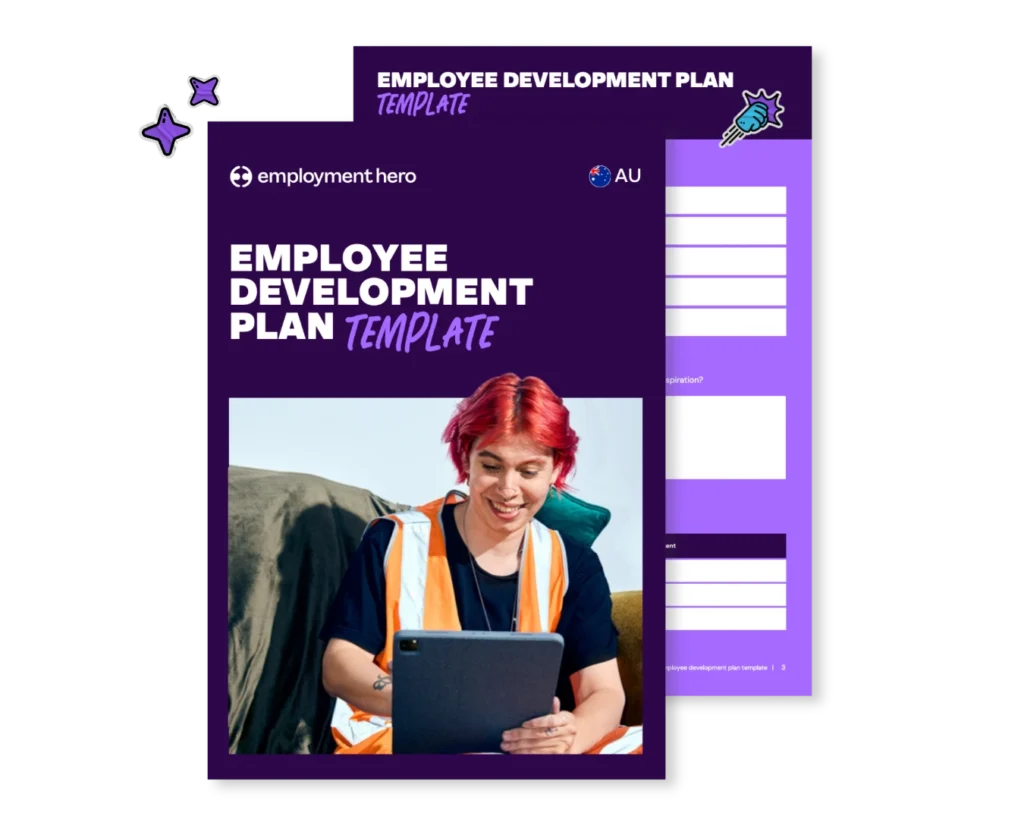
Download the Employee Development Plan Template now by filling out the form on the right.
What is an employee development plan?
An employee development plan is a strategic document designed by both the employee and the manager to enhance the employee’s skills, knowledge and abilities.
An employee development plan outlines:
- Career goals: Where does the employee want to be in one, three, or five years?
- Skill gaps: What new skills do they need to get there?
- Actionable steps: What specific training, mentoring, or projects will bridge the gap?
- Timeline: When will these milestones be achieved?
Employee development vs. professional development
These terms often get used interchangeably, but there is a distinct difference in scope and intent.
Professional development is broad. It encompasses the acquisition of skills and credentials that belong to the individual, regardless of where they work. Think of a CPA certification for an accountant or a general leadership seminar. These are transferable assets that the employee owns.
Employee development, on the other hand, is specific to the relationship between the worker and the employer. It includes professional development, but it shapes it to fit the company’s needs.
For example, a professional development goal might be “Improve public speaking.” The corresponding employee development goal would be “Lead the quarterly sales presentation to improve communication and drive higher conversion rates.”
Understanding this distinction is key to creating a development plan that delivers ROI for your business while fulfilling career aspirations for your team.

Why employee development plans matter
You might be thinking, “What if I train them and they leave?” The classic counter-argument is, “What if you don’t and they stay?”
Stagnation is a silent killer of productivity. Without development efforts, employees disengage. They go through the motions and eventually, they leave to find a challenge elsewhere, taking their wealth of knowledge with them.
Here is why prioritising employee development plans makes business sense:
- Retention: People stay where they grow. A solid growth plan signals that you value them for the long haul.
- Succession planning: You can’t scale your business if you’re the only one who knows how to run it. Employee development prepares the next generation of leaders.
- Agility: Markets change fast. Helping employees learn new skills makes sure your workforce can adapt to new technologies and challenges.
- Engagement: Employee engagement skyrockets when people feel competent and challenged.
- Attraction: Top talent asks about career development in interviews. Having a structured development plan gives you a competitive edge in recruitment.
Core components of an effective development plan
You don’t need a complex HR department to build a robust plan. You just need the right building blocks. Whether you’re using a professional development plan template or starting from scratch, every development plan should include these four elements.
Setting clear, measurable goals
Vague intentions lead to vague results. Goals within a development plan need to be SMART (Specific, Measurable, Achievable, Relevant, Time-bound).
These should cover:
- Professional goals: Objectives related to their current job performance.
- Career goals: Aspirations for future roles or higher-level responsibilities.
- Development goals: Specific competencies they need to master, like “Advanced Data Analysis” or “Conflict Resolution.”
Diagnosing skills gaps and learning needs
Before you can map the route, you need to know your starting point. Where is the employee now versus where they need to be?
This diagnosis can come from performance reviews, self-assessment or direct feedback. It’s crucial to be honest here. If an employee has strong technical chops but lacks communication skills, the development plan must address that specific gap rather than adding more technical training.
Choosing learning methods and resources
Learning doesn’t just happen in a classroom. The 70-20-10 model suggests that:
- 70% of learning comes from on-the-job experience (projects, stretch assignments).
- 20% comes from social interactions (mentoring, coaching).
- 10% comes from formal training (courses, workshops).
Your development plan should reflect this mix. Don’t just rely on courses; assign them a project that forces them to use their new skills.
Milestones, checkpoints and evaluation
A plan without a timeline most likely won’t come to fruition. An effective employee development plan includes set dates for check-ins. This keeps engagement levels high and allows you to adjust the course if priorities change.

How to build an employee development plan
Ready to get tactical? Here’s a step-by-step process to move from idea to execution. You can adapt this flow to create your own employee development plan or one for your direct reports.
Step 1: Audit current capabilities and aspirations
Start with a conversation. Sit down with your employee and ask them about their career aspirations. What parts of their job do they love? What do they find frustrating? Where do they see themselves in two years?
Simultaneously, look at your business needs. If you know you’re expanding into a new market next year, you need someone with leadership skills to head that up. Matching their ambition with your business strategy is the sweet spot.
For a deeper dive into structuring this, check out our guide to training employees, which covers the fundamentals of upskilling your workforce.
Step 2: Define role-specific growth paths
Once you know the “what,” define the “how.” If an employee wants to move from a contributor to managing a team, what does that path look like?
Break down the professional growth required.
- Technical skills: What software or processes must they learn?
- Soft skills: Do they need to improve their communication skills or emotional intelligence?
- Experience: Do they need to manage a budget or lead a small team first?
This is where career development plans become tangible.
Step 3: Map activities and support mechanisms
Now, fill in the development plan template. List the specific activities they will undertake.
- Activity: Complete Advanced Excel Course.
- Support: Company pays for the course; employee gets two hours/week of study time.
- Activity: Lead the weekly team meeting.
- Support: Manager provides feedback after each session.
Be specific about resources. Are you providing a budget? Time off? Access to a mentor?
Step 4: Launch, monitor and iterate
Launch the plan with a formal sign-off. Then, keep it alive. Review the employee development plan during 1:1s, not just at the annual review.

Employee development plan examples you can use
Theory is great, but seeing employee development plan examples in action is much better. Below are several scenarios tailored to different roles. You can use these as a base to create your own employee development plan template.
Example: Leadership track for managers
This focuses on high-potential employees preparing for leadership development.
- Employee: Sarah, Senior Marketing Specialist.
- Goal: Promote to Marketing Manager within 12 months.
- Development Goals:
- Develop strategic planning capabilities.
- Enhance leadership skills and conflict resolution.
- Understand P&L management.
- Action Plan:
- Q1: Attend “Finance for Non-Financial Managers” workshop.
- Q2: Lead the Q3 campaign strategy from concept to execution.
- Q3: Mentor a junior hire (focusing on communication skills).
- Q4: Shadow the current Marketing Director during budget planning.
- Review Schedule: Monthly career check-ins.
For a structured format to track this, you can use a professional development plan template designed to document these milestones clearly.
Example: Technical upskilling for specialists
This is one of the most common employee development plan examples, focusing on deepening expertise rather than management.
- Employee: David, Software Developer.
- Goal: Transition to Full Stack Developer.
- Development Goals:
- Master React.js and Node.js.
- Improve understanding of database architecture.
- Action Plan:
- Complete online certification in Full Stack Development (Company sponsored).
- Take ownership of one back-end project in the next sprint.
- Pair program with the Lead Architect for 2 hours/week.
- Review Schedule: Bi-weekly code reviews and quarterly progress assessment.
Example: Career lateral movement & cross-skilling
Sometimes career growth isn’t vertical. Employee development can also mean moving sideways to gain a broader perspective.
- Employee: Jessica, Customer Support Rep.
- Goal: Transition to Customer Success Manager (Sales focused).
- Development Goals:
- Learn sales negotiation techniques.
- Understand the customer onboarding lifecycle deeply.
- Action Plan:
- Shadow the Sales team on 5 client calls per month.
- Manage the onboarding process for 3 new small clients.
- Read “The Challenger Sale” and present key takeaways to the team.
- Review Schedule: Quarterly.
If you are looking to formalize lateral moves, a career progression plan template can help map out these non-linear paths effectively.
Example: Development plan for managers themselves
Even leaders need development plans. In fact, their growth often has the highest impact.
- Employee: Michael, Operations Manager.
- Goal: Prepare for COO succession.
- Development Goals:
- Strategic thinking at an organisational level.
- Public speaking and board reporting.
- Action Plan:
- Executive coaching sessions (bi-monthly).
- Lead the Annual Strategy Retreat.
- Represent the company at an industry conference.
These development plan examples show that plans must be tailored. A copy and paste approach won’t work here. The effective employee development plan is always bespoke to the individual’s career goals and the company’s needs.

Strategies to scale development across your workforce
Creating one development plan is easy, but creating fifty is a challenge. To scale employee development programs without drowning in admin, you need to systematise the process.
Integrating development with performance reviews
Don’t treat performance and development as separate silos. They are two sides of the same coin. During performance reviews, discuss employee growth plans. Look at past performance to inform future development goals. This integration makes sure that development efforts are always relevant to the job at hand.
Using technology and platforms for learning
You cannot manage employee development effectively on spreadsheets alone. As you grow, you need tools that automate the tracking of skills, goals and training.
An Employee Learning Management System (LMS) allows you to assign training, track progress and house all your educational resources in one place. It puts the power of learning into the employees’ hands, allowing them to access employee development programs on demand.
Facilitating peer coaching and mentoring
You don’t always need expensive external trainers. Your business is already full of experts. Set up a peer coaching system where senior staff mentor juniors.
This strategy means that your junior employee gains new skills and the senior employee develops leadership skills. It fosters a culture of continuous professional development that doesn’t cost a cent.
Encouraging self-directed growth
Empower your team to own their personal development plan. Give them a budget and a framework, and let them choose the professional development that excites them. When employees feel autonomy over their own employee development plan, their commitment to completing it increases significantly.

Measuring success and adjusting the plan
How do you know if your development plan is working? You measure the output.
Track metrics such as:
- Retention rates: Are employees staying longer since you introduced these plans?
- Internal promotion rate: Are you filling roles from within?
- Productivity: Is the training translating to better work?
- Employee engagement scores: Do people feel more valued?
If a development plan isn’t delivering results, don’t be afraid to scrap it and start over. Employee development is an iterative process. Job satisfaction and professional growth are moving targets and your plans should be flexible enough to move with them.
Download the employee development plan template now
To help you hit the ground running, we’ve put together a resource you can use immediately.
Don’t let the administrative burden stop you from starting. Using a development plan template saves time and ensures consistency across your team. It gives you a standard structure to document career goals, skills gaps and action plans.
How Employment Hero helps you deliver development at scale
Managing employee development manually is a recipe for burnout. At Employment Hero, we believe that every business deserves the same capability-building tools as the big end of town.
Our platform brings employee development, performance management and learning together in one seamless ecosystem.
- Goal Management: Set and track OKRs and development goals transparently.
- Learning Management System (LMS): Create and distribute custom learning content or choose from thousands of pre-made courses.
- Performance Reviews: Integrate development discussions directly into performance workflows.
- 1:1s: document career conversations and keep development plans top of mind.
We automate the admin so you can focus on coaching your team and growing your business.
Download the Employee Development Plan Template now by filling out the form.
Disclaimer: The information in this guide and template is current as at March 2026, and has been prepared by Employment Hero Pty Ltd (ABN 11 160 047 709) and its related bodies corporate (Employment Hero). The views expressed in this guide and template are general information only, are provided in good faith to assist employers and their employees, and should not be relied on as professional advice. The Information is based on data supplied by third parties. While such data is believed to be accurate, it has not been independently verified and no warranties are given that it is complete, accurate, up to date or fit for the purpose for which it is required. Employment Hero does not accept responsibility for any inaccuracy in such data and is not liable for any loss or damages arising either directly or indirectly as a result of reliance on, use of or inability to use any information provided in this guide and template. You should undertake your own research and to seek professional advice before making any decisions or relying on the information in this guide and template.
Register for the guide
Related Resources
-
![Hospitality Industry (General) Award Summary [MA000009]](https://employmenthero.com/wp-content/uploads/2026/03/Award-Summary_Hospitality-Industry.webp) Read more: Hospitality Industry (General) Award Summary [MA000009]
Read more: Hospitality Industry (General) Award Summary [MA000009]Hospitality Industry (General) Award Summary [MA000009]
The Hospitality Award is designed to cover a wide range of job roles including chefs, wait staff, front office and…
-
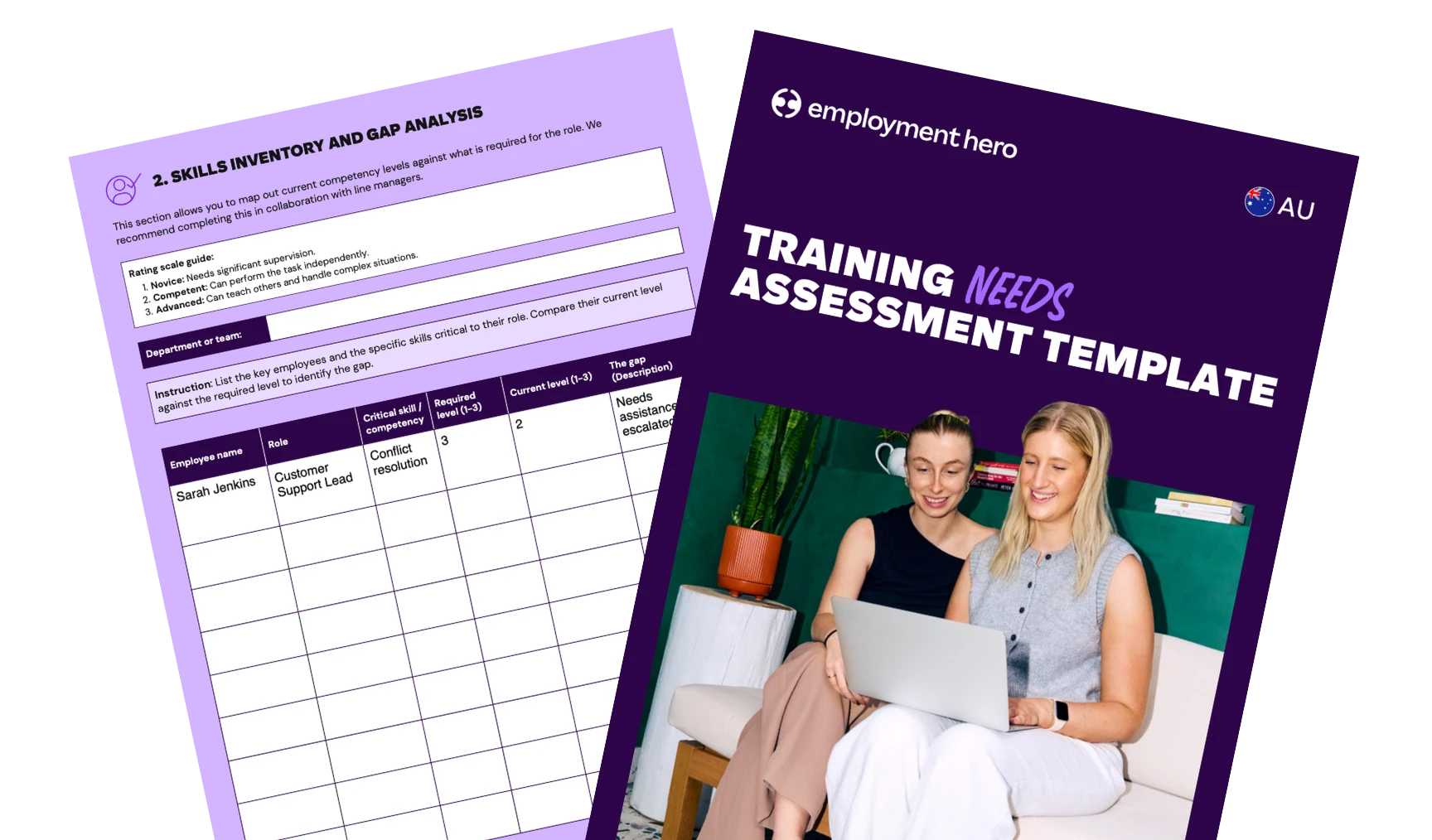 Read more: Conducting a training needs analysis: Free template and guide
Conducting a training needs analysis: Free template and guide
Unlock your team’s potential with a training needs analysis. Learn how to boost employee performance and align training with your…
-
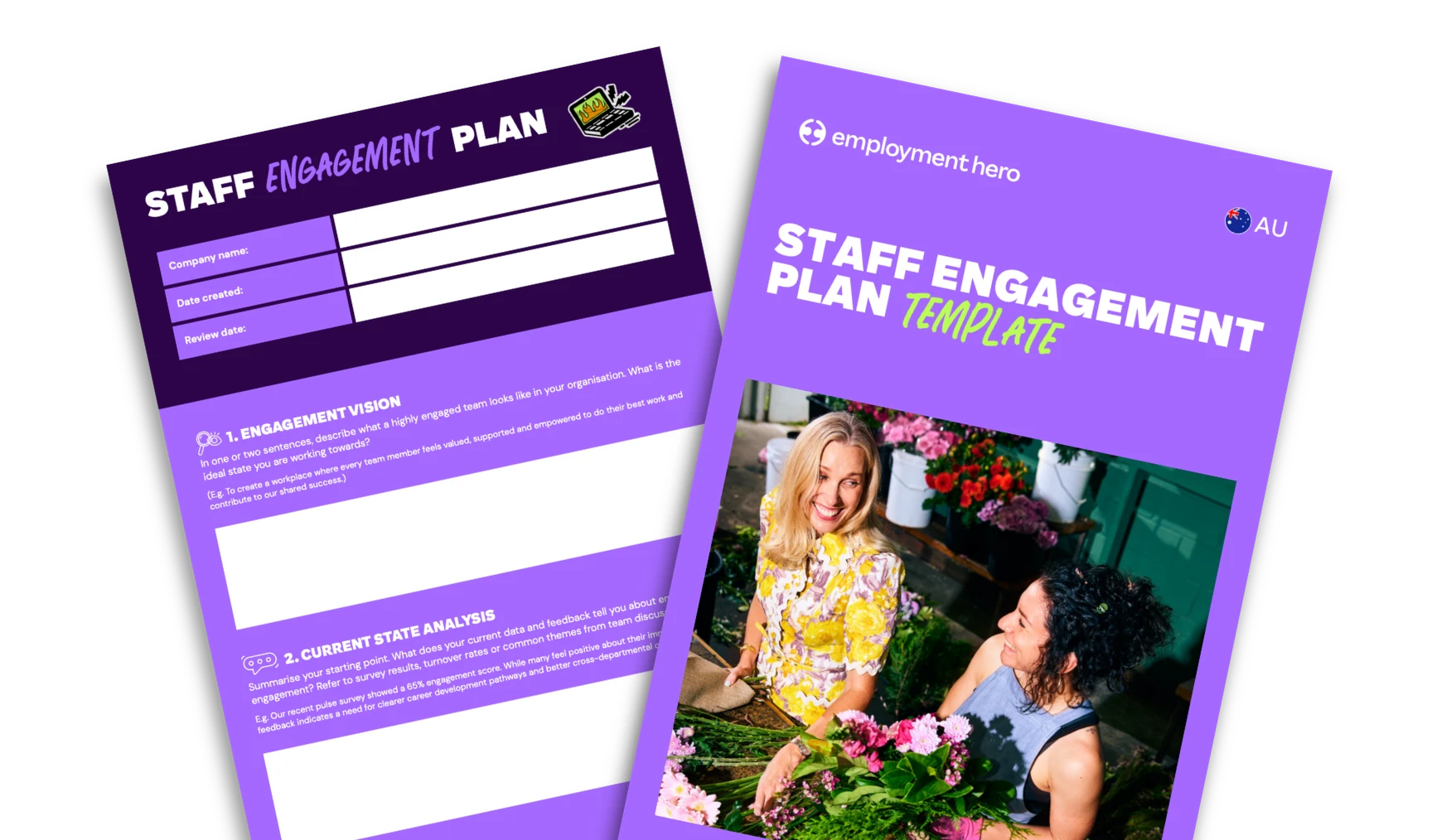 Read more: Staff engagement plan template and guide
Staff engagement plan template and guide
Discover effective strategies for creating a staff engagement plan that drives results. Download our template and guide.

