
 Australia
 New Zealand
 United Kingdom
 Canada
 Singapore
 Malaysia


One-on-one meeting template and guide
Published
One-on-one meeting template and guide
One-on-one meetings can be the most powerful tool in a manager’s toolkit, creating space for alignment, support and shared goals. But without a roadmap, these conversations can easily lose direction or get pushed aside when things get busy.
A clear framework helps protect that time and gives each meeting purpose, so every one-on-one becomes an opportunity to lift performance, strengthen relationships and keep pushing forward.
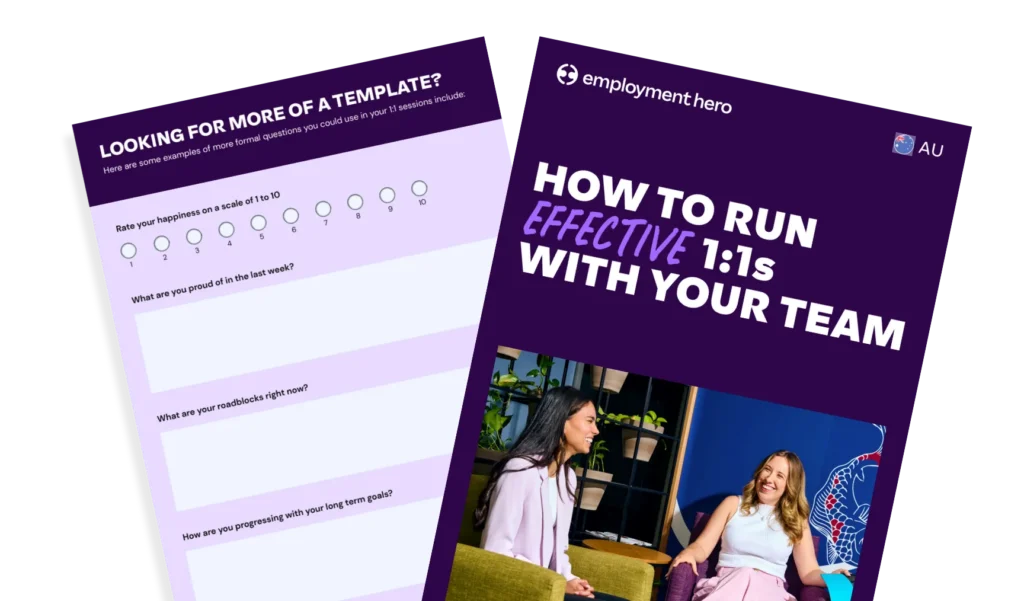
To help you run more effective 1:1s with your team, we’ve created a helpful template and guide.
What’s included in the one-on-one meeting template and guide?
This template and guide is your path to transforming your one on one meetings. It’s designed to take the question marks out of planning, helping you run productive conversations.
Inside, you’ll find learn:
- How to run an effective 1:1
- What questions should you ask in a 1:1?
- The benefits of 1:1s
- The art of feedback
- Plus a handy template you can use today
This guide and template provides a step-by-step process for holding successful meetings to help you discuss challenges, celebrate wins and build stronger working relationships.
Download the one-on-one template and guide by filling out the form on the right.
What is a one-on-one meeting?
A one-on-one meeting, or 1:1 ,is a dedicated recurring meeting between two people, typically a manager and their direct report. Unlike team meetings that focus on project updates or performance reviews that centre around past achievements, this meeting is a space for forward-looking conversation.
It’s a chance to give the employee a private forum to discuss challenges, ask questions and talk about their career development. The key difference with 1 on 1 meetings is the focus. A structured 1 on 1 meeting makes sure that the conversation is meaningful and that the employee leaves feeling heard and aligned. It frames the manager as a partner for success rather than a traditional boss, working alongside the employee to achieve their goals.
Why 1:1 meetings matter for teams and leaders
Great teams are built conversation by conversation and that’s why consistent 1:1s matter. When you sit down with someone individually, you’re telling them that they’re valued, heard and that their growth is worth your time.
These conversations create a safe, private space for honest discussion. Whether someone’s stuck on a project, unsure about priorities or simply needs support, 1:1s give them room to speak openly without the pressure of a group setting. It’s also how psychological safety is built, one conversation at a time.
For managers, 1:1s are gold. They reveal team morale, uncover roadblocks early and give you real insight into how each person is feeling and performing.
According to Gallup, employees whose managers hold regular meetings with them are three times as likely to be engaged compared to those who don’t hold regular meetings. After all, when employees feel supported and see a real path for growth, they’re far more likely to stay.

Tips and best practices for better one-on-one meetings
Running a great 1:1 is a skill. It requires preparation, focus and a genuine desire to connect. Following a few best practices can turn a good meeting into a great one by breaking the process down into three chronological phases: before the meeting (preparation), during the meeting (active listening and problem-solving) and after the meeting (follow-up and action).
Step 1: Set a regular cadence
Consistency is everything. A one on one meeting should be a recurring calendar event that both parties respect and protect. Cancelling or rescheduling 1:1s sends the message that they aren’t a priority. For most teams a weekly or bi-weekly cadence works well. The goal is to make it a predictable and reliable touchpoint.
Step 2: Prepare together
The best 1:1s have a shared agenda. Both the manager and the employee should contribute agenda items beforehand. This makes sure the meeting covers what’s most important to both people.
A shared document where you can add topics throughout the week is a great way to stay organised. You can also create and fill out the 1:1s templates in Employment Hero.Preparation signals that you value the other person’s time and are invested in a productive conversation.
Step 3: Create a comfortable and safe space
A 1:1 should feel like a safe space for open and honest conversation, which means choosing the right meeting logistics and ideal locations. Whether you opt for a casual walking meeting, a quiet cafe or a private boardroom, the environment should encourage openness. As a manager your role is to listen more than you talk. Put away distractions, close your laptop (or tabs in the background), set your phone to do not disturb and give the employee your full attention.
Practice active listening by asking clarifying questions and summarising what you hear to make sure you understand. The aim is to create an environment where the employee can feel comfortable sharing both their successes and their struggles. This is especially important for remote meetings. Remote 1:1 meetings should default to video calls to allow participants to interpret nonverbal cues.
Step 4: Capture actions and outcomes
A great conversation is only useful if it leads to action. The final five minutes of a 1:1 should be strictly dedicated to summarising the discussion and assigning timelines to action items. Recap the key takeaways and clarify who is responsible for what and by when.
Documenting these next steps creates accountability and makes sure that you follow through on your commitments. This can be as simple as a shared note, a task in your project management tool or using AI-powered note-takers to automatically capture decisions.
Step 5: Review progress and iterate
Don’t just set and forget. Start the next 1:1 by reviewing the action items from the previous one. This shows you’re serious about making progress and closes the loop on important topics. It’s also a good idea to periodically ask for feedback on the meeting itself. Is the format working? Is the cadence right? Is there anything you could do to make it more valuable?

One-on-one meeting agenda template
Not all 1:1s are the same. The focus of your conversation might change depending on current projects team priorities or an employee’s career goals. Here are a few example templates you can adapt.
Regular check-in template
This is your go-to for weekly or bi-weekly meetings. The focus is on connection alignment and clearing roadblocks. You want to cover questions like these:
- General check-in: Start with how are you? (Start with a genuine personal check-in)
- Recap: Review action items from last 1:1
- Priorities: What is your main focus this week?
- Roadblocks: Is anything standing in your way? How can I help?
- Wins: What’s something you’re proud of?
- Feedback: Anything I can do differently to better support you?
- Action items: Summarise next steps
Development conversation template
Use these questions quarterly or bi-annually to focus on long-term growth.
- Career goals: Where do you see yourself in 1 year? 5 years?
- Strengths: What parts of your job energise you the most?
- Growth areas: What skills do you want to develop?
- Opportunities: Are there projects or training that could help you get there?
- Support: What resources or mentorship do you need from me or the company?
- Next steps: Create a plan with clear milestones
Project deep dive template
Use these questions when you need to troubleshoot a specific project or initiative.
- Project status: Quick update on where things stand
- What’s working well: Celebrate successes and bright spots
- Challenges: What are the biggest hurdles right now?
- Brainstorm: Let’s explore potential solutions together
- Decisions: Agree on a path forward
- Action items: Define who does what next
First 1:1 meeting template
Use this template for your first 1:1 meeting with a new team member to establish expectations and build foundational rapport.
- Welcome and introduction: Get to know each other personally
- Working styles: How do you prefer to communicate and receive feedback?
- Role clarity: Review core responsibilities and initial expectations
- Support needs: What do you need from me to be successful early on?
- Meeting logistics: Agree on the cadence and format for future 1:1s
Goal-setting meeting template
This provides a dedicated framework for establishing Objectives and Key Results (OKRs) and KPIs rather than just general development.
- Review past goals: What did we achieve and what did we miss?
- Company alignment: How do your upcoming goals support broader business objectives?
- Draft new OKRs/KPIs: Set specific, measurable targets for the next quarter
- Resource check: What tools or budget do you need to hit these targets?
- Tracking progress: How will we measure success along the way?
Performance review debrief template
This offers managers a structured way to discuss formal review outcomes in a private setting.
- Initial reactions: How do you feel about the feedback in your review?
- Clarification: Are there any points you’d like me to expand on?
- Strengths to build on: How can we maximise what you’re already doing well?
- Areas for improvement: Let’s break down the constructive feedback into actionable steps
- Next steps: What’s one thing you’ll focus on this week?
One-on-one meeting agenda and questions
Having a good list of questions can help you move beyond status updates and have more meaningful conversations.
Core agenda items
While the specifics will vary most successful 1:1s touch on these themes:
- Wellbeing and morale
- Priorities and progress
- Roadblocks and challenges
- Feedback (in both directions)
- Career growth and development
Questions for managers
Here are some 1:1 questions for managers to ask:
- What was the highlight of your week? What was the lowlight?
- Is your workload feeling manageable right now?
- What’s one thing we could change about our team to make it better?
- Are you feeling challenged in your role?
- What support do you need from me this week?
Questions for employees
Employees should also come prepared with questions and topics:
- Can we talk about my career path and opportunities for growth?
- I’d like to get your feedback on a project I just completed.
- I have an idea for improving a process. Do you have a few minutes to hear it?
- I’m feeling stuck on a task. Can we brainstorm some approaches?
The art of feedback
One-on-one meetings are the ideal setting for giving and receiving feedback. Unlike formal performance reviews, feedback in a 1:1 can be timely, specific and developmental.
In these sessions, you want to use specific examples and explain the impact. Ask for feedback on your own performance as a manager, as this gives your team a voice in how they’re managed and makes 1:1s more valuable for everyone.
The benefits of good feedback speak for themselves. According to Gallup’s How Effective Feedback Fuels Performance, 80% of employees who say they’ve received meaningful feedback in the past week are fully engaged.

Common 1:1 meeting mistakes to avoid
Even with the best intentions, some 1:1s can steer off course. Here’s some things to avoid to get the most out of your session.
Inconsistent scheduling
Nothing undermines a 1:1 faster than constantly cancelling or rescheduling it. Continually rescheduling a 1-on-1 can send a signal that the manager doesn’t value the employee’s time or that their development isn’t a priority. Proper rescheduling etiquette is essential here. If you must cancel, reiterate the importance of the meeting and immediately pick a new date to maintain trust. Treat 1:1s as non-negotiable and show your team that they matter just as much as any project deadline.
Turning it into a status update
Don’t treat 1:1’s as just another task review. If the conversation is only about deadlines and deliverables, you’re missing the real purpose. Status updates can be handled in project tools or stand-ups. Use your 1:1 time to understand how your employee is feeling, what’s getting in their way and where they want to grow.
The manager doing all the talking
If you’re talking more than your employee, it’s not a true 1:1. These meetings should be driven by the employee, not led entirely by the manager. Ask open questions, listen actively and make space for them to guide the conversation. Your role is to support, not dominate.
No preparation
Walking into a 1:1 without an agenda can make the meeting feel unfocused or unproductive. A little prep goes a long way. Managers and employees should come ready with topics to discuss, whether it’s progress, challenges, wins, development goals or feedback. Preparation shows respect for each other’s time and leads to more meaningful conversations.
Forgetting to follow up
Nothing erodes confidence faster than talking about action items, but never revisiting them. Following up on commitments shows accountability and reinforces that 1:1s drive real outcomes. Track next steps, check in regularly and close the loop in future meetings.
Employment Hero is here to help
Running effective one-on-one meetings is one of the highest-leverage activities a manager can do. They’re your secret weapon for building a high-performing, engaged and loyal team. But they don’t happen by accident. They require intention structure and commitment.
That’s where Employment Hero can help. With built-in 1:1 tools, shared agendas, goal tracking and automated reminders, you can run meaningful, organised conversations every time. Everything lives in one place, making it easy for managers and employees to stay aligned, capture action items and follow through, so your 1:1s become a powerful habit that actually moves the needle.
Keen to see our suite of employee engagement tools? Get in touch with one of our business specialists today.
Ready to learn more about 1:1s? Download our free running effective 1:1s template and guide today.
Frequently Asked Questions
For most teams a weekly or bi-weekly cadence is best. This keeps the conversations timely and relevant. Monthly can work for more senior or autonomous roles, but any less frequently and you risk losing touch.
A standard 1:1 is typically 30 minutes. This is usually enough time to have a meaningful conversation without feeling rushed. Some deeper conversations like career planning might require 45-60 minutes.
Talk about more than just work. A good 1:1 covers short-term priorities, long-term goals, challenges and general wellbeing. Let the employee lead the agenda and talk about what’s on their mind.
A simple and effective structure is to have a shared document where both the manager and employee can add agenda items throughout the week. A good format to follow is: connect on a personal level, review past action items, discuss current priorities and roadblocks and define next steps.
A manager should ask questions that establish expectations and build foundational rapport in a first 1:1 with a new team member. Focus on understanding their preferred working style, how they like to receive feedback and what support they need to be successful early on.
Participants can manage digital distractions during a meeting by setting their phones to ‘do not disturb’ and closing all communication tabs. This maintains active listening and means both the manager and employee are fully present for the conversation.
A manager should handle rescheduling a 1-on-1 meeting by immediately proposing a new date and time. It’s important to reiterate the value of the meeting to the employee, and that their time and development remain a top priority despite the change.
HR can get leadership buy-in for 1:1 meetings by highlighting the direct link between regular check-ins and higher team engagement and retention. HR professionals can also use performance management software to track completion rates and demonstrate the positive impact on overall business goals.
Get your free 1:1meeting template here
Related Resources
-
 Read more: Mastering employee wellbeing beyond R U OK? Day
Mastering employee wellbeing beyond R U OK? Day
Watch our free webinar to learn how to manage psychosocial hazards and build a year-round employee wellbeing strategy beyond R…
-
 Read more: Managing cross-state workforce compliance: your complete guide
Managing cross-state workforce compliance: your complete guide
The complete guide to managing long service leave, public holidays, workers’ compensation and more across multiple states in Australia. Download…
-
 Read more: The guide to navigating modern awards with confidence
The guide to navigating modern awards with confidence
Download our guide to modern awards compliance. Learn where the risk sits at scale and get a practical checklist to…


