The ultimate guide to Payday Super for employers (2026)

Contents
Payday Super is one of the most significant changes to hit Australian payroll in years and the 1 July 2026 start date is just around the corner.
This change means that super contributions will need to reach an employee’s fund within seven business days of each payday, instead of by the current quarterly deadline. In practice, now your super payment frequency will match your pay cycle. Weekly payroll means weekly super payments, fortnightly means fortnightly and monthly means monthly.
For businesses running payroll manually or through systems built around quarterly super, this changes your processes considerably. Cash flow planning, payroll processing and super clearing all need to work in closer alignment than most employers are currently set up for.
This guide covers everything you need to know about Payday Super including how it works, what changes in your payroll calculations, what happens to the Small Business Super Clearing House and how to make sure you’re ready before the first pay run of the new financial year.
Summary and key takeaways
- Payday Super starts 1 July 2026. Super is paid with wages, not quarterly.
- Contributions must reach the employee’s super fund within 7 business days of payday.
- The ATO’s Small Business Super Clearing House (SBSCH) closes permanently on 1 July 2026.
- Qualifying Earnings (QE) replaces Ordinary Time Earnings (OTE) as the basis for calculating the Super Guarantee (SG).
- The ATO will be actively monitoring compliance and while the transition is hard, good-faith errors from employers who have genuinely been working to comply are less likely to be pursued.
- The Super Guarantee Charge now applies per payday, not per quarter. Weekly payroll means up to 52 potential Super Guarantee Charge (SGC) events per year instead of four, with no quarterly buffer to self-correct before a deadline passes.
What is Payday Super?
From 1 July 2026, every pay run creates a super obligation. The contributions must land in your employee’s super fund account within seven business days, down from the 28 days employers currently have under the quarterly system.
For businesses, this means tighter cash flow management, additional operational processes and less room for error. Employment Hero modelling shows the average SMB will need to unlock $124,615 in additional working capital just to comply with the new legislation. You can see how Payday Super will affect your business specifically using the Employment Hero Cash Flow Impact Calculator.
The new ATO Practical Compliance Guideline (PCG 2026/1) also adds an extra layer of complexity, with penalties for employers who fall short. This is one of the biggest changes to superannuation in recent times and preparation is the most important thing you can do right now.
Payday Super explained in 2 minutes
Who does Payday Super apply to?
Payday Super applies to all Australian employers who are required to pay the Superannuation Guarantee (SG). This covers all eligible employees, regardless of how often you run payroll whether that’s weekly, fortnightly or monthly.
If you currently use the Small Business Super Clearing House to pay super, you’re affected and you need to act before 30 June 2026. We’ve got more information on that below.
When does Payday Super start?
Payday Super officially begins on 1 July 2026. From the first pay run of the new financial year, you’re required to pay your employees’ super on payday, aligned to your existing pay cycle.
What is the Small Business Superannuation Clearing House (SBSCH) and why is it closing?
The Small Business Superannuation Clearing House (SBSCH) is a free Australian Government service that allows small businesses with 19 or fewer employees (or an annual turnover below $10 million) to make super contributions in a single payment, which the clearing house then distributes to employees’ individual super funds.
The SBSCH is closing down completely on 1 July 2026 as it can’t meet the technical requirements of Payday Super. It wasn’t built for real-time or high-frequency processing, New Payments Platform (NPP) payment rails or the fund-level validation needed to get contributions to employees’ funds within 7 business days of payday.
After 11:59pm AEST on 30 June 2026, the service will shut down completely. You won’t be able to log in, submit payments or access records. Any super attempted through the SBSCH after that date won’t be processed, leaving you exposed to missed deadlines and potential SGC liability.
Until then, the SBSCH operates as normal, however don’t wait until June to switch. Transitioning to an integrated solution like Employment Hero’s HeroClear now gives you time to test your setup and make sure you’re ready from day one.
Your three-step exit off the SBSCH
- Download your SBSCH records before 30 June. Once the service closes, they’re gone. Visit the ATO website for instructions on how to download your records.
- Choose an alternative clearing house or payroll-integrated solution and switch before the June quarter. Switching after the quarter means you’re testing a new system during the busiest super month of the year.
- If you stay on the SBSCH for the June quarter, you must pay by 30 June (not 28 July) to allow time for processing before it closes. Be aware that if you do this, you will have no time to test your replacement before your first July payday.

Key SBSCH closure dates
| Date | What happens |
| 1 October 2025 | No new employer registrations for the SBSCH |
| 30 June 2026 | Final day for SBSCH submissions |
| 1 July 2026 | SBSCH shuts down permanently. Employers must have downloaded records before this date |
| From 1 July 2026 | Employers must use an alternative, Payday Super-ready clearing solution |
How is super calculated under Payday Super? QE vs. OTE
Under Payday Super, the earnings base used to calculate super changes. Here’s what you need to know.
The shift from OTE to QE
You’d be familiar with Ordinary Time Earnings (OTE) which is the earnings base you’ve always used to calculate super. Under Payday Super, OTE is replaced by a new term called Qualifying Earnings (QE).
QE is largely aligned to today’s OTE, with additions such as salary-sacrificed amounts and payments covered by the extended definition of employee. SG is now calculated and tested per payday on QE. For most of your employees, the dollar amount won’t change, however it’s worth knowing exactly what’s in and what’s out, especially if you have staff on salary sacrifice, variable pay or complex pay structures.
What counts as qualifying earnings?
When you run payroll, super needs to be calculated on:
- Base salary and wages
- Paid leave, including annual leave, sick leave, personal leave, long service leave
- Certain allowances such as skilled work, on-call, adverse conditions and retention
- Lump sum payments including back pay, return to work and some payments in lieu of notice
- All bonuses paid in respect of ordinary hours of work
- All commissions including commissions for work performed outside ordinary hours, which previously weren’t included in super calculations
What doesn’t count as qualifying earnings?
You don’t need to calculate super on:
- Overtime payments
- Expense reimbursements
- Paid parental leave (government or employer-funded)
- Termination payments such as redundancy
What you need to do now
Under Payday Super, every pay run triggers a super obligation. This means that if something’s set up incorrectly, you’ll know about it quickly. Getting your payroll right before 1 July means you won’t be troubleshooting mid-cycle.
Here’s where to start:
- Review your employee pay structures: Anyone on salary sacrifice, variable pay or earnings close to the maximum super contributions base is worth a closer look. These are the arrangements most likely to be affected by the move to QE.
- Check your payroll software is updated: From your first pay run in the new financial year, SG needs to be calculated on qualifying earnings. If your software is still running on OTE only, now is the time to fix that.
- Run a test pay cycle before July. This gives you a chance to spot any discrepancies before they become compliance issues.
If you’re using Employment Hero Payroll, QE calculations are handled automatically as part of your standard pay run. This means you have to worry about separate super calculations, manual uploads or switching between systems.
What is the 7-business-day rule?
Under Payday Super, super contributions need to be received by the employee’s super fund within 7 business days after QE Day.
A key point to be aware of is that it’s not enough to send the payment within that window. The contribution must arrive in the employee’s super fund within 7 business days to be considered “on time”.
This is where processing times start to be a significant factor. Clearing houses and payment rails can take time to move money between systems and under Payday Super, there’s far less margin for delay.
If you run weekly payroll, this 7-business-day turnaround becomes a regular, ongoing compliance requirement.
A limited extension for new employees
There is an important exception under Payday Super designed to support employee onboarding.
For a new employee, the first super contribution relating to their first QE Day is generally due within 20 business days, instead of the standard 7. This provides additional time to:
- complete fund choice or stapling checks
- finalise employee details
- set up contributions correctly from the start
After this initial contribution, super payments for that employee fall back into the standard Payday Super timing rules, aligned to each pay cycle.
What is SuperStream 3.0 and why is it important for Payday Super?
SuperStream 3.0 is the updated messaging standard that governs how contribution data moves between employers, clearing houses and super funds. Think of it as the infrastructure layer that makes Payday Super’s seven-business-day deadline achievable.
The original SuperStream standard was built for quarterly batching. SuperStream 3.0 replaces that with near-real-time data exchange, NPP payment rails and improved data and reporting to support the tighter fund allocation window for employers.
Two important features for employers:
- Member Verification Requests (MVR): MVR lets you verify an employee’s USI, member number and fund ABN before a contribution is submitted, catching data errors before a payment bounces instead of after.
- Faster rejection cycles: Because funds must respond within three business days, an incorrect USI or inactive ESA needs to be corrected fast. Data quality is now a compliance requirement.
Before 1 July, confirm with your clearing house or payroll provider whether they support MVR, how quickly they process payments end-to-end and how rejections are surfaced. If they’re not on NPP-connected, SuperStream 3.0 compliant infrastructure, you have very little margin for error.
How the Maximum Contributions Base (MCB) changes under Payday Super
The Maximum Contributions Base caps the earnings on which you’re required to pay the Superannuation Guarantee (SG). Above the MCB, no SG obligation applies.
Under the pre-Payday Super system, the MCB is tested quarterly. From 1 July 2026, it moves to an annual basis. You’ll apportion the annual MCB across each pay run when calculating SG, instead of applying a quarterly cap per period.
For most of your workforce, this makes no difference. The employees it does affect are high earners and those on variable or commission-heavy structures where income isn’t evenly distributed across the year. Under the quarterly model, earnings fluctuations could affect how the cap applied period to period. Under the annual model, total yearly earnings determine the cap, which changes the SG calculation for those employees.
If you have staff paid large bonuses or irregular commissions above the MCB, review how your payroll system handles the annualised cap before 1 July.
For the current MCB figure, always check the ATO’s key superannuation rates and thresholds page, as it is indexed annually.
How does Payday Super affect cash flow?
One of the biggest challenges businesses may face with Payday Super is managing their cash flow. Prior to Payday Super, employers had the flexibility of paying super contributions quarterly, giving more breathing room to manage expenses and forecasting. From 1 July 2026, that quarterly buffer disappears. Your employees’ super will need to leave your bank account at the same time as wages, regardless of whether you pay weekly, fortnightly or monthly.
This shift puts extra pressure on liquidity, with recent Employment Hero modelling showing the average SMB will need to unlock $124,615 in additional working capital just to comply with the current legislation.
More frequent super payments means less time to hold onto cash, so even a small delay in incoming payments from clients could disrupt your ability to pay wages and super on time. What’s more, late super contributions can lead to penalties and interest charges from the Australian Tax Office (ATO) under the Practical Compliance Guideline, which can cause even more financial stress.
In July specifically it’s important to be aware that you may be settling the final quarterly liability and paying two or three weeks of Payday Super at the same time. The cash hit is real.
If you want to see how Payday Super will affect your business, visit our Cash Flow Impact Calculator.
How to manage the cash flow squeeze of Payday Super
- Start now: Model your July super payments week by week. Add the final quarterly and a contingency for rejections. You’ll also want to compare the total against your forecast cash position.
- Open a separate super bank account or use a sub-ledger your accounting system can quarantine. Transfer the super amount the moment you process payroll. This is the most common piece of advice from Australian accountants right now. You want to stop treating super as accrued working capital and start treating it as paid the day you run the pay run.
- If cash flow permits, pay the June quarter early (and by your first July payday): It gives you four weeks of buffer to correct any payment errors before 28 July.
- If cash flow is tight, talk to your accountant before July, not during it. The ATO has indicated it will be somewhat lenient on transition errors in year one, but is far less forgiving of employers who simply haven’t planned.
What are the penalties for missing a Payday Super deadline?
The Super Guarantee Charge (SGC) will apply to any late or missed payments, consisting of different penalties and interest charges. The longer the delay, the bigger the penalties, so it’s worth being across your obligations.
Under Payday Super, the Australian Taxation Office (ATO) states that businesses that don’t pay super to their employees on time and in full will be required to pay the SGC, consisting of:
- Individual final SG shortfall: These are the contributions that haven’t been paid to employees when the SGC is assessed. The shortfall calculation will be based on QE.
- Notional earnings: This is an interest component to compensate employees for lost superannuation fund earnings. This impacts employees when their contributions have not been received in full and on time.
- Administrative uplift: This is an additional charge to reflect the cost of enforcement. It also exists to encourage employers to make voluntary disclosures to the ATO.
- Choice loading: A choice loading will apply where an employer does not comply with the choice of fund rules.
- Late payment penalty: If the SGC is not paid within 28 days after it’s assessed, the ATO will be required to issue an employer a notice to pay. Then, if the employer does not pay the SGC included in a notice to pay within a further 28-day period set out in the notice, they will be liable to a late payment penalty.
- General interest charge (GIC): GIC will accrue on any unpaid portion of the assessed SGC, not just the SG shortfall component.
Once SGC is assessed, additional interest and penalties may also apply if the SGC is not paid in full.
What are the penalties for non-compliance in the first year of Payday Super?
The ATO has introduced the Practical Compliance Guideline to acknowledge that the new Payday Super requirements are a big change for businesses. It sets out how the ATO will allocate compliance resources to investigate any unpaid or missing super in the first year that Payday Super is in effect (1 July 2026 – 30 June 2027).
During this time, the ATO has stated they will focus its attention on employers who pose the biggest compliance risks by categorising them into low, medium and high risk zones. For an employer to avoid penalties in the first year, they must fall in the low risk category, showing that they’ve taken steps to address any issues or SG shortfalls in a timely manner.
This means that if an employer has made a genuine effort to pay super on time and in full under the new Payday Super rules, but the payment is delayed due to external reasons (e.g. a super fund rejects the contribution), the ATO will take into consideration how quickly the employer resolves the issue.
Key Payday Super dates
Here are the key Payday Super dates you need to know to prepare your business.
| 30 June 2026 (11:59pm AEST) | The Small Business Superannuation Clearing House closes permanently from here onwards. If you currently use it, you need to have downloaded your records and made any final payments through it by this date. |
| 1 July 2026 | Payday Super starts. Every pay run from this date is subject to the new rules. You begin calculating super based on Qualifying Earnings (QE) instead of Ordinary Time Earnings (OTE). You must also report QE through STP each payday. |
| 28 July 2026 | The last quarterly super deadline ever. Your June quarter super must be received in employees’ funds by this date. Miss it and the late payment offset is no longer available and you’ll need to lodge a Super Guarantee Charge (SGC) statement and pay the SGC. |
| 28 August 2026 | SGC statement deadline if you miss 28 July. |
What your super payments will look like in July 2026
Take a typical employer for example. Fortnightly payroll, Monday pay days, on the old quarterly super system. Their July looks like this:
- 6 July (Monday): First payday under Payday Super. Super for this run must be in employees’ funds by 15 July (seven business days after payday).
- 20 July (Monday): Second payday under Payday Super. Super must be in funds by 29 July.
- 28 July (Tuesday): Final quarterly super deadline for the April–June 2026 quarter.
That’s three super obligations in one month. For a weekly payroll, it’s four. For a monthly payroll, it’s two, consisting of the final quarterly plus one Payday Super run.
The two rules that govern your July payments
These are the rules most employers haven’t yet internalised and they’re where the real mistakes happen.
Rule 1: First dollars in cover the June quarter
Any super contribution received in employees’ funds on or before 28 July is applied to the June quarter first. Only the remainder spills over to Payday Super.
This sounds counter-intuitive as your first Payday Super payment may technically be used to settle part of the old quarterly liability, but it works in your favour as long as the total you’ve paid by 28 July covers both obligations.
Rule 2: The deadline is when the fund receives the money, not when you send it
Under Payday Super, contributions must be received and allocable by the super fund within seven business days of payday. The clock includes clearing house processing, error correction and the fund’s three business days to allocate or reject. Sending on day seven and hoping is not going to work.
Practical sequence to follow
A clean way to handle this is to pay the final quarterly and your first Payday Super contribution at the same time, on your first July payday. Both arrive in employees’ funds well before 28 July.
If a payment is rejected for something like the wrong USI, ABN mismatch or inactive ESA, you’ve got time to fix it before the hard deadline. The ATO explicitly recommends this approach for employers whose cash flow allows.
Three questions to ask your clearing house (or payroll platform) before 1 July
- How long does it take you to process a payment from instruction to fund deposit? If the answer is longer than four business days, you have very little margin for error.
- Are payments processed via the New Payments Platform (NPP)? NPP transfers are almost immediate, but older bank rails can take two to three days. The ATO has flagged this as a critical readiness question.
- Where can I see errors? You need to know within hours, not days, if a payment has been rejected. If your clearing house only surfaces errors in an end-of-week report, you’re already behind.
How to prepare for Payday Super: a checklist for employers
To make sure you’re set up for the launch of Payday Super, do these eight things:
- Confirm your payroll system is Payday Super-ready and your pay codes are mapped to QE.
- Confirm your clearing house or payment rails can hit the seven-business-day deadline, ideally via NPP.
- Verify every employee’s super fund details, USI and member number.
- Decide your SBSCH exit (if applicable) and switch early.
- Model your July cash flow with all super payments included.
- Decide your sequence. Most employers benefit from paying the June quarter and first Payday Super together on the first July payday.
- Send an employee comms note before 1 July.
- Identify where in your system you can see rejected or errored payments and make sure someone checks it daily through July.

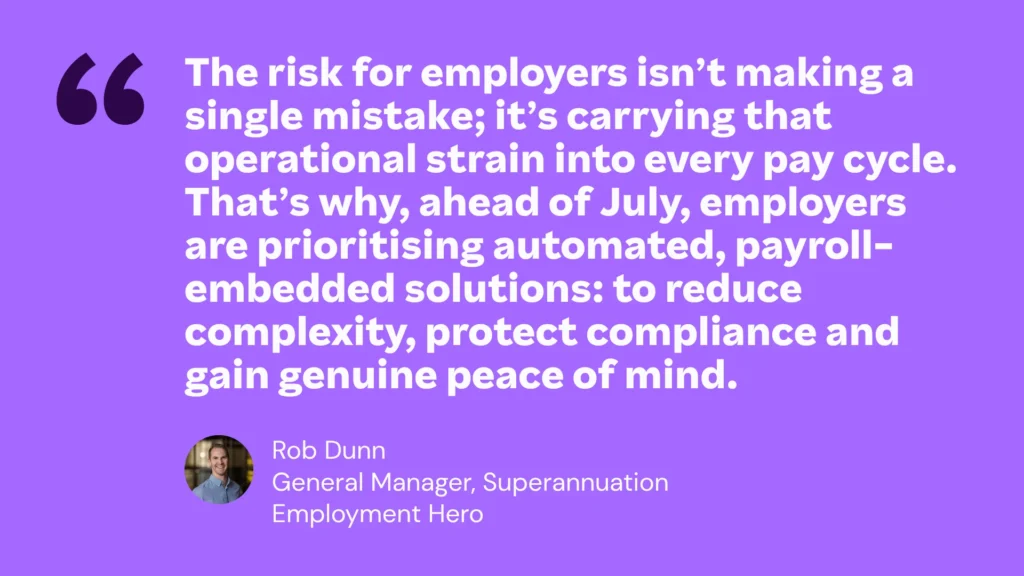
Rob Dunn on Payday Super Readiness in the The Payday Super Shift: 2026 Employer Readiness Report
What to tell your employees about Payday Super
As an employer, it’s expected you’ll get a flood of questions in July. The ATO recommends covering five points in any employee communication:
- Super will now be paid every payday, not every quarter.
- Super will still appear on their payslip.
- It will reach their fund within seven business days of payday, but may not show up in their balance immediately (depending on how often the fund updates).
- The total amount of super they receive does not change.
- They need to keep their contact details current with the ATO, their fund and their employer.
A short pre-1-July email or a payslip note for the first July pay run handles most of this. It’s a small thing that prevents a lot of HR queries.
How Employment Hero’s HeroClear makes the changeover to Payday Super easy
Most of the work, like pay code mapping, member verification, error monitoring, NPP processing and dual-system July sequencing, is exactly what HeroClear is built to handle.
For Employment Hero customers running HeroClear, the changeover looks like this:
- Pay code mapping to Qualifying Earnings is already done. Employment Hero has mapped existing pay codes to QE in line with ATO guidance, so STP reporting switches over automatically on 1 July 2026.
- Member Verification Requests are built in. Employee fund details are verified before each contribution leaves your business, so rejection rates drop sharply and the errors that do occur are caught upfront, not after a payment has bounced.
- NPP-based payment processing. Contributions move on near-real-time rails, giving you the full seven business days as a buffer instead of burning most of it in processing.
- Rejections are surfaced the same day. Errored payments appear in your dashboard immediately, with the reason visible and a clear next step.
- June quarter and first Payday Super payments are sequenced automatically. HeroClear handles the dual-system July without you needing to manage the order yourself.
- STP reporting is updated for QE. Year-to-date QE and super liability fields are reported each payday from 1 July, with no manual configuration required.
The result is that the changeover stops being a project and becomes business as usual. Cash flow is the only thing left for you to plan, everything operational sits in the platform.
Want to learn more about HeroClear? Speak to one of our business specialists today.
FAQS
Yes. Under Payday Super, your super payment frequency matches your payroll frequency. Weekly payroll means weekly super obligations, with contributions needing to reach your employee’s fund within seven business days of each payday.
You need to correct and resubmit the payment within the seven-business-day window. The most common rejection reasons are a wrong USI, ABN mismatch, inactive ESA (for SMSF members) or incorrect contribution amounts. Using a clearing house that supports Member Verification Requests (MVR) helps catch these errors before a payment is sent rather than after.
Yes, the SBSCH closes permanently on 1 July 2026. Download your records from the ATO website before that date and switch to an alternative, Payday Super-ready clearing solution before the June quarter ends.
Ordinary Time Earnings (OTE) is the earnings base used to calculate super before Payday Super. Qualifying Earnings (QE) replaces it from 1 July 2026. QE is largely the same as OTE but adds salary-sacrificed amounts and commissions for work performed outside ordinary hours, which were previously excluded.
Their payslips will look the same and the total super they receive over a year does not change. The only difference they may notice is that super appears in their fund balance more frequently.
The ATO’s Practical Compliance Guideline (PCG 2026/1) sets out a risk-based approach for the first year (1 July 2026 to 30 June 2027). Employers who demonstrate genuine effort and resolve issues promptly may be treated as low risk. The ATO’s first-year approach is designed for good-faith errors, not employers who have not prepared at all.
Yes, Payday Super applies to all eligible employees, including casuals. If a casual employee meets the SG eligibility requirements on a given payday, super must be paid within seven business days of that payday.
The MCB caps the earnings on which you are required to pay SG. Under Payday Super it moves from a quarterly to an annual basis. Check the current MCB figure on the ATO’s website, as it is indexed annually.
Want to know more about Payday Super from the experts?
Employment Hero superannuation experts, Robb Dunn and Tanya Dreup recently hosted two webinars on what employers need to know about Payday Super. You can access the recordings on-demand below.
Part 1: The Payday Super Bill explained: How to prepare for the 1 July deadline
Part 2: Payday Super: Everything you need to know
It was clear that businesses need more information and greater clarity on what Payday Super means for them.
Our experts have gone through some of the top questions you asked in the webinar, to give employers some further confidence leading up to the 1 July deadline.
The basics
From 1 July 2026, employers must pay Superannuation Guarantee (SG) contributions on payday, rather than quarterly. Super must be received by employees’ super funds within seven calendar days of each payday.
The reform is designed to reduce unpaid super (estimated at ~$5.2 billion annually), improve retirement outcomes and help employees see super contributions in real-time.
Payday Super introduces a single, streamlined earnings base called Qualifying Earnings (QE). This replaces the distinction between “OTE for contributions” and “salary & wages for SG Charge calculations.”
QE is largely aligned to today’s OTE, with additions such as salary-sacrificed amounts and payments covered by the extended definition of employee under s 12.
SG is now calculated and tested per payday on QE.
STP reporting changes
Employers will be required to report the following each pay cycle through STP:
- the Qualifying Earnings (QE) amount, and
- the super liability generated for that payday.
This supports earlier detection of missed or late SG and payroll software updates (including Employment Hero Payroll) will surface this automatically when STP changes go live.
Payment timing & deadlines
Under the current legislation, contributions must be received by the fund within seven business days of each payday. This includes weekends and public holidays, so paying on or before payday is recommended.
If it’s an “out-of-cycle” payment (bonus, back pay), super can be paid with the next regular pay run instead of immediately.
You can keep your pay frequency but super for that cycle must still reach the fund within seven days of payday.
You can start making more frequent super contribution payments as soon as you are ready. Employment Hero already has customers who are completing super contribution payments as part of their standard payroll cycle.
Super is considered on time when the employee’s super fund receives and can allocate the contribution within seven business days of the Qualifying Earnings (QE) day.
- The QE day is the day you pay the employee their salary or wages (the actual payment date, not the day you process payroll).
- If you pay employees on the 15th, super for that pay is due (on time) only if the fund has received and allocated it by seven business days after the 15th.
Your payment date alone does not determine compliance — timing depends on when the fund receives and can allocate the contribution.
This distinction is critical because:
- Different payment rails (BPAY, EFT, NPP) settle at different speeds.
- A faster payment method reduces the risk of missing the seven-business-day deadline.
Yes, the legislation provides an extended period of up to 20 business days from the QE day for:
- the first contribution for a new employee, or
- the first contribution to a new super fund for an existing employee.
If the extended period overlaps with subsequent QE days (for example, in a fortnightly payroll), the “bunching” rule applies:
- the later deadline becomes the due date for all overlapping contributions
This rule applies the same way whether employees are:
- paid fully in advance,
- fully in arrears, or
- paid using a combination of both.
If you pay in advance and an employee leaves mid-cycle, you must adjust any overpayment in their final pay.
If an employee leaves mid-month, you must correct their earnings and SG before making the payment. Employers should avoid overpaying SG, as recovery from funds is unlikely once the contribution is allocated.
Funds rarely return contributions already allocated, so employers should aim to correct any overpayment before contributions are sent
Out-of-cycle payments (including late timesheets) create their own QE day. This means they also create their own seven-business-day window for super to be on time.
You may include the correction or late timesheet in your next regular pay only if the fund will still receive and allocate the contribution within the original seven-business-day window for that QE day.
If you cannot meet that timing, you must process the super sooner, otherwise it will be late and may trigger the SG charge.
Clearing houses & processing
Yes, Employment Hero will continue to support the Beam integration and ability to export SuperStream alternative file format (SAFF) extracts for other clearing solutions. Clearing houses are updating their processes in response to Payday Super.
The current legislation states Employers remain responsible. We suggest employers submit payments on payday (or earlier) and keep proof of lodgement.
We are still early building this solution so cannot confirm yet if it will support payments from multiple bank accounts. However, this is very valuable feedback that we will account for in development.
Transition to HeroClear
HeroClear will be simple to enable inside Employment Hero Payroll. Once switched on, super will be processed automatically as part of each pay run. No separate clearing-house portal, bank file upload or manual process required.
To get ready, employers will only need to complete a small amount of one-off setup when opting in:
- Choose a funding method (PayTo, direct debit or bank transfer).
- Configure any necessary bank approvals (e.g. dual authorisers).
After that, HeroClear takes over. It validates employee fund details, initiates payments, tracks fund receipt and manages errors or rejections with real-time visibility, supporting a far more automated Payday Super workflow.
Important note on compliance:
HeroClear will automate a lot of the process, but employers still remain legally responsible for SG compliance.
Super is considered “on time” only when the fund receives and can allocate the contribution within the required window:
- For each payday (QE day): contributions must be received within 7 business days.
- For first-time payments (new employee or new fund): the law provides an extended window of up to 20 business days.
HeroClear’s automation, validation and real-time updates make meeting these deadlines significantly easier, but employers should still monitor pay run accuracy and respond to any alerts that require attention (e.g., missing fund details from an employee).
Under Payday Super, most employers will find it significantly harder to meet the seven-business-day requirement using manual bank payments or separate clearing-house workflows.
Because HeroClear is fully embedded inside Employment Hero Payroll, there is no need for a separate clearing house or bank payment process. Super is validated, paid and tracked automatically as part of the pay run.
HeroClear supports PayTo/NPP, direct debit and bank transfer, with built-in validation, status tracking and audit trails that help employers meet Payday Super timing obligations with far less manual effort.
Small Business Super Clearing House (SBSCH):
The ATO’s SBSCH retires from 1 July 2026 (and was closed to new users from October 2025). Employers currently using the SBSCH will need to transition to an alternative solution before the shutdown.
HeroClear provides an integrated, automated alternative that removes the need for separate uploads, portals or banking steps.
HeroClear is a first-of-its-kind, fully embedded clearing and validation solution built specifically for Payday Super. Unlike traditional batch-based clearing houses, HeroClear:
- Runs directly inside EH Payroll; no uploads, exports or portals.
- Uses faster payment rails (e.g., NPP/PayTo where supported) for quicker fund receipt.
- Delivers digital employee onboarding to validate employee fund details up front (USI/member checks) to prevent rejections.
- Automatically notifies employees when an error occurs that needs them to update their super fund details.
- Provides real-time status updates and automated error resolution.
- Creates an audit-ready record of attempts, rejections and resolutions aligned to ATO expectations.
These features significantly reduce the risk of missing the seven-business-day requirement and lower the admin burden when compared with traditional clearing workflows.
Traditional clearing houses will continue to operate, but they typically rely on slower, batch-based processing and manual workflows that increase the risk of missing the seven-business-day requirement.
You do not need to move unless you choose to. HeroClear simply provides a faster, automated, more accurate and more compliant alternative by being directly integrated inside Employment Hero Payroll.
No, customers will not be automatically moved.
You can choose to stay with your existing clearing solution if it continues to meet your needs and complies with Payday Super requirements.
HeroClear simply provides a faster, more accurate alternative by:
- Removing manual steps
- Reducing errors and rejections
- Providing a single payroll-based workflow
- Offering clearer visibility into fund receipt
Businesses that want stronger compliance protection and reduced admin under Payday Super may choose to switch, but migration is optional.
HeroClear will support a range of modern, compliant payment methods designed for fast settlement and real-time visibility under Payday Super:
Supported payment methods
- PayTo (real-time pull) – preferred method where available, providing fast settlement and real-time confirmation.
- Direct debit (batch pull) – initiated in Employment Hero Payroll with approvals handled through your bank.
- Bank transfer via NPP (real-time push) – supported with workflows designed to accommodate dual-authoriser accounts.
These flows are built so that approvals and authorisation work end-to-end without requiring separate clearing-house portals.
Manual payments
In exceptional circumstances, contributions can be marked as manually paid with an audit trail.
However, manual workflows increase the risk of breaching the seven-business-day rule and should only be used where absolutely necessary.
BPAY and other legacy methods
BPAY may still be available to some funds, but it is not recommended as the primary method under Payday Super because:
- BPAY settlement times are slower
- BPAY does not provide real-time confirmation
- SuperStream v3 and the new Payday Super ecosystem are shifting toward NPP/PayTo-based payments with better error messaging and faster allocation
Where possible, employers should transition to faster rails to reduce timing and compliance risks.
Debit/credit card payments
Employment Hero is considering support for debit/credit card payments for SG contributions where aligned with customer needs. More information will be provided if this becomes available.
HeroClear is designed to work seamlessly with businesses that require two or more approvers for payments. The dual-authorisation process will differ depending on the payment method you choose:
1. Pull payment methods (NPP PayTo or Direct Debit)
Dual authorisation is captured upfront when the PayTo or direct debit mandate is established during HeroClear onboarding. Once authorised, no ongoing manual approval is required for each pay run, unless your bank imposes additional internal controls.
2. Push payment methods (PayID or PayAnyone bank transfer)
Dual authorisation occurs within your bank, exactly as it does today. When a pay run is finalised, the payment instruction will appear in your bank’s approval queue (internet banking or mobile) and the required approvers must authorise it before the payment is released.
Additional controls inside Employment Hero
Employment Hero Payroll will also introduce an optional Payment Approver action for HeroClear payment processing. This allows you to maintain internal payment approval workflows in addition to your bank’s dual-authoriser process.
Why this works well under Payday Super
- It ensures no change to existing bank security controls or signatory rules
- HeroClear ensures end-to-end traceability, even though the bank handles the approvals
- Faster rails (PayTo/NPP) still support dual authorisation in banks that allow multi-party approval on NPP-initiated payments
- Employers meet Payday Super timing without compromising their internal governance processes
Yes. HeroClear is being designed to help employers stay compliant by validating super details before money moves. This includes:
- Fund and USI validation: HeroClear checks the fund, USI, member details and bank routing information where available to prevent rejections.
- Member Verification Requests (MVRs): As funds and gateways adopt new verification services, HeroClear will connect to them, enabling upfront checks that reduce the chance of payments being rejected or refunded after submission.
- Fund mergers and product changes: HeroClear will surface updated fund information and prompt employers to refresh employee details when a fund changes USIs, products or merger details.
HeroClear’s logs and audit trail (attempted dates, payments, rejections and resolutions) help employers demonstrate reasonable steps were taken. This is important if the ATO reviews a case under the Payday Super regime
Errors, bounced payments & fund mergers
It is the employer’s responsibility to re-submit to the correct fund as soon as you have the new details. It is best to keep records; the ATO has limited discretion where the delay is beyond your control.
Yes. Funds must notify employers and the ATO at least 2–4 weeks in advance. There will be improved notifications in the event of fund closure or merger.
Fund mergers and product changes are becoming more frequent across the industry. When a fund merges, its USI, product identifier, ESA or bank details may change. Contributions sent using old details may be rejected until the new information is updated.
HeroClear is designed to help manage these transitions by:
- checking employee fund and member details before payment
- receiving updated registry data from funds as part of validation
- alerting employers when details need updating
- reducing the risk of returned contributions during merger periods
Once updated, HeroClear guides re-submission so you can stay within, or as close as possible to, the required timeframes.
A payment is only “on time” if it is received and allocatable by the fund. If a fund rejects a payment (e.g., wrong USI or invalid member number), it is considered unpaid, and you must resubmit promptly to stay within the 7-day window.
Cash flow & business impact
Moving from quarterly payments to contributions every pay cycle creates a cash-flow pull-forward. Instead of holding super for up to 3 months, employers will need to fund super at each payday.
For many SMBs, our internal analysis indicates an average cash-flow impact in the order of ~$124,000 per year when shifting from quarterly to per-pay-cycle contributions (actual impact varies by workforce size, pay frequency and industry).
To understand your specific position, use the Employment Hero Payday Super Cash-Flow Impact Calculator to model your upcoming payroll cycles.
Practical planning steps
- Model early and phase in changes: For example, move from quarterly → monthly → every pay cycle as you adjust.
- Align billing and revenue cycles with payroll: where possible, this helps smooth out cash timing differences.
- Review working-capital options: Seek professional advice if you expect short-term cash-flow pressure during the transition.
- Use an embedded clearing solution (e.g. HeroClear): This helps avoid operational slippage or late payments, which under Payday Super may create SG Charge exposure.
The current draft legislation does not include any concessions. The new rules apply to all employers, regardless of size. However, Employment Hero has been advocating with the government for a phased roll out, to better support small businesses through the transition.
To date, we have not heard any consideration for cashflow assistance measures for business during the transition period.
Compliance & penalties
We have not received exact details of how this will happen and understand this remains under consideration. However, the ATO does have the ability to match STP payroll data (when wages are paid) with fund data (when super is received) via SuperStream. If there’s a mismatch, employers may face the Superannuation Guarantee (SG) charge.
If contributions aren’t received within seven days of payday, employers incur an SG shortfall, plus interest and penalties (up to 60% of the shortfall).
The ATO does. They will raise the SG charge if payments are late or missing, based on STP and fund data. It is not handled through your clearing house.
Employers must lodge a Superannuation Guarantee (SG) statement with the ATO when super is missed or underpaid. The ATO provides an online SG statement form through the Business Portal/Online Services for Business.
The 7-business-day rule applies to all employers, regardless of size. There are no statutory carve-outs for small, micro or seasonal businesses, even during shutdowns or staff leave periods.
Practical ways to manage this
- Schedule pay runs ahead of known shutdowns: Run payroll early (including SG) before public holidays, seasonal closures or extended leave periods. Make sure bank authorities and dual-approvers are in place ahead of time
- Use embedded, automated clearing: Tools like HeroClear will allow super to flow as part of each pay run, reducing reliance on a single payroll person and lowering the chance of delays.
- Have clear delegation or backup arrangements: Set up temporary payroll approvers or bank signatories before the shutdown so critical actions aren’t blocked.
- Don’t rely on the ATO’s first-year leniency: The ATO’s Draft PCG provides a risk-based approach (focusing on repeated or high-risk non-compliance), but employers should still design processes that consistently meet the 7-business-day rule.
Employers must take reasonable steps to collect accurate super details from employees, but they are not expected to verify everything manually.
If an employee does not provide fund details, employers must request the employee’s stapled fund through the ATO Online Services or use a compliant default fund where allowed under ATO rules. HeroClear digital onboarding services automate these activities for employers as part of the employee super choice process during onboarding.
If an employee provides incorrect super information, the employer is still responsible for ensuring the contribution reaches the fund. Under Payday Super, contributions that are rejected because of incorrect details may fall outside the 7-business-day window (or 20 days for newly onboarded employees or change of funds events), creating an SG shortfall if not corrected quickly.
HeroClear reduces this risk by performing data validation before money moves and alerting the employer when details need to be updated. Employers must still correct the information, but HeroClear helps them demonstrate that they took reasonable steps to stay compliant.
Under Payday Super, if contributions are not received by the fund within 7 business days of each QE day, the employer may have an SG shortfall and become liable for the Super Guarantee Charge (SGC).
The SGC has been recalibrated under the new law and can be materially higher than under the old quarterly model.
What’s included in the new SGC?
The SGC for each affected QE day includes:
- Individual final SG shortfalls: What should have been paid, still outstanding at assessment time.
- Notional earnings: A daily compounding interest amount (based on the GIC rate) applied to unpaid or late SG.
- Administrative uplift (default 60%): A surcharge applied to the total of shortfalls + notional earnings.
This uplift is new and significantly increases the cost of non-compliance compared with quarterly rules. - Choice loading (if applicable): An additional amount where the employer has not complied with choice-of-fund obligations (such as not paying to the fund the employee selected).
- Late payment penalty: This may apply if the assessed SGC is not paid after the ATO issues a notice.
Why is the new SGC more expensive?
The new framework is designed to strongly incentivise on-time contributions for each payday. The combination of:
- daily compounding notional earnings,
- the administrative uplift, and
- loss of late payment offset (no longer available for post-assessment contributions) means that even short delays can result in higher liabilities than employers experienced under the previous quarterly model.
How the administrative uplift can be reduced
The default 60% uplift can be lowered if the employer meets specific criteria:
- Reduced to 40% if the employer has not had a Commissioner-initiated SGC assessment in the past 24 months.
- Reduced further (potentially to 0%) depending on how quickly the employer lodges a voluntary disclosure statement before the ATO issues an assessment.
Tax deductibility
The ATO has indicated that under the new framework, the SGC will be tax-deductible, aligning tax treatment with paying employees’ super directly.
Special cases
This would primarily depend on the contractual agreement. If a contractor is deemed an “employee” for SG purposes (paid mainly for their labour), Payday Super rules apply. Super is due within seven days of the payday (when you pay them), not the invoice date. We recommend employers carefully review contractor agreements and seek legal advice as required.
If you pay a contractor outside Employment Hero Payroll, but the contractor is deemed an employee for SG purposes (e.g., labour-only contractors under s 12(3)):
- The QE day is still the day you pay them, even if the payment doesn’t occur through EH Payroll.
- You must still ensure contributions are made and received by their super fund within 7 business days.
- Employers remain responsible for entering the payment and super details accurately so SG obligations can be calculated and tracked.
If super is processed outside the platform, Employment Hero cannot automatically track whether contributions meet the 7-business-day requirement, and employers must manage timing and compliance manually.
You must request their choice. If not provided, the ATO will supply their stapled fund. Employers cannot delay payments waiting for employee information and should revert to the employees’ stapled fund or the employer default fund as needed. Also, for new employees, employers have 21 days to submit the super contribution after the first QE day. If the next QE day is within 14 days, it is still due within 21 days of the first QE day.
Yes. The Payday Super rules apply to all employers, including charities and NFPs.
For contractors deemed employees for SG purposes (e.g., labor-only), the QE day is the day you pay their invoice. The standard 7-business-day receipt rule applies from that payment date.
Directors & closely-held employees
Where directors or closely-held employees receive payments that fall within the QE definition (wages, fees, bonuses, allowances, etc.):
- the QE day is the day the payment is made, and
- the standard 7-business-day rule applies.
Sole traders without employees
Sole traders paying themselves are not employees for SG purposes, so Payday Super does not require SG contributions. However, they may choose to make personal concessional contributions (which fall outside the Payday Super timing rules). Independent tax advice is recommended.
If an employee has a Self-Managed Superannuation Fund (SMSF) and is eligible for SG, they follow the same Payday Super rules as any other fund:
- The QE day is when the employee is paid.
- Super contributions must be received and allocatable by the SMSF within 7 business days of the QE day.
To prevent delays, employers must ensure they have accurate SMSF details, including:
- the SMSF bank account
- electronic service address (ESA)
- fund ABN and member number
End of ATO’s Small Business Super Clearing House (SBSCH)
The Small Business Super Clearing House will close to new users from October 2025 and shut down completely by June 2026. Businesses must switch to an alternative clearing solution.
The SBSCH stopped accepting new business registrations in October 2025 and will close entirely on 30 June 2026. Current users must transition to an alternative solution before the shutdown.
Tax deductibility & EOFY timing
The fund must receive the payment by 30 June. Pay early, check provider cut-off dates and use faster payment options like NPP to avoid missing deadlines.
No, the ATO has indicated that under the new framework, the SGC will not be tax-deductible. The actual super contributions may be tax deductible, but any related SGC will not be.
Contribution caps & overpayments
There is a risk, as in some cases the timing may result in 13 contributions in a year. The Treasury was provided this feedback during industry commentary on the draft legislation. If this event were to transpire, we recommend employers flag this with affected employees as early as possible.
Super contributions generally cannot be refunded to the employer once allocated. Overpayments stay in the employee’s account. This is why it is important to use an integrated payroll system to help with the accurate calculation and payment of super contributions.
You must correct their earnings and SG before making the final payment. Recovering SG from a fund once it is allocated is extremely difficult, so employers should aim to correct errors before contributions are sent.
Many funds treat overpaid SG as additional contributions rather than issuing refunds. Refunds are generally limited to clear administrative errors, so it is vital to aim for correction before contributions are sent.
Maximum Contributions Base (MCB)
The MCB moves from a quarterly cap to an annual cap under Payday Super. Key points:
- The cap is applied across all QE days for the year, per employer.
- Payroll will need to apply this across the year.
- Complex remuneration structures; e.g., large bonuses, multiple employers, heavy salary sacrifice, may require independent advice.
Employees previously considered “super capped” on a quarterly basis will now be monitored against the annual MCB instead
Disclaimer: The information in this article is current as of 30th September 2025, and has been prepared by Employment Hero Pty Ltd (ABN 11 160 047 709) and its related bodies corporate (Employment Hero). The views expressed in this article are general information only, are provided in good faith to assist employers and their employees, and should not be relied on as professional advice. The Information is based on data supplied by third parties. While such data is believed to be accurate, it has not been independently verified and no warranties are given that it is complete, accurate, up to date or fit for the purpose for which it is required. Employment Hero does not accept responsibility for any inaccuracy in such data and is not liable for any loss or damages arising either directly or indirectly as a result of reliance on, use of or inability to use any information provided in this article. You should undertake your own research and to seek professional advice before making any decisions or relying on the information in this article.
Related Resources
-

Read more: Employer guide: appointing Employment Hero as your Digital Service Provider (DSP) ahead of the 1 July deadlineEmployer guide: appointing Employment Hero as your Digital Service Provider (DSP) ahead of the 1 July deadline
From 1 July 2026, super stapling rules change how new employees choose their fund. Here’s the one step you need…
-
Read more: Residential Support Worker Job Description: Duties, Skills & ResponsibilitiesResidential Support Worker Job Description: Duties, Skills & Responsibilities
Access a free residential support worker job description detailing key duties, skills, salary expectations and responsibilities. Ready to customise and…
-
Read more: Disability support worker job description: Duties, skills and responsibilitiesDisability support worker job description: Duties, skills and responsibilities
Access a free disability support worker job description detailing key duties, skills, salary expectations and more.