 New Zealand
  United Kingdom
  Singapore
  Malaysia
  Canada (Français)
 Australia

The Australian AI paradox: How workers really feel

Contents
Something unusual is happening in Australian workplaces right now.
Workers here are getting more out of AI. They’re more productive, building more valuable skills and redirecting time they saved into higher-value work at rates that outpace counterparts in other markets like the UK, Canada and New Zealand. Yet, 45% of Australian employees feel like AI is making them replaceable, the highest anxiety reading of any market in our recent research.
Australia sits at the sharp end of what we’ve called the AI paradox. This is a workforce thriving with AI, while simultaneously bracing for the threat of it.
For employers, the distance between AI and fear is one of the most consequential things currently happening in the Australian labour market. How you respond to it will be the difference between whether you keep the people who are making AI work for your business or if you hand them over to someone who will.
How do we know this? We surveyed 3,290 business leaders and 5,454 workers across Australia, Canada, New Zealand and the UK, conducted with Focaldata between 23 April and 7 May 2026, with an Australian sample of 1,008 business leaders and 1,634 employed adults aged 18+. These findings are created from a regionalised data set of the Employment Hero AI Paradox at Work (2026).
What the data shows
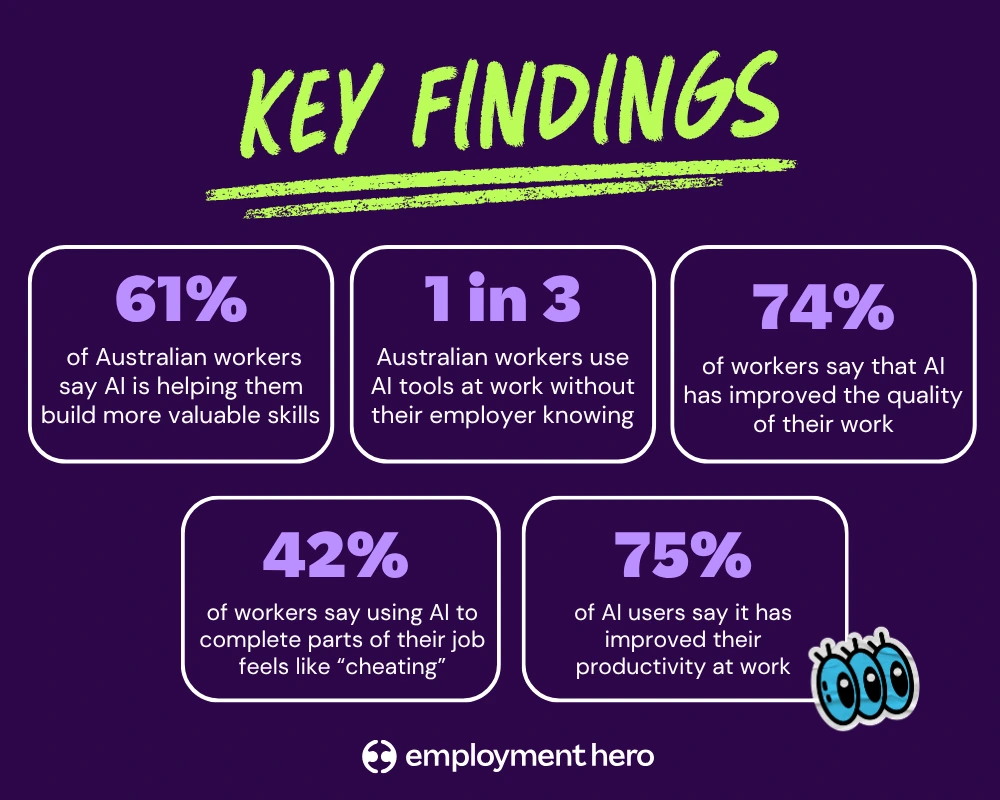
- 61% of Australian workers say AI is helping them build more valuable skills
- 1 in 3 (34%) Australian workers use AI tools at work without their employer knowing
- 42% of workers say using AI to complete parts of their job feels like “cheating”
- 74% say AI has improved the quality of their work
- 75% of AI users say it has improved their productivity at work.
The productivity gains are high, but so is AI anxiety
75% of Australian workers report an improvement in productivity. That puts Australia ahead of the UK (a market with more AI maturity), where the equivalent figure is 69%. The impact goes deeper than productivity alone. While time saved is one measure, 74% of Australian AI users say it has improved the quality of their work.
These aren’t just aspirational figures. They show what’s already happening in Australian businesses. Some of that saved time does go into more of the same tasks, with 22% of Australian AI users reporting this. But a slightly higher share, 29%, say the time saved gets redirected into strategic or creative work.
The conversation about AI replacing human judgement misses what the data shows, which is that a significant portion of the Australian workforce is already using AI to work at a higher level.
So why does 45% of that same workforce feel replaceable?
Part of the answer is that the productivity gains are happening faster than the cultural shift needed to make sense of them. Workers are succeeding with AI before organisations have built the frameworks to normalise that success. The reality is, the absence of clear guidance around this relatively new world of work means that job anxiety has the power to creep in.
The shadow AI problem is a trust problem
1 in 3 Australian workers (34%) use AI tools at work without their employer knowing.
44% of businesses report that staff are using personal AI accounts on the job.
When workers hide how they’re doing their jobs, something has gone wrong in the employer-employee relationship around AI.
The fact that 42% of Australian workers say using AI to complete parts of their job feels like “cheating” makes this even more instructive.
Nearly half the workforce is using a tool that demonstrably improves their output, but feels guilty about it.
We can assume that this moral ambiguity comes from an environment where AI use has never been explicitly endorsed, where no norms have been set and where the implicit message is that good work means doing it the old way.
But there’s something deeper underneath that. For a long time, the value of work has been measured by effort, where the focus is on hours logged, tasks done by hand and overall visibility. AI breaks that equation. When a task that used to take a day now takes ten minutes, the link between effort and worth gets called into question. Employers who haven’t addressed this directly are, by default, teaching their teams that AI is something to hide, not something that should be encouraged.
The downstream cost of that view is a huge data governance risk and the corrosion of psychological safety at a moment when workers need it most.
Your workers found their own AI trainer… TikTok
51% of Australian workers report gaining AI skills through social media platforms. That figure deserves more attention than it usually gets.
This shows that there’s a clear capability gap that many businesses have not yet decided to own. When more than half your workforce is turning to TikTok and YouTube to learn tools they use on the job, the training infrastructure inside most businesses is not keeping pace with how fast AI is changing what great work looks like.
The responsibility question is telling. Only 22% of workers firmly see AI upskilling as the employer’s job and 31% say it sits squarely with them as individuals. That split might look like a workforce comfortable with self-direction, but it also signals that many workers may have already stopped expecting their employer to show up on this. They’ve made their peace with figuring it out alone.
The cohort driving the strongest AI skills sentiment is the 35-44 age group, mid-career professionals with enough experience to see clearly what AI can do for their job trajectory. They’re using AI strategically, to extend their value and stay relevant through a period of labour market uncertainty.
61% of Australian workers overall say AI is helping them develop more valuable skills, which is the highest reading of any region in the study. The motivation to grow with AI is not the problem.
What that motivation is running into is a hiring market that is starting to formalise AI competency as a baseline expectation. 30% of Australian employers now cite AI skills in entry-level hiring criteria. Nearly 1 in 5 (18%) call AI skills essential, with a further 36% calling them advantageous. The standard is being set externally, through hiring, before it has been set internally through development.
The order in which this is happening is an interesting one to understand. Businesses that define AI capability at the point of hiring but not at the point of employment are building a two-tier workforce. New hires arrive AI-ready, while existing employees are left behind on AI competency. The employers who reduce the AI literacy gap deliberately, with structured pathways and clear expectations, are the ones who will retain their best people.
Companies with AI deeply embedded are growing entry-level headcount at twice the rate of non-adopters
Here’s the finding that goes against almost every assumption about AI and jobs. Businesses with AI deeply embedded in their processes are growing entry-level headcount at more than twice the rate of those with low adoption.
This runs against the dominant narrative that AI adoption slashes jobs. What it suggests instead is that businesses confident enough in AI to properly integrate it are confident enough to grow. AI is expanding what these businesses can take on and it’s paying off in headcount.
For employers still treating AI adoption as a risk to manage instead of a capability to build, this is the finding that should force a rethink. The businesses that are most aggressively embedding AI are the ones hiring, even as the old style of entry-level, data-entry job starts to look a little different. The junior role isn’t disappearing, but it is changing shape.
What employers need to do with this
The AI paradox in Australia right now won’t close on its own. When workers are performing at their best while simultaneously feeling anxious, there’s a much bigger problem brewing. Here is what to do now to turn it around.
Name AI use explicitly
If your workers are hiding how they work, you’ve not given them permission to do otherwise. The businesses where AI becomes a competitive advantage are the ones where using it well is celebrated, not concealed.
Build the internal pathway that social media currently fills
Workers are building AI skills on their own because they have to. Employers who formalise that development, with structured learning, clear expectations and visibility into what good AI use looks like in your specific context, create a retention advantage that’s hard to replicate.
Take the AI anxiety seriously enough to address it
When 45% of your workforce believes AI is making them replaceable, that’s a huge issue. Leaders who communicate directly, with specifics about how AI is changing roles and what the business is investing in, are the ones most likely to keep their best people, not just present, but engaged, taking ownership and caring about their work.
The Australian workforce is already ahead of most markets in what it’s achieving with AI. The question for employers is whether they’re going to lead with it or catch up to it.
The golden window of AI opportunity is open, but it won’t stay that way for long
The data from this research is unambiguous on one thing.
The businesses pulling ahead are the ones that have made a deliberate decision to embed AI as a core part of how work gets done.
They are growing their teams faster, tapping into more strategic output from their people and building the kind of institutional AI capability that only gets better over time.
What’s required now is not a technology investment. The tools are already there and your team is already using them, often without being asked. One of the most helpful things leadership can offer is a clear signal that AI has a legitimate, valued place in how the business works, and that the goal is to maximise what your people can do with it, not to replace what they do. It can start small and doesn’t need to be perfect from day one. Introduce ways of working that replace guilt around AI with a sense of empowerment and with a conversation that clearly shows where the business is heading and why AI is part of that path forward.
The employers who do that will find they have a workforce that is ready, capable and motivated to make it work. The appetite for using AI is there, the skills are growing and so too are the productivity gains.
The only question left is whether your business is going to be the place where employee potential is realised or the place people leave to realise it somewhere else.
Employment Hero is built for businesses that have already decided to take the lead. Our Employment Operating System brings HR, payroll and recruitment into an AI-powered system, handling compliance, automating pay runs and surfacing the workforce insights that HR teams need to make faster, better decisions.
Want to learn more? Get in touch with one of our business specialists today.
Related Resources
-
 Read more: What’s new at Employment Hero: Here’s our 2026 product recap
What’s new at Employment Hero: Here’s our 2026 product recap
Explore Employment Hero’s 2026 product updates: Hero AI, Recruitment Agent, HeroClear, Payroll Agent, HeroForce and Chat, built to make employment…
-
 Read more: Changes to Junior Pay Rates in Retail, Fast Food and Pharmacy Awards from 1 December 2026
Changes to Junior Pay Rates in Retail, Fast Food and Pharmacy Awards from 1 December 2026
Junior pay rates for 18, 19 and 20 year olds in retail, fast food and pharmacy are changing. Here’s what’s…
-
 Read more: Build on Employment Hero’s HR API and get more out of every client relationship
Build on Employment Hero’s HR API and get more out of every client relationship
Learn how developers, consultants and software vendors build on Employment Hero’s HR API and earn recurring revenue through the Referral…


