New Zealand
 United Kingdom
 Singapore
 Malaysia
 Canada (Français)

 Australia





Video transcript
Minimise
We will get into it there.
So welcome to another employment hero masterclass where we're breaking down some complicated entitlements and obligations under the Fair Work Act into more easily digestible information. My name is Amy. I'm one of the HR advisory team leads, and I'm not presenting solo today either. I'm joined by my colleague, Candice, another one of our HR advisory team leads.
Candice will be sharing some really practical tips today in detail with you throughout the session. Candice, I'll hand it over to you to introduce yourself.
Thanks so much, Amy, and hi, everyone. As mentioned, I'm Candace, and I'm one of the HR advisory team leaders here too.
Before we dive in, just a quick bit of housekeeping. We've set the session up so that we'll cover all of the contents first, and then we've reserved the final ten minutes of the hour purely for your questions. So if something comes to mind while we're talking, please pop it in the q and a box. Amy and I will do our best to get through as many as we can along with Tim from the advisory team. And anything we don't get to, we'll follow-up on after the webinar.
We are recording today's session, so we'll send out the recording and slides once we've wrapped up. So please don't worry about capturing every detail as we go.
And if anything today makes you think I could use a hand with this in my own business, we'll share our contact details at the end so you can reach out to our team directly.
And last thing before we dive in, everything we're sharing today reflects the law as it stands right now. But it's general information only, not legal or professional advice for your specific situation.
These pay mistake scenarios can get quite complicated fast, and not every scenario will be black and white. So if what you're dealing with doesn't feel like a clean fit for what we talk about, that's exactly the kind of thing worth getting specific advice on.
Alright. So let's get into it.
Payroll errors are one of the most common Fair Work risks we see businesses run into, and how quickly and how correctly you fix them makes all the difference.
So today, we're going to be walking you through the practical and compliance side of managing overpayments, back pay, overtime, and the record keeping you're required to have in place.
Let's start with what the legislation actually means for your business and the tools you can walk away with today to help you stay compliant.
If you've been in business for a while, some of this framework might already be familiar to you. But if you're after a refresher or a bit more detail, this bit's for you.
When you're employing people in Australia, it's really important to understand the core legislative framework governing your workplace.
Your compliance obligations mainly come from three places, the Fair Work Act two thousand and nine, the National Employment Standards, also known as the NES, and the modern award or enterprise agreement, if that's applicable to your industry or workplace.
Together, these three form the foundation for engaging your team lawfully and managing their entitlements properly.
We always encourage our clients to think of this framework less as a rigid rule book and more as a genuinely useful baseline. It's a clear compliance starting point whether you're new to employment law in Australia or you just need a bit of clarity in a gray area.
Throughout today, Amy and I will be walking you through legislative requirements that typically apply to each of the areas we flagged for you.
Now here's one thing we'd like all employers to bear in mind, and that's be really careful with how you apply a modern award or the legislation in your business.
There might be the odd exceptions here and there, but breaching the legal framework directly just isn't worth it.
Why? Well, because time and time again, we see it cost employers far more in time and money defending their position than it would have just cost to stick to the rules, or better yet, get advice on a compliant way to reach the same goal. Now that's exactly what we're here for, so please don't hesitate to give us a call or send us an email.
Now failing to comply with workplace legislation carries some serious legal and financial consequences.
Depending on what's been breached, employers can be looking at civil litigation, which means being taken before the Fair Work Commission, the federal court, and so on. And that's before you even factor in legal fees, which can run extremely high regardless of which way the case goes.
Then there's substantial civil penalties, which is fines that can easily run into the hundreds of thousands of dollars.
Then there's criminal sanctions. Under the new federal wage theft laws, intentionally underpaying staff can now mean criminal convictions and jail time for company directors.
None of us want to see a business owner end up in that position, and that's exactly why having a clear proactive understanding of your dos and don'ts is so critical.
It's going to protect your company, and then it also protects you and your leadership team personally.
And these obligations show up in very practical ways. So for example, a modern award might require you to pay overtime once someone works beyond their ordinary roster hours or where they work more than eight hours in one day, let's say.
Most businesses genuinely want to pay overtime correctly, but it's not always easy. The awards can be genuinely tricky to interpret, and that's exactly where we see a lot of employers slip up.
So one of the biggest mistakes we see businesses make is around overtime.
I'll hand it over to Amy now to talk you through what those mistakes actually look like and how to avoid and fix them.
Thanks, Candice. Yeah. We're now gonna discuss how implied overtime works and what authorization of work could look like. Now, normally, overtime becomes payable when an employer actually requires or request an employee to work those extra hours, and that's the really straightforward scenario. But what about when a business doesn't explicitly ask for it and the employee works those extra hours anyway with the employee's knowledge?
That can still count as the employer requiring the overtime, and so that it attracts overtime pay.
And I'll one of the really common questions we get asked time to time again is if we didn't approve the overtime, do we still have to pay it? And we find that the answer is often yes.
So it's really, really important to show that you have you have directly told the employees they cannot work this overtime or and structuring their role to make sure that they are not in breach of some potential overtime entitlements there.
So one important thing to really keep in mind is that overtime doesn't actually need formal sign off to become payable.
One of the recent Australian court decisions, like the federal court case involving the junior doctors, made it really clear that courts recognize the idea of implied authorization.
This can happen even if your business has a strict policy stating that overtime must be preapproved in writing. So we look at how overtime becomes implied in practice, and it usually comes down to two simple things.
So knowledge plus acceptance.
Knowledge is that the business knew or should have reasonably known that the employee was working extra hours.
For example, if the workloads are really physical and impossible to finish in normal hours, or if you are a manager and you're routinely seeing late night emails, the other thing to be aware of is acceptance. So is this this is when their business is business is benefiting from the work, and it didn't take reasonable steps to stop it from happening or disapprove the overtime.
When these two things are present, the law may treat that overtime is authorized regardless of whether you have a written policy saying that you can't work overtime without it being authorized.
So, again, the courts have a few three a few trigger points for when overtime could be authorized even if you have that policy in place.
This is observation. So management is actually seeing employees work past their ordinary hours. Again, that acceptance. Are you accepting the benefit and the output produced during those extra hours?
And then they also look at workload expectations, which is management setting deadlines or workloads that simply cannot be completed during during those normal work hours. So if any of those factors exist, it's really difficult for a business to claim that overtime was unauthorized, especially if the businesses businesses continuing to benefit from that overtime that they're doing.
A really good case example from this was the Australian Salaried Medical Officers Federation versus Peninsula Health, so the junior doctor's case.
It was a class action bought on behalf of junior doctors who were routinely working on rostered hours without being paid overtime.
The hospital's EBA stated that overtime was only payable if the extra hours were authorized. And the core issue for the court was whether that authorization had to be formally approved through a specific request form or whether it could be simply implied through the reality of daily workload and management expectations.
So in this case, the junior doctors were regularly staying back after their shifts to complete those essential duties.
If you're thinking about doctors, they're doing preparing for ward rounds. They're finishing their handovers. They're updating patient records, and they're making sure that patient care's maintained before they actually leave a shift and making sure that handover's all good to go.
And the court actually found that these tasks weren't optional tasks and they were necessary parts of the job. So the Peninsula Health Organization actually argued that overtime hadn't been approved through its formal internal process, and therefore, they said it didn't have to be paid.
And the court disagreed. They found that the enterprise agreement didn't say that approval had to be formal. So authorization could have been implied, and if the employee knew about it and reasonably knew about it, the employees were obviously also working those regular extra hours that they the court ruled in the employee's favor, and they were compensated for all of that overtime that they worked.
So the takeaway for your business is that you need to actively be monitoring the hours your employees are working. If staff are regularly staying back and business know about it and you should know about it, it can become really difficult to overtime that to argue that overtime wasn't authorized. And if you are becoming aware that your employees are working overtime, you need to actively start to direct employees to stop working those overtime hours to to reduce your risk in any underpayments there.
We looked at another common case around this one as well that shows that implied authorization can equal overtime entitlements even if you don't have a policy in place. And a myth that we kind of always hear to further detail that is that our clients often say to us, but they signed a contract and they agreed to those hours, so we shouldn't have to pay them all. And from a compliance standpoint, this doesn't really hold up, and a really good case from this is the AMU verse Dickinson case.
In that decision, the federal court confirmed that businesses cannot contract out of meet minimum legal obligations.
So even if an employee willingly signs an agreement to extend hours and work overtime, say, if they agree to a fifty hour work week, The protections under the Fair Work Act override those contract terms every single time.
And as we covered earlier, courts have held time and a time again that overtime can be implied authorized.
And this is really, like we mentioned, if management is routinely accepting it, acknowledging, and benefiting from work done outside of the ordinary hours without stepping in to stop it, this is when the law considers that overtime to be authorized.
Another really key factor is to look at what ordinary hours are and what overtime hours are under the Fair Work Act. So this brings us to section sixty two of the Fair Work Act, which sets out some limits around how many hours an employee can work per week and when overtime is required.
The maximum weekly limit for a full time employee is thirty eight hours. Anything requested or required beyond thirty eight hours is reasonable additional hours and goes into overtime.
And the law has some balancing benchmarks to show what is actually reasonable overtime.
So a few of these are health and safety risks. So what is the physical or mental fatigue the physical or mental fatigue and the toll on the worker? Their personal circumstances as well. So what are the employees, family, or caregiving responsibilities outside of work? Are they having to pick up their kids from school, drop them off, take them to appointments?
Then there's the operational needs that you'll need to review. So is there a genuine short term business need, or is it just systematic on the staffing?
They'll also review compensation. So is the employee actually being paid overtime or penalty rates for those extra hours? That could be done through a like, an offset clause or through their contract, but you'd have to be very detailed about how that's worded.
Then you also look at industry norms as well. So what's the standard practice for that specific role in that sector?
So as we mentioned before, one of the the really good cases to highlight, this is the **** and Stone case, and the court will work worked through exactly what those factors meant. And in this case, it was where a meat worker was required to work a fifty hour work week.
There was no real evidence of the industry practice that justified it. **** and Stone couldn't show that it was standard across the sector, and they were trying to push that fifty hours was really normal in that industry when it turned out not to be.
So the the respondent's personal circumstances really counted heavily in this case too. He was a recent immigrant and only weeks into life in Australia with no real understanding of award entitlements when he signed onto those hours.
And weighing up all of that, the court found that the extra twelve hours a week was was unreasonable, and **** and Stone was fined up to thirty thousand dollars for it.
So, again, one of the big takeaways here is that businesses can unintentionally absorb a lot of risk to themselves if you don't have, like, a clear policy in place or a process for managing that over time. And as we said, even if a business has a policy in place, you still need to be enforcing it. So you still need to be reminding employees, you can't be working this overtime. We need to make sure that it's reasonable for you and it's safe for you, and you can't just rely on a culture of unrecorded systematic overtime to keep things running.
It's a really big risk for the business.
So yeah. To kind of further detail that and show how policies alone are not enough and that you need to you need to enforce them is that relying on a no approval, no pay policy is isn't gonna protect you. And while many businesses rely on internal policies that must be preapproved in both of the cases we've just spoken about, Those those just do not override the fair work obligations around overtime there.
We do know, on the other hand, that a business may still enforce its policy and that overtime is not to be paid. So we have come across cases where it is the employees working overtime and the business has been directing them to not work it. And in those cases, the business hasn't been obligated to pay that overtime.
But, again, it's very, very important that you have shown steps as a business to say, I haven't directed them to your overtime. I'm not benefiting from them doing anything overtime, and we have a great policy in place that we enforce regularly.
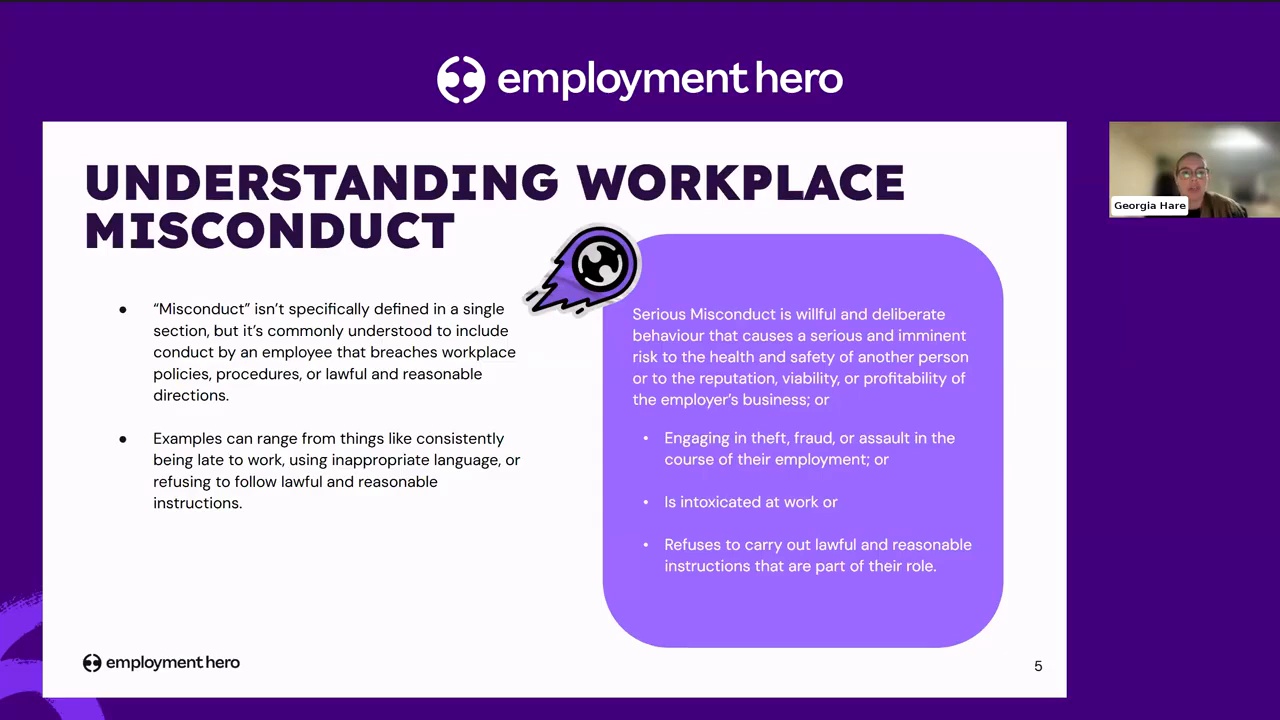
If an employee is regularly doing overtime and you haven't approved it and they're asking for it and you keep saying, no. We don't want you to do that overtime, that would likely be a breach of your policy. And you can actually take a disciplinary process for that because that could constitute misconduct or it could constitute underperformance. And then we can go through routes to show that there has been a policy breach, and that could result in a warning up until termination depending on how severe the breaches are.
We also just wanted to finally touch on a really, really critical part that these cases highlight, and that is the workload design. So courts are looking really closely at how work is structured at the moment and whether the employer is setting expectations or deadlines that make the overtime virtually inevitable.
So, again, we looked at the Peninsula Health Health case where the hospital never explicitly told those doctors to work back, and the sheer structure of their workload, like the ward rounds, handovers, the patient records made all those extra hours really unavoidable, and that was enough for the court to find that over time had been authorized.
We just wanted to mention a few other high risk sort of industries and roles that we see a lot of over time that might not be necessarily authorized, and that's when you've got professional and administrative roles or you have a lot of employees working remotely and you've got those work from home arrangements. You might see emails come out of hours and any positions where there's really tight and movable deadlines.
So, again, silence or inaction could be treated as authorization or approval there.
We really strongly recommend three actions to prevent this. And the first one is actively manage your workload. So realistically assess whether the tasks and deadlines your setting can actually be completed within someone's ordinary hours.
The second is closely monitor hours worked, not just the rostered hours through time sheets or simply checking in with regularly with your team leaders just to see if people are doing overtime, and you can see emails are coming through at out odd hours.
And third is intervene early. So whenever overtime is happening without approval, that might mean having a really clear direct conversation with the employee, reminding them of your approval process for overtime.
So we just wanted to also go over some deductions and rectifying overpayments lawfully, and I'll I'll let Candice go into this further.
Thanks, Amy.
So you spotted a payroll mistake. Maybe someone's been overpaid. Maybe they've been underpaid. Fixing it, it might sound straightforward, but there are quite a few considerations that can trip employees up along the way.
So we wanted to talk you through a practical example that covers two areas we most commonly see clients get confused about, and that's how to actually recover an overpayment and doing the right fact finding before you decide on any course of action.
So there's been this common misconception that if an employee signs an agreement authorizing a payroll deduction, you're automatically covered. You probably heard advice like, just get them to sign a deduction authority, and you'll be fine.
Unfortunately, that's not quite how the Fair Work Act sees it.
Section three two four of the Fair Work Act is what actually sets out when you're allowed to deduct money from an employee's wages.
In most cases, a deduction has to be either authorized by law or an end or an industrial instrument, or the employee needs to agree to it in writing.
And, importantly, where you're relying on that written agreement, the deduction must be for the employee's benefit or principally for the employee's benefit.
And this is exactly where recovering an overpayment gets quite tricky because, let's be honest, recovering money that was overpaid is generally for the employer's benefit, not the employee's.
So even if an employee has signed a deduction authority, relying on that alone might not actually satisfy the Fair Work Act.
If you're planning to recover an overpayment through payroll deductions, it's worth knowing upfront that this can carry real risk, and it tends to be and it needs to be thought out quite carefully.
But before you even get to the question of recovering money, there's a more fundamental one to answer first, and that's has an overpayment actually occurred?
And that's where doing your homework properly really matters here. And an example of this is, let's say, you have an employee and they have an Australian employment contract, but then they also have a separate contract with an overseas entity.
Now at a first glance, it can look like they've been simply paid twice. But if both contracts are valid and each payment relates to genuinely different work, there might not actually be an overpayment at all.
Without the full picture, it's really easy to jump to the wrong conclusion. So a genuine overpayment usually comes down to an administrative or payroll error somewhere along the line.
So I guess sticking to that example, if the employee was only ever meant to be paid through the overseas entity, but the Australian payroll processed those same wages by mistake resulting in, let's say, a duplicate payment, that's generally a genuine overpayment. So it's only once you've actually confirmed an overpayment has occurred that it makes sense to actually move on to talking about how to recover it.
So once you've confirmed a genuine overpayment, you generally have two practical options on the table.
Option one is asking for the repayment as a lump sum. This is generally your lowest risk risk option where you can explain the error to the employee, confirm the amount owing, and agree on a bank transfer to repay it.
Option two is agreeing on a voluntary repayment plan outside of payroll. So that could be where the employee pays the amount back over time via a direct bank transfer. And this tends to be a practical lower risk solution when a lump sum just isn't realistic.
So these two options are generally the safest path to take, but there may be other more commercial options available too, like recovering the amount through payroll deductions.
But those can carry real risk under section three two four of the Fair Work Act. And working through them properly goes beyond what we can cover in a webinar like this. So if that's the situation you're in, it's well worth reaching out to us directly so we can walk you through the right approach for your specific circumstances.
Whichever of the two safe options you land on, we'd always recommend putting it in writing.
A simple repayment agreement lets both sides confirm the amount owing, the repayment schedule, and the installments, so there's no confusion down the track.
Now there are a handful of limited situations where you can make a deduction without the employee's agreement. For example, from where an applicable award allows that, but those exceptions are quite specific. So it's worth getting specific advice before you rely on one of those.
Now you must be wondering what happens if you make a deduction without the employee's agreement or maybe you've just underpaid them.
Now the most serious consequence is wage theft, which became a criminal offense on the first of January twenty twenty five. Now that's where an employer deliberately and systematically underpays their staff.
Now that can mean real criminal penalties for the individuals involved, including potential jail time.
But wage theft isn't the only consequence, and it's worth keeping that in mind.
Even a genuine unintentional underpayment still carries serious financial risk on its own.
If an underpayment is proven, you're on the hook for the back pay itself.
And on top of that, civil penalties can apply too, and those can run into the hundreds of thousands of dollars per contravention for a business climbing into the millions for anything found to be serious, gnawing, or reckless.
So every case is reviewed on its own merits. If it's genuine, it's an honest mistake, the Fair Work Ombudsman and the courts will take that into account. But if it's not, let's say you knowingly withheld wages or entitlements, or maybe you deducted from someone's pay with without even seeking their authorization, chances are that's not really going to be a great case for your business to be defending.
So if you do realize you've made a genuine mistake, there is some good news here. The law has been built, with this safe harbor for exactly, that situation.
If you're a small business with less than fifteen employees and you follow the voluntary small business wage compliance code, essentially taking the right steps to identify and fix the underpayment yourself, the Fair Work Ombudsman can't refer you for criminal prosecution.
There's also another option which is self reporting to the ombudsman and entering into what's called a cooperation agreement.
Just keep in mind that safe harbor only protects you from the criminal side of things. Having a having in place a cooperation agreement or complying with the wage compliance code doesn't actually stop you from the Fair Work Ombudsman taking civil enforcement action against you. So you'll still need to back pay what's owed, and then the civil penalties can still apply. But I guess it's a really strong reason to get in front of the moment you make a mistake, rather than just sitting on it.
There's also another important one to keep in mind, and that's section five hundred and fifty of the Fair Work Act.
This lets courts hold individuals personally liable as accessories if they were involved in a breach, not just the company. So it's also there partly to stop businesses dodging responsibility by closing up one entity to escape underpayment liabilities and then sim simply continuing to operate through a new one.
Let's look at a real case example now.
The Fair Work Ombudsman versus Glasshouse Mountains Tavern, which is a really great illustration of why a general deduction clause in a contract can't be used to claw back money from someone's pay.
The employee's contract required them to hold a gaming license for their role, which the company paid for upfront right at the start of employment.
The contract also included a general clause allowing the employer to deduct amounts from the employee's pay.
Now when the this employee's, employment ended, the employer relied on that clause to recover the license cost, which was around four hundred and ninety five dollars from their termination pay.
The court agreed with the Fair Work Ombudsman finding the deduction wasn't permitted under section three two four of the Fair Work Act.
The general contract clause and, the employer relied on simply wasn't good enough, and penalties actually followed as a result.
So this decision really enforce reinforces three important boundaries for everyone to keep in mind, and that's signing off on your onboarding paperwork is just general acceptance of terms. It's not specific consent for a future pay deduction.
And as the courts put it, a blanket authorization in an employment contract, it can't be relied on to authorize any particular deduction down the track.
Now the second one is written consent needs to be gathered at the actual time the deduction happens, and it needs to spell out the specific figure. Now in this case, simply failing to specify the exact amount was enough on its own to make the deduction unlawful.
And then finally and separately, accrued annual leave is strictly protected under section ninety of the Fair Work Act. You cannot dip into it as a employee's debt to you.
So the main lesson here is relying on standard onboarding clauses to deduct someone's final paycheck is almost always going to breach workplace laws. What you actually need is a specific up to date agreement signed at the time they leave.
Yeah. Thanks, Candice. I'm gonna jump into how award determinations and allowances apply to businesses and why it's so important to get it right for your award and for your business to be able to determine the right pay rates and allowances to avoid underpayment. So as we know, awards are legally binding industrial instruments, and coverage is determined entirely by the nature of the work and employee performs and the industry that the business is servicing.
So it's not just by their job title or compensation level. And in practice, many senior or highly paid employees remain covered under an award despite earning well above award minimums. This isn't just like a technical classification exercise. It's if an employee should have been covered under an award but wasn't paid that correct overtime penalty rates or allowances, the business could be exposed to back pay liabilities that can stretch back up to several years.
So to put that into perspective, the Fair Work of of odd bomb odd bomb bomb about thirty thirty five million in unpaid wages for more than two thousand four hundred and ninety thousand underpaid workers during twenty four to twenty five financial year alone. So award coverage and classification errors continue to be one of the most common causes of these underpayments and highlighting just how important it is to get award determination right from the outset.
So when determining whether an award applies to a specific role, the Fair Work Commission looks beyond surface level details. And a position like the managing director or a coordinated a coordinated carries no weight on its own, and courts normally look at the substance of the role itself when assessing ward coverage. And some of the factors they consider are the actual duties and tasks performed on a day to day basis, the operational context in which the work is carried out, and the front the primary fundamental purpose of which the position was actually created for.
So assessing coverage is not simply a time percentage exercise. It's when an employee might spend a noticeable noticeable portion of their week carrying out administrative or operational tasks that appear in an award.
However, if the overarching purpose of their position is to do and carry out executive strategy or managerial tasks, then their award coverage likely needs to be assessed primarily on what they're actually doing, like the purpose of their role, as opposed to how much time they spend doing certain components of their job. So one of the principal purpose one of the principal purpose of the role is clear. Those core duties benchmarked against the coverage clauses and classification definitions of relevant modern awards to confirm whether the position is covered.
So relying on salaries or job titles to assume that an employee is award free is a is a really big risk, and we always recommend to check the coverage clauses and then check the classifications. And the devil is in the detail as we always say here.
So the federal court reinforced these principles in the Chopper Helicopters case for Spotbridge, and this confirmed that award coverage is determined by looking at the employee's major and substantial employment.
So it requires a really practical assessment of the role as a whole, considering both the quantity of the work performed and the quality or significance of the duties.
It's not it's not as a simple matter of calculating which tasks really are taking up the most amount of time. So in this case, the court explained that an employee may perform a range of different duties, some of which could fall under different awards or classifications. And in these situations, the key question is what is the principal or dominant character of the role? So factors such as the level or skill required, their qualifications, responsibility, and the purpose for which the employee is engaged may outweigh the amount of time spent performing particular tasks. So in the Chopper case, the employee spent much of her time undertaking administrative duties rather than actually flying helicopters.
However, she was employed as a commercial pilot and was required to hold and maintain a commercials pilot license, complete ongoing flight training and proficiency checks, and fly whenever she was required by the employer.
The court found that although flying occupied less of her work time, it remained as the most defining and most significant aspect of her role. And as a result, the Air Pilots Award applied.
And that this decision really shows why it's important for the principal for businesses to determine the coverage, and you should not simply ask what does the employee spend most of their time doing. Instead, you should be considering what's the overall nature of the position and why was the employee engaged and what skills and qualifications were required for that role.
These will be the main factors when determining what what classification best suits there.
We also wanted to chat about how important allowances are, and simply paying an employee above the minimum award rate does not mean that the award no longer applies or certain allowances just don't apply anymore.
So even when an employee is paid above the minimum rate, all of the relevant terms and conditions of the award such as your overtime, your penalty rates, allowances, your consultation obligations maybe around termination or redundancy or your changes or notice periods, and other entitlements will generally apply unless they're lawfully offset through an appropriate contractual arrangement.
For this one, we looked into a great case, the Muscat versus Chase commercial case, where the Fair Work Commission held that the director of the asset management of the real estate agency was actually covered by the real estate industry award despite her title and her her salary being above the high income threshold.
The Fair Work Commission found that the employee performed functions that were covered by the real estate industry award, that was not alleviated beyond coverage under the award simply by virtue of title and above award remuneration.
To summarize this, awards cover much more than your minimum pay on pay rates. They set out the requirements for your entitlements such as leave, shutdown periods, your allowances, and allowances can be really work specific ones as well. So we've got your tool allowances, your travel allowances, your meal, uniform, first aid, and the entitlement requirements are determined by the award, and they're regularly updated by the Fair Work Commission each year. So we always recommend checking the pay guides each year to see if those allowances have been increased along with the along with the annual wage reviews as well.
Awesome. So now let's shift to another area of employment contracts, and that's how you structure a salary to cover overtime and allowances.
A lot of employers rely on what's called a salary absorption or an offset clause, and the logic seems simple enough. You pay someone a higher flat salary, say, ninety five thousand dollars on the understanding that it absorbs any overtime, weekend penalty rates, or allowances they end up working.
Now it sounds great on paper, and it keeps payroll nice and simple, but there is a catch to this.
If that offset clause isn't actually written in the employment contract and you're not genuinely compensating the employee enough within each pay pay period, it's actually worth precisely nothing. You could end up paying that high salary and then facing a massive back pay claim for underpayment.
So let's look at why these clauses fail and how you actually protect your business in this.
Guess, firstly, what is an offset clause?
At its core, an offset clause says that anything you pay an employee above the minimum award rate can be used to credit against other entitlements they're owed.
So let's say you're paying an employee an hourly rate well above the minimum award rate for ordinary hours.
Understandably, you'd want to, you know, give that extra buffer to cover anything else that comes up, let's say, overtime, weekend penalty rates, annual leave loading, that sort of thing.
But here's the danger with this. Without a precise offset clause in the contract, you're completely exposed here. An employee could argue that their entire fixed salary, however high you've set it, was only ever meant to compensate them for their ordinary thirty eight hours a week and nothing more.
And if they win that argument, they can claim annual leave loading or any hours over thirty eight a week need to be paid on top of that salary separately.
So effectively, you end up paying more for exactly the same hours worked simply because the contract never legally tied that extra pay to those specific entitlements.
Now a great example of what can go wrong even with an offset clause in place comes from a recent decision, the Fair Work Ombudsman versus Woolworths and Coles, which was finalized back in September last year.
In this case, the supermarket giants had paid thousands of store managers an annualized all inclusive salary, which meant to cover their ordinary hours, overtime, and penalty rates.
Because these managers were paid well above the award minimums, the employers leaned on their contractual offset clauses to smooth everything out. Essentially, they argued was that if a manager was overpaid in a quiet fortnight, that extra money could actually pull or carry forward to offset a heavier fortnight where maybe they worked a lot of overtime.
Now the federal court flatly rejected that sort of practice, calling six monthly annual, six monthly or annual pooling nothing more than an accounting abstraction.
So justice Parham ruled that under section three two three of the Fair Work Act, an offset clause can only ever operate within a single pay period.
So that means every pay cycle, weekly or fortnightly, whichever applies to you, has to stand entirely on its own. You can't be using an overpayment in January to cover an underpayment in February.
If an employee's salary doesn't fully cover the exact hours and penalty rates they worked in that specific pay cycle, that's an underpayment, full stop.
And despite the supermarkets already having paid out over three hundred million in back pay remediation, the court confirmed a salary just isn't a set and forget shield. The takeaway is clear.
Even with a beautifully drafted clause, you need to run regular reconciliations to make sure that the salary clears the award minimums every single pay period.
Now I'm sure you're all wondering now how regularly should you actually be doing these reconciliations.
Now as a general rule, we'd recommend checking every single pay period if you can. That's the standard that the Woolworths and Coles decision has now set.
But I guess if that's not realistic for your business, quarterly may be a reasonable minimum with a proper review anytime someone's hours or duties change.
And I guess none of this works without good records. You can't reconcile a salary against the award if you don't actually know how many hours someone worked or what penalties, have applied here.
But we'll come back to record keeping properly a little later, but I guess it's worth flagging now.
Reconciliations and record keeping go hand in hand, and one doesn't work without the other.
Now I want to contrast that with a related but quite different concept, annualized wage arrangements.
Now where contractual offsetting relies on what's agreed in an employment contract, an annualized wage has to strictly follow the rules set out in the specific award or registered agreement that applies to your employee.
Under this sort of arrangement, you'd pay an employee a fixed regular amount each pay period across the year instead of calculating an hourly wage each time.
So depending on the award, that annualized wage can bundle together several entitlements at once. For example, minimum pay rates, penalties, overtime, allowances, and annual leave loading.
But depending on what your award says, you'll also need to clearly define what's known as outer limits.
And in practice, that means specifying two things, the maximum number of penalty rate hours an employee can work and the maximum number of overtime hours they can be required to work within a given roster cycle.
Now why do those limits matter so much? Well, specifically with this arrangement, they define exactly what the fixed annualized wage covers. So as long as your employee stays within those limits, their extra hours are covered by the annualized wage.
But the moment they work beyond those outer limits, you're gonna be legally required to pay them extra for those specific hours on top of their regular annualized wage.
Now there's a golden rule here much like with offsetting, and that's an annualized wage can never be less than what the employee would have received under the award for the actual work they did across the year.
Because annualized wages are governed by the award, there are strict compliance steps you need to follow.
And most modern awards require you to formally review the arrangement every twelve months or whenever the employment or arrangement itself ends.
You'll also need to review if it, if any award entitlements change, say, during an annual wage review, usually in that July period, or if your employee's working patterns change significantly.
During that review, you'll need to work out what the employee would have been paid under the award and then compare it against what they would have actually received.
If what you paid them maybe fall short of their actual award entitlements, you're going to be required to pay them the difference generally within that fourteen day period.
Yeah. As Candice mentioned, we're gonna talk a little bit more about pay records and good record keeping and some really common misconceptions that we hear from clients as well. So a really common question that we get is they're on a salary, so we don't need to check their track their hours anymore, or we pay them well above the awards. So record keeping isn't as important. And, unfortunately, as we've touched on, both of these assumptions are really correct and can create a really big risk for your business.
So under the Fair Work Act, every business has a legal obligation to make and maintain accurate records for your employees and issue out compliant payslips. And these obligations apply regardless of whether an employee is full time, part time, casual, paid above the award, or earns a high annual salary. And simply paying someone more money does not reduce your compliance obligations. In fact, it usually can increase it, especially if you don't have really solid systems in place.
So at a minimum, businesses should be recording all hours worked, rates of pay, overtime, penalty rates, allowances, of course, your leave balances, and super contributions as well. And then we we do recognize with the payday super that that that legislation has now changed, and we have done a lot of webinars and blogs around payday super that you can refer to or find links to after this webinar.
And, of course, as Candice mentioned before, if you make any deductions from an employee's pay, this might just be for salary sacrificing. You need to also make sure that that's documented down as well.
This documentation becomes really, really important for employees who are working a lot of overtime, your weekends, public holidays, or regular hours. For for an example, if you've got an employee that's working an extra three hours on a Saturday, they'll likely be entitled to those weekend penalty rates and potentially an overtime rate after a certain number of hours, and you need to accurately record when they started and finished work to be able to apply those rates collect correctly and see if it is a penalty rate or if it is an overtime rate.
So as we mentioned earlier, really common trap we see businesses fall into is assuming that paying an employee a higher salary completely removes your award obligations.
If an employee is covered under an award and the salary is intended to absorb those entitlements, such as overtime, penalty rates, and allowances, the business still needs to make sure that the salary is sufficient to cover those entitlements and that you have an offset clause in there. And we know that it's just really difficult for businesses to accurately track the hours, the employees working, and those additional entitlements they would have been entitled to if you don't have accurate records there.
So similar to Candice before, we really recommend regularly comparing what an employee has been paid against what they would have been entitled to under the award, so making sure you do those regular reconciliations.
A lot of businesses we see conduct these reviews at least annually. However, depending on your employees' work patterns, it could be better to do that, like, on a weekly basis or at least biannually there.
So if an employee complains that they were underpaid and the business has not kept those proper records, the Fair Work Act flips the rules, and it's called a reverse onus provision, and the burden of the proof shifts to the employer. So instead of the employee having to prove that they were underpaid, the employer the the business itself must prove that the employee was actually paid correctly. And without those time sheets, it's it's near impossible to be able to do that.
And we sort of mentioned before there that another big trap that we see businesses fall into is trading awards, like, they're just a minimum wage checklist, and they're getting the hourly rate right, but they're really overlooking everything else. And as we know, awards dictate a massive chunk of how you actually run your day to day operations. We're kind of referring to your strict rules around meal breaks or your rest breaks, and how far in advance you have to post rosters, your consultation requirements, or your allowances such as your travel and tour reimbursements.
So we have a few really key questions we recommend asking yourselves, and that is, do we actually know with a hundred percent certainty which of our employees are covered by an award?
Are we tracking every single hour worked, including those quick extra tasks before or after a shift? For salaried staff, are we running regular reconciliations to assess whether the amount we pay them is actually high enough to cover all the entitlements under the pay period.
Are your contract are your contracts compliant with the award or the Fair Work Act? And are you honestly keeping up with all those nonmonetary obligations, or are you just doing the pay rates?
So if you're gonna take anything away from today's webinar, we really hope it is this, and that high salaries do not equal low risk of underpayments, And they don't get you out of using award clauses such as meal breaks or travel allowances, and paying above award does not remove those obligations. And good record keeping is one of your strongest protections, and we often see that it's businesses that are not necessarily intentionally trying to do the wrong thing. They are the businesses that are assumed to pay be paying a salary that's, you know, to cover off all of the entitlements, but they're the ones that usually get in hot water there.
So that brings us to the end of today's master class, and we're really hoping that you found today's session useful and practical, and it's given you greater confidence in managing overtime, pay mistakes, and award obligations, and record keeping, and all the sort of questions that we see regularly come up with our clients.
Remember that being proactive is always far easier than trying to fix a problem after it's occurred, and taking the time to understand your obligations is gonna significantly reduce your compliance risk, and that's what we're here to help with as well. So thank you all for taking the time to join us today.
We do have a poll that we wanted to jump into just before we go into the q and a.
So we've covered off a number of areas today, and you should be able to see the poll there.
And what you can do is you can just answer the poll that's popped up on your screen if you'd like to speak with one of the employment specialists here, and we can walk you through your current payroll processes and show you how Employment Hero can simplify your payroll and give you that confidence that you might be seeking.
I'll give everyone a little bit more time to go through that poll there.
Okay. Awesome. So now we'll jump to the q and a section. And this is where you can put all your questions in your box. I can see that we have a great amount of questions coming through as well. We're gonna aim to get through about maybe three questions as we only have about five minutes left. And then after the webinar, we're gonna send the rest out over the next coming weeks.
Okay. We'll jump into the q and a box here.
I've got one here that says if the employee is award free and there's no indication that the agreement reasonably needed, what rate should be paid for overtime hours? So this question is about employees that are award free, and there's no real policy on overtime, and there's no details in their contract about whether they're entitled to overtime payments.
So interestingly enough, under the Fair Work Act itself, which is what employees that are award free will be governed by, there is no requirement to pay the actual overtime rates to the employees. So work that the award free employees are doing after thirty eight hours is considered overtime for record keeping purposes. But in regards to actually having to pay a higher rate for overtime, there is nothing in the Fair Work Act itself that says award free employees are entitled to a higher overtime rate. But they are entitled to making sure that they have reasonable, safe overtime hours and that, you know, if you are going to have a contract that says they're doing more overtime, that you are correctly at making sure that their rate is high enough to cover off all the ordinary rates. They will be doing plus any overtime there.
I'll see if Candace might wanna have one there. Yeah.
Yeah. I can see one question. What if the company have employees that are not on a salary that we don't record hours, no clock in or clock off? And I guess there's a similar question.
We have shift workers who are paid an annual salary and only reconcile annually. Is this not best practice? I guess just on the back of the Woolworths and Coles case itself that was decided back in twenty twenty five, I guess it's not really best practice to be reconciling annually. It would be in each pay period off the back of the case itself.
So, ideally, we don't wanna be doing annually anymore purely because of the case law that's just recently come out.
Awesome.
Okay. I can see another one that has come through there as well around can you deduct from annual leave? So the answer is typically no. A lot of in this question, there's a lot of businesses that are paying out petty cash, and to be able to recoup those funds from annual leave is typically unlawful.
You can you have to look in the contract and look in the award to see if it is. But, typically, taking out from annual leave to recoup funds that are being paid out as petty cash is typically unlawful, and you can only really deduct if it's for the employee's benefit. So you'd have to be able to prove that first, and then if it's legal in the award, and then you'd have to get their agreement. So to answer that one, pretty simply, I would say it's likely to be unlikely you can remove or deduct from an employee's annual leave.
Alright. Well, thank you so much for joining us today. That really brings us to the end of our session there. And like I said, we'll send out the rest of the questions in the next few weeks. And we'd really appreciate if after this this webinar that you fill in a survey that's gonna automatically launch for you there.
We'll also be sending out some additional resources along with the webinar recording after today's session, and we really hope you have a wonderful afternoon and see you again next time.
Thanks, everyone. Thanks. Bye.