 New Zealand
  United Kingdom
  Singapore
  Malaysia
  Canada (Français)
 Australia

Creating an onboarding buddy program: Checklist and guide
Published
Creating an onboarding buddy program: Checklist and guide
Published
Starting a new job is daunting. There are new names to remember, new systems to learn and new ways of doing things.
As an employer, you want your new hires to hit the ground running which is where an onboarding buddy program comes in. It’s the secret sauce to turning a nervous newbie into a confident, productive team member in record time.
We’re going to walk you through everything you need to know to build a buddy system that actually works with actionable steps to get your people connected and thriving.
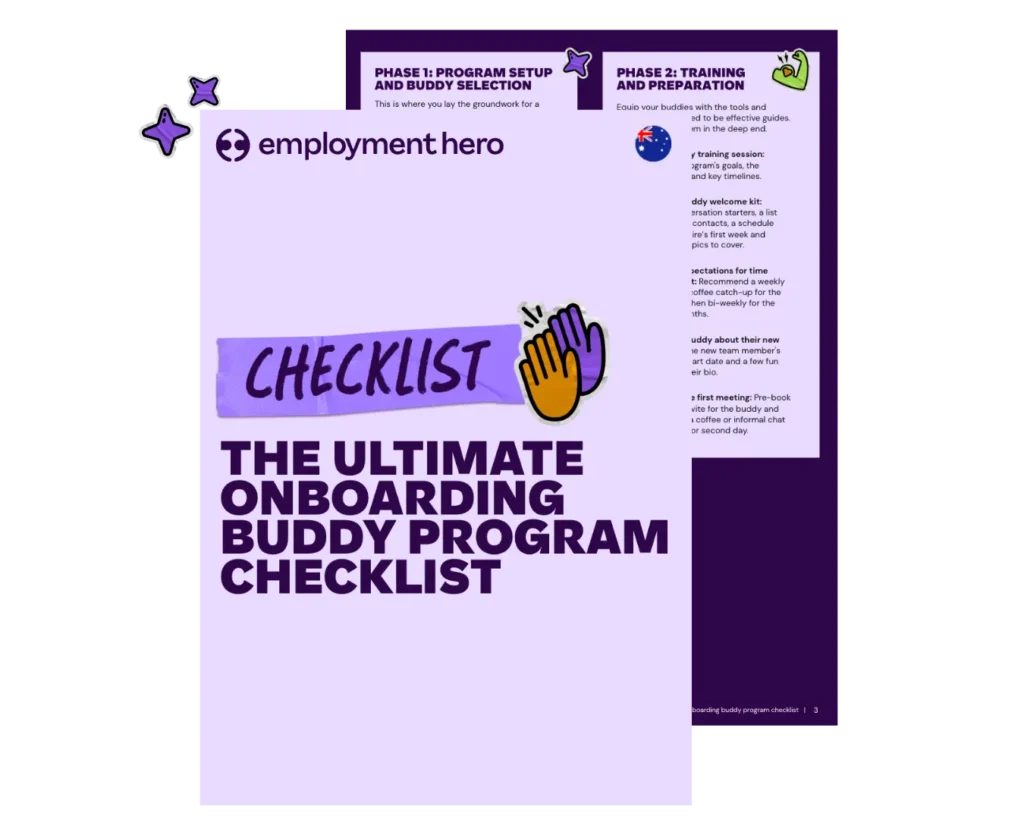
What’s in the onboarding buddy program checklist?
In this checklist you’ll find everything you need to build a buddy program that transforms your onboarding process and sets every new team member up for success.
In here, you’ll find everything you need to know about:
- Program setup and buddy selection
- Training and preparation
- The first week
- Ongoing support

What is an onboarding buddy?
An onboarding buddy is simply a friendly face. They aren’t the new hire’s manager and they aren’t there to critique performance. Their role is to be a peer mentor; someone who can answer all of their questions, explain how the coffee machine works and decode the unwritten rules of the office.
Benefits of an onboarding buddy program
A structured onboarding buddy program has the potential to deliver measurable ROI for your business.
- Faster time to productivity: New hires with buddies feel comfortable asking questions sooner, meaning they spend less time stuck and more time doing.
- Higher retention: People stay where they feel they belong. A buddy accelerates that sense of belonging.
- Reduced manager burden: Managers are busy. A buddy takes the load off by handling the day-to-day queries that don’t require management intervention.
- Cultural reinforcement: It’s the best way to demonstrate your values in action, not just on a poster.
5 steps to start an onboarding buddy program
Keen to get started with a buddy program? You don’t need a complex committee to get this off the ground. Here are five practical steps to get moving.
- Define the scope: Decide exactly what the buddy is responsible for (and what they aren’t). Is it a one-week commitment or a three-month partnership?
- Select your buddies: Don’t just pick anyone. You want people who are enthusiastic, patient and know the ropes.
- Train them: Give your buddies a basic buddy onboarding checklist so they know what to cover.
- Matchmaking: Pair people up. Try to match based on role similarities or shared interests, but avoid pairing them with direct reports.
- Track and tweak: Use tools to monitor how it’s going. Employment Hero’s onboarding software is great for standardising this process, making sure no step is missed.
Getting started with your new buddy
The first interaction sets the tone. We recommend the buddy reach out before the new hire’s first day. A simple LinkedIn message or a quick email saying, “Hey, I’m your buddy, can’t wait to meet you,” can reduce those first-day jitters.
On day one, the buddy should be the person waiting at the door (or in the Zoom waiting room). They should facilitate introductions and perhaps handle the first lunch break. This immediate connection signals safety and welcome.
Pro tips for onboarding buddies
If you’ve been tapped on the shoulder to be a buddy, here is how you crush it:
- Be proactive: Don’t wait for them to ask. Ask them, “How are you finding X?” or “Does Y make sense?”
- Share your failures: Nothing builds trust faster than admitting you also struggled with the printer on your first day.
- Listen more than you talk: Sometimes they just need to vent about information overload.
- Respect confidentiality: If they ask a question in confidence, keep it that way (unless it’s a serious HR issue).
A people-centric onboarding process
Processes are necessary, but people are paramount. The most robust checklist in the world won’t work if the human experience is cold and robotic. A people-centric process acknowledges that starting a job is a major life event.
Your onboarding buddy program should be designed with empathy in mind. It should account for the nerves, the imposter syndrome and the fatigue of learning new things.
How to launch an onboarding buddy program
Launching is about communication. Don’t just start pairing people up in the background. Announce the program to the whole company and explain why you are doing it.
If you want to get the most out of the program launch, consider these things:
- The announcement: Send a company-wide update explaining the benefits.
- Call for volunteers: Ask for people who want to step up. This is a great leadership opportunity for aspiring managers.
- The kick-off: Once you have your pairs, officially launch their partnership with a clear start date and resources.
Using a platform like Employment Hero’s HR software allows you to announce these initiatives and store the policy documents where everyone can find them easily.

What makes an effective buddy program?
The difference between an average program and a great one is structure. A “let’s go have coffee sometime” instruction is too vague. An effective program has:
- Clear expectations: Both sides know the time commitment.
- Resources: Buddies have access to cheat sheets, maps and org charts.
- Feedback loops: There is a mechanism for the new hire to say if the pairing isn’t working. At the end of the pairing period, use formalised post-onboarding surveys to gather actionable feedback so you can continuously improve the program for future hires.
- Recognition: Buddies are rewarded or recognised for their extra effort.
Building a successful buddy system
Consistency is key. You can’t have a great experience for one new hire and a terrible one for the next just because their buddy was busy.
To build a successful system, you need standardisation. Create a buddy onboarding checklist that every buddy follows. Make this a shared, collaborative document that is visible to and tracked by both the buddy and the new hire together. This shared responsibility supports better communication and makes sure every new starter gets the tour, gets the intro to the CEO and gets the lowdown on the best local lunch spots.
Embedding company culture through buddy programs
You can read a values statement, but you only truly understand a culture by watching how people behave. Buddies are your culture carriers.
If your culture values innovation, the buddy should encourage the new hire to share new ideas early on. If you value work-life balance, the buddy should be the one telling the new hire to log off at 5 PM. They model the behaviour you want to see.
The impact of buddy programs on employee onboarding
The data is clear: buddy programs work. Recent research found that new hires with buddies were 23% more satisfied with their onboarding compared to those without.
It transforms onboarding from a compliance exercise into a social integration exercise. This shift is fundamental to modern, people-first employment.
How onboarding buddies boost employee satisfaction
It comes down to psychological safety. When you have a buddy, you have a safe space to be vulnerable. You don’t have to pretend to know everything.
This safety reduces stress. Less stress means a happier employee and a happier employee is more engaged, more creative and more likely to recommend your company to their network. It’s a positive cycle that starts with a simple introduction.
Enhancing the employee experience with buddy systems
Employee Experience (EX) is the sum of all interactions an employee has with your company. The buddy system is a high-touch, high-impact interaction.
By formalising this, you are telling your staff: “We care about your experience enough to dedicate resources to it.” It elevates the EX from transactional to relational.
Aligning buddy programs with company values
Your program must mirror your values.
- Value: Transparency? Ensure buddies are open about company challenges, not just the highlights.
- Value: Innovation? Encourage buddies to ask new hires for fresh perspectives on old problems.
- Value: Teamwork? Make sure the buddy introduces the new hire to cross-functional teams, not just their immediate desk-mates. You can also expand these introductions to include key external stakeholders, suppliers or partner contacts to give the employee a broader understanding of your external ecosystem.
If your program contradicts your values (e.g. a supportive culture where buddies are too busy to reply), it will do more harm than good.

How buddy programs boost productivity
A new hire who doesn’t know how to access the shared drive might spend 2 hours figuring it out. A new hire with a buddy asks a quick question and is working in 5 minutes.
Multiply that by lots of small questions over the first month and the productivity gains are huge. The ramp-up period is significantly shortened when there’s a dedicated guide to navigate the roadblocks.
Supporting the first week for new hires
The first week is make or break. Here is where a buddy shift checklist becomes invaluable.
- Day 1: Lunch, office tour, key introductions.
- Day 2: Systems setup, overview of communication tools (Slack/Teams etiquette).
- Day 3: Coffee catch-up to debrief on the first few days.
- Day 4: Introduction to social groups or committees.
- Day 5: End of week review and a casual chat about how the week went.
Ouremployee onboarding guide offers even more depth on structuring this critical week.
Empowering buddies to answer questions
Buddies need to feel empowered to give answers or at least know where to find them. They shouldn’t be guessing.
Create a “Buddy FAQ” document. This should cover the harder to know questions.
- “How do I request leave?”
- “What is the expense policy?”
- “Who do I talk to about payroll?”
Better yet, give them access to a central source of truth. With Employment Hero, all these policies are stored centrally in the EH Work app, so the buddy just needs to show the new hire where to look in the app.
Making the first day count for new employees
First impressions last. A buddy makes sure the first day isn’t spent sitting alone reading a handbook.
Make it memorable. Have the buddy decorate the desk , place a small welcome gift or personalised item like a water bottle or company swag on it before the new hire arrives. You could also organise a team welcome lunch. These small gestures create an immediate sense of belonging and signal that the new hire is valued and anticipated.
Ready to build your buddy program?
An onboarding buddy program is a low-cost, high-impact strategy that can transform your new hire experience. But managing it manually like tracking who is paired with whom and if they’ve done their check-ins, can quickly become an administrative headache.
That’s where Employment Hero comes in. Our platform streamlines the entire onboarding process, from paperless contracts to automated checklists that keep buddies and managers on track. We take the admin off your plate so you can focus on the human connection.
Keen to learn more? Get in touch with one of our business specialists now.
The information in this article is current as at 2 March 2026 and has been prepared by Employment Hero Pty Ltd (ABN 11 160 047 709) and its related bodies corporate (Employment Hero). The content is general information only, is provided in good faith to assist employers and their employees, and should not be relied on as professional advice. Some information is based on data supplied by third parties. While such data is believed to be accurate, it has not been independently verified and no warranties are given that it is complete, accurate, up to date or fit for the purpose for which it is required. Employment Hero does not accept responsibility for any inaccuracy in such data and is not liable for any loss or damages arising directly or indirectly as a result of reliance on, use of or inability to use any information provided in this article. You should undertake your own research and seek professional advice before making any decisions or relying on the information in this article.
Register for the checklist
Related Resources
-
 Read more: AI skills assessment template for your team
AI skills assessment template for your team
Help your team build their AI skills. Download our free AI skills assessment template for managers and employees.
-
 Read more: The AI Adoption Blueprint
The AI Adoption Blueprint
What does it take to embed AI across an entire team? We’re sharing our training, our policies, and the lessons…
-
 Read more: Employment Essentials: AI Best Practices
Employment Essentials: AI Best Practices
Learn how to use AI in HR without creating privacy, compliance or employment risks in our latest webinar.


