

















The employer’s guide to Australia’s new casual employment rules
Published
The employer’s guide to Australia’s new casual employment rules
Published
2 min read
Casual employment in Australia has entered a new era, with recent legislative updates reshaping how businesses must now define, engage and manage their casual workforce.
We know that navigating new legislation can feel overwhelming, but you don’t have to do it alone. For employers, understanding these changes is essential, and staying compliant means knowing exactly how to classify casual employees and manage ongoing obligations.
Let’s break down exactly what has changed and what you need to do to adapt.

What are the new casual employment changes?
The new laws affect both the definition of casual employment and the process of converting to permanent work. They also introduce new compliance requirements and penalties for employers.
Key changes include:
- A new definition of casual work that considers the real nature of the working relationship, not just the employment contract.
- A new process for casual conversion, where employees can now request to move to permanent employment.
- Ongoing obligations to issue the Casual Employment Information Statement (CEIS) multiple times throughout employment.
- Prohibitions on rehiring permanent staff as casuals to perform the same work.
When did the casual employment changes take effect?
Most of the new casual employment rules commenced on 26 August 2024.
This means businesses are now required to operate under this new framework. If you haven’t already reviewed your casual arrangements, the time to act is now.

Changes to the definition of a casual employee
One of the most critical updates is the new casual employee definition. This change moves away from a purely contract-based assessment to one that considers the real-world dynamics of the employment relationship.
How the old casual employee definition worked
Previously, an employee was considered casual if their employment offer stated there was no firm advance commitment to ongoing work, and they accepted the job on that basis. This classification was determined at the start of the employment and relied heavily on the wording of the employment contract.
Key differences between old and new definitions
The new definition of casual employee shifts the focus from the initial agreement to the “real substance, practical reality and true nature” of the working relationship. While the employment contract is still relevant, it’s no longer the only factor.
Courts and regulators will now look at the total picture of the employment relationship to determine if a worker is genuinely casual. This means a consistent, predictable work pattern could challenge a casual classification, regardless of what the contract says.
What is “firm advance commitment to continuing work”?
The concept of a “firm advance commitment” remains central, but its assessment has changed. It’s no longer just about what the contract says. A firm advance commitment can now be identified by looking at the practical reality of the relationship. Factors that may indicate a firm advance commitment include:
- The employer’s ability to offer regular, ongoing work.
- The employee’s pattern of accepting or rejecting shifts.
- Whether other employees doing similar work are permanent.
- A shared, mutual expectation of continuing employment.
Changes to casual conversion rights
The old system of mandatory employer-led offers for casual conversion after 12 months is gone. The power has now shifted to the employee, creating a new pathway for those seeking the security of permanent employment.
The new employee choice pathway explained
Under the new rules, casual employees can now request to convert to permanent employment. This employee-led process gives workers the initiative to change their employment status once they meet certain conditions, empowering them to seek more stable work arrangements if their circumstances change.
Who is eligible to request permanent employment?
A casual employee can request conversion after a minimum service period. The eligibility criteria are:
- 6 months of service for businesses with 15 or more employees.
- 12 months of service for small business employers (fewer than 15 employees).
This allows employees who have demonstrated a consistent connection to a business to formally request a transition to full-time or part-time permanent employment.
How casual employees can request permanent status
To initiate the process, the casual employee must submit their request in writing to their employer. This formal step kicks off a clear and regulated procedure that employers must follow.
Employer response requirements under new casual rules
Once an employer receives a written request for casual conversion, they have 21 days to consult with the employee and provide a written response. If the request is accepted, the response must detail the new employment type (full-time or part-time), the agreed-upon hours of work and the start date for the permanent role.
Grounds for refusing a casual to permanent request
An employer can only refuse a request on specific grounds. These include:
- The employee still meets the new definition of a casual employee.
- There are fair and reasonable operational grounds for the refusal (e.g. significant changes to business operations are planned).
- Accepting the request would breach a recruitment or selection process required by law.
The decision must be clearly communicated in writing.
Fair Work Act changes: Closing loopholes legislation
These changes to casual employment are part of the broader “Closing Loopholes” legislation. This reform aims to strengthen workplace laws, improve job security and ensure that the Fair Work Act remains relevant to modern working arrangements.
Updating casual employment contracts
Consider whether your casual employment contracts need to be updated to align with the new casual employment laws. They should reflect the new definition and clearly outline the terms of engagement. Don’t fall into the trap of relying on vague or outdated contracts, as they’re a significant liability. For expert guidance on reviewing your agreements, consider our HR Advisory services for personalised support.

Risks of casual employee misclassification
Misclassifying a permanent employee as casual is one of the biggest compliance risks a business can face. It can lead to substantial back-pay claims for unpaid leave, public holiday pay and other entitlements, even if you’ve paid a casual loading.
Our HR Compliance: The Essential Guide can help you navigate employee classification.
Managing compliance with casual employment laws
The Fair Work Ombudsman can impose significant financial penalties for breaching casual employment regulations.
Effective HR management is your best defence. Employment Hero’s HR software automates key compliance tasks, such as distributing the CEIS, which must now be given to employees at multiple points in their tenure.
For new HR leaders, getting this right from the start is essential. Learn how to start your new role off on the right foot and download the First 90 Days as a New HR Manager Guide to get a roadmap to success.
Download the changes to casual employment factsheet
Ready to take control of your casual employment compliance?
Disclaimer: The information in this factsheet is current as at 3 November 2025, and has been prepared by Employment Hero Pty Ltd (ABN 11 160 047 709) and its related bodies corporate (Employment Hero). The views expressed in this factsheet are general information only, are provided in good faith to assist employers and their employees, and should not be relied on as professional advice. The Information is based on data supplied by third parties. While such data is believed to be accurate, it has not been independently verified and no warranties are given that it is complete, accurate, up to date or fit for the purpose for which it is required. Employment Hero does not accept responsibility for any inaccuracy in such data and is not liable for any loss or damages arising either directly or indirectly as a result of reliance on, use of or inability to use any information provided in this factsheet. You should undertake your own research and to seek professional advice before making any decisions or relying on the information in this factsheet.
Register for the factsheet
Related Resources
-
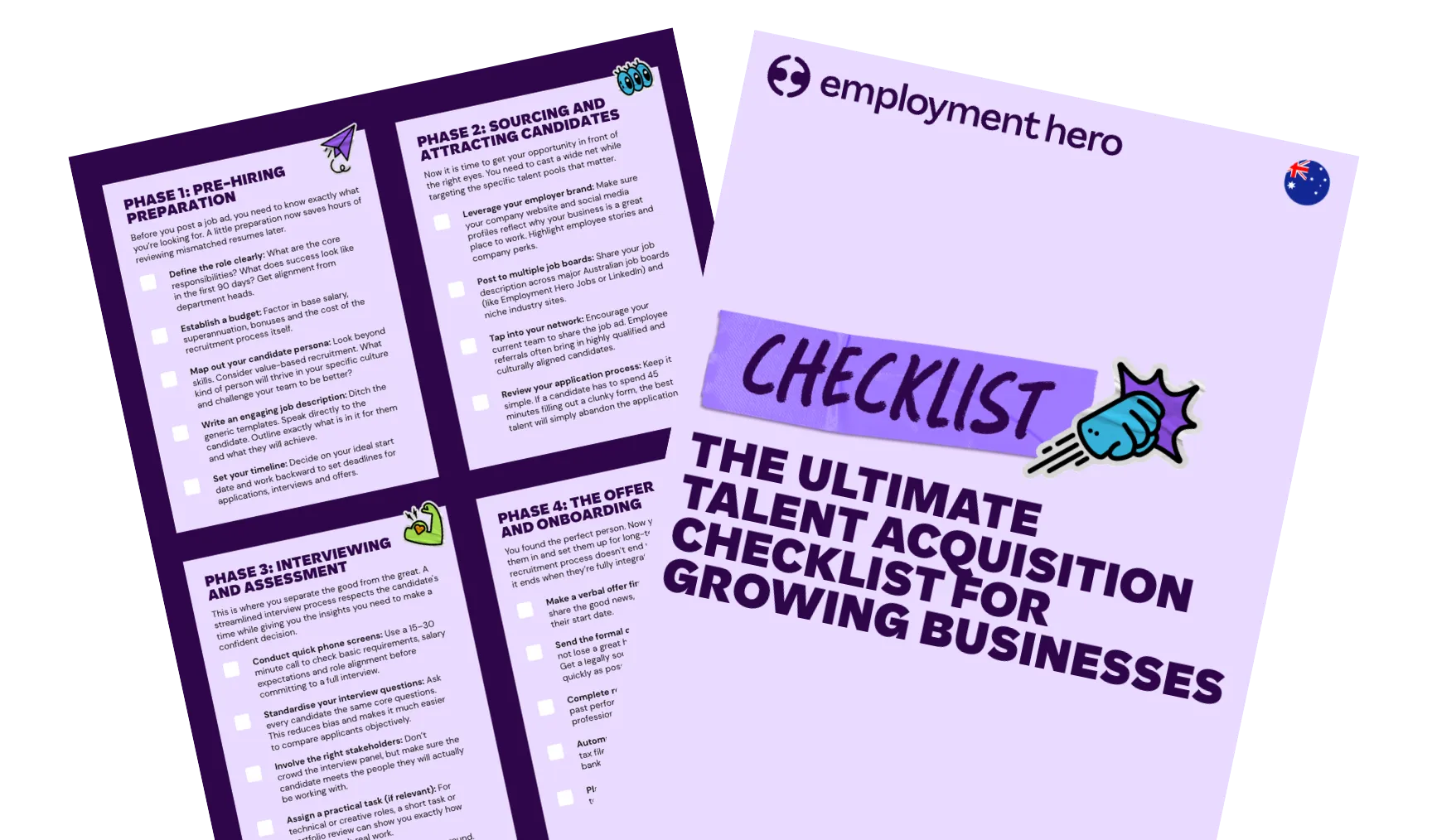 Read more: Talent acquisition audit checklist
Talent acquisition audit checklist
A talent acquisition audit is your secret weapon to cut costs, find better candidates and build the team of your…
-
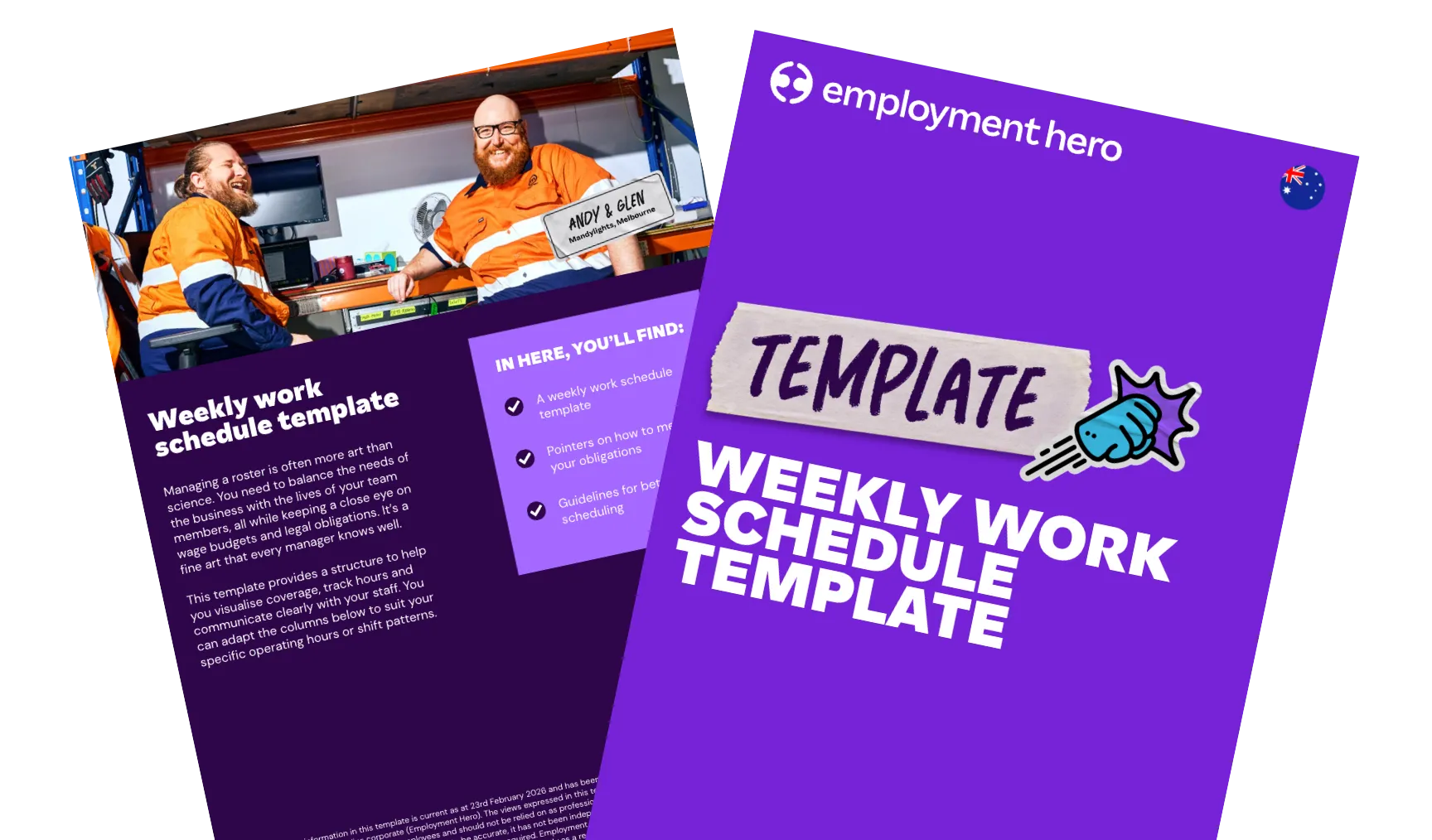 Read more: Designing an employee work schedule: template and guide
Designing an employee work schedule: template and guide
Learn how to create a flexible work schedule that can boost productivity among your employees.
-
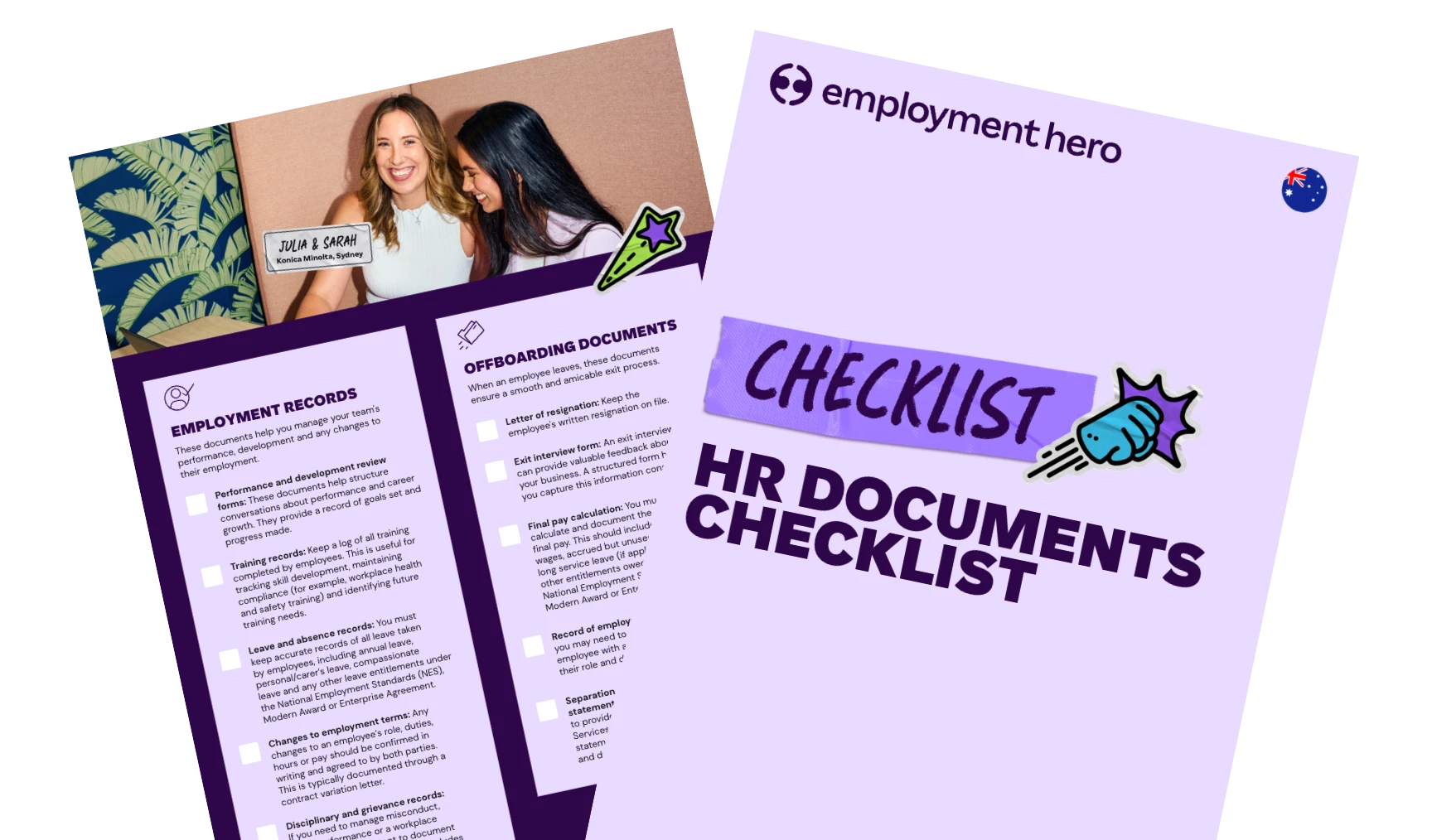 Read more: Essential HR documentation checklist for employee management
Essential HR documentation checklist for employee management
Use our HR documentation checklist to figure out what you’re missing, then download our free templates to close the gaps.

