 New Zealand
  United Kingdom
  Singapore
  Malaysia
  Canada (Français)
 Australia






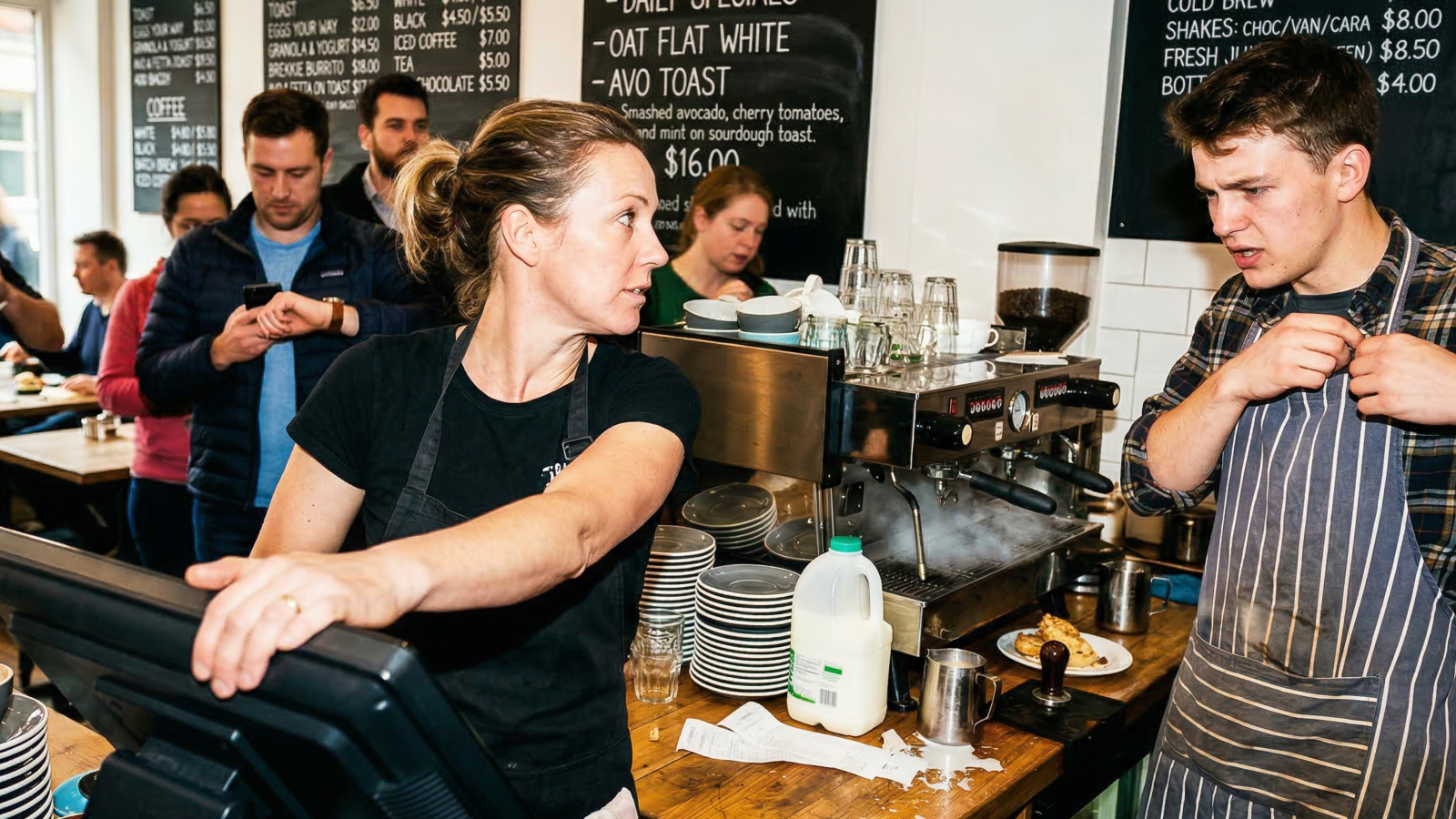
Never before has there been greater weight placed on psychological safety in the workplace. Even the smallest businesses are now required by Australian law to eliminate emotional hazards. But while employers prioritise protecting employees from overt behaviours such as bullying, a covert threat may be undermining the business itself.
Executive coach and author Errol Amerasekera says fear is acting as a handbrake on performance in many small and medium businesses, yet the owners he works with rarely recognise it. He says too many regard psychological safety as a compliance requirement when they should regard it as a cultural issue.
“Fear doesn’t announce itself or turn up like we think it will, where we’re frightened,” he says. “It looks like a withdrawal.” In his book, From Fear to Flow: The Adaptive Safety Revolution, he encourages owners to reimagine what fear in the workplace looks like, so that they can create a culture that drives high performance.
This Is What Fear In A Team Actually Looks Like
Amerasekera says workplace safety exists on a spectrum. “At one extreme is a culture that’s 100 per cent fear-based, the other extreme 100 per cent safe. Now, most teams sit somewhere in the middle, where there’s a degree of safety, but it’s not absolute,” he explains. “In any team, there are behaviours which are creating fear, and behaviours which create safety running simultaneously.”
He defines fear not as terror but as a withdrawal of honesty which is often linked to tenure. People adapt their behaviour out of fear for the consequences. “For example, in a team meeting, people will kind of couch their responses. People don’t feel safe to challenge the prevailing opinion. It’s where, for example, the post-meeting conversation is more honest than the actual meeting. They’re all signs that some degree of fear is working its way through a team,” he says.
The fear of losing social safety is also a factor as staff stay quiet to avoid an eye roll or ridicule. The phenomenon is pervasive, with Gallup research finding only three in ten people believe their opinions are valued at work. Yet the concept is not widely understood among business owners, many of whom still regard a sea of nodding heads in a meeting as a sign of a well-run operation.
Amerasekera cites the example of one coaching client. “He goes, ‘I run a meeting, Errol, and everyone agrees. We have total harmony in our team,’” he says. “I coached him to actually study the non-verbal communication of his team. While the verbal communication was ‘Yep, we agree’, some of the non-verbal communication was, ‘I don’t agree but I’m too scared to challenge.’” He encouraged the leader to read the cues and the culture changed within three months. “Suddenly, the team felt safe to challenge each other and really be in that spot of, well, we could go this direction or this direction. Let’s have a robust discussion about it, where we aren’t taking it personally.”
Fear And Culture Are Intrinsically Linked
SME owners can struggle with team dynamics, often because they are thrust into leadership without formal training. “You go from being the subject matter expert to the steward of the business,” Amerasekera says. “And if you’re an accountant, for example, you didn’t learn how to be a mentor or a coach or a teacher. So, we default to that subject matter expert role and we tend to steer away from where we feel less skilled, which is the mentoring people, development side of our role.”
In a small business without an HR function, the responsibility for steering culture often falls on the owner but Amerasekera argues the burden is not theirs alone. “The cultural buck stops at everyone,” he says. “Everyone is responsible for culture.”
Another mistake is thinking culture can be worked on intermittently, through off-sites or team building events. Instead, Amerasekera says culture is built through daily microbehaviours. These include a leader’s response to learning someone has made a mistake or people’s demeanour in a crisis.
“One microbehaviour doesn’t make or break a culture, it’s the accumulation of these behaviours over time, which send the message to team members how safe it is to be myself, to challenge, to be vulnerable, to be open, to engage deeply, to care about the work,” he explains.
Psychologically Safe Teams Must Adapt To The Times
The concept of psychological safety became mainstream after Harvard academic Amy Edmondson and Google’s Project Aristotle established the idea that the highest-performing teams enabled employees to speak up without punishment.
But Amerasekera has identified a common misconception in which psychological safety is too readily regarded as a goal that can be reached or a switch that can be flicked. Instead, he promotes the idea of adaptive safety, where cultural improvements are constant.
“Psychological safety is how safe I feel to speak,” he says. “Adaptive safety is a capability to maintain trust, connection and inclusion as the conditions change. In an adaptively safe team, they are better at adapting and learning and correcting in real time.”
As proof of the pace of change, he cites 2024 research into Australian SMEs in which three out of four leaders said their business had changed more in the previous four years than in the two decades before that. “Leaders tell me they do a three-year strategic plan and it’s already obsolete in six months,” he says.
“Adaptive safety is actually a learnable skill. We can reflect on our process, reflect on how we do business, and make the tweaks to make our business more efficient, and make our culture more efficient. That’s the biggest difference I see.”
Address Fear In Your Team And Boost Performance
For a small business owner already running on fumes, the idea of overhauling culture can feel insurmountable. Amerasekera’s advice is to start small and look for signs of fear masquerading as silence.
“The first thing is just to observe,” he says. “Spend the next three team meetings observing your team. Who speaks? Who doesn’t speak? Where does honesty get shut down? Where does challenge not happen? Rather than blaming people, see the patterns, because these patterns are less personal and more belong to the team culture.”
Once the patterns have been identified, bring them to the team’s attention. “The leader might say, ‘I notice whenever things get a bit tense, we make a joke. I notice when we have a difference of opinion, we just default to the most senior person. What do we think about that?’ And get the team to reflect on those dynamics.” That reflection is what creates a learning culture. “If we do it enough times, like a muscle, that gets stronger. That’s a capability we need to practice.”
He notes that some leaders may find it hard to know where to draw the line between encouraging people to speak up with helpful ideas and platforming opinionated staff who could otherwise be described as difficult. “If people are difficult, I would say, why are they being difficult? And if there’s coaching or support needed, I would give them that.”
The key is to prioritise relationships. “Culture really is about our connection, our trust, our interactions,” he says. When ideas are shared more readily and problems are solved more efficiently, performance, sales and revenue inevitably improve. “That’s part of the revolution.”