 New Zealand
  United Kingdom
  Singapore
  Malaysia
  Canada (Français)
 Australia


Businesses that invest most heavily in AI are hiring more staff, not fewer, according to a multi-nation survey that challenges the doom-and-gloom narrative surrounding artificial intelligence.
Employment Hero’s The AI Paradox report, built on insights from almost 9,000 leaders and workers across Australia, New Zealand, the UK and Canada, paints a more nuanced picture of AI in the workforce, revealing the technology is having contrasting positive and negative impacts within individual businesses.
The report identifies five AI paradoxes, where two seemingly contradictory things are true, within small and medium businesses, spanning headcount, skills, sentiment, expertise and efficiency. For SME owners, each carries direct implications for how they hire, train and retain their teams.
“Our research suggests the direction of travel is clear,” says Ben Thompson, CEO and Co-Founder of Employment Hero. “The businesses that get this right won’t be the ones deploying AI fastest, they’ll be the ones using the leverage to build more, and the ones who help their people see AI as an ally rather than a threat.”
The Headcount Paradox: AI Firms Are Growing Junior Jobs
While commentary on the potential impact of AI on the labour market has dominated headlines, The AI Paradox report captures what is already happening in small and medium businesses.
The survey confirms 16 per cent of companies have cut entry-level roles in the past two years, citing automation as the reason. But there’s a more pronounced trend on the flipside: 42 per cent have grown entry-level headcount over the past two years.
Drilling further into the data, that figure jumps to 62 per cent for businesses that have AI at the core of operations, more than double non-adopters at 30 per cent.
This may be a result of AI directly driving headcount growth or could be a sign that AI-mature companies are stronger overall. The results do not distinguish between the two. But, broadly, the data shows upward momentum and pushes back against fears that firms are hollowing out their junior ranks.
Thompson adds context. “When new technology gives a business more leverage and greater output, the response isn’t to shrink the team. It’s to do all the things you’ve wanted to in order to expand your business, develop meaningful relationships with your customers and invest 1-to-1 time with your team, the backbone of your business.”
The Skills Paradox: SMEs Want Trained Workers But Who’s Training Them?
Employers have shifted the goalposts to favour workers with AI skills but the paradox emerges in their reluctance to provide training.
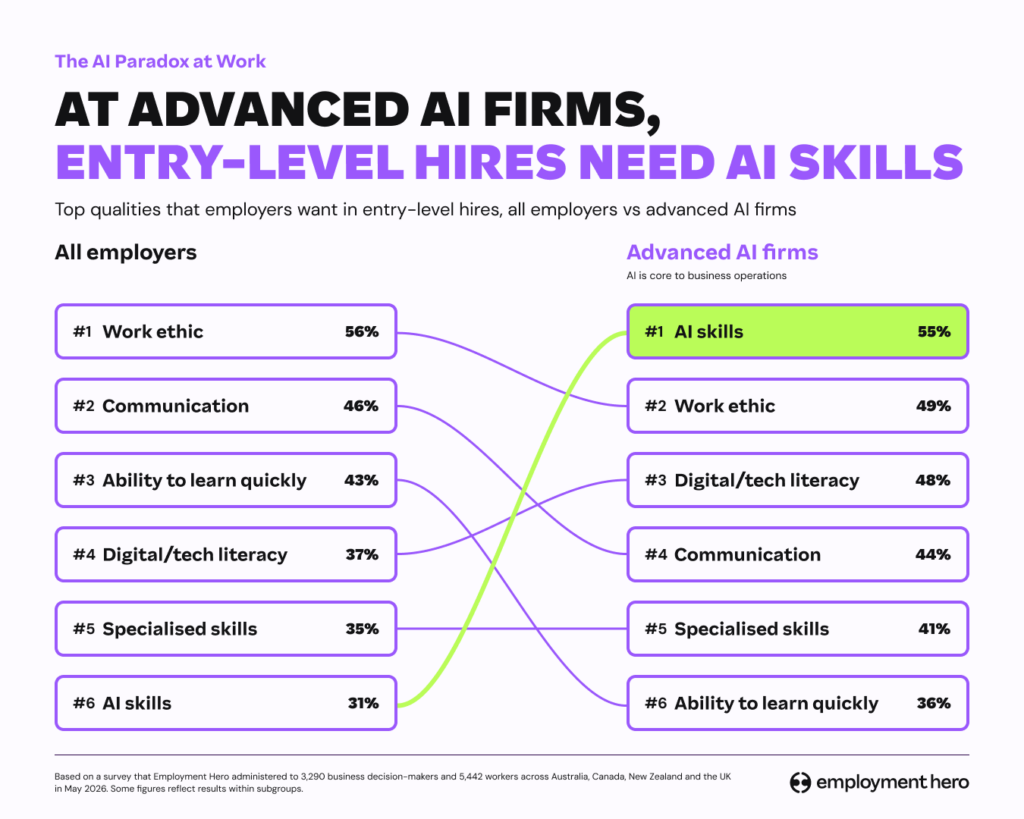
The desire for AI proficiency is clear: mentions of AI skills in job descriptions on Employment Hero’s platform have surged 235 per cent year on year, and ‘Claude’ is so far the fastest-growing in-demand term of 2026. Survey respondents rank AI skills as the sixth most valued hiring criterion overall, sought by 31 per cent of businesses. That’s behind traditional traits such as work ethic (56 per cent), communication (46 per cent) and quick learning (43 per cent), but ahead of holding a university degree (25 per cent).
Beyond job ads, demand extends to recruitment, with 58 per cent of businesses saying they have already updated their hiring criteria to give greater weight to AI skills. Another 24 per cent plan to follow suit. But the report raises the question of where these skills should be obtained.
Half of the workers surveyed say their employer is doing little or nothing to help them learn to use AI tools. Only 38 per cent of businesses run formal AI training programs, although that figure rises to nearly two-thirds of AI-core firms. SMEs that are just beginning to adopt AI are least likely to invest in training, despite their staff needing it most.
Perhaps due to the absence of structured learning opportunities, 6 in 10 employees rate their current AI competence as low or average. But instead of waiting for employers to roll out training, workers are filling the void themselves.
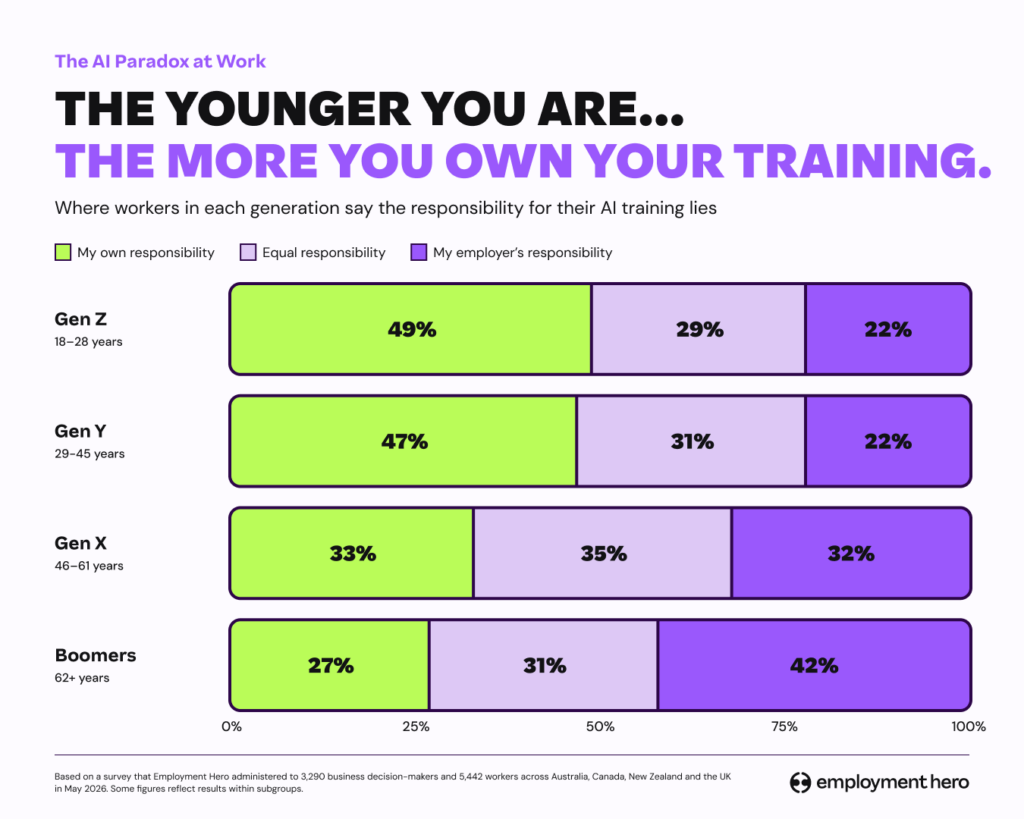
More than half the workforce is learning about AI through social media platforms including YouTube, TikTok, Reddit and Discord, and often don’t resent the burden. 41 per cent of workers believe upskilling is their own responsibility, overshadowing the 27 per cent who believe the obligation lies with their employer. The DIY attitude is strongest among workers aged 18 to 24, who are 1.8 times more likely to self-educate than those aged 55 and over.
While many Australian SMEs still lack a formal AI strategy, the skills gap represents both a risk and an opportunity. Employers that invest in tailored AI development may stand to gain an edge over competitors making do with an informal, individual-led approach.
The Guilt Paradox: Owning AI Output Feels Like Cheating
60 per cent of employers believe their employees have a positive view of AI in the workplace. Yet employees report conflicting emotions about their new automated colleague. The report has unearthed an identity crisis among people who struggle to redefine what it means to ‘own’ their work now that AI is sharing the load. 42 per cent of workers say using the technology feels like cheating.
The finding hints at a scenario where even though AI assistants can help produce higher-quality work, people can regard their use as a shortcut rather than a skill and feel uncomfortable putting their name to the output. It’s also possible they’re wary of stigma.
The result is a shadow AI culture, where 33 per cent of workers confess to covertly employing the tools to meet performance expectations but hide or downplay their usage to protect their professional standing. This gap between expectation and behaviour creates inconsistency but also risk, if staff are uploading proprietary data to personal AI accounts.
For employers, this highlights the importance of AI governance policies which give staff explicit guidelines over how the technology should and should not be used.
The Expert Paradox: AI As Both Advantage and Threat
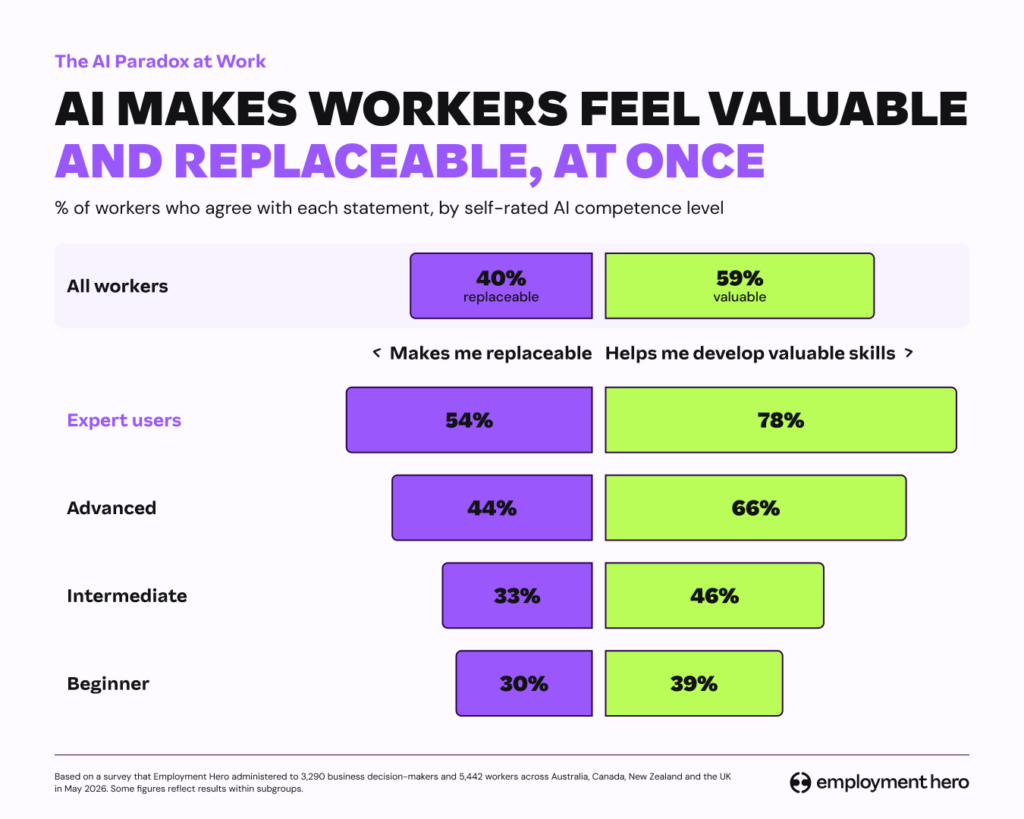
The most competent AI users in the community are also the ones who feel most threatened by it.
They are quick to accept its benefits: 78 per cent of workers with advanced AI knowledge agree the technology builds valuable skills, compared with 59 per cent of average workers. 87 per cent say AI helps them produce higher-quality work, versus 73 per cent overall.
Yet those same experts are more likely to feel replaceable: 54 per cent report that fear, compared with 40 per cent of the broader workforce. They are also more likely to feel vulnerable to AI-driven layoffs, at 47 per cent versus 38 per cent, from their position at the frontline.
For SME employers, this paradox can guide retention strategies. High-value AI talent may need reassurance about their evolving roles within a business, through conversations about what AI will and will not replace. Instilling job security may also help drive innovation, if employees can have confidence their work is promoting growth rather than making their roles obsolete.
The Efficiency Paradox: Saving Time While Creating Work
At the same time that AI is driving efficiencies in small businesses, it’s also creating more work.
Leaders are talking up the technology, with 65 per cent saying AI is accelerating their business and allowing them to work faster. Nearly three-quarters of employees agree AI tools have boosted their overall productivity. 87 per cent of expert AI users are diverting time saved to higher-impact tasks.
But, on closer inspection, the report suggests speed can come at the expense of quality. 63 per cent of workers claim AI has actually created more work, primarily through the effort required to verify outputs and eliminate hallucinations. Of those experiencing productivity gains, only 1 in 4 describe them as significant.
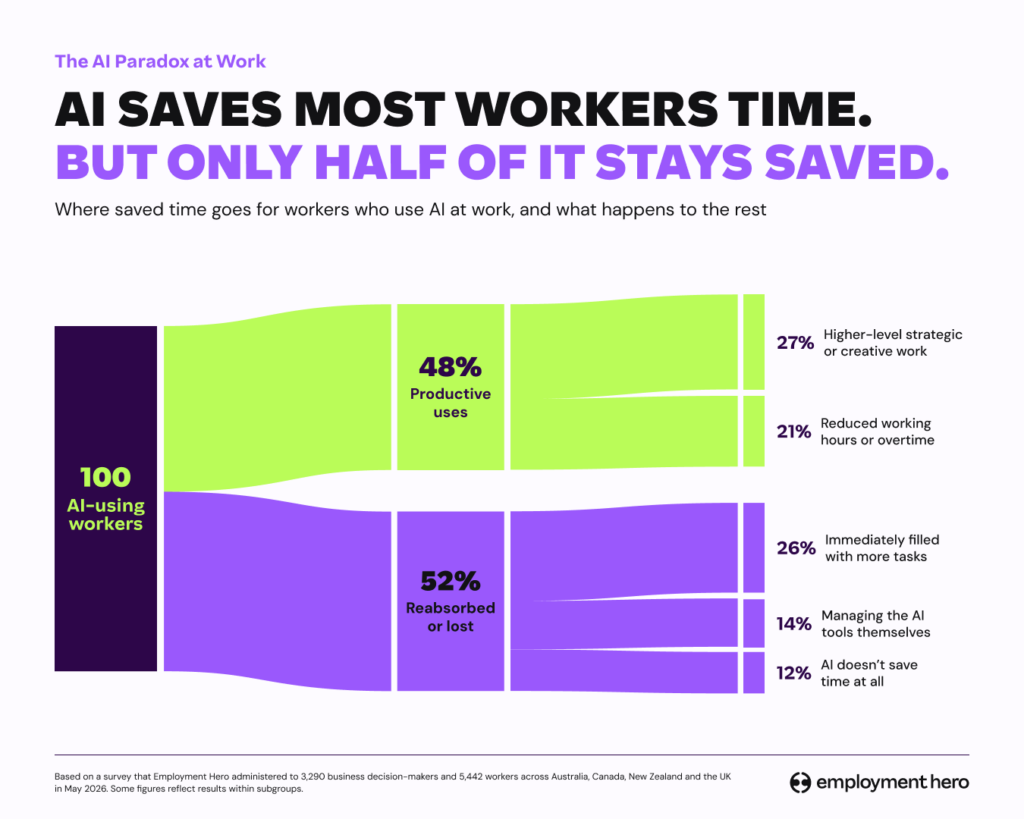
There is another layer of nuance surrounding time savings. Just 27 per cent of workers say they redirect the hours AI unlocks into strategic or creative work. 26 per cent see freed-up time absorbed by additional tasks. 14 per cent spend it managing and troubleshooting the AI tools themselves, while 12 per cent say they have experienced no time savings at all. But a positive signal for employees lies at the other end of the spectrum: 21 per cent of people report that AI allows them to work fewer hours.
Business owners may be buoyed by the finding that AI is producing cost savings for 39 per cent of SMEs. This is almost on par with larger enterprises and suggests the playing field is levelling.
For small and medium business owners digesting The AI Paradox report, there is a distinct takeaway. Had the survey thrown up mixed results, sector-specific winners and losers, it might have tempted cautious adopters to continue to stand back and wait. But, instead, paradoxes suggest conflicting AI forces are already colliding within businesses, so delaying action may cause the gap between adoption and maturity to widen further.
“The AI Paradox is a story of growth, not loss,” says Thompson. “It’s a story of businesses doing more, teams getting bigger, and people getting the chance to do work that matters. The best of it is still ahead.”