 New Zealand
  United Kingdom
  Singapore
  Malaysia
  Canada (Français)
 Australia

How to use AI to match candidates with job descriptions

Contents
Hiring has never felt this hard. You’re juggling a growing pile of applications, a packed calendar and a team that needed reinforcements yesterday. Sound familiar? You’re not alone.
Our recent Recruitment Report revealed that 78% of Australian businesses say hiring has become tougher because of economic uncertainty and yet, most are still relying on the same manual processes they’ve always used. Job boards, spreadsheets and back-and-forth emails are creating a huge admin load for results that don’t always deliver.
That’s where AI changes the game. AI-powered job description tools and candidate matching technology are giving Australian employers a faster, smarter way to find the right people, without the hours of admin that usually go with it.
Here’s everything you need to know about how to use AI to match candidates with job descriptions, write better job ads in less time and build a hiring process that keeps up with the pace of business this year.
Why matching candidates to job descriptions is so time-consuming
Consider this scenario. You’ve just posted a role for a Sales Account Manager and within 72 hours, you’ve got 120 applications sitting in your inbox. Some are from highly qualified candidates, but a lot aren’t. A few look promising at first glance, but fall apart when you dig into the details.
Now multiply that by the three other roles you’re currently hiring for. Then factor in the day job with all of the meetings, the performance conversations, the onboarding of the person you just hired last month.
Manual shortlisting is hugely inefficient and for most business leaders and HR managers in Australia, it’s eating time they don’t have.
Our 2025 Hiring Snapshot Report found that Australian businesses spend an average of $13,545 per year on hiring. Small businesses (2–19 employees) spend around $8,090, while medium-sized businesses (20–150 employees) spend closer to $18,371. That’s a significant investment and a large chunk of it goes towards a time-consuming screening process that doesn’t always deliver the best candidates.
The problem here is the volume and the inconsistency. Without a structured approach, shortlisting decisions are influenced by how a CV is formatted, how familiar a job title sounds or simply motivation levels before opening the inbox. You end up with an uneven process that makes it harder to identify the people who’d excel in the role.
This is where AI-powered screening tools can make a meaningful difference.

What is AI resume matching and how does it work?
AI resume matching is software that reads a resume, extracts the skills and experience it contains and scores how closely that candidate aligns with a specific job description.
The AI scans a CV for things like qualifications, years of experience, job titles, industry keywords and technical skills. It then compares those attributes against the requirements outlined in the job description and ranks candidates accordingly.
The technology draws on machine learning to understand context and the keywords. So it can recognise that “managed a team of five direct reports” and “led a cross-functional team” are pointing to a similar capability, even if the phrasing is different. It can also factor in softer signals like progression, tenure and role relevance.
This is a powerful tool for time-poor leaders and it does it at a speed no human reviewer can match.
Importantly, AI resume matching doesn’t replace human judgement. It removes the groundwork that eats up your time, so you can focus your energy on the candidates who deserve a closer look.
How to use AI to write and auto-generate job descriptions
There’s one thing that most hiring managers don’t consider until it’s too late. AI matching is only as good as the job description it’s working from. Put in a vague brief and you’ll get a vague shortlist.
If your job ad is generic, buried in corporate buzzwords or missing key requirements, you’ll attract the wrong people. Unfortunately, no amount of AI will fix that upstream problem.
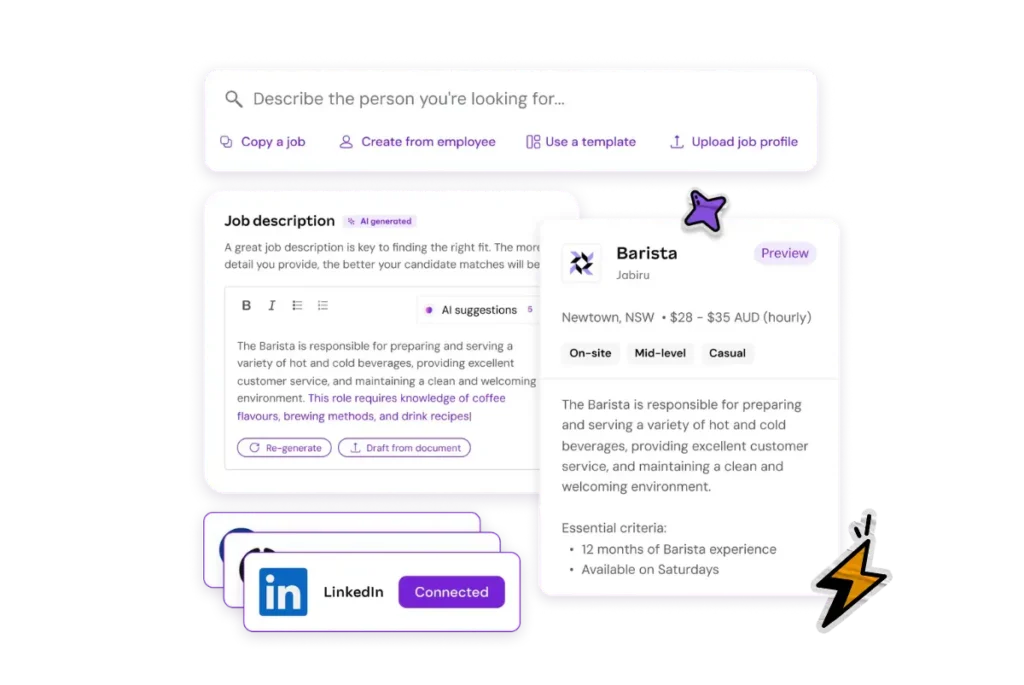
Thankfully, AI can help you write a better job description in the first place. Here’s how it works:
- You provide a role brief: A few lines about the role, the team, the key responsibilities and must-have skills. That’s your starting point.
- The AI drafts a complete job description: Role overview, responsibilities, requirements, culture. It’s structured and ready to go.
- You review and refine: Adjust the language, add any specifics and publish. The whole thing takes minutes, not hours.
Employment Hero’s AI-powered recruitment tools do exactly this. Feed it a brief and it generates an optimised job posting with built-in prompts so nothing important gets missed. The output is consistent, well-structured and set up to work with AI matching in our Recruitment Agent from the moment applications start coming in.
Having a standout job ad matters more than you’d think. Worryingly, only 6% of Australian businesses rate their hiring process as excellent and a sharper job description is one of the fastest ways to move that needle.
How AI matches resumes with job descriptions in practice
Once your job description is live and applications are rolling in, the matching process kicks in. Here’s how it works in practice:
Step 1: The job description is analysed
The AI reads your job posting and identifies the core requirements including skills, qualifications, experience level and role-specific criteria. This becomes the benchmark every applicant is measured against.
Step 2: Resumes are processed and scored
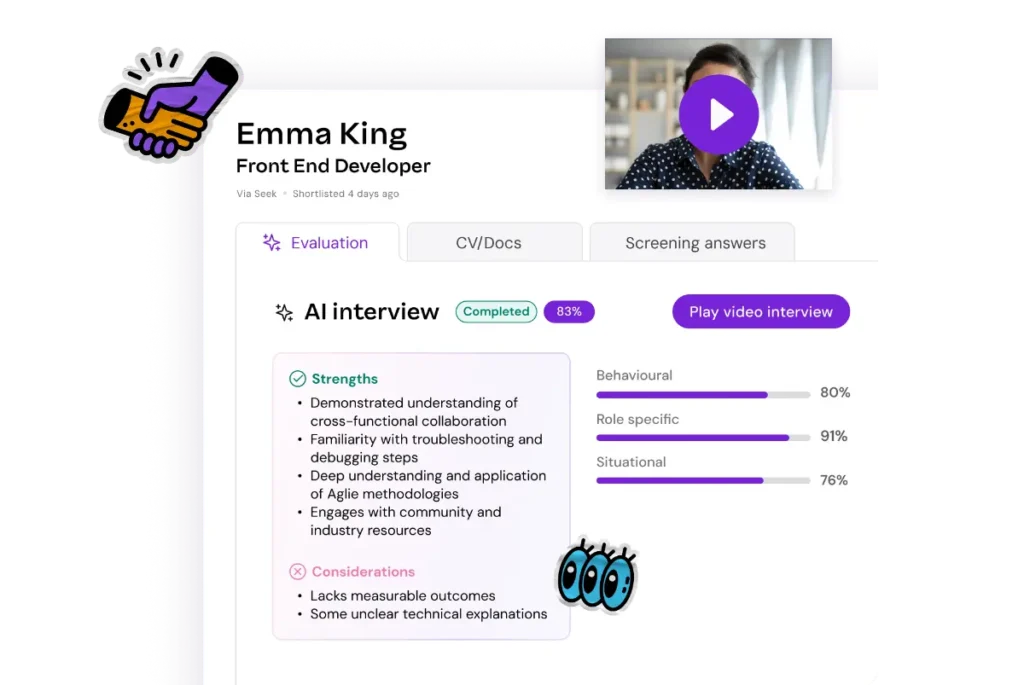
As candidates apply, their CVs are automatically parsed by the AI. It extracts relevant attributes and scores each applicant against the benchmark, producing a ranked shortlist within moments of the application being submitted.
Step 3: You review a prioritised candidate list
Instead of wading through 120 CVs, you’re presented with a ranked list of the strongest matches. You can see at a glance why each candidate has been surfaced, highlighting what skills align, what gaps exist and where they sit relative to your requirements.
Step 4: You make faster, more confident decisions
With the hard work done, your energy goes toward reading the standout applications, having better screening conversations and moving quickly on the people worth pursuing.
What are the benefits of AI candidate matching for employers?
If you’re still manually screening every application, here’s what you’re missing out on.
Time savings that give you a competitive edge
Manual hiring is one of the biggest drains on a recruiter’s day. AI candidate matching cuts screening time dramatically, with what used to take days now being done in minutes. Connecting Families found that using Employment Hero’s AI matching and candidate screening tool saved their team 30 to 45 minutes per candidate on screening alone. This is valuable time that’s now been redirected to interviews, onboarding and the human side of hiring.
Consistency across every application
Manual shortlisting is inconsistent by nature. Two people reviewing the same stack of CVs will surface different candidates. AI applies the same criteria to every single application without the fatigue, gut-feel deviations or overlooked diamonds at the bottom of the pile.
Reduced unconscious bias
When decisions are based on skill and experience alignment instead of name, suburb or university prestige, you create a more level playing field. AI matching focuses on what’s relevant to the role, instead of factors that can introduce unconscious bias at the screening stage.
A stronger shortlist, faster
Poor quality applicants and difficulty finding qualified candidates are the top two barriers to hiring reported by Australian SMEs, according to our 2025 Recruitment Report. AI matching filters for genuine fit upfront, so the candidates you spend time on are the ones most likely to become great hires, instead of filling your calendar with interviews that go nowhere.
Cost efficiency
Hiring is expensive and as we noted earlier, Australian small businesses are already spending over $8,000 a year on recruitment. A meaningful share of that goes toward ad spend, screening time and mis-hires that could have been avoided. Reducing the hours spent on manual screening has a real dollar impact that compounds quickly, especially for smaller teams without a dedicated HR function.

What to watch out for with AI resume matching
AI matching is powerful, but it’s not infallible. Here’s what to keep in mind.
It can miss context
A candidate who took two years out to care for a family member, then returned to their field with renewed focus, might score lower than their experience warrants. AI reads what’s on the page, not between the lines. That’s why it’s worth treating AI matching as a shortlisting tool rather than a final decision. The ranked list narrows the field, but your team still reviews every candidate and makes the call.
CV format can affect results
Resumes built as graphics or PDFs with unusual formatting can be harder for AI to parse accurately. Candidates who present their experience in non-standard ways may not score as highly as their actual capability deserves. Prompting candidates to complete structured profile fields alongside their CV upload helps offset this as the matching draws on consistent, comparable data instead of just whatever’s in the document.
Training data influences outcomes
Like all AI tools, candidate matching reflects patterns in the data it’s been trained on. That means whoever is setting up the job requirements and reviewing the outputs still needs to apply critical thinking. The AI surfaces candidates but it’s still your people who make the hire. Keeping humans in the loop at every stage is what separates a useful tool from an unchecked one.
How to get started with AI-powered candidate matching
Ready to bring AI into your hiring process? Here’s how to make it happen in four straightforward steps.
Step 1: Audit your current job descriptions
Before you bring in AI tools, make sure the briefs you’re working from are clear and specific. Vague requirements produce poor matches, regardless of the technology. Identify the must-haves, the nice-to-haves and the role outcomes you’re actually hiring for.
Step 2: Choose a platform built for end-to-end AI recruitment
Look for a platform that combines AI job description generation and candidate matching in one place, so you’re not jumping between systems. Employment Hero is built for exactly this. The AI Recruitment Agent handles screening and shortlisting, the Applicant Tracking System keeps your pipeline moving from job ad to offer and the Talent Pool gives you instant access to over 2.3 million active candidates from the start.
Step 3: Set up and publish your first AI-generated job ad
Use the platform’s AI tools to draft your job description, review it with fresh eyes and publish it. Note how the structured output differs from your previous job ads and how that structure pays off when the AI starts scoring applicants.
Step 4: Review your shortlist and iterate
Assess the quality of the candidates the AI surfaces. Over time, refine the way you write role briefs to get even better results. The more specific your inputs, the stronger your outputs.
If you started reading this with 120 applications sitting in your inbox, you don’t have to work through them all manually. A smarter process exists, it’s accessible to businesses of every size and the teams that adopt it are spending less time on admin and more time on the hires that matter.
Want to learn more? Talk to a business specialist to see how Employment Hero can help your hiring process.
Related Resources
-
 Read more: Changes to Junior Pay Rates in Retail, Fast Food and Pharmacy Awards from 1 December 2026
Changes to Junior Pay Rates in Retail, Fast Food and Pharmacy Awards from 1 December 2026
Junior pay rates for 18, 19 and 20 year olds in retail, fast food and pharmacy are changing. Here’s what’s…
-
 Read more: Build on Employment Hero’s HR API and get more out of every client relationship
Build on Employment Hero’s HR API and get more out of every client relationship
Learn how developers, consultants and software vendors build on Employment Hero’s HR API and earn recurring revenue through the Referral…
-
 Read more: Changes to the Health Professionals and Support Services Award from 1 October 2026
Changes to the Health Professionals and Support Services Award from 1 October 2026
The Health Professionals and Support Services Award changes from 1 October 2026. Here’s what employers need to know.


