 New Zealand
  United Kingdom
  Singapore
  Malaysia
  Canada (Français)
 Australia




AI in construction: What every employer needs to know

Contents
The construction industry has always been built on more than materials. Behind every finished structure is a complex web of decisions; who to hire, how to schedule them, where the risks are and how to keep a project from blowing out before it’s done. For many Australian builders and site managers, getting those decisions right is a daily battle against cost overruns, labour shortages and razor-thin margins.
Those challenges are getting harder. The building and construction industry needs 90,000 additional workers, projected to grow to 130,000 by 2029, and one in four construction businesses currently report job vacancies.
The old ways of managing a workforce including manual timesheets, reactive scheduling and gut-feel hiring are hitting a wall. Artificial Intelligence (AI) has stepped onto the job site and for Australian construction employers, it’s becoming a competitive necessity.
What is AI in construction and why does it matter for employers?
When we talk about AI in construction, we aren’t talking about autonomous robots swinging hammers (at least, not yet). For a busy employer, AI is essentially a high-powered engine that sits inside your project management and HR software. While standard software follows fixed rules, AI learns from past project data to make predictions, recognise patterns and solve problems in real time.
It matters because the stakes in construction have never been higher. Our Recruitment Report found that 43% of Australian business leaders are worried their organisation won’t survive the year, with 59% feeling pressure to cut operational costs while still delivering results. In construction, where a single blown schedule or workforce gap can cascade into six-figure losses, that pressure is felt acutely.
AI addresses the big three project killers: unpredictable costs, scheduling delays and safety risks. By using AI to crunch numbers and forecast obstacles, employers can protect their margins and make sure their workforce is used where they’re most effective.
How AI is transforming the construction industry
Australia’s construction sector is in the middle of a perfect storm. Our Jobs Report data shows Construction and Trade Services is now Australia’s top-paying growth sector, with wages rising 8% year-on-year, outpacing high-skilled fields like Science and Technology. That’s good news for workers, but it puts even more pressure on employers to run lean, efficient operations.
AI is moving the industry from reactive to proactive. Whether it’s predicting a supply chain bottleneck, optimising a roster across multiple sites or flagging a safety hazard on a high-rise build, AI acts as an extra set of eyes that never gets tired. The result? Fewer cost blowouts, more stable teams and a more predictable business model.
How to use AI in construction: key applications across the project lifecycle
Efficiency is won or lost in the details. Knowing how to use AI in construction means understanding where it fits into every phase of the build, from the first sketch to the final handover.
Planning, design and feasibility
This is where AI saves the most money before a single shovel hits the dirt. During preconstruction, AI tools can run thousands of design iterations in minutes, identifying the most cost-effective and structurally sound options. It analyses project viability by comparing your plans against historical data from similar builds, producing cost estimates that are significantly more accurate than manual calculations.
Project scheduling and resource allocation
Rostering a site team is a logistical puzzle. AI builds baseline schedules faster by accounting for lead times, weather patterns and labour availability. It allocates equipment and crew more efficiently, flagging potential delays weeks before they actually hit the timeline. This makes sure you aren’t paying for a crane to sit idle or for a crew to show up when the materials haven’t arrived.
On-site safety monitoring
Duty of care is a heavy responsibility for Australian employers. AI-powered cameras and drones can monitor site conditions in real time, detecting if a worker isn’t wearing PPE or if a trench hasn’t been properly shored. These systems flag unsafe behaviours immediately, allowing for instant intervention, protecting your people and shielding the business from liability.
Quality control and progress tracking
AI can monitor active builds against original BIM (Building Information Modelling) models. By using site scans and photo documentation, it flags inconsistencies early before they result in expensive rework. This constant feedback loop confirms the quality of the build stays high without requiring a manager to walk every corner of the site daily.
Predictive maintenance for equipment and assets
Breakdowns are expensive. AI analyses sensor data from heavy machinery to forecast when a part is likely to fail, so you can schedule maintenance during downtime rather than watch a backhoe die mid-pour. It extends the life of your plant and keeps projects moving.
Generative AI in construction: What it means beyond automation
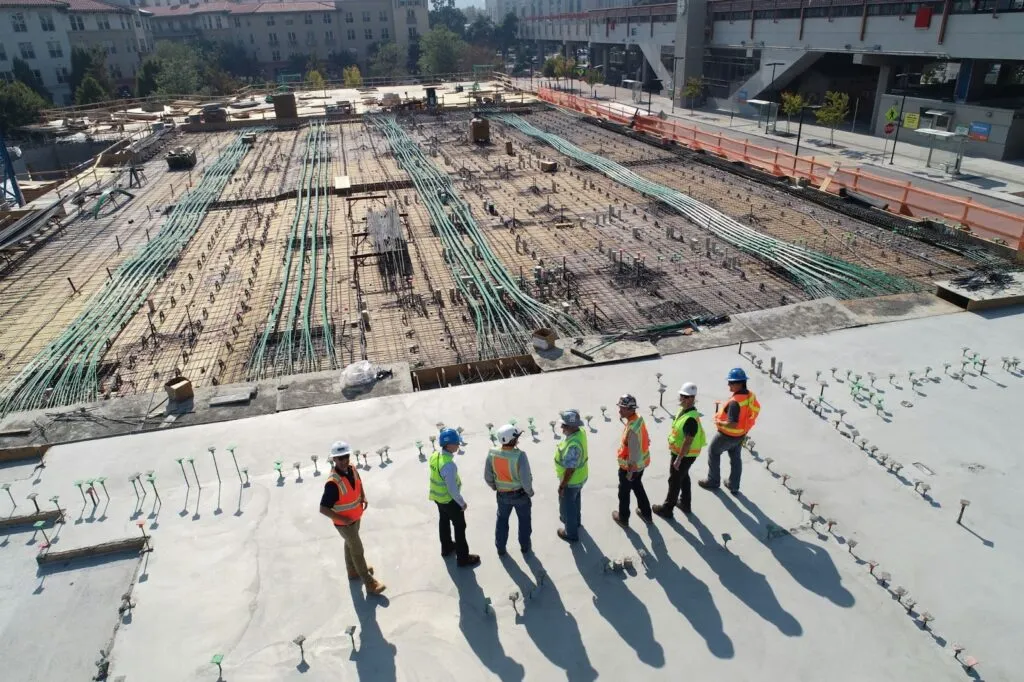
While basic AI follows rules, generative AI in construction actually creates new solutions. It’s the difference between a system that tracks your schedule and one that suggests a brand-new, more efficient schedule you hadn’t considered.
Generative design allows architects and engineers to input constraints, like budget, site size and local covenants, and have the AI generate dozens of optimised floor plans. It’s also being used for scenario modelling: “What happens to our timeline if the concrete delivery is delayed by four days?” Generative AI provides the answer and the solution instantly, assisting with complex documentation and reducing the admin drag that keeps site managers in the trailer instead of on the floor.
AI tools for construction management: what employers should look for
The market is flooded with tech, but not all of it is built for the dust and dirt of a real site. When evaluating AI tools for construction management, employers need to look for three things:
- Integration: Does it play nice with your current project management software?
- Scalability: Can it handle a small residential renovation and a massive commercial high-rise?
- User experience: If your site foreman can’t figure it out on a tablet in 30 seconds, they won’t use it.
Look for platforms that combine scheduling, cost management and AI in HR to get a 360-degree view of your business health.
AI for construction workforce management: Hiring, scheduling and retaining site teams
The biggest challenge in Australian construction today isn’t tech, it’s people. AI for construction is now a critical part of workforce strategy, helping employers find and keep the talent they need to actually finish the job.
Using AI to recruit and onboard construction workers
Our research shows 41% of Australian businesses cite poor-quality applicants as a top hiring challenge, while 40% struggle to find qualified candidates at all. AI-assisted recruitment tools help construction firms screen hundreds of applications for trades and site staff in seconds, matching candidates to project requirements based on certifications and experience.
Once hired, AI-driven onboarding makes sure every worker understands site safety protocols before they pick up a tool, which is critical in an industry where compliance isn’t optional.
Employment Hero’s AI Recruitment Agent automates the most time-consuming part of hiring: first-round screening. It conducts structured AI-led video interviews, scores candidates against the same criteria every time and delivers a pre-vetted shortlist; saving considerable time off the hiring process. For construction businesses hiring at scale, that’s a significant competitive advantage.
The skills construction employers are now hiring for
The modern construction worker needs more than just a trade ticket. We are seeing a massive shift in AI in the workforce, where digital literacy is becoming a core requirement. Employers are now prioritising site managers who are comfortable with data-informed decision-making and can work alongside AI-powered tools.
Challenges construction employers face when adopting AI
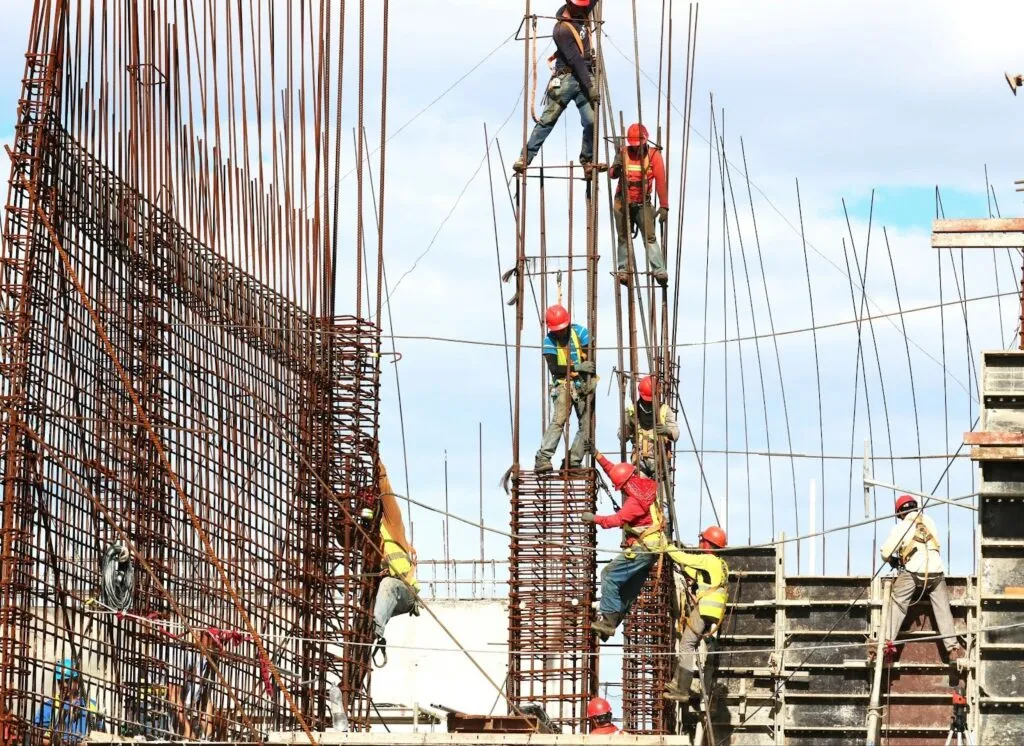
It’s not all smooth sailing. Adopting AI in a multi-party construction environment is complex.
- Upfront investment: High-quality AI tools aren’t cheap and the ROI can take a few project cycles to show up.
- Workforce resistance: Some old school crews may be skeptical of technology telling them how to work.
- Data quality: AI is only as good as the data you feed it. If your past project records are a mess of paper notes, the AI will struggle.
- Compliance: Employers must make sure they’re using AI right by following Australian privacy and compliance standards, especially when monitoring site workers.
The future of AI in Australian construction: what forward-thinking employers should prepare for
We are heading toward a world of AI-native construction. Imagine a site where autonomous equipment operates safely alongside human crews, guided by a central AI that manages the entire project’s digital twin in real time.
Predictive workforce planning will become the standard, where you’ll know you need three extra electricians six months before the wiring even starts. Proactive employers should be investing in their digital infrastructure now. The firms that win the next decade will be the ones that stop viewing tech as an extra and start viewing it as the foundation of every build.
Build a smarter workforce with AI and Employment Hero
The shift toward AI isn’t about replacing the skilled tradespeople who make the construction industry what it is. You want to give them the tools to work safer, faster and more efficiently. By letting technology handle the scheduling and the data-crunching, you give your team the breathing room to do their best work.
At Employment Hero, we’re here to help you navigate this transition. From smarter recruitment to automated payroll that actually works for site-based teams, our platform is designed to take the admin weight off your shoulders.
Want to see how our AI-enhanced HR and payroll can save your construction company time?
Related Resources
-
 Read more: AI skills assessment template for your team
AI skills assessment template for your team
Help your team build their AI skills. Download our free AI skills assessment template for managers and employees.
-
 Read more: The AI Adoption Blueprint
The AI Adoption Blueprint
What does it take to embed AI across an entire team? We’re sharing our training, our policies, and the lessons…
-
 Read more: Employment Essentials: AI Best Practices
Employment Essentials: AI Best Practices
Learn how to use AI in HR without creating privacy, compliance or employment risks in our latest webinar.


