 New Zealand
  United Kingdom
  Singapore
  Malaysia
  Canada (Français)
 Australia

AI performance reviews: How to use AI to give better feedback

Contents
Performance reviews take more out of managers than most businesses realise. Pulling together months of notes, writing fair and specific feedback for a whole team, getting the tone right for difficult conversations… It’s a lot of work and it all lands at once.
AI doesn’t fix the conversation, but it can take most of that prep work off your plate. When managers are better prepared, the conversations are better and so are the outcomes.
Here’s what Australian employers need to know including what AI can and can’t do in a performance review, where the guardrails are and the prompts that will save you hours.
What AI does in a performance review
AI in performance management is a drafting and analysis tool. It doesn’t evaluate your people, decide who gets promoted or who needs a performance improvement plan. That’s still your call and under Australian workplace law, it has to be.
What AI does well is the admin that slows managers down like synthesising information, finding the right language and flagging inconsistencies in how feedback is written. Here are the five applications of AI at performance review time worth your attention.
Synthesising 360 feedback
When five or six people contribute feedback on the same employee, you end up with something that’s contradictory, repetitive and hard to distil. AI can pull out the consistent themes quickly, so you walk into the conversation with a clear picture instead of a pile of notes you’ve barely had time to read.
Drafting review language
Most managers aren’t trained writers. Translating “this person is technically strong but creates friction in the team” into fair, professional, actionable feedback takes skill and doing it ten times in a row, for ten different people, is challenging. AI produces a solid first draft based on the facts you give it. Your job is to make it accurate and human.
Flagging potential bias
AI can scan written feedback for patterns that suggest bias such as gendered language, feedback that focuses on personality rather than outcomes, inconsistent tone between different team members. It won’t catch everything, but it catches things a busy manager running on five hours of sleep at the end of a long review cycle easily misses.
Tracking goal progress over time
With the right platform, AI can pull together how an employee has tracked across review cycles. This could include taking a look at where they’ve grown, where they’ve plateaued and where goals were set but have ended up abandoned. That longitudinal view is something most managers struggle to reconstruct from memory.
Employment Hero’s AI-powered platform does exactly this by tracking goals and performance across review cycles so managers aren’t starting from scratch every time.
Suggesting development goals
Based on the role, the level and the performance data, AI can generate a starting point for SMART goals that you then refine and discuss in the actual conversation.
From annual to continuous: how AI is shifting the feedback model
The annual performance review made sense when tracking and coordinating feedback across a team was difficult. It isn’t anymore and the cost of waiting twelve months to tell someone something important is well understood.
AI tools are making continuous feedback practical, not just theoretically preferable. They can prompt managers to check in more regularly, flag when performance signals shift between formal review cycles and build up a running record that makes year-end reviews a summary instead of a rush. The result is that performance conversations stop being a high-stakes annual event and start becoming a regular habit, which is where development actually happens.
Employment Hero’s 1:1 tools, continuous feedback features and goal tracking are built around this, so the formal review becomes a summary of an ongoing conversation, not a one-off event.

How to use AI safely in performance reviews
The efficiency gains are real, but so are the risks and in Australia, where employment law is specific and well-enforced, getting it wrong has consequences.
Four rules should be non-negotiable:
1. Never put real employee names or identifying information into public AI tools
Free, consumer-grade AI tools are not built to handle confidential HR data. If you’re typing an employee’s name, salary, performance rating or personal circumstances into ChatGPT or a similar public tool, you’re creating a genuine privacy and legal risk. Only use tools covered by your organisation’s data agreements and confirm that everything aligns with your AI usage policy.
2. Treat every AI output as a draft, not a final product
AI produces a strong starting point, however, it doesn’t know that this particular employee has been dealing with something difficult outside work or that the feedback about their communication style needs careful framing given what happened in the team last month. You do. This is where you need to review, edit and personalise everything before it goes to the employee.
3. Be transparent with your team
If AI is informing how their review is written or structured, employees should know that. In a workplace environment where Australian workers are increasingly focused on fairness and what they value from their employers, trust is important. Employees finding out after the fact that a tool shaped their performance review, without anyone mentioning it, could do some damage.
4. Final decisions are human decisions
Ratings, pay outcomes, promotions and performance improvement plan decisions should not be the output of an AI tool. AI informs the process, but a person needs to make the call. That accountability has to sit somewhere specific and under the Fair Work Act, it sits with you.
| What AI can do | What must stay human |
| Draft review language | Final ratings and scores |
| Synthesise feedback themes | Pay and promotion decisions |
| Flag potential bias in writing | Disciplinary outcomes |
| Suggest development goals | The performance conversation itself |
| Track goal progress over time | Context, empathy and judgment |

What about data privacy?
It’s worth spending some time on this because it catches more Australian employers off guard than you’d expect.
When you’re using AI tools in your performance review process, you’re handling sensitive employee information. This could include ratings, feedback, development notes and sometimes personal context. That data needs to stay inside the systems your organisation has approved and controls themselves. Typing it into a free, public AI tool is the kind of thing that creates problems if something goes wrong down the track.
You need to be sure you’re only using HR tools that your IT and legal teams have signed off on. If you’re not sure whether a tool is covered by your organisation’s data agreements, treat that as a no until you’ve confirmed otherwise. Employment Hero’s platform is built to Australian compliance standards, so if you’re running performance reviews through us, that question is already answered. You can learn more in our Trust Centre.
How to reduce bias in performance reviews using AI
Bias in performance reviews is common and almost always unintentional. It’s largely a reflection of how brains work under time pressure, with incomplete information, across a large group of people. AI doesn’t eliminate it, but it can surface patterns that are otherwise invisible to the person who created them.
Here’s what it can help detect:
Recency bias
Weighting the last few weeks heavily while earlier performance fades. This is one of the most common review errors. If someone had a strong September but a quiet October, then October tends to dominate. AI that tracks feedback over time can flag when a review looks disproportionately shaped by recent events.
The halo effect
When strong performance in one area colours the whole review. An employee who is exceptional with clients doesn’t automatically deserve high marks across every competency. AI can flag where ratings or language look inconsistently positive across the board.
Inconsistent tone across your team
If feedback for one group of employees consistently reads more critical, less specific or shorter than feedback for others, that’s worth investigating. AI can identify these patterns at scale in ways a manual review process simply can’t.
Personality over outcomes
Feedback focused on how someone “comes across” instead of what they’ve delivered is both less useful and more likely to reflect personal bias. AI can flag when a review is heavy on adjectives and light on actual evidence.
One caveat worth knowing is that AI is only as good as what you feed it. If you’ve historically produced feedback with certain patterns, prompting an AI tool with that feedback will replicate those patterns. Bias-checking with AI is a useful additional layer. It works alongside human calibration, consistent rubrics and a structured review process, not instead of them.

AI performance review prompts: how to write them well
The quality of your output depends almost entirely on the quality of your prompt. Vague in, vague out.
A prompt that works includes
- The employee’s role (not their name)
- The review period
- Specific facts and examples
- The tone you want
- A clear output format
Give AI those five things and you’ll get something useful. Give it nothing and you’ll get something that reads like it was written for no one.
If you’re using Employment Hero, these prompts work alongside our built-in review templates, so you’re not starting from a blank page.
Here are eight copy-paste-ready templates for the scenarios Australian managers face most often. All examples use role title, not employee name.
1. High performer recognition
“Write a performance review summary for a Senior Account Manager who exceeded their sales target by 22% this quarter, brought in three new enterprise clients and mentored two junior team members. Tone: warm and specific. Output: three paragraphs covering results, behaviours and development areas.”
2. Steady performer with a development area
“Draft a performance review for a mid-level Marketing Coordinator who consistently meets deadlines and produces reliable work, but has struggled to take initiative on projects without direction. Highlight the strengths first, then introduce the development area constructively. This is a growth conversation. The tone should reflect that.”
3. Underperformer: difficult conversation
“Write a performance review for a Customer Support Specialist who has missed their response time targets for three consecutive months and received two formal customer complaints. Tone: direct and fair, focused on specific behaviours and outcomes rather than personality. Include language that opens the door to a support conversation. This review may be referenced if formal action is required, so it needs to be factual and specific.”
4. New hire 90-day review
“Draft a 90-day check-in for a junior Software Developer who has integrated well with the team and shown strong technical ability, but is still building confidence in asking for help when stuck. Frame this as an early-career development conversation, not a formal evaluation. Output: a short summary plus three development focus areas for the next 90 days.”
5. Self-evaluation preparation
“Help me write a self-evaluation for a Product Manager ahead of their annual review. They led two successful product feature launches, navigated a difficult stakeholder relationship well and want to flag readiness for a more senior role. Tone: confident but grounded. Format: structured around achievements, learnings and goals.”
6. Manager reviewing a manager
“Write a performance review for a Team Lead managing a team of six. They’ve maintained strong morale through a period of organisational change and have solid individual relationships, but their team meetings are poorly structured and feedback to direct reports is inconsistent. Include specific, actionable development suggestions.”
7. Bias-checking existing written feedback
“Review the following performance feedback for language that may reflect bias, including gendered language, focus on personality over outcomes or inconsistent framing compared to a results-focused standard. Flag specific phrases and suggest alternatives. [Paste feedback here.]”
8. Generating SMART goals from performance data
“Based on the following performance summary for a Finance Analyst, suggest three SMART development goals for the next six months. Goals should be specific, measurable and realistic for someone at this level. Reference the Australian context where relevant. [Paste performance summary here.]
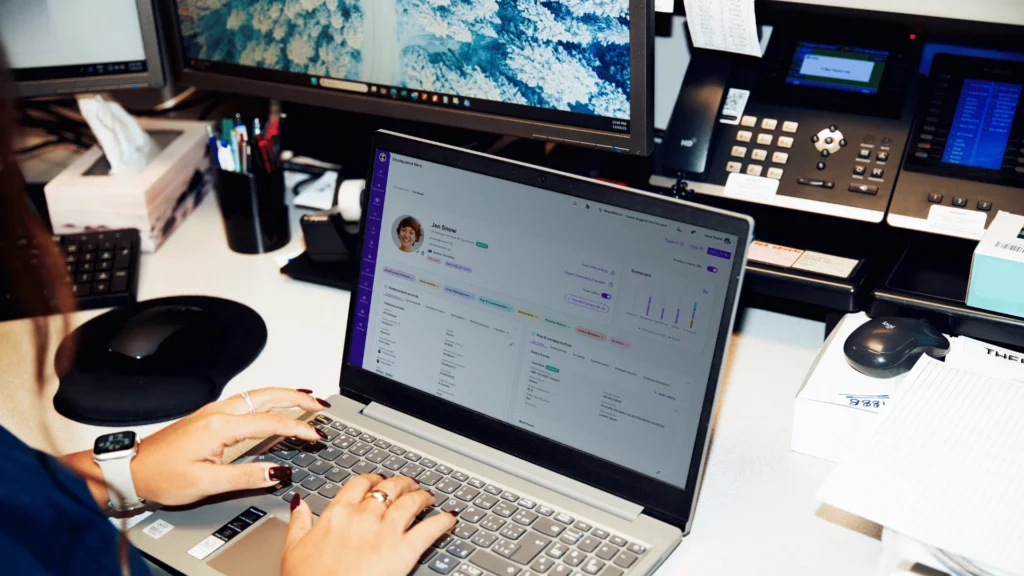
Performance review templates by role and how AI helps you customise them
A generic performance review template is better than nothing, but a customer service rep in a retail business, a software developer at a tech company and a sales manager in professional services require fundamentally different evaluation criteria. A template built to cover everyone ends up being useful for no one.
The failure mode is predictable. Managers either bend the criteria to fit the employee, which undermines consistency or they evaluate the employee against criteria that doesn’t actually match their role, which undermines fairness and accuracy.
AI solves this without requiring managers to start from scratch for every review. Starting from a structured template, a prompt like “Adapt this review template for a senior operations role where the key performance criteria are process improvement, cross-functional collaboration and meeting compliance deadlines” takes thirty seconds and produces something far more relevant than a generic form. The structure stays consistent and the criteria becomes more meaningful.
Employment Hero’s performance management tools include customisable review templates that can be tailored by role, level and review type. This, paired with AI prompts, gives managers a head start without cutting corners.

The human element AI cannot replace
The concern we hear most from HR managers is “Will AI make performance reviews feel impersonal?” Only if you let it.
That’s not what AI is for. The performance conversation that has real outcomes (where an employee genuinely understands where they stand, feels heard and walks away knowing what comes next) is where real development happens. That conversation can’t be automated and it shouldn’t be.
Here’s what has to stay human in the performance review process.
Empathy: An employee’s output this quarter might look underwhelming on paper. The manager who knows they’ve been dealing with a health issue, a difficult period in the team or a project that fell apart through no fault of their own can frame that conversation in a way no AI can.
Context: Performance data doesn’t capture the person who held the team together during a rough patch or who did reliable, unglamorous work all year without recognition. That context belongs in the review and it comes from the manager knowing their people.
Accountability: AI can help you document consistently and communicate clearly, but the decision about what happens to someone’s role, pay or future at your business has to be made by a person who knows the full picture and is prepared to stand behind it.
The conversation itself: The best performance reviews happen when managers are prepared, focused and completely present. Employment Hero’s AI-enhanced HR platform handles the process, so you can focus on the people.
Ready to make performance reviews work harder for your business?
If your team is still running review cycles on spreadsheets or your managers are going into review conversations underprepared, there’s a better way to do it.
Employment Hero gives Australian employers the tools to run performance management properly with customisable review templates, goal tracking, continuous feedback features, 1:1 management and a 9-box talent grid, all in one platform. Take a look at our full suite of performance management features.
Employment Hero supports over 350,000 businesses worldwide and performance management is one of the reasons they stay. If you’re ready to run reviews that actually move the needle, talk to our team today.
Related Resources
-
 Read more: AI skills assessment template for your team
AI skills assessment template for your team
Help your team build their AI skills. Download our free AI skills assessment template for managers and employees.
-
 Read more: The AI Adoption Blueprint
The AI Adoption Blueprint
What does it take to embed AI across an entire team? We’re sharing our training, our policies, and the lessons…
-
 Read more: Employment Essentials: AI Best Practices
Employment Essentials: AI Best Practices
Learn how to use AI in HR without creating privacy, compliance or employment risks in our latest webinar.


