 Australia
  New Zealand
  Singapore
  Malaysia
  Canada (Français)
 United Kingdom







Permanent hiring in the UK stopped shrinking in July, ending a downturn sustained since Liz Truss resigned in 2022, according to a new report.
The monthly index from accounting giant KPMG and the Recruitment and Employment Confederation (REC) trade body shows hiring for permanent roles hit 50.0 in July, up from 49.1 the month before. The figures, compiled by S&P Global from responses to questionnaires sent to around 400 UK recruitment and employment consultancies, outline the depth of sustained decline the job market has seen in recent years, with no such uplift seen for 45 consecutive months.
The survey of UK recruitment consultancies, conducted by KPMG and REC found permanent hiring growth concentrated in London and the Midlands in July, with growth in the capital hitting a near four-year high, while permanent placements kept falling in the South and North of England.
But Employment Hero’s payroll data, drawn from 140,000 employee records across small businesses (SMEs) and covering all contract types, expands on this pattern.
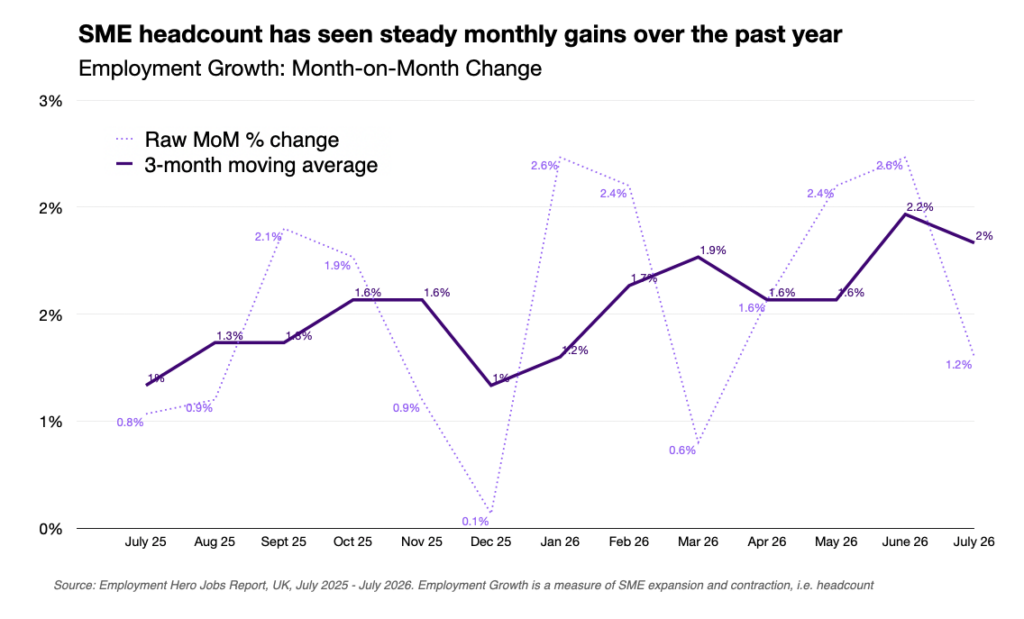
Its platform data points to a steadier trend than the recruiters’ survey alone suggests, with month-on-month employment growth climbing consistently since the start of 2026. July’s regional figures also show that in the South of England, excluding London, employment growth reached 2.5% month-on-month, with the North recording 1.8% and London 0.8%. Full-time wage growth in the North, meanwhile, hit 3.2% that month, compared with 0.2% in London.
Kevin Fitzgerald, UK Managing Director at Employment Hero, suggests the regional figures highlight “a strong community of SMEs who are willing to hire and power regional growth”. He points out that without sustained support – beyond what’s already been announced since Andy Burnham’s premiership began in late July – meaningfully moving the needle on employment growth may prove difficult.
“It’s crucial that we now maintain that momentum through supporting SMEs to create employment opportunities,” he adds.
Job Vacancies Are Still Falling, Just More Slowly
While positive employment gains are encouraging, stability isn’t quite the same as recovery. KPMG and REC’s broader snapshot of the UK jobs market shows permanent vacancies fell at a slower, but still solid rate in July. Employment Hero’s data shows a similar picture within retail and hospitality specifically: year-on-year employment growth in the sector sat at just 0.4% in May 2026, against 10.1% the year before.
On temporary hiring, however, demand rose for the first time in two years. Meanwhile, the revenue recruitment agencies earn from placing temporary staff grew at close to their fastest pace in three years, with recruiters pointing to employers turning to flexible staffing before committing to permanent headcount.
Where Small Businesses Are Already Hiring
Beyond region, sector-specific insights from Employment Hero show where this employment growth is landing among SMEs. Employment growth in construction was 6.5% in July versus three months prior, a growth figure more than double of that seen in the first quarter of 2026. Banking and finance, meanwhile, moved in the opposite direction over the same period, with employment down 3.7% versus three months ago and wages falling 4.9% year-on-year, the only sector in Employment Hero’s data to register a pay decline.
KPMG and REC’s report also found starting salaries for permanent hires rising at their fastest pace in six months in July, meaning the cost of hiring is moving before confidence has fully caught up.
Maxine Bligh, Chief Membership and Innovation Officer at the Recruitment and Employment Confederation, stresses that the figures make an even stronger case for the government to focus on building “business confidence and momentum in hiring.”
“This means action to bring the Industrial Strategy to life and exercising pragmatism around the implementation of the Employment Rights Act, particularly guaranteed hours proposals,” she adds.
As the past few years have shown, the job market’s volatility isn’t quite yet in the rear view. Without the action employers need, the confidence behind these figures could reverse.
Pointing out that this unevenness is exactly what small businesses need clarity on, Kevin added: “With a date set for the Autumn Budget, the onus is now on the Prime Minister to provide these businesses with the certainty needed to restore confidence and unlock the true potential of the UK labour market.”