 New Zealand
  United Kingdom
  Singapore
  Malaysia
  Canada (Français)
 Australia




Superannuation clearing house: What employers need to know
Published
Superannuation clearing house: What employers need to know
Published
Running a business is challenging enough without losing hours to the manual management of superannuation payments. If you employ people in Australia, staying on top of super is a non-negotiable part of your compliance obligations. However, the way you handle these contributions can be the difference between an admin headache and a smooth, automated workflow.
With major changes coming 1 July 2026, including Payday Super and the closure of the ATO’s Small Business Superannuation Clearing House (SBSCH), now is the perfect time to rethink your payroll setup.
What is a superannuation clearing house?
A superannuation clearing house is a platform that lets employers pay super contributions for all their employees in one go. Instead of logging into multiple different super funds and making individual transfers, you make one single payment to the clearing house. The clearing house then distributes the money to your employees’ nominated funds.
Think of it as a sorting office for your super payments. It takes the heavy lifting off your plate, reduces errors and supports your compliance with Australian law.
How It works under SuperStream
Under the government’s SuperStream system, employers must pay super and send employee data electronically in a standard format. A clearing house handles this.
Here’s the standard process:
- You upload a payroll file containing your employee’s details and contribution amounts.
- You make a single electronic payment to the clearing house.
- The clearing house automatically splits and sends the money to the multiple super funds.
It’s that simple. Making payments this way means you don’t need to juggle direct entry details for every single fund.
One important rule to be aware of is that a contribution is only considered ‘paid’ on the date it is received by the super fund, not the date it is received by the clearing house. If you use a commercial clearing house, allow enough processing time before the quarterly due date, don’t submit on the last day and assume you’re covered.

Clearing house vs paying each fund individually
Why not just pay each fund directly? If you only have one or two employees who happen to share a default super fund, you might get away with it. But as your team grows, paying individually becomes a nightmare.
Using a clearing house means:
- Time saved: One transaction instead of twenty.
- Fewer errors: Automated data matching stops payments from bouncing back.
- Better records: You get a complete history of all transactions in one place.
Paying individually means manually entering data, risking compliance breaches and wasting hours you could spend on other important tasks.
Closure of the Small Business Superannuation Clearing House (SBSCH)
For years, many small businesses have relied on the ATO’s free SBSCH; available to businesses with 19 or fewer employees or an annual aggregated turnover of less than $10 million. However, with the new Payday Super reform on the way, the government is phasing out the small business superannuation clearing service.
Closure dates and transition period
The SBSCH closed to new users on 1 October 2025. By 1 July 2026, the service will fully close for everyone. Under Payday Super, contributions must reach the employee’s super fund within 7 business days of payday. If you currently use the SBSCH online through the ATO, you’ll need to change your processes and systems.
Importantly, you must also download your SBSCH transaction history before 1 July 2026. Once the service closes at 11:59pm AEST on 30 June 2026, you will no longer be able to access or download records.
What this means for employers
You can no longer rely on the ATO’s portal to pay super. You must transition to a commercial super clearing house or adopt payroll software with built-in clearing functionality. Whether you manage this yourself or rely on a registered tax professional, you need a solution ready before the deadline.
Importantly, the ATO has issued a compliance guideline (PCG 2026/1) outlining a risk-based approach for the first year of Payday Super (1 July 2026 – 30 June 2027). Employers who genuinely attempt to pay on time and promptly correct errors are likely to be treated as low-risk. Learn more about the compliance guideline here.
Did you know that HeroClear is Australia’s first embedded super-clearing solution designed specifically to manage the Payday Super reforms? HeroClear is built directly into your Employment Hero Payroll workflow, making it easy to manage everything from one place.
How to choose a clearing house
Don’t wait until the last minute to find an alternative to the ATO online services. Here is what you should look for.
SuperStream compliance and data standards
Your chosen solution must be strictly SuperStream compliant. It needs to handle all required data standards seamlessly, whether an employee uses an industry fund or a self-managed fund.
Validations and error handling
Look for a system that checks employee details before you hit send. If an employee provided an incorrect member number, the system should flag it immediately, saving you from sorting out bounced payments later.
Integration and automation capabilities
The best clearing house is one you barely notice. When your clearing house is built into your payroll software, calculating super and transferring the funds happens in the exact same workflow.

Employment Hero is supporting businesses through Payday Super
Our all-in-one Employment Operating System has automated super payments built right into the payroll workflow. You run payroll and with a few clicks, your super contributions are calculated, batched and sent off. We act as your integrated clearing house solution, securely splitting and allocating funds to the right places.
As the SBSCH winds down and Payday Super comes into effect, we’re helping Australian employers transition without the stress. Want to learn more? Get in touch with one of our business specialists today.
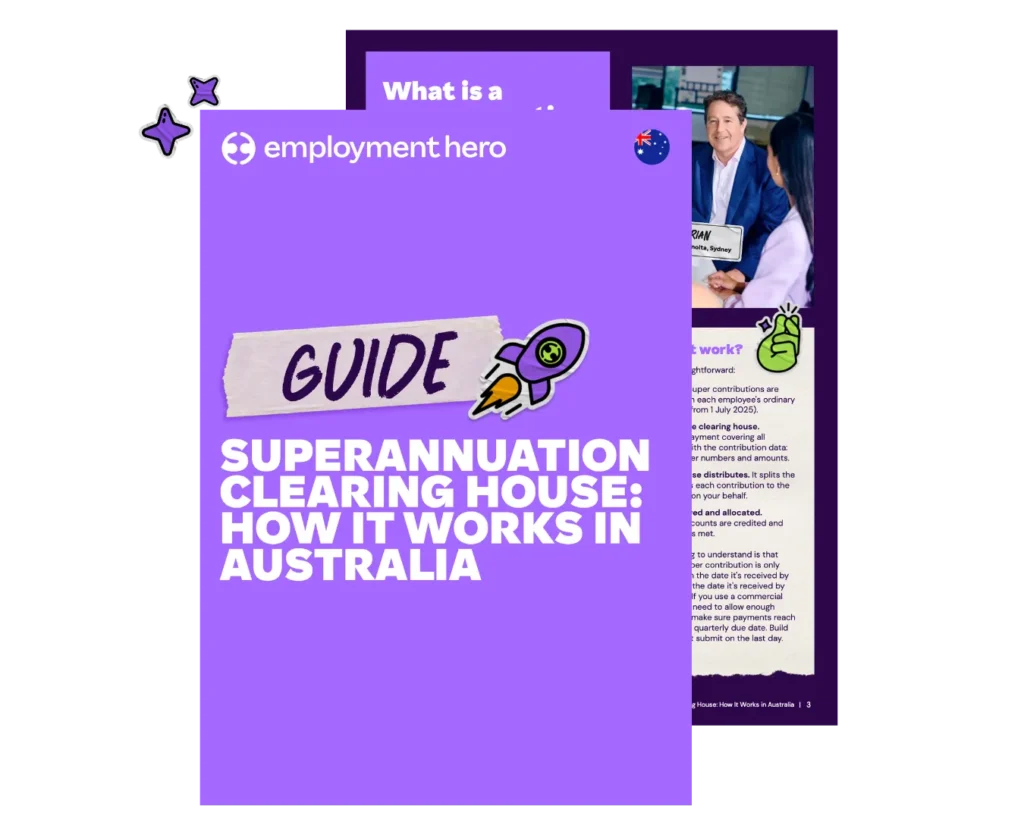
Download the Superannuation Clearing House Guide
Ready to ditch the admin and future-proof your payroll?
Disclaimer: The information in this guide is current as at 26 March and has been prepared by Employment Hero Pty Ltd (ABN 11 160 047 709) and its related bodies corporate (Employment Hero). The views expressed in this guide are general information only, are provided in good faith to assist employers and their employees and should not be relied on as professional advice. The Information is based on data supplied by third parties. While such data is believed to be accurate, it has not been independently verified and no warranties are given that it is complete, accurate, up to date or fit for the purpose for which it is required. Employment Hero does not accept responsibility for any inaccuracy in such data and is not liable for any loss or damages arising either directly or indirectly as a result of reliance on, use of or inability to use any information provided in this guide. You should undertake your own research and to seek professional advice before making any decisions or relying on the information in this guide.
Register for the guide
Related Resources
-
 Read more: AI skills assessment template for your team
AI skills assessment template for your team
Help your team build their AI skills. Download our free AI skills assessment template for managers and employees.
-
 Read more: The AI Adoption Blueprint
The AI Adoption Blueprint
What does it take to embed AI across an entire team? We’re sharing our training, our policies, and the lessons…
-
 Read more: Employment Essentials: AI Best Practices
Employment Essentials: AI Best Practices
Learn how to use AI in HR without creating privacy, compliance or employment risks in our latest webinar.


