

















Staff engagement plan template and guide
Published
Staff engagement plan template and guide
Published
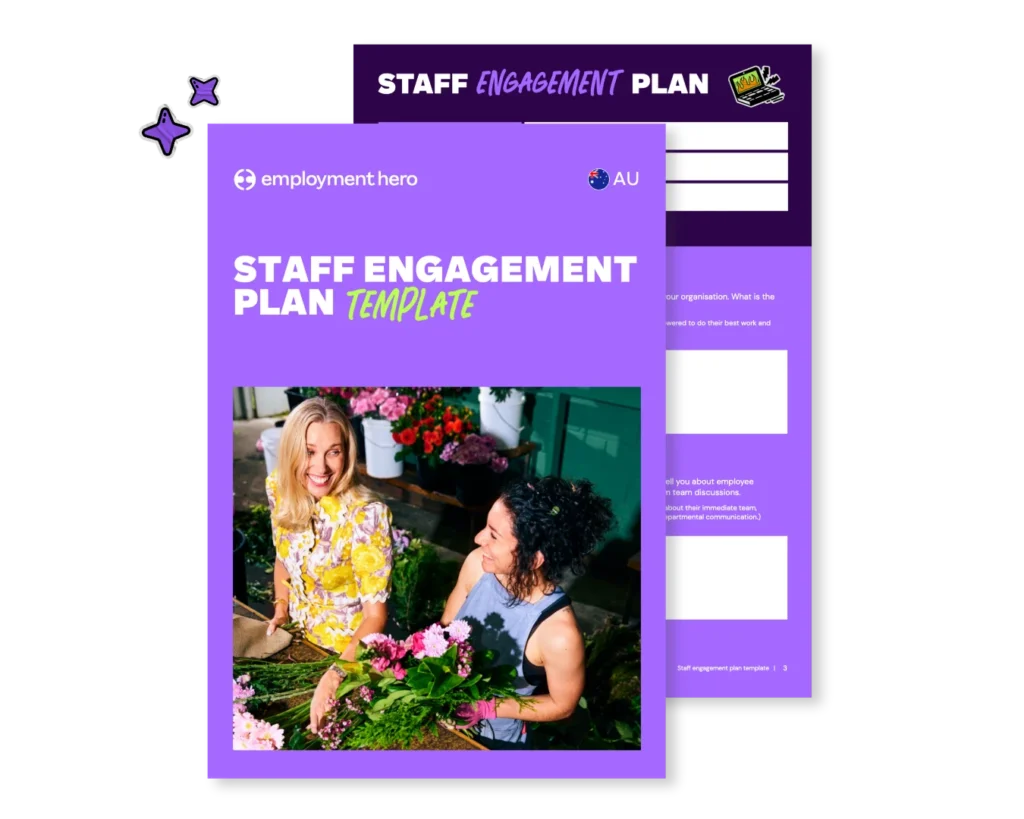
The most successful Australian businesses share a common secret: high engagement. When a team feels truly heard and deeply connected to the “’why”behind their work, productivity comes naturally. It’s the difference between a team that just works and a team that innovates together.
If you’ve ever looked at a survey and wondered how to turn “we want more transparency” into a meaningful action, that transition is where the magic happens.
We’re providing a clear, practical roadmap to help you build strong engagement, which you can start using today.
What’s in the guide?
We’ve created this template to be a practical tool for any Australian business. Use it to build a structured plan that fits your unique team and culture.
In here, you’ll have space to fill out:
- Your engagement vision
- A current state analysis
- Your key focus areas
- An action plan
- Measurement and reporting metrics
Download the template now by filling out the form on the right hand side.
What is an employee engagement plan?
Think of an employee engagement plan as a documented strategy that outlines exactly how you will improve the employee experience based on feedback.
It’s a deliberate set of actions designed to address specific pain points, like communication gaps, lack of recognition or unclear career paths that have been identified by your team. It connects the dots between what your employees need and what your business needs to grow.
How to conduct an employee engagement survey
Before you can fix anything, you need to know what’s broken.
When done right, it moves beyond a complaint box and becomes a strategic roadmap for retention and growth. Here’s some important things to remember when creating and distributing your employee engagement survey.
Guarantee absolute anonymity
True honesty only happens when your team feels psychologically safe. If an employee thinks their feedback can be traced back to them, they’ll give you safe answers instead of the raw truth.
To protect your people and your data, adopt the rule of five. This means never viewing specific results for teams with fewer than five respondents. By using a secure HR platform to aggregate results, you encourage the kind of radical candor that helps you improve.
Beat survey fatigue with pulse checks
We’ve all been there: a 50-question annual marathon that people rush through just to get back to their work.
When respondents get bored, data quality nosedives. The modern way to stay connected is through pulse surveys. Instead of one giant survey once a year, send out short, 5-to-10-minute checks every quarter or month.
This agile approach allows you to see the immediate impact of a new policy or a change in leadership in real-time, rather than reacting to a problem that’s already twelve months old.
Ask the questions that actually matter
Surface-level questions about office snacks or Friday drinks don’t drive business results. If you want to master engagement, you need to measure what matters.
Focus on questions that get to the heart of why people stay or leave. Instead of asking if they’re happy, ask: “Do you see a clear future for yourself here in two years?” Instead of asking if they like their manager, ask: “Does your manager provide the resources and recognition you need to succeed?” These are the insights that reveal the structural integrity of your culture.
Close the loop and take action
The fastest way to kill engagement is to ask for feedback and then offer nothing but radio silence. If your team doesn’t feel heard, they’ll stop talking. High-performing leaders share a summary of the findings including the good, the bad and the ugly.
The gold standard here is following a ‘you said, we did approach’. For every major pain point identified, commit to one tangible action. If the team says communication is messy, announce a new monthly All-Hands meeting. By turning feedback into a catalyst for change, you prove that your team’s voice has real power, fostering a culture of mutual respect and continuous improvement.
In summary, to run a successful survey:
- Keep it anonymous: If you want the truth, you have to protect identities.
- Keep it short and frequent: Survey fatigue is real. If it takes more than 10 minutes, you’re losing data quality.
- Ask the hard questions: Don’t just ask “Do you like the coffee?” Ask “Do you see a future here?” and “Do you feel valued by your manager?”
- Take action: Let your team know that you’re taking action based on their feedback.
Using dedicated employee engagement software like Employment Hero can automate this process, allowing you to take the pulse of your organisation regularly without the admin headache.

Decide on your employee engagement initiatives
Once the data is in, resist the urge to fix everything at once.
Look for the common threads. Is the biggest issue a lack of career progression? Or is it burnout? Pick 2-3 high-impact initiatives to focus on for the next quarter.
Examples of initiatives:
- Issue: “I don’t know how I’m performing.” -> Initiative: Implement weekly 1:1 check-ins.
- Issue: “I feel undervalued.” -> Initiative: Launch a peer-to-peer recognition program.
- Issue: “I’m burned out.” -> Initiative: Review resource allocation and introduce “meeting-free Wednesdays.”
Establish milestones to monitor progress
Here, something like “improving culture” is too vague. You need milestones that are concrete and crystal clear.
If your initiative is to improve professional development, a milestone might be: By Q3, 100% of staff will have a personal learning budget and a documented career pathway.
Milestones keep things moving when the daily grind tries to take over. They also give you something to celebrate along the way.
Analyse survey results
Don’t get lost in the raw numbers. An engagement score of 7/10 is not helpful without the right context.
Look for patterns across demographics.
- Are your sales teams highly engaged while your support teams are struggling?
- Is there a drop in engagement after the two-year mark?
- Do remote employees feel less connected than office staff?
The gold is in the comments. The open-ended responses often tell you why the score is what it is. That’s where you find the real stories that drive your staff engagement plan template.
Follow up
This is the non-negotiable step. You must close the feedback loop.
After the survey, let your team know that you’ve heard them, that these are the top three things you told us and here is exactly what we are going to do about them.
Even if you can’t fix a problem immediately, acknowledging it builds trust. Silence, on the other hand, breeds a much bigger problem.
Staff engagement plan template
You’ve asked your team for feedback. Now it’s time to show them you’re listening. Use this template to sort your survey insights into a clear, prioritised action plan.
Download the free staff engagement template now by filling out the form on the right.

Developing an employee engagement strategy
A strategy is the long game, whereas the plan is the immediate action item. Your overall strategy should be embedded in your company DNA.
This involves looking at the entire employee lifecycle. How do you engage candidates before they are hired? How do you engage them during onboarding? How do you keep them engaged as alumni after they leave?
Your strategy should move you from reactive fixing to proactive culture building. It aligns with your brand archetypes; are you the Hero that supports them or the Challenger that pushes them to grow?
Creating an effective employee engagement plan
An effective plan has three key ingredients:
- Leadership buy-in: If leadership doesn’t understand or value engagement, it’s likely neither will anyone else. Engagement is a leadership responsibility.
- Manager empowerment: Your managers are on the front lines. They need the tools and authority to fix issues for their teams.
- Flexibility: Business changes fast. If a pandemic hits or the market shifts, be ready to write a new one that suits the current reality.
Measuring employee engagement effectively
Survey scores (eNPS) are the headline, but they aren’t the whole story. To get a true reading, you need to look at:
- Retention rates: Are high performers leaving?
- Absenteeism: Is there an increase in sick days?
- Productivity metrics: Is output dropping despite long hours?
- Glassdoor reviews: What are people saying publicly?
Combining these hard metrics with your sentiment data gives you a well-rounded view of your culture.
Using survey data to drive action plans
Data without action is overhead. When you use a staff engagement plan template, you need a framework to prioritise.
Use the impact vs. effort matrix:
- Quick wins (high impact, low effort): Do these immediately. (e.g. fix the broken coffee machine, clarify WFH policy).
- Major projects (high impact, high effort): Plan these carefully. (e.g. salary benchmarking, new HR software implementation).
- Thankless tasks (low impact, high effort): Put these at the bottom of the list.
Employee retention through engagement strategies
It costs significantly more to replace an employee than to keep one.
Engagement is your best defence against turnover. Employees rarely leave solely for money; they leave because they feel stagnant, unappreciated or badly managed.
By using your engagement plan to address these drivers, you can support your top talent through their development.
Conducting employee surveys for actionable insights
Sending out a survey is easy, but asking questions that move the needle is where you make a real impact. The more specific your questions, the more valuable your data will be. General questions give you general answers and leave you in the dark about what actually needs to change.
Ask your people, “Are you happy?” It’s a big, vague question and you’ll get answers that are tough to act on. Instead, flip it and go granular. For example:
- Instead of: “Are you happy at work?” Try: “Do you have the tools and resources to do your job effectively?”
- Instead of: “Is management supportive?” Try: “Can you easily reach out to your manager when you need help or guidance?”
- Instead of: “Is communication good?” Try: “Do you receive clear updates about company changes and goals?”
Specific questions lead to targeted, actionable insights. If 80% of your team says no to having the right tools, you know exactly where to start. You can get stuck into auditing your tech stack. That’s how trust is built and improvements happen.

Building an action plan for employee engagement
Building the plan is a collaborative process. Don’t sit in a room and write it alone.
The roadmap:
- Survey and analysis (weeks 1-2): Gather data.
- Focus groups (week 3): deep dive into specific issues with small groups of staff.
- Drafting the plan (week 4): Use the template above.
- Leadership sign-off (week 5): Get budget and approval.
- Launch (week 6): Communicate to the company.
Setting professional goals to boost engagement
Finally, growth is a massive driver of engagement. If your team feels they are moving forward in their careers, they’re more likely to be more committed to your company.
Your engagement plan must include goal setting. Using a framework like OKRs (Objectives and Key Results) aligns individual ambition with company success. It gives everyone a north star to aim for.
Keen to get started boosting employee engagement? Download the staff engagement plan template now by filling out the form on the right.
The information in this article is current as at 19 February 2026, and has been prepared by Employment Hero Pty Ltd (ABN 11 160 047 709) and its related bodies corporate (Employment Hero). The views expressed in this article are general information only, are provided in good faith to assist employers and their employees, and should not be relied on as professional advice. Some information is based on data supplied by third parties. While such data is believed to be accurate, it has not been independently verified and no warranties are given that it is complete, accurate, up to date or fit for the purpose for which it is required. Employment Hero does not accept responsibility for any inaccuracy in such data and is not liable for any loss or damages arising directly or indirectly as a result of reliance on, use of or inability to use any information provided in this article. You should undertake your own research and seek professional advice before making any decisions or relying on the information in this article.
Register for the template
Related Resources
-
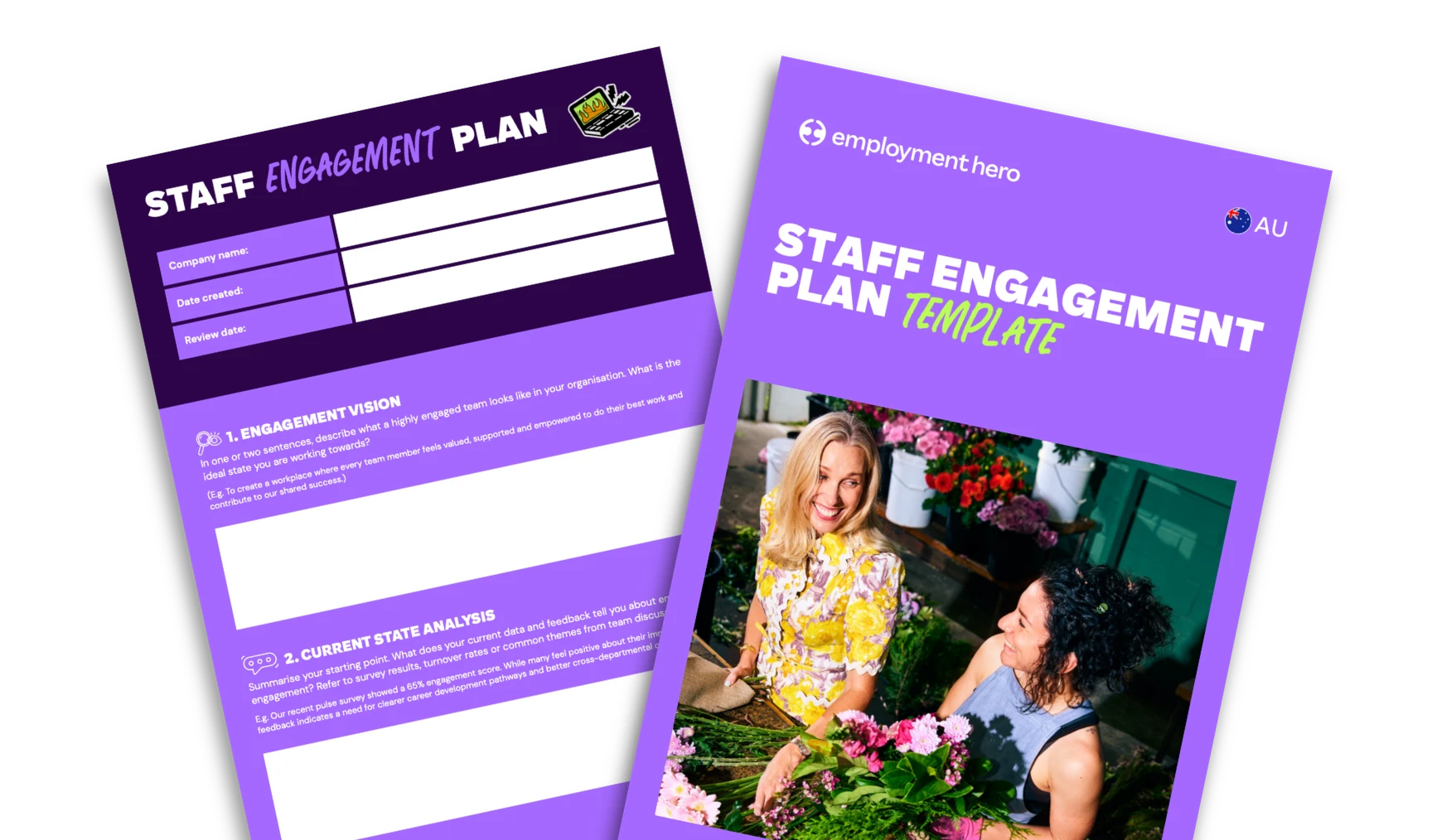 Read more: Staff engagement plan template and guide
Staff engagement plan template and guide
Discover effective strategies for creating a staff engagement plan that drives results. Download our template and guide.
-
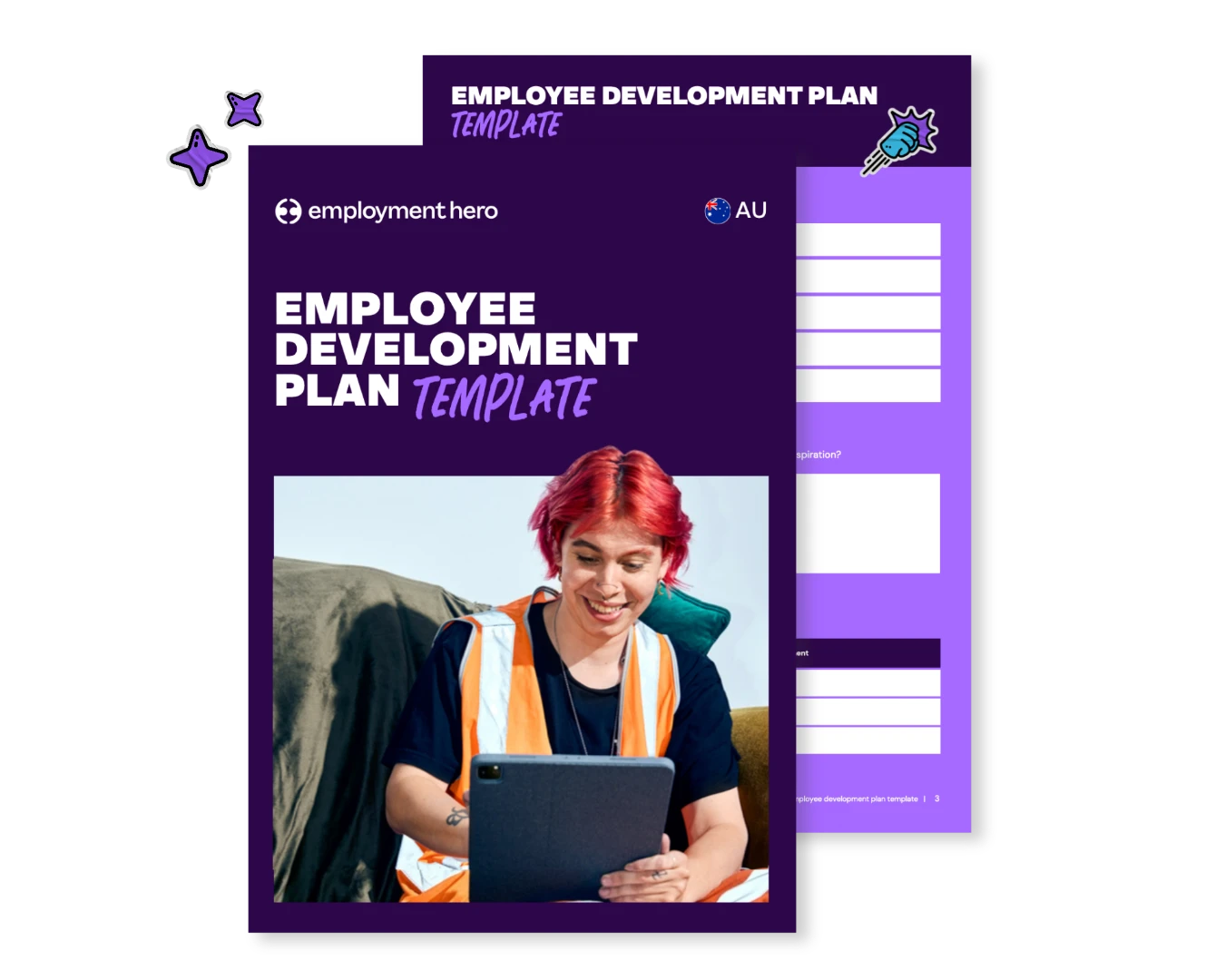 Read more: Employee development plan: Examples and template
Employee development plan: Examples and template
Discover real employee development plan examples, strategic frameworks and a free template to empower growth in your team.
-
 Read more: The Payday Super Shift: 2026 Employer Readiness Report
The Payday Super Shift: 2026 Employer Readiness Report
New research on the cash flow risk and compliance gaps facing Australian employers. Download the report now and access industry…

