 New Zealand
  United Kingdom
  Singapore
  Malaysia
  Canada (Français)
 Australia


Employee Leave Policy Template [Australia]
Published
Employee Leave Policy Template [Australia]
Managing employee leave gets complicated fast without a clear leave policy in place. Ambiguous entitlements, inconsistent approvals and requests that fall through the cracks all create unnecessary headaches for your team and your HR function.
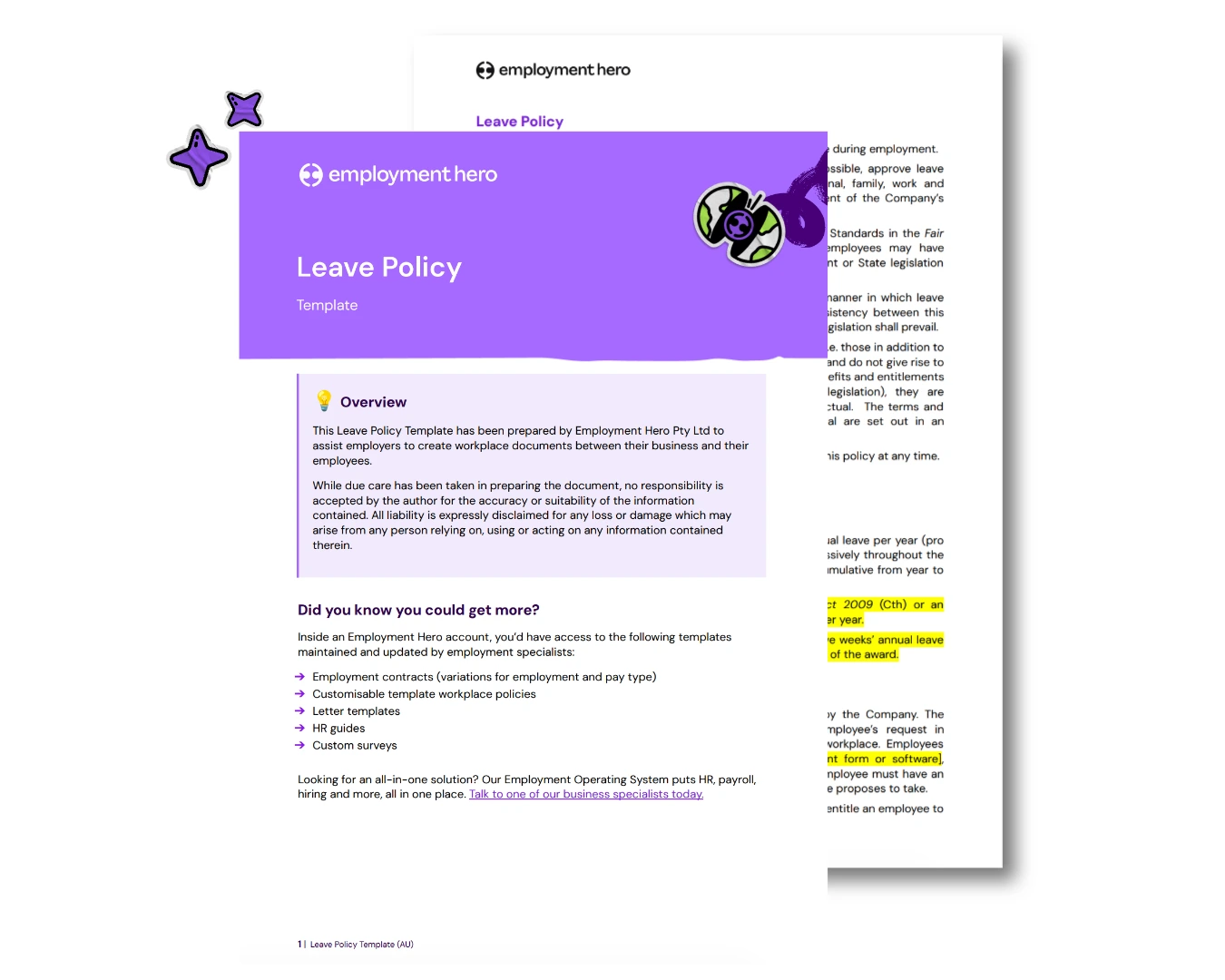
This free employee leave policy template gives you a ready-to-use framework you can customise to your business. Update the highlighted sections to match your requirements and if you need additional support crafting employment documents, our HR Advisory team is here to help.
What is in this leave policy template?
This free employee leave policy template is created to provide your business with everything needed to manage employee time off on a regular basis efficiently and fairly:
- Coverage of all NES leave types including annual leave, personal leave, parental leave, long service leave, compassionate leave, family and domestic violence leave and community service leave
- Leave practices that can be adjusted as your workplace evolves
- A clear approval process for leave requests that works whether you manage leave manually or through payroll software
Download the employee leave policy template now by filling out the form on the right.
What are the different types of leave?
Understanding the different types of leave available to your team is a crucial part of running any Australian business. The National Employment Standards (NES) outlines the minimum leave entitlements you must provide, but your specific employment contracts can include additional benefits.
The following leave types represent the most common entitlements for employees across Australia, in addition to public holidays, which vary by state and territory:
Sick leave or personal leave
A leave policy should cover sick leave (more formally known as personal/carer’s leave) for all eligible Australian employees. This allows time off when employees are unwell or when caring for immediate family members.
Full-time staff receive 10 paid days annually, with part-time employees getting a pro-rata amount depending on their working arrangement. This Fair Work Act entitlement exists to provide employees with address to health needs without employment risks.
Annual leave
All Australian employees are entitled to 4 weeks of annual leave annually, with part-time workers receiving amounts proportional to their hours, and a leave policy must address it.
Annual leave accumulates gradually, and while timing should be discussed with management, employers cannot unreasonably refuse requests. Annual leave is paid and is calculated at the regular base rate, though specific industry awards may specify additional requirements during peak operational periods.
Parental leave
The parental leave section of your leave policy template should detail eligibility requirements and entitlements for new parents. Eligible employees who have accrued 12 months of service can access parental leave upon giving birth, when their spouse or partner gives birth, or when adopting a child.
The standard entitlement is 12 months of unpaid leave with an option for 12 additional months. While typically unpaid, government-funded Parental Leave Pay (PLP) may be available, and some employers voluntarily offer their own paid schemes.
Long service leave
Long service leave rewards employee loyalty with an extended paid break after 7-10 years of continuous service with your company. While primarily for permanent staff, long-serving casual employees may also qualify in several states and territories.
The standard provision is approximately 8-13 weeks, varying by state and territory. This can also vary by industry.
See how the NSW Government has introduced Portable Long Service for the Community Services Industry.
Community service leave
In case of jury duty or emergency management activities, employees can access community service leave. When including it in your leave policy, know that it is typically unpaid, except for jury duty, where employees receive payment (though arrangements vary by state). There’s no fixed limit on this leave, but it must be reasonable and connected to legitimate community service, such as volunteering during natural disasters.
Compassionate leave
An employee leave policy template should include compassionate leave for when family members face life-threatening illnesses or pass away. Full-time and part-time employees receive 2 paid days per occasion, while casuals get the same unpaid. This leave doesn’t accumulate year to year and can be taken continuously or on separate days.
Family and domestic violence leave
Your leave policy template should include family and domestic violence provisions. This entitlement gives all employees, including casuals, 10 days of paid leave yearly to attend court hearings, seek medical care, or arrange safe housing when experiencing violence. The leave policy should note that this entitlement renews annually but doesn’t accumulate if unused.
What are leave applications?
Leave applications are formal requests submitted by staff when they need time away from work. The process typically begins with the employee completing a leave request form, specifying the leave type, dates, and reason, and upon completion of the review, the leave is recorded in your payroll system.
Having a standardised process around leave policy ensures consistency, maintains accurate records, and helps with workforce planning. Regular refresher training for managers and HR staff helps maintain compliance and fair application of leave policies.

How can Employment Hero help with leave management and compliance?
Leave management gets complicated quickly when policies live in email threads, outdated Word docs or people’s heads. Employment Hero centralises leave requests, approvals and balances in one place, so your team always knows where things stand. Our HR Advisory service can also help you build employment documents that are tailored to your business and compliant from day one.
Download the employee leave policy template to get started.
Alternatively, Book a demo and see how our Employment Operating System can streamline your entire employment lifecycle.
Disclaimer: The information in this article is current as at 28 July 2026, and has been prepared by Employment Hero Pty Ltd (ABN 11 160 047 709) and its related bodies corporate (Employment Hero). The views expressed in this article are general information only, are provided in good faith to assist employers and their employees, and should not be relied on as professional advice. The Information is based on data supplied by third parties. While such data is believed to be accurate, it has not been independently verified and no warranties are given that it is complete, accurate, up to date or fit for the purpose for which it is required. Employment Hero does not accept responsibility for any inaccuracy in such data and is not liable for any loss or damages arising either directly or indirectly as a result of reliance on, use of or inability to use any information provided in this article. You should undertake your own research and to seek professional advice before making any decisions or relying on the information in this article.
Employee leave frequently asked questions
Annual leave entitlements come from the National Employment Standards (NES), as well as any applicable awards and enterprise agreements. Awards and enterprise agreements cannot offer less than the NES minimums, but they can offer more. Your employment contracts must always meet or exceed these baseline entitlements.
Annual leave accumulates from the first day of employment, even during a probation period. Employees don’t need to complete probation or reach the 12-month mark before leave starts building up.
Leave continues to accrue while an employee is on paid leave such as sick leave, but does not accumulate during unpaid leave, or when an employee is taking unpaid leave from their employer while being paid under the government’s Paid Parental Leave Scheme.
Unused annual leave rolls over and accumulates year to year and there is no “use it or lose it” rule under Australian employment law. A leave balance is generally considered excessive when it exceeds eight weeks or ten weeks for shiftworkers.
When a balance reaches that threshold, there are legal processes that allow you to direct an employee to take leave, but the rules vary depending on whether they are covered by a modern award or enterprise agreement.
A direction to take excessive leave generally cannot result in the employee’s balance dropping below four weeks. For award and agreement-free employees, any direction to take leave must simply be reasonable in the circumstances.
Yes, but only under specific conditions. The payment for cashed out leave must be the same as what the employee would have been paid if they had taken the time off and an employee cannot cash out more than two weeks of leave in any 12-month period.
Employers cannot force or pressure an employee to cash out their leave. Each arrangement also requires a separate written agreement between you and the employee and the employee must retain a minimum balance of four weeks of annual leave after the payout. It’s also worth checking whether your applicable modern award permits cashing out at all, as not all awards allow it.
Award-free shiftworkers are entitled to 5 weeks of annual leave under the National Employment Standards. This provides an additional week of paid time off compared to standard employees.
For shiftworkers covered by a modern award, whether or not they are entitled to an extra week of leave depends on the rules of the award itself.
Employers can request evidence for a sick day, such as medical certificates or statutory declarations, but the evidence does not need to include exact details of the illness. Your policy should clearly outline what proof is acceptable.
Casual employees and contractors do not receive paid sick or carer’s leave, but they can access unpaid carer’s leave. This allows them to take time off for emergencies or caring responsibilities without receiving regular pay.
Every employee receives 10 days of paid family and domestic violence leave upfront at the start of each year of employment. It resets on the employee’s work anniversary and does not carry over if unused.
Yes, on reasonable business grounds. You can decline a request if approving it would cause significant operational disruption, but the refusal must be reasonable and you should document your reasons.
The right to disconnect gives employees the legal right to refuse to monitor, read or respond to work-related contact outside their ordinary working hours, unless doing so is unreasonable.
It has applied to all Australian employers, including small businesses with fewer than 15 employees, since 26 August 2025 (earlier for larger employers). While it sits outside your leave policy specifically, it’s worth addressing in your broader employment documentation so managers understand where the boundaries are.
Employees must have at least 12 months of continuous service to have the legal right to request flexible working arrangements. This entitlement allows eligible staff to request changes to their hours, patterns or locations of work.
Leave Without Pay (LWOP), or unpaid leave, is an approved absence where the employee does not receive wages. Taking unpaid leave impacts continuous service calculations and requires a clear approval process outlined in your policy.
Australian Defence Force (ADF) Reservist Leave requires employers to release staff for military training and deployment. You must hold their position, though the leave itself is typically unpaid by the employer.
Study and volunteering leave are discretionary leave types that you can offer for professional development and corporate social responsibility (CSR) initiatives. While not legally mandated, they can be a meaningful retention tool.
Sole traders and partnerships in WA that fall outside the national Fair Work system are governed by the Western Australian Industrial Relations System and must follow state-based leave entitlements rather than the NES.
The Fair Work Ombudsman’s leave calculator is the most reliable tool for determining exact entitlements. It’s free, government-issued and helps you stay on top of compliance.
A consistent process protects both you and your employees. Follow these steps:
- Have the employee submit a formal request specifying leave type, dates and reason.
- Review it against their accrued balance and your operational requirements.
- Request supporting evidence such as a medical certificate if your policy requires it.
- Approve or decline in writing, with clear reasons if the request is refused.
- Record the outcome in your payroll system to keep leave balances accurate.
To download the policy template, we just need a few quick details.
Related Resources
-
 Read more: AI skills assessment template for your team
AI skills assessment template for your team
Help your team build their AI skills. Download our free AI skills assessment template for managers and employees.
-
 Read more: The AI Adoption Blueprint
The AI Adoption Blueprint
What does it take to embed AI across an entire team? We’re sharing our training, our policies, and the lessons…
-
 Read more: Employment Essentials: AI Best Practices
Employment Essentials: AI Best Practices
Learn how to use AI in HR without creating privacy, compliance or employment risks in our latest webinar.


