 New Zealand
 United Kingdom
 Singapore
 Malaysia
 Canada (Français)

 Australia


What your fragmented HR systems are really costing you: A practical guide for Australian businesses
Published
What your fragmented HR systems are really costing you: A practical guide for Australian businesses
Last Updated
Most Australian businesses don’t set out with a fragmented tech stack in mind. It tends to happen gradually as business needs evolve and teams grow.
It can look like a payroll platform when the spreadsheet stops coping, an applicant tracking system when hiring is picking up or a separate tool for onboarding. You might have one for leave management and then another for employee benefits. Each one solved a real problem initially, but now you’re left with multiple tools that don’t talk to each other.
Our ROI Report found that 43% of Australian SMBs run three or more separate platforms to manage employment and only 13% say their HR, payroll and hiring data is fully integrated.
On the surface, everything still works. But underneath, the costs begin to build. Wasted time, avoidable errors, slower processes, a patchy employee experience. These aren’t costs that always show up on a balance sheet, but they’re felt across the business every day. These are the kind of things that only compound over time.
This guide breaks down what fragmented HR systems are really costing Australian businesses and what changes when you bring everything together in one place. In here, you’ll find:
- The real cost of fragmented systems.
- The compliance challenges with fragmented systems.
- The system consolidation checklist.
- What an integrated system changes.
- How to choose the right consolidated system.
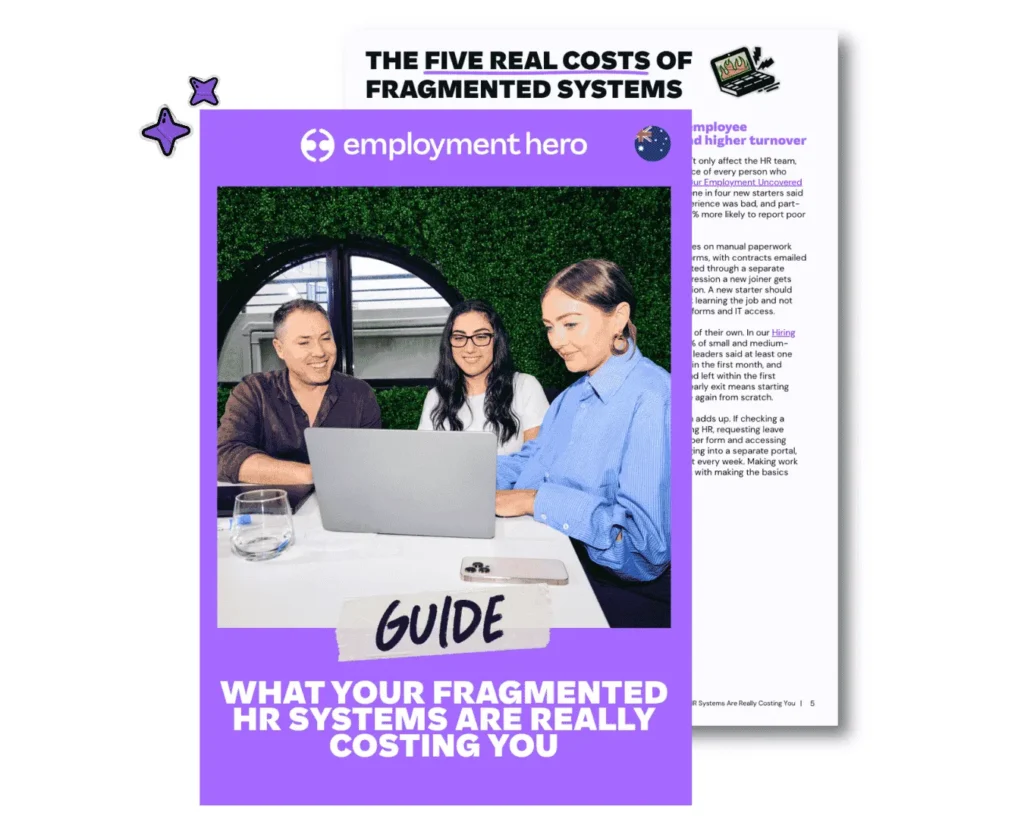
Download the guide now by filling out the form.
What are fragmented HR systems?
Fragmented HR systems refer to the use of multiple, disconnected tools and processes to manage different aspects of human resources within a business. Instead of operating from a single, unified platform, organisations rely on separate systems for tasks such as payroll, recruitment, onboarding, performance management, leave management and employee records.
In practice, this often means HR teams are switching between spreadsheets, email chains, standalone software and manual records to complete everyday tasks. The problem arises when these systems don’t communicate with each other, leading to duplicated data entry, inconsistent information and a lack of real-time visibility across the employee lifecycle.
Fragmentation usually develops gradually as teams adopt tools to solve immediate problems without considering long-term integration. While each system may work well in isolation, the lack of connectivity between them creates inefficiencies that only grow as the organisation scales.
Why are fragmented systems a problem for Australian businesses?
The impact of fragmented systems can creep up on business owners and HR managers because it often starts small and escalates, spreading across different teams and processes. When each HR tool operates independently, the inefficiencies are not always immediately visible, but over time, they become embedded in day-to-day operations.
Here are some of the real world problems businesses face when they have fragmented systems.
Wasted admin time
Manual data entry, reconciliation and duplicate work across platforms are the most visible cost of fragmented systems, but it’s rarely quantified. The same employee details get entered into the HRIS, re-keyed into payroll and copied again somewhere else for IT access. Multiply that across every new starter, every pay run, every personnel change and the hours add up fast.
Payroll errors and compliance risk
When payroll and HR data sit in separate systems, errors become more likely. One in three Australian businesses say data has to be retyped between systems, and every retype is a chance for a mistake. Three in four Australian businesses have had an error or delay in HR or payroll in the past 12 months.
Errors in Single Touch Payroll (STP) reporting, PAYG withholding or super contributions can lead to penalties. Since 1 July 2026, Payday Super means super is paid on each payday, which leaves less time to catch a mistake before it becomes a late payment.
Slow and expensive hiring
Disconnected job boards, spreadsheet tracking and email chains are no match for high application volumes. Without an integrated ATS, candidates move through a process that relies on manual steps at every stage: CV downloads, individual phone screens, hiring manager updates sent by email. Time-to-hire stretches, strong candidates accept other offers and every hire made through external sourcing tools that sit outside your core platform adds to the cost per hire unnecessarily.
Sound overwhelming? Thankfully, with Employment Hero, your next hire is already here. Our hiring product comes with talent built-in, so you can meet candidates before you pay to post a role. The talent pool includes more than 2.3 million ready-to-work candidates and if you still want to advertise, you can publish to the most popular job boards. Plus, the Recruitment Agent runs screening calls and structured video interviews, then gives you a summary of each candidate, so you decide who moves forward. Keen to learn more? Get in touch with one of our business specialists.
Poor employee experience and higher turnover
Fragmentation doesn’t only affect the HR team, but also the experience of every person who joins your business. Our Employment Uncovered research found that one in four new starters said their onboarding experience was bad, and part-time workers were 35% more likely to report poor onboarding overall.
When onboarding relies on manual paperwork across multiple platforms, with contracts emailed and IT access requested through a separate process, the first impression a new joiner gets is one of disorganisation. A new starter should spend their first week learning the job and not caught up in chasing forms and IT access.
Early exits add a cost of their own. In our Hiring Snapshot Report, 60% of small and medium-sized business (SME) leaders said at least one new hire had left within the first month, and 78% said someone had left within the first three months. Every early exit means starting the recruitment cycle again from scratch.
Hidden IT and subscription costs
This is the cost that rarely appears on anyone’s radar until someone sits down and adds it up. Multiple platform licences, renewal dates no one is tracking, integration costs for connectors that half-work, developer time maintaining workflows holding the whole thing together.
Some costs are harder to put a number on, but they’re just as real. Every new starter has to learn several systems instead of one, your IT team is juggling a growing list of vendors and employee data ends up spread across platforms, each with its own security standards and access controls, so it’s harder to know where each record lives and who can see it.
The benefits of a consolidated system
Running HR, payroll and recruitment on one platform doesn’t just remove the friction from your current processes. It changes what your HR function is capable of, what your employees experience and how confidently you can manage compliance. Here’s what that looks like in practice.
Data is entered once and trusted everywhere
A new joiner’s details flow automatically to payroll, onboarding and every system that needs them. No re-keying, no cross-referencing, no version control issues. One record per employee, updated in one place, accurate across the board. When a detail changes, it changes everywhere. Your HR team stops being the people who manually keep everything in sync and starts being the people who actually move things forward.
Compliance confidence
Right to work rights checks sit alongside the employee record they belong to, Modern Award pay calculations draw from accurate data and Payday Super contributions happen with each pay run. Audit trails are complete because everything runs through a single system. Compliance stops being something you check afterwards and becomes part of the everyday pay process.
Hiring moves faster and loses fewer good people
When your ATS, onboarding workflows and HR records all sit in the same platform, a candidate moves from application to offer to their first day without anyone re-entering the same information at every stage. There are no handoffs between tools, no export and re-import, no email chains updating a hiring manager who doesn’t have access to the ATS. Strong candidates don’t fall through the cracks because the process couldn’t keep up with the volume. The best people get an experience that reflects well on your business from day one.
Your team gets meaningful time back
Not a few minutes here and there. The hours currently spent reconciling data between systems, chasing information that should be in one place and correcting errors that a connected system would have caught automatically. That time makes a big difference, it compounds every week and it’s currently going into work that only exists because your systems don’t connect. On a consolidated platform, it goes back into the work that moves your business forward.
Ready to find out what fragmented systems are costing your business?
Fragmented HR systems rarely feel urgent until you add up the numbers. The hours lost to admin that shouldn’t exist, the payroll errors that could have been caught automatically or the compliance gaps that grow as employment legislation gets more complex.
But there is a better way. Find out what consolidating your HR, payroll and recruitment onto one platform could save your business in time, money and compliance risk.
Disclaimer: The information in this guide is current as at 11 November 2026, and has been prepared by Employment Hero Pty Ltd (ABN 11 160 047 709) and its related bodies corporate (Employment Hero). The views expressed in this guide are general information only, are provided in good faith to assist employers and their employees, and should not be relied on as professional advice. The Information is based on data supplied by third parties. While such data is believed to be accurate, it has not been independently verified and no warranties are given that it is complete, accurate, up to date or fit for the purpose for which it is required. Employment Hero does not accept responsibility for any inaccuracy in such data and is not liable for any loss or damages arising either directly or indirectly as a result of reliance on, use of or inability to use any information provided in this guide. You should undertake your own research and to seek professional advice before making any decisions or relying on the information in this guide.
Register for the guide
Related Resources
-
 Read more: What your fragmented HR systems are really costing you: A practical guide for Australian businesses
What your fragmented HR systems are really costing you: A practical guide for Australian businesses
Fragmented HR systems cost businesses more than they realise. Download the guide and see the hidden admin, payroll and compliance…
-
 Read more: Children’s Services Award 2010 Summary [MA000120]
Children’s Services Award 2010 Summary [MA000120]
The Children’s Award covers pay rates, allowances, overtime and more. Learn how to navigate the rules for your business.
-
 Read more: Understanding the Aged Care Award [MA000018]
Understanding the Aged Care Award [MA000018]
The Aged Care Award 2010 sets the benchmark for those employing or working in aged care facilities or residential services.


