 New Zealand
  United Kingdom
  Singapore
  Malaysia
  Canada (Français)
 Australia


Mastering contract management: A guide for employers
Published
Mastering contract management: A guide for employers
Published
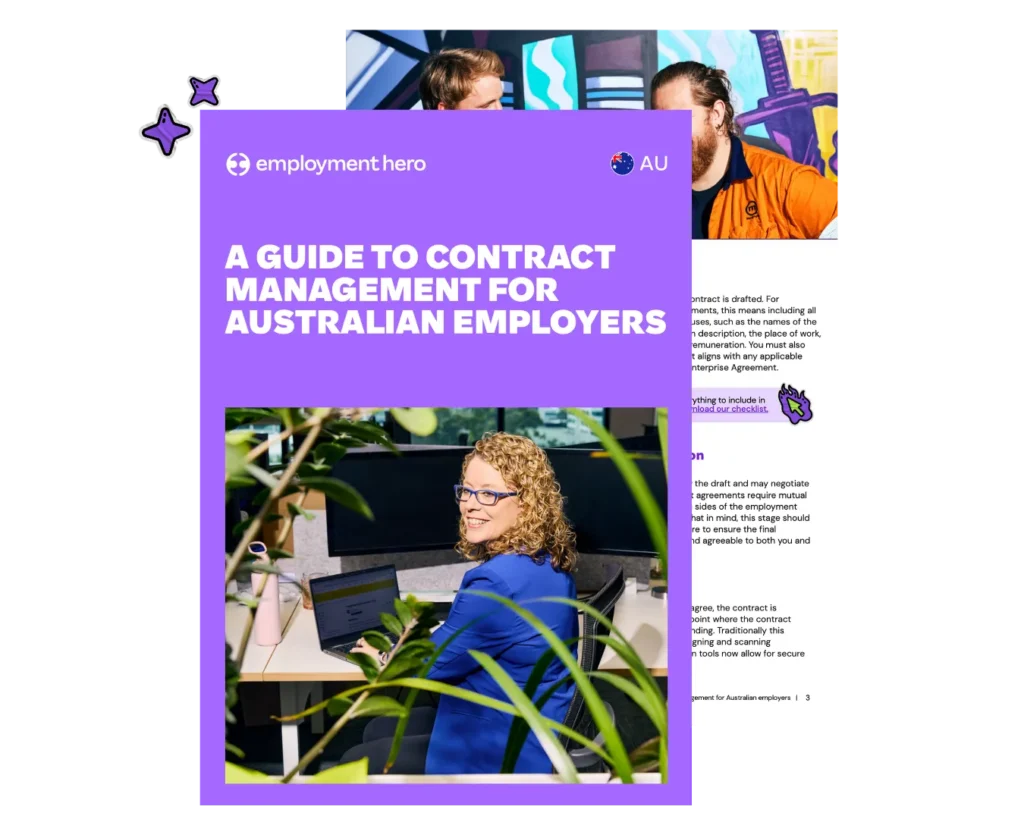
Every business is built on agreements. From the employment contracts you sign with new hires to the supplier agreements that keep the lights on, contracts are the lifeblood of your operations.
But managing them? That’s often a different story.
If you’re drowning in email chains, struggling to find the latest version of a document or missing renewal dates, you’re not alone. Manual contract management is a silent productivity killer. It drains time, introduces risk and keeps your team bogged down in admin when they should be focused on growth.
It’s time to change the way you think about your agreements and we’re helping you do just that in our contract management guide.

What is contract lifecycle management (CLM)?
Contract Lifecycle Management (CLM) is the process of managing a contract from the moment you request it until the moment it expires or renews.
It’s so much more than just filing a signed PDF in a dusty digital folder. It includes the entire process from drafting, negotiating, approving, signing, storing and analysing.
When you have visibility over every stage of your contracts, you move faster. You reduce bottlenecks in hiring, procurement and sales. Most importantly, you support your compliance obligations, protecting your business from the legal headaches that come with outdated or missing agreements.
The risky business of manual contract management
Still relying on spreadsheets, shared drives and endless email threads? You’re opening yourself up to risk. Manual contract management might seem free, but the hidden costs are massive.
1. Human error
We’re all human and we make mistakes. But a typo in a salary figure, a missing clause in an employment agreement or the wrong termination date can lead to costly disputes. Manual data entry is a common cause of contract errors.
2. Bottlenecks and delays
“Where is that contract?” “Has Legal seen this yet?” “Who has the final version?” If you’ve asked these questions recently, your process is broken. Manual workflows rely on individuals remembering to forward emails or save files. When someone goes on leave or forgets, everything grinds to a halt.
3. Compliance gaps
Laws change and awards update. If you’re manually updating templates every time legislation shifts, you’re likely to miss something. This is a major blind spot in HR policy that can leave you exposed to fines and penalties.
4. Missed renewals
There is nothing worse than an auto-renewal on a service you wanted to cancel or an employee contract expiring without a review. Without automated alerts, these dates slip through the cracks, costing you money and potentially damaging relationships.
How modern contract management software delivers value
Modern contract management software takes the heavy lifting off your plate. Here’s a few benefits of going digital.
- Automation: Say goodbye to copy-pasting details. Software can auto-populate contracts with data from your existing systems, ensuring accuracy and saving hours of admin time.
- Transparency: You can see exactly where a contract sits in the pipeline. Is it with the candidate? Stuck with the CEO for signing? You have a bird’s-eye view of every agreement.
- Reduced admin: By centralising everything in one platform, you eliminate the mission for finding lost documents.
- Better collaboration: Stakeholders can comment, edit and approve within the platform, creating a single source of truth rather than five different versions floating around in email inboxes.
AI in contract lifecycle management
Artificial Intelligence is changing the game for CLM. AI can scan thousands of contracts in seconds to extract key data like expiry dates, payment terms and different clauses. It enhances visibility by turning static documents into searchable data.
AI can speed up reviews and approvals by highlighting exactly what needs attention, so your team doesn’t have to read every single line of text.

Best practices for contract lifecycle management
Optimising your CLM workflow doesn’t happen overnight, but these steps will put you on the right path.
- Centralise your repository: Stop storing contracts in email attachments and local hard drives. Move everything to a secure, cloud-based central repository.
- Standardise your templates: Create a library of pre-approved templates for common agreements (like employment contracts). This ensures consistency and reduces the need for legal review on every single document.
- Define your workflows: Map out who needs to approve what. Does a $50k contract need the CFO’s sign-off? Build these rules into your process.
- Automate alerts: Set up automatic notifications for key dates like probation periods, contract renewals and payment milestones.
- Track your data: Use the reporting features in your software to spot bottlenecks. If contracts always get stuck at the legal review stage, you know where to focus your improvements.
Why effective contract management matters commercially
Getting your contracts in order has a direct impact on your bottom line.
Faster revenue recognition: For sales-led businesses, a signed contract means revenue. Reducing the cycle time from “proposal” to “signed” accelerates your cash flow.
Stronger relationships: Whether it’s a new hire or a new supplier, a smooth, professional contracting experience sets the tone for the relationship. It shows you’re organised, respectful of their time and easy to do business with.
Cost control: Better visibility helps you avoid unwanted auto-renewals and identify opportunities to consolidate suppliers or renegotiate terms.
Key challenges in managing contracts manually
We’ve touched on the risks, but let’s look at the daily pain points that push businesses toward digital transformation.
Version control nightmares: We all know this scenario too well… “Is this v3_FINAL or v3_FINAL_UPDATED?”
Lack of security: Emailing sensitive employment data is a security risk. Who else is cc’d? Is the attachment password protected?
Inability to scale: As you hire more people and sign more deals, manual processes break. You can’t hire an admin army just to manage paper. You need scalable systems.
Understanding the contract lifecycle: stages and flow
To master CLM, you need to understand the lifecycle. It generally breaks down into these stages:
- Request: A business user needs a contract (e.g. a hiring manager needs an employment offer).
- Creation/drafting: The contract is generated, ideally using a pre-approved template.
- Negotiation: Both parties review the terms. Redlines and comments are exchanged.
- Approval: Internal stakeholders sign off on the final terms.
- Signature: The contract is executed, usually via e-signature.
- Storage: The signed document is saved in a central repository.
- Management/performance: The terms of the contract are executed (goods delivered, services rendered, employee onboarded).
- Renewal/termination: The contract ends, renews or is renegotiated.
Understanding this flow allows you to map your current process and identify exactly where things are slowing down.
Automating your contract lifecycle for better compliance and value
Automation is the key to unlocking value at every stage of the lifecycle.
By automating the creation phase, you enforce policy. In the negotiation and approval phases, automation keeps things moving. Reminders nudge people who are sitting on a document, ensuring faster turnaround times. And for storage and management, automation ensures nothing is lost.
Powerful HR software like Employment Hero can automatically trigger onboarding workflows the moment an employment contract is signed, creating a seamless experience for new hires.

Contract management software: what to look for
Not all contract software is created equal. When you’re evaluating options, look for these must-have features:
- User-friendly interface: If it’s too hard to use, your team won’t use it.
- Robust search capabilities: You should be able to find any contract in seconds using keywords.
- E-signature integration: This is non-negotiable for modern businesses.
- Version control: Automatically track changes and maintain a history of edits.
- Configurable workflows: The software should adapt to your processes, not the other way around.
- Integration: Does it talk to your CRM, your payroll and your onboarding software?
How to select the right contract management software
Choosing the right partner is critical. Here’s how to evaluate the market:
Identify stakeholder needs: Talk to Legal, HR, Sales and Finance. What are their specific pain points?
Check for integrations: You want a system that plays nicely with your existing tech stack.
Evaluate scalability: Will this software grow with you as you expand from 50 to 150 employees and beyond?
Consider pricing: Look for transparent pricing models that scale with your usage or user count.
Ask about support: When things go wrong, you need a support team that understands the Australian market and regulations.
The information in this article is current as at 19 February 2026, and has been prepared by Employment Hero Pty Ltd (ABN 11 160 047 709) and its related bodies corporate (Employment Hero). The views expressed in this article are general information only, are provided in good faith to assist employers and their employees, and should not be relied on as professional advice. Some information is based on data supplied by third parties. While such data is believed to be accurate, it has not been independently verified and no warranties are given that it is complete, accurate, up to date or fit for the purpose for which it is required. Employment Hero does not accept responsibility for any inaccuracy in such data and is not liable for any loss or damages arising directly or indirectly as a result of reliance on, use of or inability to use any information provided in this article. You should undertake your own research and seek professional advice before making any decisions or relying on the information in this article.
Register for the guide
Related Resources
-
 Read more: AI skills assessment template for your team
AI skills assessment template for your team
Help your team build their AI skills. Download our free AI skills assessment template for managers and employees.
-
 Read more: The AI Adoption Blueprint
The AI Adoption Blueprint
What does it take to embed AI across an entire team? We’re sharing our training, our policies, and the lessons…
-
 Read more: Employment Essentials: AI Best Practices
Employment Essentials: AI Best Practices
Learn how to use AI in HR without creating privacy, compliance or employment risks in our latest webinar.


