














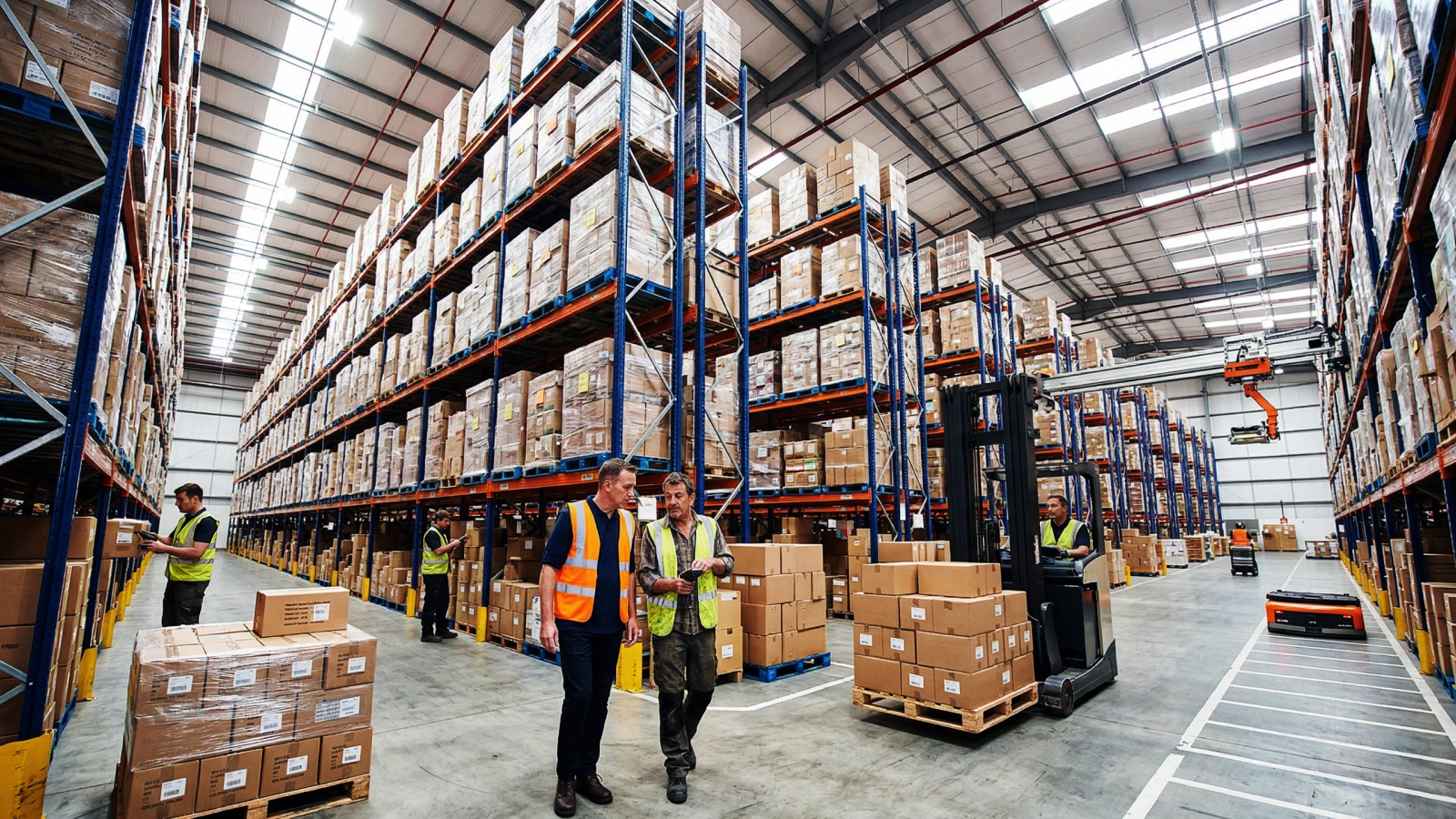
To understand the pace of change in logistics, just look inside an Amazon fulfilment centre. Thousands of robots move in near-perfect coordination as AI systems predict demand before customers have clicked Buy.
For SME logistics businesses, it’s a confronting reality: technology that will likely be an industry benchmark in future is already here, and the gap between the giants and smaller players is growing fast.
That gap won’t close itself, says Vincent Fletcher, co-founder of logistics software company CartonCloud. To keep pace with disruption, he believes someone in every business has to own the change and essentially become a Chief Change Officer. In a small business, he argues, that person has to be the owner. Even when there are many hats to wear, he believes AI is such a disruptive force, it must be managed from the top.
Systems Are Clogged With Manual Admin Bottlenecks
SMEs are the driving force behind Australia’s logistics sector, accounting for around 97 per cent businesses. Insatiable customer demand for online purchases means it’s an industry on the rise: the number of Transport, Postal and Warehousing businesses grew by 5 per cent last year to almost 250,000.
Fletcher has witnessed enormous change since he and a friend purchased a small refrigerated freight business in Sydney’s western suburbs in 2012. It was a shock introduction to the world of manual admin. “These guys were sending out the drivers with pieces of paper to be signed and brought back, and then filed and sent back to the customers,” he recalls, shaking his head.
“We had three fulltime admin staff doing stuff like trying to get invoicing out within a month of us doing the deliveries, which is nuts. So, we had this huge cash flow hole.”
They started searching for a smartphone-based solution but came up short. “Nothing like that really existed yet, and so we set out to basically build a system from scratch just to improve the operation of our own organisation. Subsequently, about three years later, we transitioned into being a software company full time.”
Fletcher says while most of the SMEs CartonCloud deals with now have moved beyond spreadsheets, they haven’t ventured far into the world of automation. “Lots of logistics companies have no real Help Desk software, which is so bizarre because a lot of what they provide is customer service, like, ‘Hey, where’s my delivery?
This thing’s damaged, what do I do?’” he explains. “With the Help Desk tools that you can get, and AI agents on top of that, which can make it easier to respond, it just seems wild. There’s a lot more that they could do within their business that would improve it even more.”
Leaders Need To Take Charge of Change
Fletcher believes many businesses can’t keep up with evolving technology because they’re short on two key commodities: time and motivation. He observes that although they’re most affected by poor processes, employees on the frontline are least likely to seek automated solutions. “There’s quite a lot of self-preservation associated with that,” he says, understanding the sensitivities. “Like, if AI did this job that I’m doing, what am I going to do?”
He says it’s human nature for staff to push back on change, so change must come from leadership level. In an SME, where there’s unlikely to be a department head, that means the business owner. He suggests rolling up sleeves and spending time performing frontline roles to identify pain points, then asking AI to recommend software solutions.
“The most senior people are often also the most stretched and so they don’t really have the time often to say, ‘Hey, you know, I want to completely fix the way that we handle customer support in our 15 person logistics business,’ for example. But that’s ultimately what’s needed,” he says. Fletcher is leading by example here: originally a software engineer, as Chief Product Officer he’s recently returned to coding alongside his engineers to identify areas for improvement.
“I think if you’re the CEO or managing director, you’re kind of like the Chief Change Officer,” he says. “You need to be digging into those things and looking for how things can improve, and pushing those things through. Not just saying, ‘Oh, none of my staff are on board, so we’re just not going to do anything.’ That’s ultimately, I think, slow death.”
Keeping Up With Change Requires Continuous Learning
Busy SME owners generally wear many hats and Fletcher acknowledges most would feel they lacked the headspace for another, especially one as significant as Chief Change Officer. He personally finds it hard to keep up with what he calls the ‘machine gun of information,’ where a brand new AI model can become obsolete in months or even weeks.
He recommends leadership teams act as an AI information gate to track trends and alert staff to new possibilities. “Not everyone can keep on top of this information all the time. They kind of need it distilled and fed to them,” he says. It’s recognition that even if an SME has adopted AI solutions, it’s not a one-and-done project. Rather, it takes a mindset of continuous learning. “I often find myself starting to dig into something manually and then going, “Hold on. What happens if I just put this file into ChatGPT and ask it the same question and see what it comes out with?”
In highlighting practical uses, Fletcher says he wouldn’t use AI to review a multi-million contract but he would ask it to scan an NDA for anomalies, to generate a report or to bounce around ideas. “The speed at which it can provide you with feedback on something is quite unlike anything you’ve ever experienced before,” he marvels.
The Logistics Sector Can’t Grow Without Automation
Looking ahead, Fletcher wrestles with what he sees as some inevitable job losses in logistics due to AI, and says attention must be given to timely retraining. But on the flip side, he sees technology as a lifeline for some roles. He gives the example of truck drivers, where a global report forecast a shortfall of 3.6 million drivers and predicted 21 per cent of the Australian workforce would retire by 2029. “Things like driverless longhaul trucks, they’re actually required for civilisation to continue,” he says. “There just aren’t enough human drivers coming into the workforce to cover that and I think that’ll be the same for many of these things.”
Fletcher believes it’s important to remember AI will also create jobs and that the ‘size of the pie’ may increase as opportunities expand. He also points out that even cutting-edge tech has current limitations, after watching a robot at a recent Las Vegas conference packing a chocolate into a box.
“At first, it assembled the cardboard box by kind of folding it together.It took five minutes to pack a single chocolate. By no means fast,” he explains. “You would need a lot of these robots currently to compete with a human. So, the technology is certainly interesting, but when you see it, you’re like, okay, they’ve still got quite a long way to go.”
He sees that as a sign that SME owners who’ve been wary of AI haven’t missed the boat – but warns they might soon. The key is to keep an open mind and to keep experimenting.
“Maybe people tried things a year ago and it wasn’t very good, but a year is like two decades in AI time,” Fletcher says. “I think if you’re not already, then you need to go and start. It’s incredible.”