 Australia
 New Zealand
 Singapore
 Malaysia
 Canada (Français)

 United Kingdom







When you’re training in the RAF and practising flying 100 feet off the ground at 600 miles an hour, there’s no time to stall on a decision. For Jo Salter MBE, Britain’s first female fast-jet pilot, one of the biggest lessons she learned came when a missile failed to launch from her aircraft, leaving it, in her words, “sizzling on the rails”.
She was asked to fly a racetrack pattern off the coast of Wales for 30 minutes in case it blew up, with no guarantee as to whether she would make a safe landing. “You’ve got to make decisions really fast,” she told the audience at an event celebrating women in sport and business leadership at Headingley Cricket Ground, adding that “making the decision is what’s the most important.”
That’s exactly the kind of instinct that made her a natural fit for business leadership. After commanding an all-male squadron, Jo moved into senior leadership roles in global business, and came away with key observations on micromanagement, decision-making and training that businesses of any size can learn from.
Decision Making in Business: Where Authority Follows Skill
Against her assumptions, joining the corporate world meant realising that businesses were even more staunchly attached to rank – but often for the wrong reasons. “The corporate world’s far more hierarchical than the military, which sounds like a surprise,” she said.
The military Jo knew ran on a different rule. What people focus on there, she explained, is “the person who has the skill to do what you need to do, irrelevant of grade”. “And yes, there is a respect for rank,” she added.
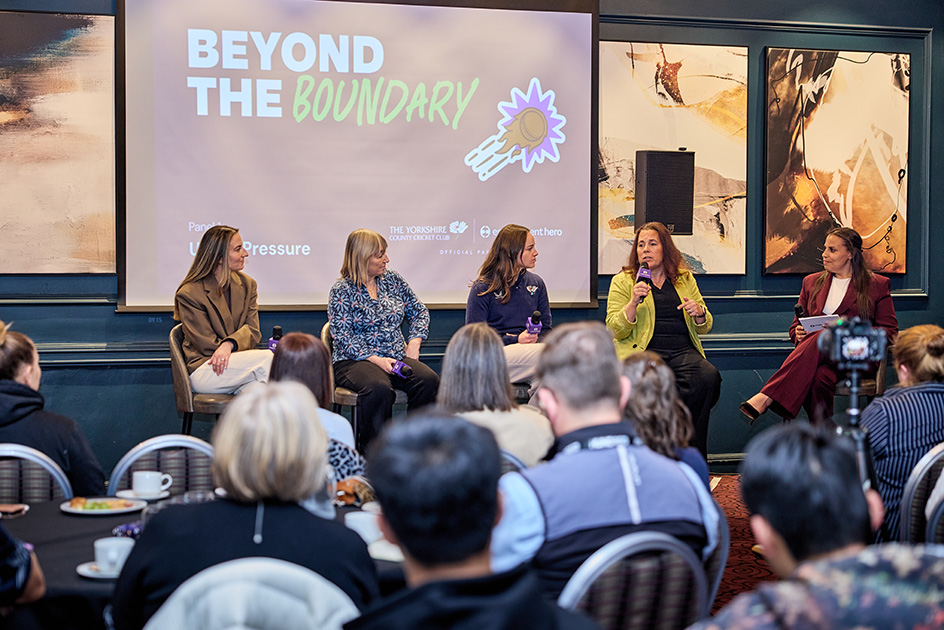
The sheer volume of hours Jo spent rehearsing emergencies in simulators goes some way to explaining why that comes so easily. “We prepare over and over again,” she said, because “there’s a huge difference of being under pressure and performing under pressure.” What a pilot can’t do, she said, is “go into freeze or fight or flight”, and at that speed there is less time to think. At low level the response has to come “before your brain is even really thinking about it”, so the only option is to have practised until the right decision is the automatic one.
What she found in business ran the other way. People would say “that’s not my job, that’s not my responsibility”, and the decision would be deferred to someone else, so a call that one person with the right skills could have made, remained unsolved.
Micromanagement After Promotion for Technical Skill
Another prevalent issue Jo saw was in how employees were selected to manage teams. Colleagues with strong technical skills, while incredibly valuable in terms of knowledge and experience, were being promoted into management without ever being taught how to lead.
In her words, they “didn’t know how to lead and therefore micromanage”, which left their teams disempowered. “None of that leads to a high performing team,” she said.
In an article for Eurofound, the European Union agency for living and working conditions, Senior Research Manager Sara Riso describes micromanagement as a style “marked by excessive supervision and a lack of trust” that “can create a toxic environment and cross the line to (cyber)bullying” when it becomes systematic and persistent.
That’s consistent with other findings too. A 2025 review of 94 organisational studies in the journal Sage Open, for example, found that constant surveillance can leave employees with lower morale and that close supervision reduces their willingness to take risks or experiment.
Accidental Managers and Management Training in the UK
Broader research around appointing experts without leadership experience points the same way as Jo’s observations. A major 2023 study by the Chartered Management Institute (CMI) and YouGov found that 82% of managers who enter management positions have not had any proper management and leadership training, a group CMI called “accidental managers”. It said candidates who fell into this category were often promoted because they were popular, good at their job or happened to be available to take charge.
CMI’s chief executive, Ann Francke OBE, said promotions “based on technical competence that ignore behaviour and other key leadership traits” lead to “failings that cause damage to individuals and their employers, not to mention the wider economy’s performance.” CMI has also pointed to earlier research showing that organisations investing in management and leadership development see, on average, a 23% increase in organisational performance and a 32% increase in employee engagement and productivity.
More recent figures suggest the problem has not gone away. A May 2026 survey of 5,000 employees at large organisations by Ipsos Karian and Box found that only 15% of non-managers say becoming a manager looks appealing, while 66% think management roles involve significantly more responsibility than they did a few years ago.
Workplace Culture and Productivity: Deciding First, Inviting Disagreement
The pace of work in a business, regardless of size, makes the cost of a stalled decision much easier to see.
While working in an environment where everyone is under intense pressure, and the level and rate at which you’re working is significant, she came upon a realisation: “What I discovered is that people aren’t very good at making decisions,” she said. “What people like to do is have meetings. And at end of the meeting they go, that was great, let’s have another meeting. And I sort of didn’t understand that.”
Her move as a senior leader, especially after fruitless meetings, was to offer a solution and invite dialogue afterwards.
“I make decisions for people, share it with people by email afterwards and say, if you disagree – because people love to disagree – let me know,” she said.
People’s reaction, she recalled, was “wow, we’ve been trying to make that decision for ages.”
The main factor holding people back, she believes, is trepidation. “What’s stopping people making those decisions and working under pressure is a level of anxiety and fear,” she said, urging anyone who’s ever been in that position to “feel the fear and do it anyway”. Feeding fear and anxiety only makes it worse, she argued, suggesting instead to focus “your attention on the outcomes that you want”, at which point things begin to shift, not only in how people operate but across the whole environment. “It is about empowering people,” she said.
Jo’s advice to leaders was to “surround yourself with brilliant people”, because, she said, she has never met anyone who doesn’t want to be heard more. For any business about to promote its strongest performer, the leadership training that person receives before taking over the team will decide whether they empower people or micromanage them.