 Australia
 New Zealand
 Singapore
 Malaysia
 Canada (Français)

 United Kingdom





More UK workers are staying put in their jobs as hiring slows amid economic uncertainty. Job vacancies fell to 691,000 in the three months to September, the lowest level outside the pandemic since 2014, according to the Office for National Statistics. With fewer roles on offer, many employees are choosing the security of their current job over the risk of moving on.
Job hugging, as it’s being referred to, is “a rational response to a weak job market, but not a cost-free one”, according to Nina Skero, chief executive of the Centre for Economics and Business Research (CEBR).
Job hugginghas become more common as UK hiring has pulled back and technology reshapes the skills employers want, the economic consultancy says. Vacancies are at their lowest in over a decade, excluding the pandemic.
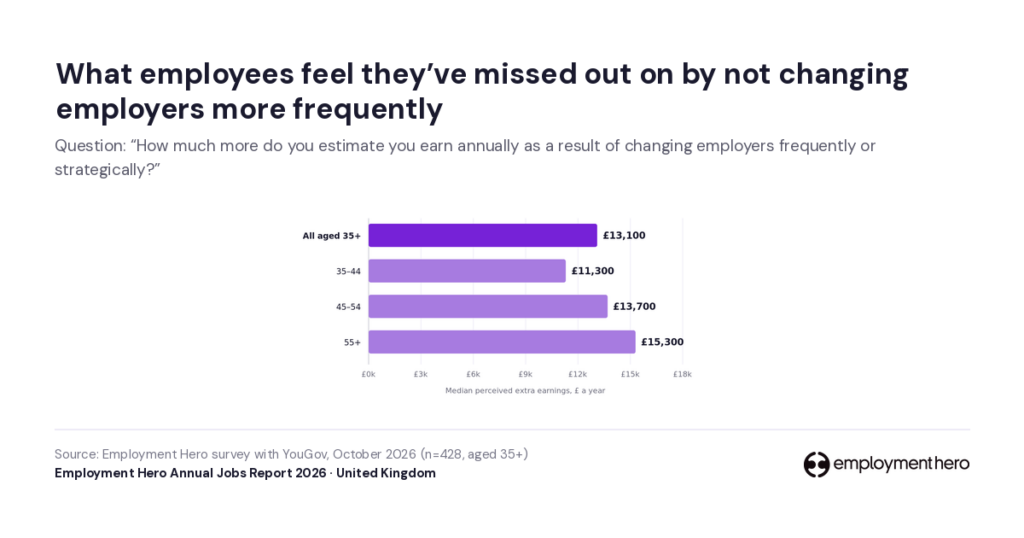
Cebr’s analysis forms part of Employment Hero’s 2026 Annual Jobs Report, which draws on a survey of 1,550 UK employees carried out online by YouGov for Employment Hero between 15 and 22 October 2026. Among workers aged 35 and over, 54% believe they would be earning more today if they had changed employers more often.
Why Job Hugging Feels like the Safe Option
Skero suggests the prevalence of the trend is having a ripple effect on the jobs market. Speaking to Employment Hero, she said: “Workers are trading progression for security, and when fewer people move, it becomes harder to match people with the roles where they can thrive.”
Employment Hero’s data points to the trade-off she describes. Some 34% of workers are in a job they want to leave but have stayed because changing feels too risky or difficult, with a total of 58% have considered leaving but stayed because of cost of living pressures. A majority (61%) say they prioritise security over ambition because of the cost of living, up from 58% last year.
The report shows the extent of workers’ doubts about being able to find new roles. More than half (52%) are not confident they could find another job within three months if they lost their current one.
For those who stay in their jobs because they feel a sense of satisfaction and stimulation in their roles, the numbers are much lower. Only 24% say they stay because they feel genuinely fulfilled and challenged, whereas more than four in 10 (43%) describe their job as comfortable, i.e. “it’s not perfect, but it’s good enough”. Even so, three-quarters of respondents give at least one positive reason for staying, such as valued benefits or loyalty to colleagues, though a quarter say they have reduced their effort at work.
What the Data Says About Pay
Employment Hero’s payroll data, drawn from around 4,800 UK businesses on its platform, shows pay growth slowing over the year. Of the workers surveyed, 72% received a pay rise in the past year.. Of those, 46% say it fell behind the cost of living and 11% say it outpaced it.
In the payroll data, median pay growth was 4.9% year on year (YoY) in October 2026, before adjusting for inflation. That is still ahead of the 3.5% rate of consumer price inflation (CPI) recorded in September, but the cushion is lessening: YoY growth has cooled from a peak of 6.4% in April and is the lowest in 13 months, against 4.9% in October 2025.
Workers aged 35 and over who think they would be earning more put the median gain at £13,100 a year, and nearly a third (30%) believe it could be £20,000 or more. These are workers’ estimates, not measured losses.
Workers also say they would need a sizeable pay rise to make changing jobs worthwhile. The median rise they name is 20% to 24%, and 30% say at least 20%. A further 12% say no pay rise would persuade them. Employment Hero’s analysis of the data suggests that threshold sits well above the pay growth currently seen in the market.
Essentially, two things are happening: Workers say they have lost out, with pay rises falling behind the cost of living, yet changing jobs would take a hefty lift in pay. Employment Hero’s reading is that the two are linked: changing jobs is tough, the market is hard to navigate and a move carries uncertainty and risk, so the pay rise workers say they would need to make it is correspondingly high.
What Job Hugging Means for the Economy
Cebr describes a backdrop of elevated cost pressures on businesses, with unemployment rising most among younger workers and wage growth slowing, particularly in the private sector. With fewer vacancies, workers have less bargaining power.
The cost, in Cebr’s assessment, falls on productivity: fewer moves mean weaker matching of people to roles, less skills pick-up and less dynamism in the labour market. “That can leave productivity gains unrealised and weaken the pressure on firms to improve how they attract and retain staff,” Skero says.
Job moves matter, Cebr’s Chief Executive adds, because they are “one of the main ways workers find roles that make better use of their skills, pick up new skills along the way, and push employers to compete for talent through better pay and conditions”.
That is a concern when many workers doubt their own skills. Some 30% worry theirs are becoming outdated, and confidence in adapting to new technology fell from 75% to 70% over the past year.
Slower pay growth also squeezes household real incomes and holds back consumer spending, Skero says: “In turn, softer demand weighs on business revenues and hiring, risking a self-reinforcing cycle in which a weaker jobs market gives workers even more reason to stay put.”
Employment Hero’s data shows pay growth slowing and hiring becoming more cautious, which gives important context to the survey finding that workers are reluctant to leave secure roles and shows the conditions in which many people are weighing up whether a move is worth the risk.
The figures reveal that headcount grew slightly every month this year but the pace has slowed. In the quarter to October 2026, average month-on-month growth was 0.7% compared to 1.3% in the same quarter of 2025, so while small and medium-sized businesses are still hiring, they are doing so more cautiously.
The slowdown is also reshaping the geography of UK pay. London’s once considerable lead in wage growth has almost disappeared. At a time when the Government is pushing to rebalance economic growth beyond London, Lisa Cowie, Head of Insights at Employment Hero, says: “On the surface, this looks like regional levelling-up. But rather than the regions accelerating, London has slowed to meet them. Regional wage growth is converging, but closing the gap only signals meaningful progress if it delivers genuine opportunities, not just a more evenly distributed slowdown.”
Kevin Fitzgerald, UK MD at Employment Hero, describes job hugging and workers’ lack of confidence as a ‘chicken-and-egg problem’.
“It is unclear” whether people are clinging to their jobs because they lack confidence,” he says, “or because staying put without seeing a path forward makes that confidence worse.”
Staying may feel safer, he adds, but workers still need to see room to grow, and employers have a role in making that possible. “Happiness at work is fundamental; it is not a nice-to-have workplace benefit.”
For employers, Skero sees an opening. “Employers that offer clear progression, fair pay and good training can stand out to the talent that is currently standing still,” she says. Breaking the cycle, she adds, “means building a labour market where staying is a choice rather than a necessity, and moving is an opportunity rather than a gamble”.
Until vacancies recover, staying put will remain the sensible choice for many workers, and the businesses that set out clear progression routes now will be best placed when that changes. One of the ways businesses can prepare, according to Employment Hero’s CEO and Co-Founder, Ben Thompson, is by embracing AI and giving businesses more capacity, thus freeing them up to hire as skills gaps are plugged.