

















Payroll Guide: The Basics of Payroll In Australia
Published
Payroll Guide: The Basics of Payroll In Australia
Published
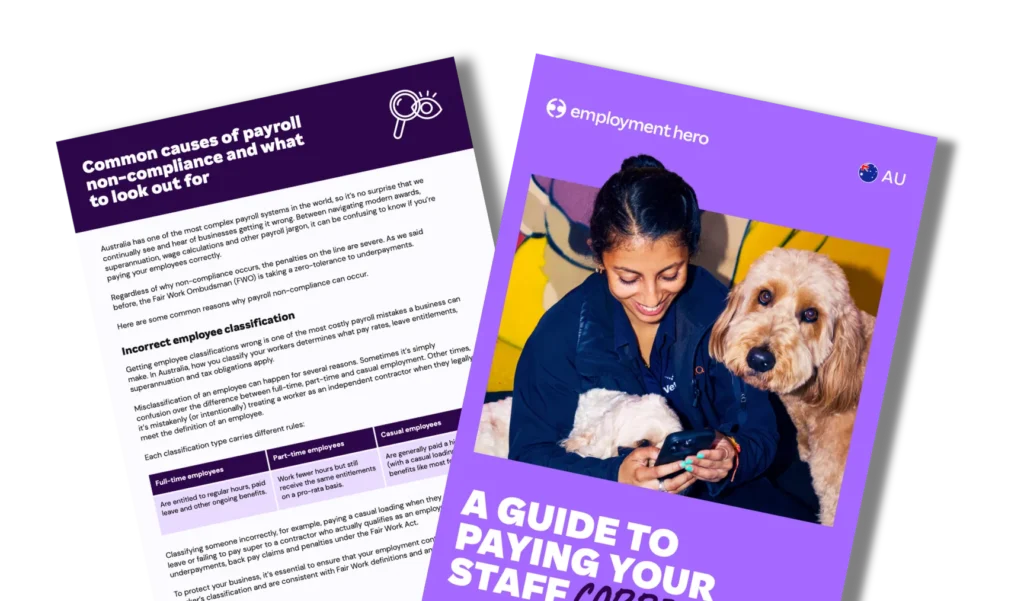
No one starts a business dreaming about navigating payroll, interpreting modern awards or mastering tax compliance. Most business owners are driven by passion, to create something meaningful and build a team that shares their vision.
But as your business grows, so does your compliance responsibility. The moment you hire your first employee, you take on one of the most critical parts of running a business… making sure your people are paid correctly, every time.
Australia’s employment and payroll laws are complex and constantly evolving. Even the smallest error can lead to costly consequences. The Fair Work Ombudsman (FWO) has taken a zero-tolerance approach to underpayments and non-compliance, meaning that unintentional mistakes can still result in substantial back payments, heavy penalties and in some cases, criminal charges.
If you’ve ever worried about making a mistake or wondered whether your business is fully compliant, you’re not alone. Payroll and compliance can be overwhelming and even the most diligent employers can feel uncertain.
That’s why we created this guide. To give you the confidence and tools you need to pay your staff correctly. We’ll help you understand your obligations, avoid costly mistakes and stay across compliance when it comes to paying your people.
What’s in this guide?
In this guide, we’ll cover:
- The basics of payroll in Australia
- Common causes of payroll non-compliance and what to look out for
- Important things to consider when paying your staff
- And so much more
Download the payroll guide now by filling out the form on the right.
Understanding payroll with the National Employment Standards
Managing payroll in Australia involves much more than simply calculating an employee’s pay. It requires a thorough understanding of the National Employment Standards (NES), which form the foundation of employment rights and obligations across the country.
Whether you’re an HR leader managing payroll in-house or an outsourced payroll provider serving multiple clients, aligning payroll systems with these standards is essential to ensure compliance and avoid potentially costly penalties.
The NES are 12 minimum entitlements that apply to all employees covered by the national workplace relations system, regardless of their award or agreement. You cannot provide conditions that are less than these standards.
The 12 entitlements are:
- Maximum weekly hours of work: 38 hours for full-time, plus reasonable additional hours.
- Requests for flexible working arrangements: eligible employees may request changes to hours/patterns/locations.
- Parental leave and related entitlements: up to 12 months unpaid and right to ask for additional 12 months.
- Annual leave: 4 weeks paid per year for full-time and part-time employees.
- Personal/carer’s leave, compassionate leave and paid family and domestic violence leave: includes 10 days paid personal/carer’s leave (for full-time and part-time employees); 2 days unpaid carer’s leave,2 days compassionate leave (only paid for full-time and part-time employees) and 10 days paid family and domestic violence leave for all employees including casuals.
- Community service leave: unpaid leave for voluntary emergency management activities and paid leave for jury duty (up to 10 days) for full-time and part-time employees.
- Long service leave: an entitlement for employees with long service, paid for all employees including casuals (state/territory laws apply).
- Public holidays: a day off on a public holiday (unless requested to work and the employee accepts).
- Notice of termination and redundancy pay: minimum notice based on length of service and redundancy pay up to set amounts (not applicable to casuals).
- Superannuation contributions: employers must make contributions to eligible employees under the super guarantee laws.
- Provision of statements: These include the Fair Work Information Statement, the Casual Employment Information Statement and the Fixed Term Contracts Information Statement.
- Casual conversion: An employee’s choice to convert from casual employment to permanent employment.
For both HR teams and outsourced payroll providers, understanding how the NES applies across different employment types and pay cycles is essential to maintaining accurate and compliant payroll.or employee wellbeing, helping them rest and recharge away from the workplace.

What are the benefits of payroll software ?
Payroll in Australia is becoming more complex, with changing legislation, evolving workforce arrangements and increasing compliance requirements. Relying on manual processes can make it difficult to keep up, but that’s exactly where payroll software comes in.
Payroll software helps businesses simplify these demands by automating repetitive tasks and improving accuracy, all while supporting their compliance obligations. For many businesses, platforms like Employment Hero Payroll provide the oversight, consistency and confidence needed to pay people correctly every time.
Aligning with payroll compliance
Payroll software plays an essential role in helping employers meet their legal obligations. A quality platform can significantly reduce the risk of errors by automatically applying the latest tax tables, superannuation rates and award conditions.
Built-in checks help flag unusual data before a pay run is finalised and digital record-keeping makes it easy to meet the ATO’s record-keeping requirements. With automatic updates and direct STP reporting, systems like Employment Hero Payroll help businesses stay aligned with changing legislation and the NES.
Streamlining pay period processing
Processing payroll manually can be time-consuming and prone to mistakes. Payroll software simplifies this by automating calculations for ordinary hours, overtime, penalties and multiple pay rates. Clear, compliant payslips are generated instantly and batch processing makes it easier to run payroll for multiple employees at once.
Superannuation administration is also simplified, removing one of the biggest manual pain points for many small businesses. And with Employment Hero’s upcoming HeroClear embedded clearing solution, this process will become even more seamless under the new Payday Super requirements. HeroClear will allow employers to send super payments directly through Employment Hero Payroll, meaning no external portals, no file uploads and no double handling.
Improving employee experience
Payroll software enhances transparency and convenience for employees. Self-service features allow staff to access payslips, tax documents and pay history anytime, while digital leave requests flow directly into payroll calculations.
With the EH Work App, employees can view their pay and leave information on the go, contributing to a smoother and more positive employee experience.
Enhancing reporting capabilities
Accurate payroll data offers valuable insights for planning and decision-making. Payroll software generates reports on labour costs, overtime trends, leave balances and other workforce metrics that support budgeting and audits.
Integrating with broader business systems
Payroll software is most powerful when it connects seamlessly with the rest of your business tools. Integrations with accounting platforms, rostering systems, time and attendance tools and core HR software create a single source of truth, reduce double handling and eliminate the need to manually move data between systems.
The Employment Operating System is built with this connected approach in mind. By bringing HR, payroll, time and attendance, rostering and workforce management together in one platform, it gives businesses a unified, efficient and reliable payroll ecosystem. This level of integration not only streamlines day-to-day operations, but also provides the visibility and accuracy employers need to make confident, compliance-driven decisions.
When should a business outsource payroll?
As your business grows, payroll can quickly become more complex than your internal team can reasonably manage. If you’re navigating multiple awards, different employment types or complex rules, outsourcing can reduce the pressure and help make sure employees are paid correctly every time.
Outsourcing also strengthens compliance. With constant changes to tax rules, super obligations and STP reporting, a dedicated payroll provider can help you stay aligned with ATO requirements and avoid costly mistakes, freeing your team from time-consuming admin.
In many cases, outsourcing simply makes financial sense. When the cost of specialist payroll staff, training and software outweighs the investment in an external provider (or when internal errors start impacting your bottom line) it’s a clear sign it’s time to rethink your approach.
Finally, outsourcing supports stronger risk management. Providers offer additional safeguards around confidentiality, ensure pay runs continue smoothly during staff absences or system issues and reduce the likelihood of non-compliance.If payroll is becoming a burden, outsourcing can give your business back valuable time, peace of mind and confidence in every pay run. Interested in outsourcing your payroll? Get in touch with our team to learn about our outsourced payroll service.

Key considerations for internal payroll management
If you’ve decided to manage payroll in-house, it’s essential to establish robust systems and expertise to manage compliance. Here are the critical elements to consider.
Building internal payroll expertise
Managing payroll in-house requires deep and ongoing expertise. Your team must understand payroll tax obligations, interpret awards correctly and stay across frequent changes to minimum pay rates and entitlements. As your workforce grows or becomes more complex, maintaining this level of knowledge can quickly become a significant commitment.
Managing payroll changes and transitions
Smooth payroll management relies on clear processes for updates and employee movements. This includes documenting pay rate changes, handling promotions and role transitions and accurately calculating pro-rata adjustments when staff shift between full-time, part-time or casual employment. Verifying bank details and personal information is also essential for preventing errors.
Technology infrastructure requirements
Effective in-house payroll relies on the right technology. Businesses need STP-compliant software, secure data storage that meets record-keeping rules and reliable backup systems to protect sensitive payroll information. Strong access controls ensure payroll data remains safe and confidential.
Industry-specific complexity
Some industries face additional payroll challenges. Hospitality and retail manage complex penalty rates, construction requires systems for site allowances and industry super, healthcare faces shift loadings and professional services need to process salary packaging correctly. Seasonal industries must handle fluctuating workforce numbers while remaining compliant with minimum pay obligations.
Ready to be confident with payroll?
Download our comprehensive guide for a complete overview of Australian payroll requirements. Or take the next step and learn how our payroll software platform can transform your processes, combining automation, compliance checks and powerful reporting with expert support, all from one powerful system.
Get in touch with one of our business specialists to learn more about Employment Hero.
Download the payroll guide now by filling out the form on the right.
Register for the guide
Related Resources
-
![Hospitality Industry (General) Award Summary [MA000009]](https://employmenthero.com/wp-content/uploads/2026/03/Award-Summary_Hospitality-Industry.webp) Read more: Hospitality Industry (General) Award Summary [MA000009]
Read more: Hospitality Industry (General) Award Summary [MA000009]Hospitality Industry (General) Award Summary [MA000009]
The Hospitality Award is designed to cover a wide range of job roles including chefs, wait staff, front office and…
-
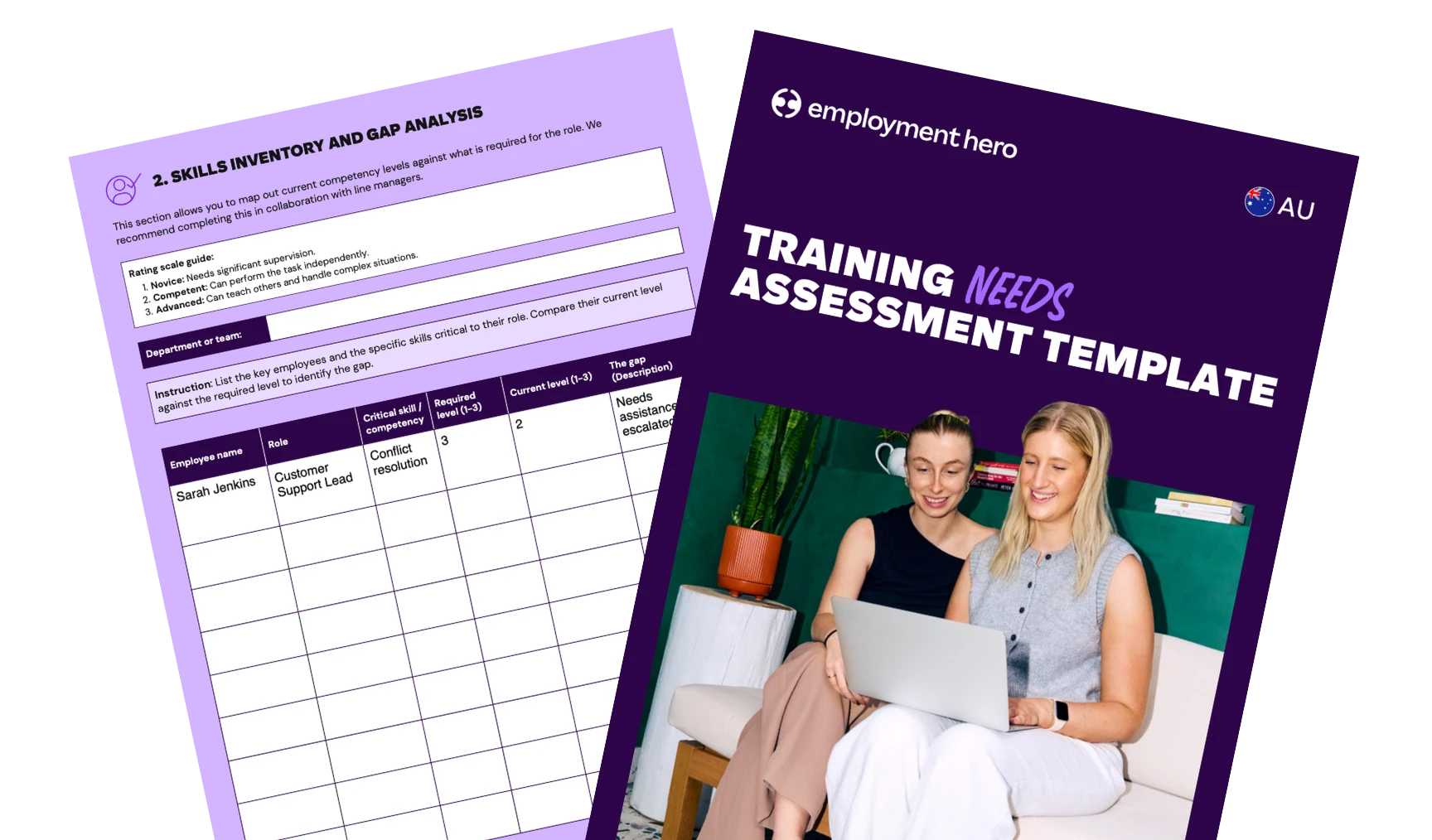 Read more: Conducting a training needs analysis: Free template and guide
Conducting a training needs analysis: Free template and guide
Unlock your team’s potential with a training needs analysis. Learn how to boost employee performance and align training with your…
-
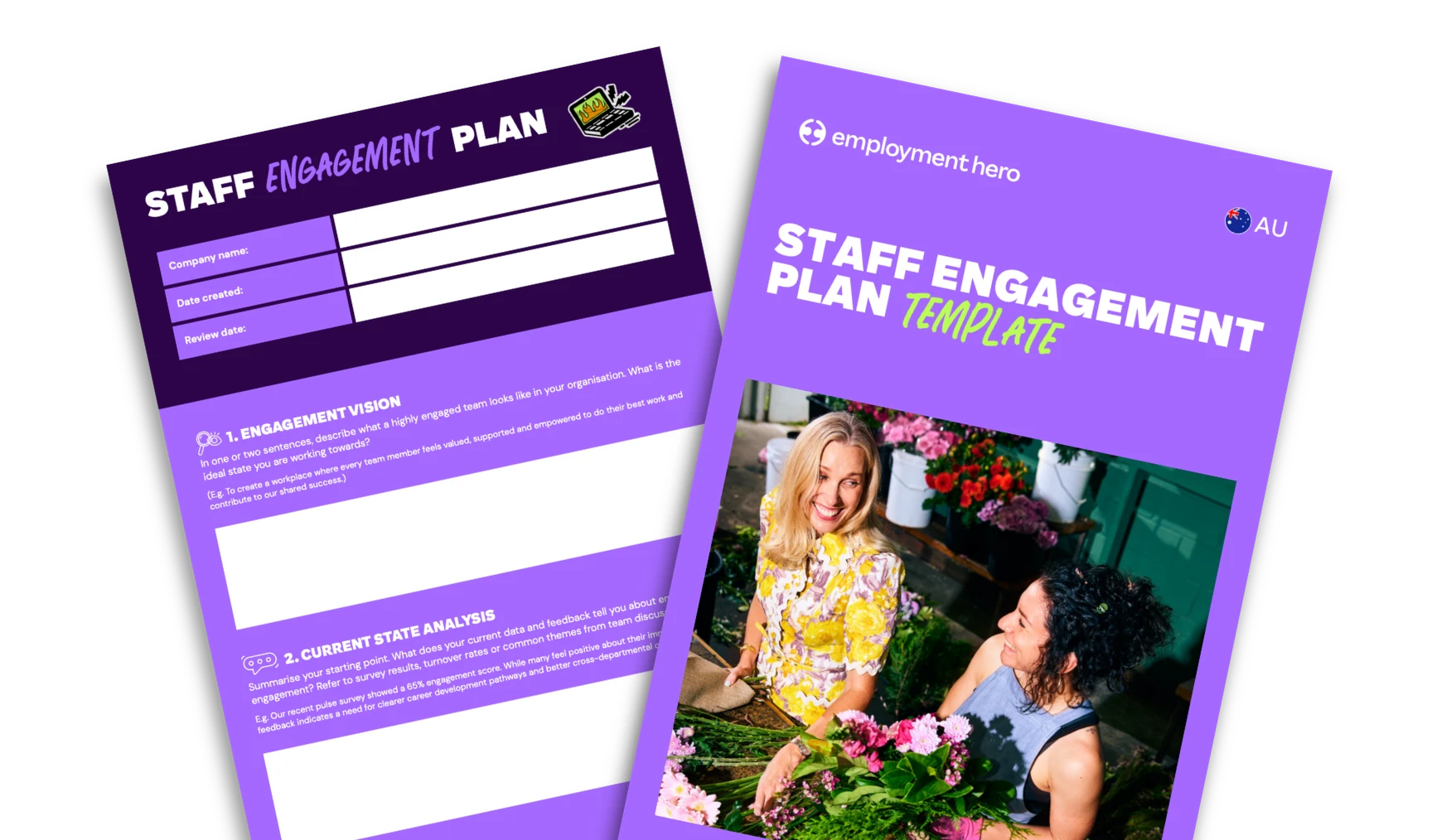 Read more: Staff engagement plan template and guide
Staff engagement plan template and guide
Discover effective strategies for creating a staff engagement plan that drives results. Download our template and guide.

