

















Employment Uncovered 2025: The Story of Australian Work
Inside the story of Australian work in 2025. From rising ‘sickies’ to hiring fatigue, see how workforce patterns are shifting. Read the full insights.
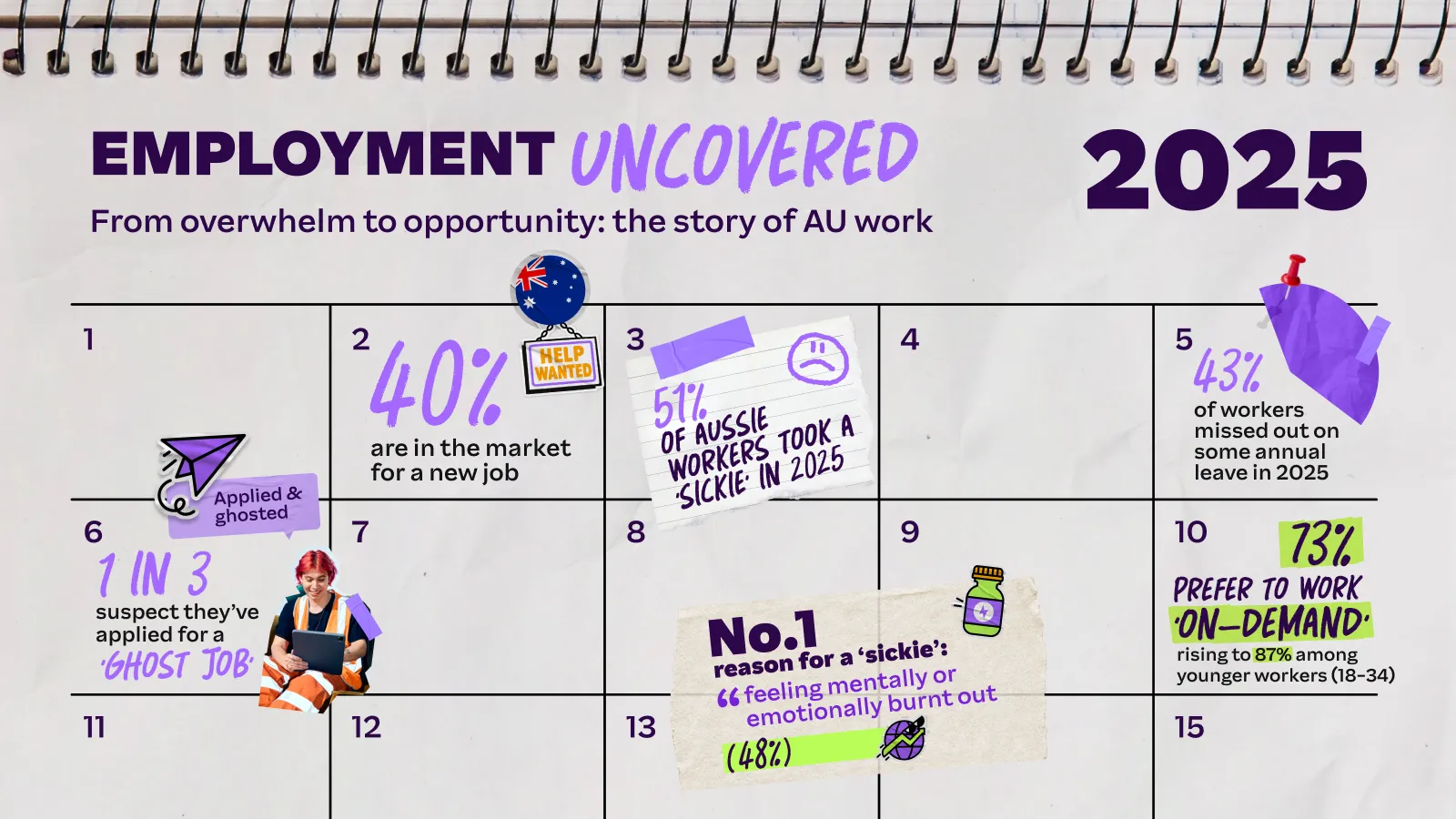
After a demanding year, Australian workers are heading into 2026 tired, restless and ready for change
It’s a contrast that feels distinctly Australian in 2025: a workforce pushed to its limits, yet increasingly determined to take control of how they work, what they’re worth, and what they need to thrive.
For many, the past year was defined by missed breaks, mounting pressure, uneven recruitment experiences and a growing appetite for flexibility. Yet beneath the fatigue sits something surprisingly positive, a clearer sense of what workers want, and a stronger willingness to pursue it.
Insights from Employment Hero’s Employment Uncovered survey offer a detailed picture of these shifting patterns. Drawing on aggregated and anonymised insights from more than 300,000 businesses and 1.5 million employee records across small businesses and a national survey of 1,000 Aussie workers, the findings reveal a year where exhaustion rose, mobility surged and trust in the hiring process wavered, but workers continued to show resilience, ambition and a renewed focus on fairness.
Sickies as a Last Resort for Real Downtime
One of the clearest signs of accumulated strain comes from how Australians used their sick leave in 2025.
More than half of Australian workers (52%) said they took at least one “sickie” in 2025 despite not being physically unwell, and 34% did this more than once. Full-timers were significantly more likely to use sick leave for rest (58%), while self-employed workers were the least likely (23%).
When asked why, Australians pointed overwhelmingly to emotional exhaustion:
- 48%: felt mentally or emotionally burnt out
- 35%: were overwhelmed and needed a break
- 27%: had caregiving or family responsibilities
- 24%: needed time for life admin
- 10%: used the day for a social commitment
Younger workers were nearly twice as likely as older generations to cite burnout as the catalyst another sign of mounting pressure on early-career Australians trying to keep pace with rising demands.
Sick days have increasingly become the fallback option for genuine downtime, a signal that the country’s recovery systems aren’t keeping pace with rising pressure.
Annual Leave left at the Office
On paper, Australian workers had opportunities to rest, but for a significant portion, those breaks didn’t feel like real downtime.
Forty-three percent of workers missed out on some of their annual leave in 2025, with younger workers most affected; 55% of 18–24-year-olds said they didn’t take all the leave they were entitled to. Those who changed jobs this year also struggled, with 52% missing out on days off during transitions.
A Year Marked by Job Hunting and Job Switching
Australians didn’t just think about change this year, they acted on it.
By the end of 2025:
- 54% had searched for a new job
- 40% had applied for one
- 23% had started a new job or new role
But change didn’t always bring smooth transitions. One in four new starters said their onboarding experience was bad, and part-time workers were 35% more likely to report poor onboarding overall.
The story behind these numbers is one of a workforce increasingly unwilling to settle, ready to explore new environments but struggling against dated processes and inconsistent experiences.
A Hiring Landscape Wearing People Down
Perhaps the strongest theme of 2025 is the mounting frustration with Australia’s recruitment systems.
A quarter of workers (26%) said securing their current role was difficult, climbing to 36% among those who moved to a new employer this year. Younger Australians felt this pressure most, being 32% more likely to struggle.
Job seekers pointed to several recurring issues:
- No clarity on salary or conditions (43%)
- Vague or jargon-heavy job ads (35%)
- Unrealistic skill expectations (35%)
- Algorithm-recommended roles that don’t match their abilities (30%)
- Ghost jobs – roles that never seemed to progress (23%)
The emotional toll is significant. Three in five workers say the hiring process has discouraged them from applying for new roles.
And one problem towers above the rest: 56% say the worst part of applying for jobs is “ghosting” or simply never hearing back.
It’s a process that feels slow, silent and disconnected at a time when workers are seeking clarity more than ever.
A Workforce Redefining Flexibility, Technology and Control
Despite strain across the year, Australians are remarkably forward-looking in how they want their working lives to evolve.
A shift to on-demand work
A striking 73% of workers would prefer to work “on-demand” selecting shifts or projects through digital platforms if reliable work were available. Among 18–34-year-olds, this rises to 87%.
Trading pay for balance
Four in ten workers say they would accept less pay in exchange for more flexibility, a clear sign of shifting priorities for 2026.
The rise of AI in everyday work
AI has quietly woven itself into the fabric of work:
- 21% use AI daily
- 46% use it weekly
- 61% of workers new to a job in the past year use AI at least weekly
But there’s a disconnect: only 44% say their employer actively encourages AI use, and 41% say their employer is indifferent.
Skills for the future
The top skills workers believe will matter most are:
- Digital and data skills (34%), and
- Human-centric capabilities such as empathy and care (27%)
Together, they signal a future where technology and humanity coexist, not compete.
Preparing for 2026
Employment Uncovered paints a picture of a workforce that is stretched but far from stagnant, one that felt the strain yet continued to push for progress.
Australians didn’t always rest well this year, and many struggled to disconnect. They wrestled with slow hiring systems, unclear expectations and mounting emotional pressure. But they also explored new roles, embraced new technologies and made clear what they value most: flexibility, wellbeing and meaningful control over how they work
As businesses prepare for 2026, the priorities are clear:
Support real downtime. Simplify hiring. Improve onboarding. And design work in ways that give Australians the autonomy and balance they’re searching for.
Turning this year’s tension into next year’s progress will define the employers who stand out and the ones who fall behind.
Related Resources
-
 Read more: The rise of ‘benefitsmaxxing’: UK workers look beyond pay during period of slowing wage growth
The rise of ‘benefitsmaxxing’: UK workers look beyond pay during period of slowing wage growth
February 26 2026 – New research commissioned by Employment Hero reveals 53% of UK workers say better benefits are a…
-
 Read more: Employment Hero Named Among Best Australian & New Zealand Companies by G2
Employment Hero Named Among Best Australian & New Zealand Companies by G2
Ranked #6 on G2’s 2026 Best Software Awards, officially a Top 10 software company in ANZ
-
 Read more: New research reveals Australians remain unprepared for Payday Super, now mere months away
New research reveals Australians remain unprepared for Payday Super, now mere months away
February 23, 2026 – Employment Hero’s Inside the Future of Super: 2026 Report reveals a national readiness crisis as businesses…
