















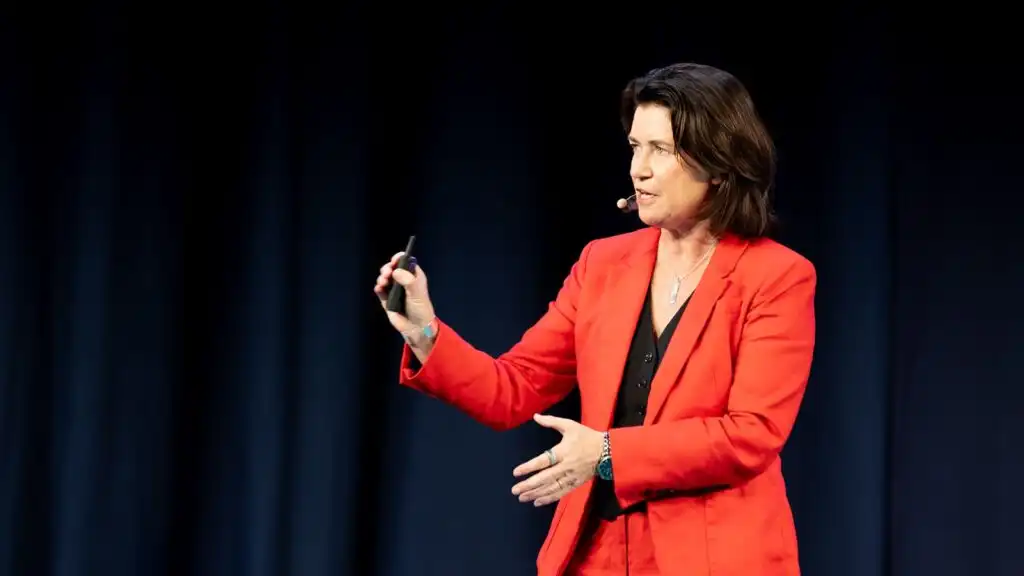
At a time when customers crave authenticity, expert storyteller Gabrielle Dolan says small business owners can use AI as a bridge to human connection.
Storytelling is having a moment. The Wall Street Journal recently declared ‘storyteller’ the corporate world’s hottest job, as companies strive to create narratives that resonate in a crowded marketplace. For Gabrielle Dolan, that recognition is well overdue. As a global authority on business storytelling, she knows the value of a well-spun yarn.
“Stories are the most effective part of your communication,” she says. “If you want your audience to remember your message, tell a story.”
As generative AI platforms like ChatGPT, Gemini and Claude began to transform workplaces, Dolan was repeatedly asked whether the technology would spell the end of storytelling in business. A deep dive resulted in an emphatic answer – “absolutely not” – and a book, Story Intelligence, that helps business leaders harness technology to communicate with purpose.
What Exactly Is Business Storytelling?
“In a world of AI-generated content, our stories are needed now more than ever,” Dolan says.
While people often think of the pub or dinner table as places to tell stories, Dolan realised they’re just as effective in the office and the boardroom, during her time in a senior leadership role at NAB. She made ‘business storytelling’ her speciality, writing books and advising leaders from SMEs to multinationals and not-for-profits.
“I think the most powerful story people can share is a personal story, but sharing it to communicate a business message,” she explains. “It’s about being very deliberate and strategic around how you do that.”
Dolan says stories make a message ‘sticky,’ a point reinforced by science. Studies have shown that hearing compelling narratives makes brains release oxytocin and build bonds with the narrator, while stories are up to 20 times more likely to be remembered than facts alone. She cites an example from home: telling her children not to jump in the pool was ineffective, but when she recounted how their auntie jumped in the pool and broke her tooth, they listened.
While storytelling has a broader role in corporate messaging, Dolan’s focus is on the interpersonal form: managers addressing staff, salespeople speaking to clients, leaders addressing conferences. Her observation is stories cut through better than arguments and are more easily absorbed, making her point by paraphrasing George Bernard Shaw: “So many of us think we’ve communicated, but if people haven’t understood it, that’s an illusion, and communication has not taken place.”
The End Goal Should Be Authenticity
So, where does AI come in?
Dolan sees two camps: people who go all in and consult ChatGPT before conversations or presentations, and others who steer clear and regard its use as cheating. She is quick to bust that myth: “It’s not cheating,” she insists. It’s not the enemy either, she says, but nor is it the answer. What it is, she concludes, is a tool that can amplify the value of being human but must be used with its advantages and limitations firmly in mind.
The biggest limitation is the lack of authenticity, since an AI chatbot is, by name. artificial. “In an age of distrust, authentic stories are your greatest asset,” she writes in the book, “maybe even your superpower.” She notes the predominance of AI slop online and the distaste for AI-generated content on platforms like LinkedIn. She defines the book’s title phrase, story intelligence, as using storytelling skills in an authentic way to connect, engage and inspire.
Yet, the technology’s greatest advantage – efficiency – means the temptation to use it can be irresistable.”People go, ‘I need to share a story on teamwork, and I’m just going to get AI to come up with a story on teamwork and then pass it off as my own,’” she explains. “But that’s not story intelligence. That’s story stupidity.”
In her book, Dolan performed an experiment, asking people to assess anonymised stories written by ChatGPT, Claude and herself. She admits she was initially skeptical that AI could help with personal stories at all, but was surprised to find AI fared better than she expected, rating highly for clarity. But the concocted stories trailed hers for authenticity and engagement, suggesting people had a ‘BS detector’ for content that wasn’t real.
The same goes for using a true story but asking AI to polish it. “It may sound good, but it doesn’t sound like you,” she says. “That’s where I think we start to get lazy. All this AI-generated content is starting to sound the same, because we’re losing our voice in the process.”
You Have A Storytelling Coach In Your Pocket
The solution, she says, is to accept limitations and restrict use to areas of advantage. That means, in storytelling, AI should be reliable sidekick Robin and never Batman, doing the leg work without taking control. “Use it as your creative partner,” Dolan recommends. “Use AI as your storytelling coach. It can help you find and refine your story.”
She’s observed business people almost always have compelling personal stories to tell but many struggle to connect them to the workplace. It may be a childhood trauma that forced them to face their fears, a travel disaster that made them think outside the box, or a toddler parenting challenge that informed management techniques. She suggests prompting AI to ask a series of questions that will draw out examples, such as, “Have you ever had a time where you didn’t do something, or you tried something different, or you were too scared to try something?” It should be enough to jog memories. “What will happen is you will then think of a story,” she promises.
She believes AI’s superpower is its efficiency in brainstorming – generating more ideas more quickly than any team sitting around a table. She admits to being surprised by the calibre of responses, particularly in providing kernels of ideas for people to build on.
More advanced users could train a custom GPT or Gem to write in their typical tone or style but Dolan notes this would still require careful oversight. “I think as long as you stand by that and are strong to that, AI can be a really, really helpful, creative member of your team.”
Cutting Through With Ultimate Connection
Once leaders have identified useful stories, Dolan says AI can write the framework but stresses the words must still be their own. She recommends incorporating other practical advice to influence everyone from employees to clients and stakeholders:
The 60-Second Rule
A short story is a good story, says Dolan. “Your story should be about 60 seconds. When people say to me, ‘I’ve only got a 10-minute presentation, I don’t have time to tell a story, I say, ‘Take a minute of that, and it’ll be the most effective minute of your 10 minutes.’”
The Out Loud Test
Stumbling over words when speaking is a dead giveaway that words are not your own, so practice stories out loud. “If you never use that word, why are you using it?” Ensure you write how you speak.
Avoid clichés
Dolan says the biggest storytelling turn-offs come at the beginning and the end. “You never want to start your story with, ‘Let me tell you a story…’ and you never want to end your story with, ‘The moral of the story is…’” An effective story should appear effortless.
Dolan understands that many small business owners are simply too busy to experiment with AI and lack the headspace to learn new concepts. “We put so much time into communicating, we put so much time into writing an email to our staff, to developing a presentation – the amount of time we waste on PowerPoint, for example.”
But she argues ignoring storytelling skills could also prove costly. “Find the time, because it’s going to transform the way you communicate. It’s going to transform the way you influence, the way you sell, the way you get your message across. How you differentiate yourself from your competitors is by the stories you share.”