













The majority of Australians are startlingly unaware the biggest superannuation shake-up in decades is looming, including more than half of SME owners.
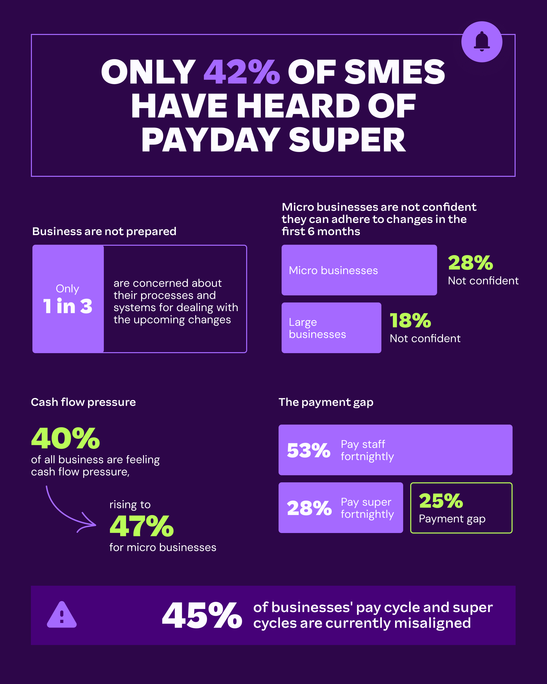
Exclusive data from Employment Hero’s Payday Super Shift: 2026 Employer Readiness Report found 4 in 5 employees and 58 per cent of business owners have never heard of the landmark Payday Super reforms, which come into effect in four months.
Payday Super will require employers to pay superannuation contributions at the same time as salary and wages, replacing the current system where payments are made quarterly.
“Payday Super is one of the most positive reforms for working Australians in decades,” says Employment Hero General Manager, Superannuation and Benefits, Rob Dunn. “The challenge is that with just over four months to go, nearly 6 in 10 employers still don’t know about this change. It’s not a reflection of unwillingness – businesses need clearer guidance and smarter tools to get ready in time.”
Businesses Are Facing a Preparation Gap
The survey of 500 Australian businesses and more than 1,000 employees found 84 per cent of business owners are frustrated with the current superannuation system, citing the return of funds due to errors and manual processing as the major pain points.
But while they welcome reforms, 70 per cent of SME owner worry about their ability to keep up with requirements, and two-thirds fear penalties if they make a mistake. A significant proportion is concerned they can’t afford the transition. Employment Hero’s financial modelling suggests an average of $124,000 in additional cash flow is needed to move from quarterly to per-pay-cycle contributions. 40 per cent of businesses indicate they may need to access credit or financing to meet these obligations.
In a double blow, the law comes into effect on the same day the ATO’s Small Business Superannuation Clearing House is scheduled to close. This means SMEs using manual processing must find new software to handle the jump from 4 to 52 super payments a year, while meeting a calendar-day deadline.
Greater Visibility May Boost Interest In Super
In a positive effect, the report suggests Payday Super may encourage employees to take more of an interest in their long-term finances.
Currently, only 18 per cent of workers check their super each pay cycle and fewer than half actively engaged with their fund in the past year. This comes at a cost: over a 40-year career, the difference in retirement savings between an engaged and disengaged employee can reach approximately $156,000, due to proactive steps such as account consolidation and fee monitoring.
Sydney sales manager and self-confessed ‘super nerd’ Jacob Jackson has been ribbed by mates for years for tracking his contributions via a spreadsheet, but insists it’s worth the effort. “I see super as the biggest wealth-building tool most Australians have access to,” he explains. “The problem with quarterly payments is you’re essentially giving your employer an interest-free loan for up to three months. Multiply that across your whole career and it adds up to thousands of dollars in lost earnings. Payday Super fixes that.”
The research projects a 33 per cent increase in employees checking their super every payday once contributions become more frequent and visible. Says Rob Dunn: “More frequent contributions mean better visibility, fewer lost accounts, and ultimately, healthier retirement savings for millions of people,” Mr Dunn said.
There’s room for improved confidence between genders: only 6 per cent of women consider themselves knowledgeable about super, compared to 15 per cent of men. The report states: “For employers, this highlights the importance of having super processes that are not only compliant but clear, consistent and accessible across a diverse workforce, instead of relying on confidence or financial literacy to fill the gap.”
SMEs Still Have Time To Get Ready For Reforms
While July 1 is looming, Rob Dunn says small businesses can still meet the deadline with the correct support. “Businesses need clearer guidance and smarter tools to get ready in time. The right payroll and payments solution will not only help businesses stay compliant, but also better position them to attract and retain talent in a market where employees increasingly expect visibility over their entitlements.”
Employment Hero CEO Ben Thompson agrees technology is key, particularly among the 30 per cent of owners who doubt their current system can handle the changes. “As Payday Super approaches, one message is clear: the businesses that move early will be best placed to succeed,” Thompson states in the report. “That means modernising payroll and super workflows, reducing manual effort and bringing super back into sync with the employment experience, in a way employees can see, understand and trust.”
As Payroll Manager at indigenous healthcare service Purple House, Brian Knappstein has seen enormous benefits since switching to Employment Hero’s HeroClear product. “The manual workload I used to manage is now gone with just a few clicks, and I can close my laptop for the day,” he says. “I especially like the tracking feature, which makes it much easier to stay on top of compliance, since meeting obligations ultimately depends on when the funds actually receive the payment. With Payday Super on the horizon, it’s a huge relief knowing we’re ready for it.”