

















SBSCH closure: What small businesses need to know
Contents
Payday Super is one of the biggest changes to payroll and superannuation in recent years and the deadline of 1 July 2026 is fast approaching.
At the same time, the ATO-run Small Business Superannuation Clearing House (SBSCH) will also close, meaning that businesses using this services will not only need to shift from quarterly superannuation payments to paying super in line with payday and ensure that contributions reach employee funds within seven business days, but they will also need to find a new clearing solution that can service these new requirements.
If your business relies on the SBSCH, it’s important to understand what’s changing, when it’s happening and how to prepare. This guide breaks down everything small businesses need to know, with practical steps to make sure you have a smooth transition come 1 July 2026.
What is the Small Business Superannuation Clearing House (SBSCH)?
The SBSCH is a free service provided by the ATO that helps small employers pay super to multiple funds in a single transaction. Instead of sending contributions to each employee’s chosen super fund individually, employers could submit one payment through the SBSCH and the clearing house would distribute it on their behalf.
For many small businesses, especially those without dedicated payroll teams, the SBSCH has been a simple, reliable and cost-effective way to manage their quarterly super obligations. It became the go-to tool for micro-businesses and small teams looking to streamline super requirements
The SBSCH was designed for small employers meeting specific eligibility criteria. To use the service, businesses needed to have:
- 19 or fewer employees, or
- An annual aggregated turnover under $10 million.
Once registered, employers could log in through ATO online services, enter contribution amounts and pay their entire super batch at once. The system then forwarded the contributions to the correct funds, meeting employers’ SuperStream obligations.
Within the broader superannuation ecosystem, the SBSCH has acted as a centralised distribution hub. While it wasn’t a full payroll system, it worked to fill a gap for small employers who didn’t use payroll software or preferred a manual approach to processing super.
Why is the SBSCH closing?
The Small Business Superannuation Clearing House (SBSCH) is closing because it can’t meet the operational and technology requirements of Australia’s upcoming Payday Super reforms. From 1 July 2026, employers will need to pay super at the same time as wages, shifting superannuation from quarterly processing to near real-time payments.
To support Payday Super, systems must be able to process contributions quickly, accurately and in a payroll-embedded workflow. The ATO has confirmed that the SBSCH cannot support the key capabilities needed, including:
- Real-time or high-frequency processing
- New Payments Platform (NPP) payment rails
- Fast, fund-level validation
- Automated error and return handling
Because the SBSCH lacks these critical features, it can’t support the new requirements (such as ensuring contributions reach funds within 7 business days of payday). As a result, the Government is retiring the SBSCH and directing employers towards integrated solutions that can handle real-time super transactions.
Powerful tools like Employment Hero’s HeroClear are built specifically to meet these new standards and help employers manage their super obligations under Payday Super.
ATO SBSCH cut-off date: key dates employers must know
Since 1 October 2025, new employers have been no longer able to register for the SBSCH.
Existing users can continue to use the clearing house until 30 June 2026, which is the final date that super contributions can be submitted through the service. From 1 July 2026, the SBSCH will be completely closed.
After 11:59pm AEST on 30 June 2026, employers will have no access at all. You won’t be able to log in, submit payments or view any records. The system shuts down completely. Any super payments attempted through the SBSCH after 30 June 2026 will not be processed, putting employers at risk of missed deadlines and compliance risks.
Until the closure date, the SBSCH will operate as normal. However, small businesses are strongly encouraged to transition to an integrated super payment solution well ahead of time to avoid last-minute pressure or disruption.
For more information on downloading your records, visit the ATO website.
To recap:
| 1 October 2025 | No new employer registrations for the SBSCH. |
| 30 June 2026 | Final day for SBSCH submissions. |
| 1 July 2026 | SBSCH shuts down permanently. Employers must download records before 30 June 2026. |
| From 1 July 2026 | Employers must use an alternative, Payday Super–ready clearing solution. After this, any super submitted through the SBSCH will not be processed, creating immediate non-compliance and risk of the SGC. |
Why you need to prepare early
The best thing you can do right now is start planning how your super process will work under Payday Super. Taking the time to map out your new workflows early will help you:
- Transition smoothly well before the SBSCH shuts down.
- Test and confirm your new super clearing solution.
- Reduce the risk of compliance issues or last-minute pressure.
- Feel confident that your final SBSCH submission will be processed correctly and on time.
Don’t wait until 2026 to get Payday Super-ready. Begin reviewing and updating your super contribution process now so your business is set up long before the SBSCH closes.
How the SBSCH closure impacts your business
Payday Super brings two major impacts for your business:
- More frequent processing: You may go from 4 super submissions per year to 26 or 52.
- Greater compliance risks: Under the new Super Guarantee Charge (SGC) model, employers face penalties for each Qualified Earnings (QE) day shortfall, including notional earnings and a 60% administrative uplift.
Administrative and payroll workflow changes
Small businesses will need to adopt a new clearing solution that supports real-time payments, as the SBSCH and other batch-based systems can’t meet the Payday Super seven-business-day requirement. By using tools like HeroClear super is processed and validated directly from payroll with real-time visibility on payment outcomes, helping you save time, reduce admin and feel confident your payments are on track.
To stay compliant without adding extra workload, businesses should also remove manual steps from their payroll workflows. Manual SuperStream Alternative File Format (SAFF) files, external portals and batch submissions create delays and increase the risk of errors, all of which can lead to late payments under the new rules. Automating this process inside payroll is the safest path forward.
Businesses should also integrate super processing directly into their payroll software (like Employment Hero). Payday Super is designed around integrated, automated systems that calculate, submit and track super as part of each pay run.
It’s also essential to keep employee fund details accurate and up to date. Incorrect Unique Superannuation Identifiers (USIs), outdated fund names or invalid member numbers are common causes of delays or rejections. Validating this information early helps avoid payment issues and gives you greater confidence that contributions will reach the right fund on time.
How HeroClear helps you meet all of these changes
HeroClear takes the complexity out of Payday Super by bringing clearing, validation and real-time payments directly into Employment Hero Payroll. It removes manual uploads and external portals, automatically validates employee and fund details, and processes super as part of every pay run. The result is less admin, faster fixes when something goes wrong and instant visibility over payment outcomes, helping you meet your obligations with confidence.
Compliance under Payday Super
Payday Super introduces real-time super obligations, meaning employers must pay super at the same time as salary and wages, with payroll and super aligned every pay cycle. Any delay, even by a few days, may trigger penalties much faster than under the old quarterly system.
The ATO’s draft Practical Compliance Guideline (PCG) provides some early guidance by outlining how the ATO intends to apply a risk-based approach in the first year, but it does not remove employers’ core obligation to make sure contributions reach funds on time. In practice, businesses will need reliable, integrated systems to meet these new expectations and avoid unnecessary compliance risk.
Payday Super and SBSCH transition options for employers
Small businesses have several options when replacing the SBSCH. The right choice depends on your payroll setup, budget and preferred level of automation.
Employment Hero Payroll and HeroClear (recommended)
For small businesses, the smartest and most future-proof way to prepare for Payday Super is to use payroll software with super clearing built directly into it. That’s exactly what Employment Hero is building and it’ll be ready well before Payday Super comes into effect.
From the moment you onboard a new employee, Employment Hero Payroll helps you capture and validate their super details correctly, so contributions are set up right from day one. Unlike external clearing houses or manual file-based processes, our fully embedded solution, HeroClear, is purpose-built for the speed, accuracy and real-time compliance Payday Super demands.
With HeroClear, super is calculated, validated and paid automatically inside your payroll workflow. There’s no file uploads, no separate logins and no waiting for batch processing. Every contribution syncs instantly with each pay run, dramatically reducing admin and minimising the risk of errors, delays or SGC exposure.
For businesses wanting a seamless transition away from the SBSCH, HeroClear is the clear frontrunner. It will be available well before the SBSCH shuts down and by moving to Employment Hero now, your business can simplify processes, stay on top of compliance and step confidently into the new Payday Super world, all with one trusted, end-to-end platform.
Commercial clearing house providers
Standalone commercial clearing houses may still operate, but many rely on manual uploads, batch file processing and limited real-time visibility.
These capabilities don’t align well with the fast, high-frequency requirements of Payday Super. As a result, these providers carry a higher compliance risk under the new timelines.
Clearing houses from super funds
Fund-run clearing houses can help you send contributions, but they rarely manage the full journey from onboarding through to real-time error handling. They sit outside your HR and payroll systems, require extra logins and manual steps, and often rely on batch processing.
This can make it harder to validate super details up front, identify issues early and support frequent, pay-cycle–level contributions in line with Payday Super requirements.
How to prepare for the SBSCH closure
Here’s what small businesses should do now:
- Download your SBSCH records before 30 June 2026.
- Review your current payroll processes for manual steps or quarterly dependencies.
- Choose your replacement clearing solution, prioritising automation and Payday Super readiness.
- Update employee super details. This includes the correct fund names, USIs and member numbers.
- Test your new system early to catch any setup issues.
- Coordinate with your bookkeeper, accountant or payroll partner to avoid mistakes.
The simplest path? Move onto Employment Hero now, so HeroClear becomes a natural part of your payroll and super workflow, long before the SBSCH closes and Payday Super comes into effect.
If you’re looking for more resources and expert insights, visit our Payday Super Hub and sign up to our mailing list. Ready to get Payday Super ready? Get in touch with one of our business specialists now.
Disclaimer: The information in this article is current as at 18 November 2025, and has been prepared by Employment Hero Pty Ltd (ABN 11 160 047 709) and its related bodies corporate (Employment Hero). The views expressed in this article are general information only, are provided in good faith to assist employers and their employees, and should not be relied on as professional advice. The Information is based on data supplied by third parties. While such data is believed to be accurate, it has not been independently verified and no warranties are given that it is complete, accurate, up to date or fit for the purpose for which it is required. Employment Hero does not accept responsibility for any inaccuracy in such data and is not liable for any loss or damages arising either directly or indirectly as a result of reliance on, use of or inability to use any information provided in this article. You should undertake your own research and to seek professional advice before making any decisions or relying on the information in this article.
Related Resources
-
![Hospitality Industry (General) Award Summary [MA000009]](https://employmenthero.com/wp-content/uploads/2026/03/Award-Summary_Hospitality-Industry.webp) Read more: Hospitality Industry (General) Award Summary [MA000009]
Read more: Hospitality Industry (General) Award Summary [MA000009]Hospitality Industry (General) Award Summary [MA000009]
The Hospitality Award is designed to cover a wide range of job roles including chefs, wait staff, front office and…
-
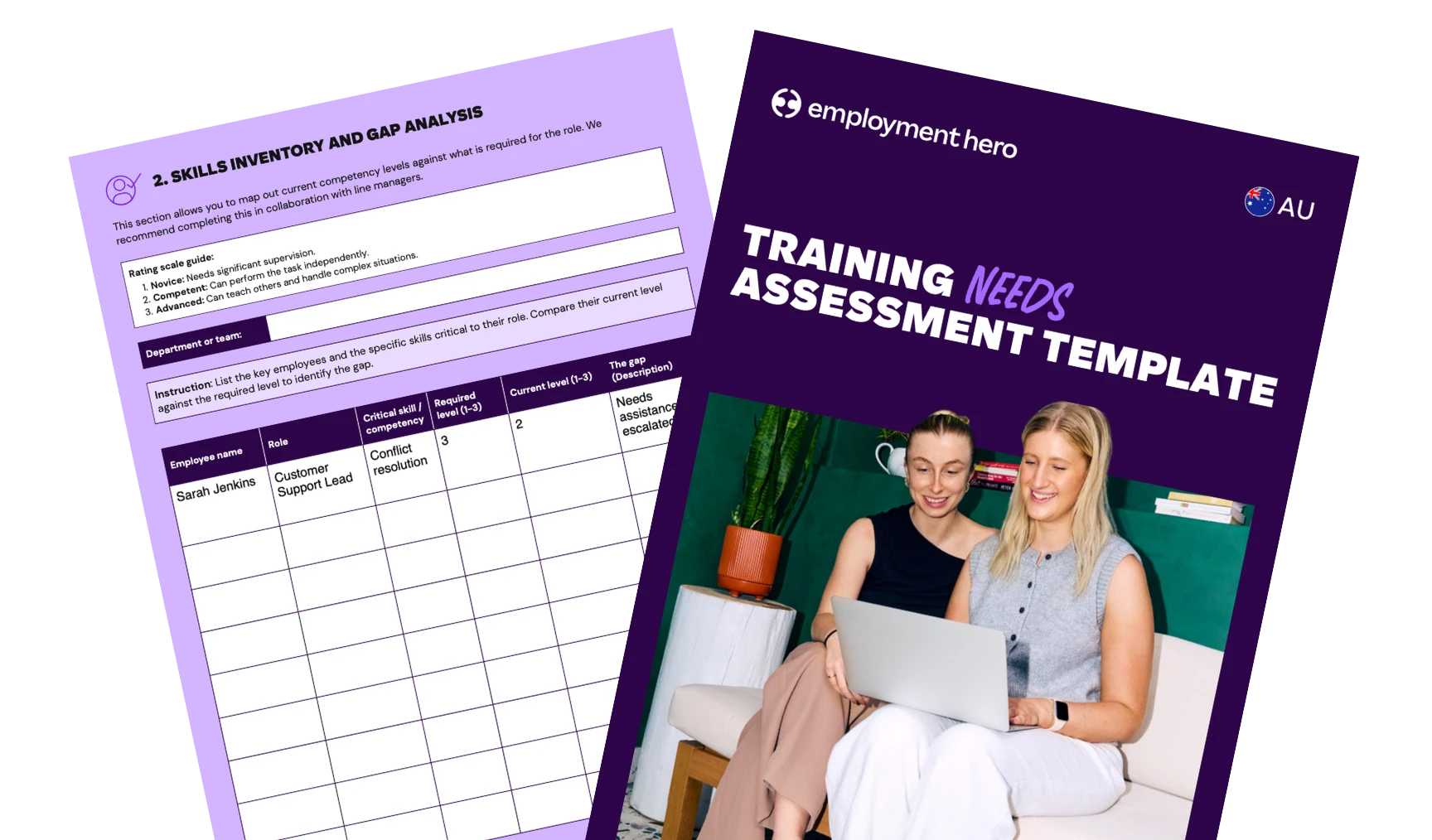 Read more: Conducting a training needs analysis: Free template and guide
Conducting a training needs analysis: Free template and guide
Unlock your team’s potential with a training needs analysis. Learn how to boost employee performance and align training with your…
-
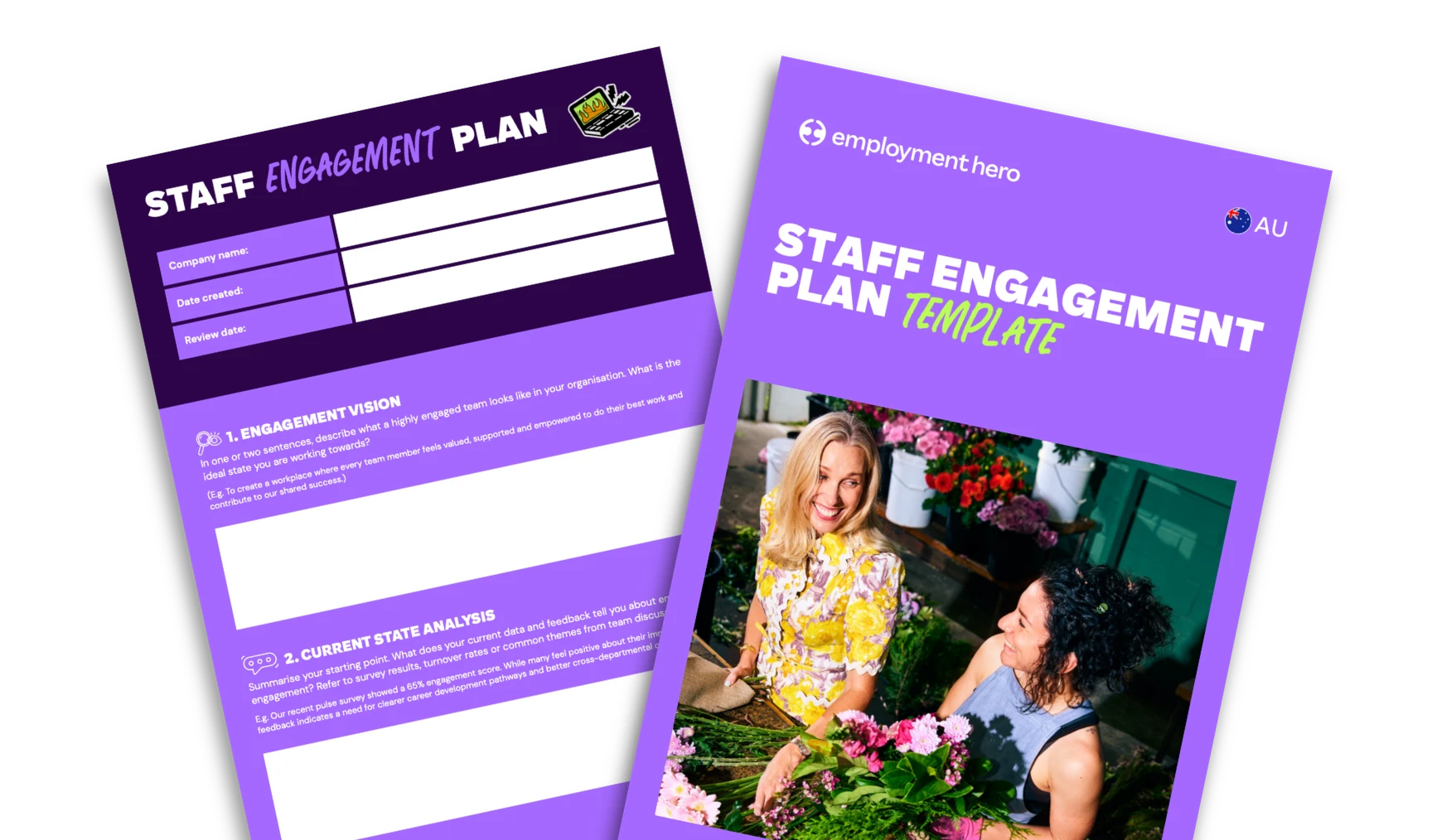 Read more: Staff engagement plan template and guide
Staff engagement plan template and guide
Discover effective strategies for creating a staff engagement plan that drives results. Download our template and guide.


