 New Zealand
  United Kingdom
  Singapore
  Malaysia
  Canada (Français)
 Australia

AI in the workplace: How to integrate it without losing the human touch

Contents
Right now, Australian businesses are feeling the pressure to get AI right. Most are investing in it, many are experimenting with it and almost all are trying to figure out what using it well looks like. However, underneath the urgency, there’s something more interesting happening.
Our 2026 AI Paradox at Work research revealed that 75% of Australian AI users say it has improved their productivity at work, yet 45% of those same workers feel like AI is making them replaceable.
That tension, a workforce thriving with AI while bracing for the threat of it, is the thing Australian employers need to understand right now.
The challenge many are facing is how to bring it in without creating confusion, losing trust or making people feel like the process is more important than they are. The businesses that get this right will improve their ways of working and give their teams more time for the work that needs empathy, context and care.
The AI workplace reality: where most businesses are
Most Australian businesses today aren’t running business-wide AI transformation programs. They’re experimenting, often inconsistently, with a handful of tools. Meanwhile, their employees are already using AI on their own terms, sometimes without permission and sometimes without telling anyone.
So much so that 1 in 3 Australian workers (34%) are using AI tools at work without their employer knowing. A further 44% of businesses report that staff are using personal AI accounts on the job.
This creates a trust and governance problem, and the data reveals that it’s already happening in your business. It’s what happens when tools move faster than conversations and when expectations aren’t clear.
After all, most people are just trying to do good work, keep up and stay relevant in a time that feels uncertain for a lot of reasons. When they don’t hear anything from leadership about AI, they fill the silence themselves. They figure it out alone, while feeling guilty about it.

What adopting AI in the workplace means for businesses
Before the strategy conversation, it helps to define what we’re talking about.
AI in the workplace isn’t just one single technology. At one end, there are simple automations like rule-based systems that route a leave request or auto-fill a timesheet. At the other end, there are systems that augment human decision-making, surfacing insights from large datasets, predicting hiring needs or flagging compliance gaps before they become problems.
Most of what Australian businesses are deploying today sits closer to the automation end of that spectrum. That’s also where significant, measurable value lives right now.
For a business owner, the practical question is simple. Where are the hours going that don’t need to go there? Where are decisions being made slowly because someone is drowning in admin? What is costing you talent you can’t afford to lose? Answer those questions and the AI use cases will begin to write themselves.
What AI can and can’t do in your workplace
AI is good at processing volume, identifying patterns, flagging anomalies and automating repetitive tasks with a high degree of accuracy.
What it can’t do is manage a person through a difficult performance conversation, read the room in a team going through change or make a judgment call that requires weighing nuance, relationships and organisational history at the same time.
The businesses that get the most from AI are aware of this boundary. They use AI to create more capacity for the things that require human judgment, instead of expecting AI to replace that judgment entirely.
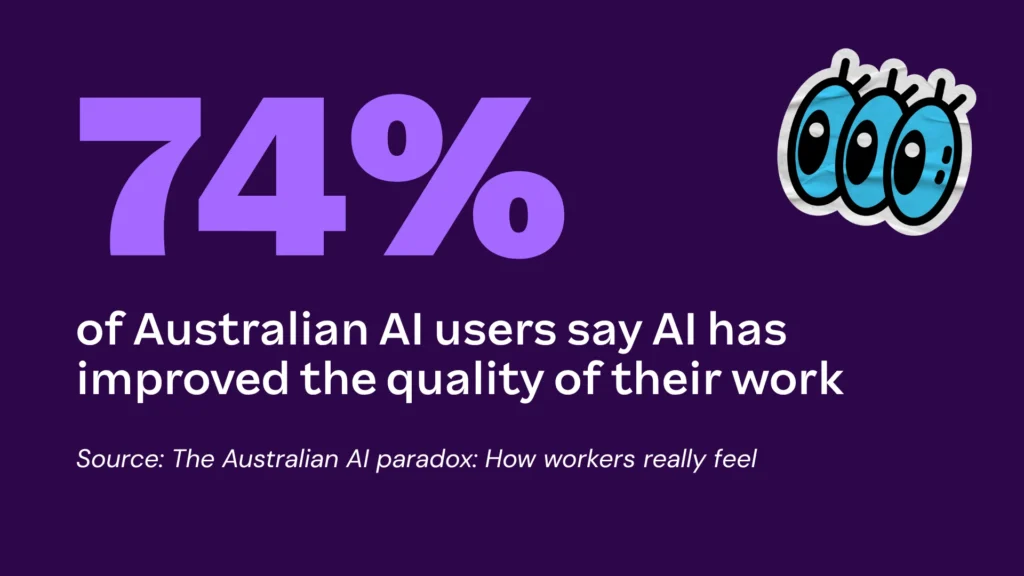
When looking at output, our research revealed that 74% of Australian AI users say AI has improved the quality of their work and 29% report redirecting time saved by AI into strategic or creative work.
Where AI delivers the biggest return in employment
For Australian business owners, the highest-return AI use cases cluster around a few specific employment workflows where time and money disappear most visibly.
Recruitment is one of the clearest.
Hours spent sifting resumes, chasing references and coordinating interview schedules are hours that could go toward the candidate experience itself. AI tools that automate shortlisting, screening and scheduling can reduce what used to take weeks into days.
The cost pressure underneath this is huge. Our Hiring Snapshot Report revealed that small businesses spend an average of $8,090 per year on hiring, while medium-sized businesses stretch to $18,371. For teams already operating lean, that spend needs to work harder. When 60% of businesses have seen new hires leave within their first month, getting the shortlisting stage right matters more than ever before.
Employment Hero’s AI Recruitment Agent is one example of what that looks like in practice. It scores every applicant, runs AI video interviews and gives hiring teams a ranked shortlist before they’ve opened a single CV. Teams using it have reported 90% less recruitment admin and a hiring process that’s 2 weeks faster.
HR admin is another area where time disappears. Payroll queries, leave approvals, compliance checks, onboarding paperwork, policy updates, the list is long and the tasks can be relentless. None of it’s unimportant, but most of it doesn’t need a person making judgment calls. When your HR team spends the bulk of their week on that operational load, the strategic work, important conversations, workplace culture and the decisions that shape how people experience work, gets pushed to the time left over, which usually isn’t enough.
The human side of AI adoption why most transformations stall
Here’s the finding that should be on business leaders’ minds.
42% of Australian workers say using AI to complete parts of their job feels like cheating.
Nearly half the workforce is using a tool that demonstrably improves their output, but feels guilty about it. That guilt comes from an environment where AI use has never been explicitly endorsed, where no norms have been set and where the implicit message is that good work means doing it the old way.
For a long time, the value of work has been measured by effort including hours logged, tasks done by hand and overall visibility. AI breaks that equation because when a task that used to take a day now takes ten minutes, the link between effort and worth gets called into question. Employers who haven’t addressed this directly are, by default, teaching their teams that AI is something to hide.
The downstream cost of that is significant. It creates a data governance risk and corrodes psychological safety at exactly the moment workers need it most.
Shadow AI: the hidden adoption problem
Most of your employees are most likely already using AI at work. The question is whether it’s the tools you’ve sanctioned or the ones they found themselves.
Employment Hero’s research found that 1 in 3 Australian workers are using AI tools without their employer knowing. Between 23% and 58% of employees globally are doing the same, according to EY’s 2025 Work Reimagined Survey.
That’s compliance exposure most businesses haven’t fully mapped yet. This could mean that sensitive client data, internal documents and confidential communications are being fed into external tools with no visibility, no audit trail and no data processing agreements in place.
Shadow AI creates huge risks from data security, inconsistent outputs and decisions made on unverified information. If your employees are working around your systems to get things done, that tells you something important about where the friction is and it’s time to put guardrails in place.
If you’re looking to put guardrails in place, download our AI policy template here.
Bridging the AI skills gap on your team
51% of Australian workers report gaining AI skills through social media platforms like TikTok and YouTube.
When more than half your workforce is turning to social media to learn tools they use on the job, the training infrastructure inside most businesses is not keeping pace with how fast AI is changing what great work looks like.
Interestingly, only 22% of workers firmly see AI upskilling as the employer’s job and 31% say it sits squarely with them as individuals. That split might look like a workforce comfortable with self-direction, but it also signals that many workers have already stopped expecting their employer to show up on this.
Despite that, 61% of Australian workers say AI is helping them develop more valuable skills.
The motivation to grow with AI is already there, but the disconnect is that most businesses haven’t decided to meet it.
Now, that divide is starting to show up in hiring too. 30% of Australian employers now cite AI skills in entry-level hiring criteria. The standard is being set at the point of hiring before it’s being set at the point of employment. Businesses that implement structured pathways and clear expectations, are the ones who are more likely to hold onto their best people.
How to build an AI strategy that works
The businesses that get this right tend to share a few common traits. They start with the problem, not the technology. They invest in people readiness alongside tool deployment. They also treat AI governance as an ongoing practice, not a one-time policy.
A practical starting point? Audit where time is going. For most Australian businesses, a meaningful slice of leadership time is consumed by employment admin, compliance checking and repetitive HR workflows that could be substantially automated.
If the audit reveals what it does for most Australian businesses, a significant slice of leadership time consumed by admin that doesn’t need human judgment, Employment Hero’s Employment Operating System (eOS) is built for exactly that. HR, payroll, recruitment and compliance in one AI-enhanced platform, so the time your people spend on processes shrinks and the time they spend on work that needs them grows.
Once you’ve identified the highest-impact use cases, the deployment question is less about which tools to choose and more about how you bring your team along. That starts with honest communication, supported by access to training and measured through actual usage rather than theoretical availability.

The people team’s role in AI transformation
When getting started, you want to be aware that AI transformation is not an IT project alone. IT can select the tools and manage the security architecture, however, the success or failure of AI adoption in any organisation comes down to people and culture. That means your HR and people leaders need to be at the centre of this, not consulted afterwards.
The people team’s role in AI transformation spans at least four functions.
- Governance: what are the standards for how AI is used, what decisions it can inform and where human judgment is non-negotiable?
- Literacy: how do you build AI capability across your workforce, not just awareness, but applied skill?
- Sensing: who is the early warning system when adoption creates friction, anxiety or unintended consequences?
- Culture: how do you sustain psychological safety during a period of significant change, so that people feel able to flag problems rather than quietly route around them?
What AI-enabled work looks like in practice
The businesses that get this right in the next few years won’t look radically different from the outside. They’ll still have humans making decisions and they’ll still have teams doing creative, relational, judgment-intensive work.
What will be different is the ratio. The hours spent on admin, resume sifting, leave approvals and payroll queries will shrink substantially. The hours spent on people conversations, strategic planning and the work that requires human presence will grow.
It’s already happening in the organisations that are getting the foundations right. They’ve got clear use cases, people investment, strong communication and systems that are built for the complexity of running an Australian business today.
If that’s the kind of business you’re building, speak with one of our business specialists.
Related Resources
-
 Read more: Changes to Junior Pay Rates in Retail, Fast Food and Pharmacy Awards from 1 December 2026
Changes to Junior Pay Rates in Retail, Fast Food and Pharmacy Awards from 1 December 2026
Junior pay rates for 18, 19 and 20 year olds in retail, fast food and pharmacy are changing. Here’s what’s…
-
 Read more: Build on Employment Hero’s HR API and get more out of every client relationship
Build on Employment Hero’s HR API and get more out of every client relationship
Learn how developers, consultants and software vendors build on Employment Hero’s HR API and earn recurring revenue through the Referral…
-
 Read more: Changes to the Health Professionals and Support Services Award from 1 October 2026
Changes to the Health Professionals and Support Services Award from 1 October 2026
The Health Professionals and Support Services Award changes from 1 October 2026. Here’s what employers need to know.


