New Zealand
 United Kingdom
 Singapore
 Malaysia
 Canada (Français)

 Australia




Hiring in 2026 is faster, more competitive, and more data-driven than ever. In this webinar, Employment Hero’s recruitment specialists walk through how to set realistic hiring goals that balance speed, quality, and candidate experience. Whether you’re scaling a team or filling a critical role, this session gives you a clear framework for approaching recruitment strategically rather than reactively.
Video transcript
Minimise
Hello, everyone. For those dialing in, welcome aboard. We will be kicking off in a couple of minutes. We're just gonna wait and give people a moment to sign in.
Hello. Welcome.
We need some, like, jokes or something that we can share during the couple of minutes before people dial in.
Gotta run our our stand up game for next time.
Absolutely. Either that or some elevated music. Yeah.
Oh, dear.
For anyone who's just dialing in, hello. Welcome aboard. We'll be kicking off shortly. We're just waiting for everyone to dial in. Sadly, we've not got any elevated music for you, but we'll we'll take that on advice maybe for next time.
We still see some people dialing in, so we'll give it another minute, and then we will commence. But hope everyone's having a lovely start of their day depending on what time zone you're in, but I think most of our guests today are Australia or potentially New Zealand.
Yep. Numbers are coming in. Good to see everyone. Welcome. Thanks for joining us today.
Alright. It is eleven o two, so I think we will kick off.
Good morning, everyone, and thank you so much for taking the time to join us today for our newest hire like a hero webinar, recruitment goals for twenty twenty six. So today, we are going to be breaking down how to set realistic measurable recruitment goals for the year ahead. And for anyone that hasn't seen me on these webinars before, my name is Kate Jolley. I'm the global head of talent here at Employment Hero, and I'm joined today by Jenny Williams, one of our wonderful talent acquisition managers here at So, Jen, could you briefly unmute, say hello, and and introduce yourself?
Already unmuted. But, yes, hi, everyone. I'm really pleased to be, yeah, talking about all things recruitment goals. It's a great way to, I guess, yeah, kick start the new year. So, yeah, excited to get into it.
Fantastic. So some quick context perhaps on Employment Hero before we get into the detail. We are now approximately a seventeen hundred person business, and we hire up to as many as, like, seventy five people a month in a really, really busy period. And we're remote, so we also hire across multiple different markets.
We sell Employment Hero in six different regions now, but being remote, we hire globally as well. So there's quite a lot of complexity to how we do hiring ourselves because of those factors. And recruitment is a really critical, valuable component of our operations function, and it's one that really genuinely helps to drive commercial outcomes for the business. So it's a hot topic for me.
I really love this one, talking about setting goals and and making sure that it's a focus for anyone that does look after recruitment.
Now we've blocked a full hour in case on the off chance we do get lots of questions, but I'm hoping that we might be able to deliver this session in a shorter time frame. We've aimed for it to be very kind of clear, succinct, easy to follow. So, hopefully, we'll be able to deliver on that. Now before we get into the discussion, a little bit of housekeeping.
We have allocated time at the end of the webinar for your questions. So please type your questions in the box down at the bottom of your Zoom screens, and we'll get to as many as we can after the presentation. And for any that we don't get to, we'll answer these after the webinar and release a webinar FAQ. I would also like to note that today's session is being recorded as per usual, and the recording and slides will be made available after the webinar has concluded.
So next slide, please. And, Jen, over to you to kick us off.
Thank you so much, Kate. So let's get started.
Really wanna start to frame the discussion first on why. Why are we talking about recruitment goal setting in twenty twenty six? So across Australia and New Zealand, the labor market remains incredibly complex going into this year. Latest government labor data is actually showing that there were more than three hundred and twenty six thousand job vacancies in Australia alone around kind of late last year, and that was even as hiring activity cooled in some sectors.
So what we, I guess, are hearing from around half of employers is they actually are still struggling to fill roles. And it's actually not because that there are no applicants.
It's actually because some are just not suitable or they might be really hard to find.
That's actually not too surprising. We are in an extremely high change dynamic environment at the moment. AI, particularly agentic AI, is arguably the most disruptive technology of our lifetime. It's going to change how we hire, who we hire, the overall talent mark makeup, sorry, and the DNA of our businesses. So we might be actually hiring for completely different skill sets that we've done in the past and also in very different time frames.
So in our view, the SMART recruitment goal setting for twenty twenty six should not just be about hiring faster or getting a bum in the seat.
It's actually about building your business with intent. It actually means that modernizing how you define, measure, improve your your recruitment goals. It's it's something you can reflect that with the real labor market dynamics and the way that, yeah, employment is actually evolving very, very quickly. So with that set in mind, I'll hand it back over to Kate.
Yeah. The the context piece is so important, and and AI will obviously continue to talk about throughout the webinar because I think it is a really, really big factor. But I would like to talk about, goal setting framework, and this is one that I'm really, really passionate about personally, having kind of set goals and and strategies and things for our team. So how should you actually think about setting recruitment goals?
If you're a head of talent or perhaps someone that is accountable for the recruitment function, I would personally always start with looking at the business's macro goals for the year, so in this case, twenty twenty six, as your starting point. So start there. For example, what are your top three company wide goals for twenty twenty six? Is it about revenue?
Is it about increased efficiency and productivity, or is it perhaps about something very specific? So for example, perhaps you're entering into an entirely new product category, and you need to make that a success in twenty twenty six as well. Whatever those kind of big company goals are, your recruiting strategy has to support them. You can't be kind of setting goals in isolation, and ignoring the bigger picture of actually the direction that the business is headed in.
So the key focus of your business will determine to a massive extent the key focus of your recruitment efforts and also how you set those really commercial targets that actually make sense and deliver on what the business wants and needs.
So I'll briefly go through a couple of examples. If your organization is focused on something like rapid revenue growth and you know for a fact that you will drastically need to grow something like your sales team in order to get there, A metric that's focused on speed to hire, so something like time to fill, is probably going to be a really vital metric for your team. Similarly, if you're focused on productivity and trying to do more with less, you'll likely focus more on something like the quality of your hires and also things like their throughput and efficiency level. Like, are you hiring new team members that are able to deliver a higher level of productivity or efficiency in your current business context than people that maybe you hired a couple of years ago.
And, interestingly, if you are going on that kind of, you know, new product category or making kind of a major shift in strategy, you might actually have some more work to do in mapping what the makeup of your workforce needs to look like in order to deliver on this. So, like, what are the skills and capabilities that you need in the organization to help support whatever that big strategic shift is? Is it that you want more people that can use AI to a really high level? Is it that you're launching a new product category and you need people with really specific expertise in that space?
Whatever the case may be, map those competencies, map who you've got in the business at the moment, and then think, okay. To get from here to here, what are the things that we actually need to bring into the organization when we're hiring to make sure that we're actually supporting the business with that? Now one that I'll also call out is candidate experience, which to me is applicable to all organizations regardless of their specific goals. And and I'll just briefly articulate why.
So quite obviously, you never really know who the candidate is, who they know, or how their opinion might impact your employer brand.
It could be a negative review somewhere that deters future applicants, which isn't ideal, but it could also be really much more damaging that, depending on who they are or or sort of the course of action that they choose to take. They could be a prospective customer that, for example, is entirely turned off of your brand and using you as a result of a really crappy candidate experience. So in addition to it just being the right thing to do, and kind of treat treat applicants how you wanna be treated when you're going through the process yourself, It's also kind of a commercially beneficial thing to do.
Give that really good candidate experience, have some sort of targets or SLAs around that, and it's why it's such a common target for most recruitment teams. Now if you do wanna have some focus on candidate experience, you could do something like a really formal survey that gets sent out to all candidates, but you could also just put in place some SLAs and nonnegotiables around things like getting back to a hundred percent of applications even if the answer is a polite no or responding to all new applicants within a certain time frame, or it could be mandating a touch point with them within twenty four hours after they've completed an interview, etcetera.
There's there's kind of lots of different ways that you could approach it.
And so that's candidate experience. But, otherwise, that's kind of how I pick the metrics that matter. Focus on what's actually important to the organization in order for it to deliver on its goals. Ensure that your recruitment targets ladder up to your business goals for the year and ask yourself if this is what the business is trying to achieve, what is the number one thing that the recruitment team could be doing that's really going to assist in actually achieving that?
And now we're gonna talk through some examples of goals that are worth considering, and some kind of common goals, for anyone that maybe is completely new to this and is wondering what even are the metrics that might be available. And I'm gonna hand over to Jen to talk through those.
Awesome. Thanks, Kate. So I guess just for the the those of the of you that are joining us today and and might be a newer to to how to set recruitment goals and targets, we're gonna break that down for you. We're gonna explore some of the commonly used goals or targets, but then more appropriately how they're used so that you can get certain outcomes for your business.
So let's take a look at the first one, which is speed. So speed often grouped as time to hire. So time to hire actually means how long it takes to hire a candidate once they enter your recruitment process. So, typically, that's calculated from the date that the candidate applies or or maybe they're first contacted, and that's all the way through to when the offer is accepted.
Now this metric really helps you understand how efficiently your candidates are moving through your pipeline. And this is one that sometimes actually gets confused with the second metric, which is time to fill. So let's go through that one. The difference between time to hire and time to fill is that time to fill is actually looking at the total time that your role stays open.
So it's usually calculated from the date that a job is approved or perhaps when it's kind of live and and advertised and starts receiving applications. And, again, tracked all the way through until when your offer is accepted.
Now the time to fill reflects both recruitment speed, but also takes into consideration your internal decision making as well.
And now lastly, time to first interview. So you could actually take a look at time to first interview. This measures how quickly candidates are engaged after applying. So it's actually calculated from, you know, the application date all the way through to the first interview date. And it's used by some businesses as an indicator of, I guess, your candidate experience, but also that early stage process efficiency.
Right. That was kind of, yeah, looking at the speed. We'll move over to quality. So quality is typically referred to as quality of hire, and quality of hire is measured on how successful a hire or or an employee is once they're in the role. So it's usually assessed using a combination of indicators that could include hiring manager satisfaction, could be the outcome of the probation period, it also could be just overall performance feedback, retention. So there is largely, I guess, or or not largely, a a singular number that we're kind of measuring here. It's often based on the kind of ongoing trends and outcomes that progress over time.
And then looking at the match for competencies. So when we look at this, it's actually measuring how well a candidate's skills and capabilities actually align with the role requirements.
So I guess a way you could kinda typically assess that is through a really structured interview process. You might embed something like a interview evaluation scorecard where you kind of really outline what are the specific requirements, and then you're aligning that to competency based questioning where you're really soliciting those examples to to to get an understanding of the competency level.
So I I guess just maybe embedding that into your process, it's really going to drive consistency, and it's also gonna lead you to objective hiring decisions.
And then lastly, really important to take a look at efficiency. So some metrics that you might use to track efficiency across your recruitment team might be roles per recruiter. So, commonly, it is actually the the number active roles that each recruiter is managing at the one time.
What that really should demonstrate is is understanding your team's capacity and therefore the productivity with the number of roles. So I guess, like, higher numbers can perhaps indicate efficiency, but that's only when your quality of hire and your candidate experience outcomes have remained strong.
Now cost of hire.
I think a lot of a lot of kind of companies look at this one.
So really measuring the cost of hiring a new employee. It usually, I guess, includes a number of factors. You might need to look at what what is the cost of advertising the role across different job boards or platforms.
Maybe you do need to engage with an agency, so there's likely to be some agency fees involved, technology costs, yep, recruitment platforms and systems, and then obviously calculating the internal time that your team that your team takes. So I guess the cost of cost of hire really helps organizations understand the financial efficiency of their recruitment process.
So we've done a kind of a zoom out here. I'd like to zoom in. We're gonna actually maybe take a look at what would be some KPIs that you might consider. Now these are typically your your kind of sub goals.
They might be a target that you're looking to to aim for and and achieve from from the activity. So if we were to typically focus on kind of your recruitment funnel and then also conversion as well. So things like applications per role. Obviously, this is going to measure how many candidates are actually applying to each job. It can help to assess the role attractiveness, for example, and also the, like, effectiveness of different job advertising, particularly if you are using a combination of different job boards.
Another one that we love to to definitely take a look at is candidate source. So where you're looking at your candidate source, you wanna track where your successful candidates are being hired from. So, you know, looking at referrals. If you've got an internal referral program that's really encouraging your employees to refer friends, colleagues, people from their networks, it might also be, yeah, agencies wanna obviously test the the efficiency and, you know, what are they kinda sending through.
Job boards, like we said, you might be across, like, an array of different job boards, but actually, which ones are giving you the top talent and the quality candidates?
But, also, don't forget direct sourcing. So direct sourcing might be your proactive kind of headhunting, outreaching, but you could also be using a tool like SmartMatch, which is in the Employment Hero ATS system.
Store supplier really helps identify which channels are best kind of delivering, you know, suitable candidates. And it's not just about the highest volumes. You really need this as, like, a valuable metric to be thinking about where to prioritize your search. So for example, if you're using a particular tool or job board and it's giving you four amazing candidates, and you know what? We could hire all of them. They're great.
That's actually gonna be a much better outcome than perhaps using a tool or a job board that's, you know, got high numbers, three hundred applications, but actually, none of them are right. So really needed to, you know, take that into consideration.
I think some other things that are worth considering are your diversity of candidate pool. This really looks at the representation across your your your candidate pipeline. Really helps teams to understand whether they're attracting a broad and inclusive range of applicants.
Also, things like shortcut shortlist, sorry, to interview ratio.
This really measures how many shortlisted candidates progress to interview. So, like, for example, you know, how many have moved from applied stage to your first TA interview?
You know, what what's the ratio there? And then even, you know, once the TA interviews have happened, how many are you passing through to hiring manager interview as as an example?
I guess that is gonna really highlight how selective your screening process is and actually whether the role requirements have been realistic.
And the last one also can be commonly used is an offer acceptance rate. So I guess this naturally is going to measure the percentage of offers that that are accepted.
How you would calculate that is is dividing the acceptances, I guess, by the total number of offers that you've made.
It's like a really good indicator of candidate experience, the role alignment, but then also market competitiveness. I think if, you know, if you're if you're an employment hero customer on this call today, I'm I'm really actually pleased to tell you that some of these metrics you you have available in in our applicant tracking system, I mean, things like tracking your time to fill and time to hire. And then actually broadly across Employment Hero platform, you can use data around things like attrition, particularly in probation periods and performance ratings because that's gonna help you measure that quality of hire.
There's actually already reporting on things like diversity of pipeline, and as of next quarter, we're actually gonna be seeing new metrics come in, which include time to first interview, roles per recruiter, and offer acceptance rates as well. So, yeah, really great reporting tools already at your fingertips, and there's actually more more to come. Alright. Back to you, Kate.
Yeah. Well, thanks so much for for talking through that. I think it's useful for anyone that is not familiar with metrics for for recruitment and maybe hasn't, hasn't worked on them before. So if we move through to the next, slide, I'm keen to cover off the topic of trade offs.
Almost every goal has a cost or a trade off of some description, although there are things that you can do to certainly help mitigate that. So I do really wanna talk through it, and we'll go through some examples. So if you optimize too heavily for speed and you don't supplement that with any metrics around things like quality, you often end up with reduced assessment depth and a lower quality of hire because you're so focused on speed at all costs, like just get someone into the role that you often have fewer stages in the hiring process. You're less thorough, and maybe you aren't evaluating people with with a high enough bar.
Similarly, if you focus purely on something like cost per hire, you can really impact maybe your candidate reach or, again, also that quality piece, which can make things really challenging, particularly if you've got, like, a very hard to fill niche role. And finally, if you focus really heavily on that kind of high quality, very high benchmark, then obviously, you're likely to end up with an increased time to hire because it's gonna take you longer potentially to find someone that meets all of those needs. And so the reality is it's typically impossible to eliminate all trade offs. There is
always a bit of a balancing act, and I think this probably applies to every function, not just recruitment. But you can certainly be quite strategic about creating a bit of balance. And so, for example, if you have a target around speed, but you also have a target around quality, it really sets the expectation that both are important to the business, and it should be balanced. It shouldn't be speed at all costs, and it shouldn't just be quality and let's keep the role open for twelve months because that's gonna have some pretty poor business outcomes.
But what you would need to do in that scenario is make it quite explicit which priority wins if there is a scenario where there's clearly an unavoidable trade off. So, for example, if you've got really challenging role brief and you really wanna hold back exceptionally high quality bar for candidates, it's highly likely to result in a slower time to hire. That might be a totally acceptable trade off to you. You might say that quality is the number one, but we also want some sort of metric around speed, and that might be kind of a a good way of helping to mitigate it.
Not perfect, but does really help to set the appropriate motivational structure for anyone involved on the hiring panel. So practical framework that you can trial for every goal that you are setting, I would ask, firstly, what are we optimizing for?
Secondly, what are we willing to trade off? And thirdly, how will we know when we've gone too far? And I would look at it in the lens of these three points on screen here. Speed, quality, cost. They're kind of a three points where often you you end up in trouble if you're targeting all three and trying to optimize all three. Having a little bit of a a prioritization layer can really help.
So moving on to the next slide, having talked through how to pick your recruitment goals and some of the metrics to consider, we're going to cover off how to actually track these. And best practice in my view is usually to combine both quantitative and qualitative data. Now I would always rely primarily on quantitative, but backing it up with qualitative feedback from your hiring managers and from your candidates to validate that nothing's been missed is actually really, really useful. So for anyone that's unfamiliar with those terms, quantitative data would be things like time to hire or source of hire for a metrics driven.
Qualitative like, feedback would be things like candidate satisfaction or hiring manager feedback. Now the latter, that that kind of feedback piece that's less quantifiable, is a really good way to validate that nothing is being missed in your actual recruitment data and your performance against those metrics that you set. So for example, if the data says that the team are hitting their targets around time to hire, but the hiring managers are telling you that they're offering candidates without consultation, they're stepping on people's toes, The quality is completely misaligned, whatever it might be.
That's obviously a cause for concern and something you want to address. Whereas if you look purely at the speed metric and you didn't get any of that kind of verbatim feedback as well, you might just charge ahead and and keep going with, like, speed at all costs. So recommend just sense checking by getting a bit of both. Secondly, I really recommend that you make sure that you don't measure performance in a vacuum.
You can't measure improvement unless you've got a starting point. So establish a baseline for your key metrics first, ideally, before you then start setting targets. And that's really part of the the SMART goal setting approach that that we'd want to use. So that stands for specific, measurable, achievable, relevant, and time bound.
So for example, if you're thinking I've never done this before, but maybe I wanna start targeting time to fill for the first time ever for our recruitment team, I would start by gathering some data on your average time to fill for January first and, you know, figure out what it was for that month and then start setting targets for the rest of the year on how to kind of gradually continue to improve that. You want to see both the raw number, at the end of the month, like, did we meet that target or not? But you also wanna monitor the trend over time.
So that even if maybe you didn't didn't increase or improve your your speed to to higher as much as you hoped for in March, if you can see that it's still sort of trending in the correct direction, you know that you're sort of broadly on the right track and and helps you to iterate as you need to.
Now the best way to do this is obviously to use something like an ATS so that you're capturing that really accurate real time data. And an applicant tracking system like or whatever you're using should really help you to monitor things like time to fill, stage transitions, top candidate sources, and so forth. And because your applicant tracking system holds, like, what I would describe as maybe the single source of truth for all of your recruitment activity, it means that, a, you've got real time visibility of what's happening. As soon as something changes in your recruitment data, it's really obvious because it's happening in the applicant tracking system.
Secondly, it really means that you've got consistent definitions of what things like time to hire means. It's always gonna be calculated the same way in something like an applicant tracking system. So there's no kind of manual calculations where things can go wrong. So just fewer manual errors off the back of that as well.
Now finally, I always recommend reporting back to your senior stakeholders to show them how you're performing and how your numbers are tracking. And, again, that is made really easy via something like an applicant tracking system because there's a report that you can screenshot or download to illustrate really, really quickly and easily where a particular metric is at. So by reporting back on progress, you're not just gonna demonstrate the value of the function and the impact it's having, which is important, but it also, in my view, really helps to present an opportunity to realign with your stakeholders or your hiring managers and unblock things as necessary.
So let's say, for example, you're massively behind the target that you set yourself around time to fill, and it's and everyone's going, it's taking way longer than we were hoping it would. But maybe the reason for that is something like the budget is significantly short or or the candidates are in the wrong location or we're being too specific, whatever it might be, it gives you an opportunity to connect with the hiring manager and potentially unblock that. But, know, we set this target around time to fill. We all agreed it was really important.
Here was our actual data for last month. Here's where we're really stuck. Is this something that we can maybe work on together and and change a bit of the brief or the location or whatever it might be so that we can unblock this and and move it along a bit faster because we've agreed as a business that that's the right priority.
So having that target and the data will make the conversation much easier.
And with that, I'm gonna hand over to Jen for a couple of common pitfalls that I recommend from perhaps keeps keeps an eye Absolutely.
Really, really lots and lots of takeaways there, Kate. So thanks so much for taking that deep dive. Equal to that, yeah, we definitely wanna be, I guess, aware of some of the common pitfalls that, you know, you might find in your first time setting setting these goals. And just overall, like, how how how are you gonna track this?
So firstly, if a goal is too vague, you know, for example, we just wanna hire faster, that's gonna be pretty impossible to actually measure. So metrics really need to have clear definitions and calculations before you track them. So, you know, defining your metrics up front, example, you know, exactly how time to hire is measured just so that everyone is across the same start and end points, that's actually gonna really make you have a a single trusted source of truth. So you can actually do that in an applicant tracking system.
Now secondly, you quickly can become unstuck by tracking to too many metrics. So sometimes, you know, when teams are measuring everything, but they're not measuring anything deeply enough, this is actually likely to lead to a lack of, like, a focus on those metrics, particularly the ones that are gonna matter the most. And it probably will just result in reporting fatigue because, you know, you're gonna spend more time actually just, you know, using reporting rather than actually influencing the outcomes. So we'd recommend link limiting, sorry, your your core tracked metrics. You know, use the ones that are going to definitely drive the right behavior and outcomes, not just having kind of simple vanity metrics.
It can also be quite challenging if you're working with multiple tools that just don't talk to each other.
If you pull some metrics that are coming from, like, spreadsheets, emails, multiple tools, you're really lacking a single source of truth here, and that absolutely can result in things like inconsistency, confusion, and actually just really poor decision making. So wherever possible, we really recommend using an applicant tracking system. It it really becomes your central repository so that your reporting is consistent. And, yeah, actually, it's automated. So, yeah, less manual admin for you.
And better yet, if you are using a HR information system or an employment operating system like Employment Hero, you can actually measure other metrics. You know? You can you can look at your turnover in probation periods, which are actually going to help you assess quality of hire.
So my final tip on this is to actually revisit your recruitment goals regularly.
Static goals especially become risky in quite a volatile market sorry, in volatile labor markets, particularly when there is, like, a rapid shift to to the expectations. So metrics should be reviewed so that your business is remaining agile and adaptive.
Fantastic. Well, I think a lot of our, attendees today will be from, smaller organizations. We typically work with SMEs, which we're very passionate about. And there are some huge advantages to being a smaller business.
So if we go through to the next slide, I'm gonna talk through a couple of key takeaways. But the first thing I'll point out is that you're much more agile when you have a smaller team. And so if there are, like, pivots or changes to prioritization that need to happen because maybe your business strategy for the year has shifted, it's way easier to actually act on that at pace. It's not like you're trying to, you know, turn the Titanic.
So you can actually be a lot more responsive, which means you're you're much more in sync, like, with your CEO and executive team. It also means that there's less kind of layers and spans, and so strategy doesn't get diluted. If you come back to kind of that first first point around making sure your recruitment goals ladder up to your business goals, What can happen sometimes if you're a really big business and there's lots of spans and layers is that actually the strategy from the top isn't clear enough by the time you need to start setting your functional goals. So there are some really big advantages to being an SME when when you're looking at these sorts of projects.
But to sum up, I think our kind of top takeaways would be if you're a smaller business and and maybe it's the first time you're doing this or you just wanna improve, I suppose, your your way of working. Firstly, start with absolute clarity on business priorities. So before you set any recruitment targets, step back, look at that bigger picture, and think what is the most important problem at the moment that the business needs to solve? Is it growth?
Is it productivity? Is it cost control? Whatever. Is it capability building? There's so many. And then make sure your recruitment goals are designed to put those priorities front of mind.
Secondly, design your recruitment goals to support the business, not just sit alongside it. Like, recruitment is not a standalone function. It's it's very much the opposite. Its role is to enable the business to deliver on the goals that it needs to.
So when your recruitment targets are really clearly aligned to the business needs, it becomes really harmonious, much easier to kind of justify decisions, set expectations, and have the right conversations with your leadership group. My third tip will be to avoid over focusing on a single type of target, which I think Jen mentioned. So if you focus too heavily on one type of metric like speed, you really can create problems elsewhere, such as lower quality or poor candidate experience. So try using a mix of goal types to balance out your priorities, but just be explicit about which goals take priority, when a trade off might be required.
And and finally, use data to guide your decisions, absolutely, a hundred percent, but make sure that you're sense checking it. So that quantitative data from your applicant tracking system or your employment operating system, whatever it is, is essential, and it shows you what's happening. But it should always be validated with that qualitative feedback from hiring managers and candidates so that important signals aren't missed or maybe kind of masked by some of the data that you're seeing. Now the other thing I'd potentially note, especially if you're a small business, is not to take your benchmarks from inappropriate external sources.
So, for example, don't compare something like your time to hire or whatever else with data that you've got from, like, an enormous, you know, ten thousand person bank. Like, set your metrics and what you're targeting in the right contract, right context. So we spoke earlier about kind of getting benchmark first. I'd always recommend that.
Like, start by getting your current internal benchmark. What where is the metric sitting at currently, and then look at how you can advance it. And if you are going to look at kind of external data points, just make sure that they're relevant. Like, if you're benchmarking yourself against an enterprise business, there might be some really obvious reasons why you're getting very different results, and we would always take that into account.
So a good example is obviously the, salary benchmarking tool that that we launched with. Same same logic. We know that often, like, salary surveys take data from businesses of all sizes. That really skews the average and the median.
And it specifically means that if you're an SME and you look at an average salary survey, often it's not reflective of what SMEs are paying, and so it can really send you along the wrong wrong course of, action. So just the same thing applies. Make sure that if you're looking at external data or benchmarks, it's relevant to fellow SMEs.
Now we are going to talk about our twenty twenty six predictions. And so over to the next slide. To come back to my earlier point, I think your goal should be very tailored to the unique needs of your business. So don't copy what others are doing just for the sake of it, but I do think it's quite fun to maybe look at what the twenty twenty six trends will be in, in Jen and I's view. So our predictions are, firstly, the organizations will be hiring for AI skills and capability, and this will start to become really heavily targeted.
So for example, there might be a metric in there, like a hundred percent of new hires meet a benchmark for AI proficiency. Because we know for sure that organizations that are starting to make use of those tools and really leverage generative AI to their advantage we'll see massive productivity and performance gains. So I think people are gonna start to get much more deliberate about how they set targets around AI skills and and having AI capabilities in the business.
And in the same vein, I think organizations will probably set productivity or AI targets for their actual recruitment teams or the people that work on hiring. So for example, they might wanna increase that metric that we talked about earlier, which is number of roles that one recruiter is expected to work on with the knowledge that AI should be increasing productivity in the team and ensuring that they can actually work on a higher number of vacancies. So from a personal standpoint, we're we're, like, at we're interested in both of those, but we're probably particularly excited about introducing some clearer metrics for productivity in the TA function.
We have a plan release in Employment Hero ATS for next quarter, which is focused on recruiter performance, that's really gonna allow us to track things like how many requisitions our recruiters can manage at one time and how that improves throughout the year, in detail as we kind of become more efficient as a function. So I'll briefly perhaps speak to some of the ways that we're already using AI to to improve this metric, but I know there will be even more to come this year. We're obviously using our SmartMatch matching schools in We've been using those for a while now. So when we do post roles via a job board, if we choose to go that route, then we're finding that it makes it much easier to just to prioritize basically the applications that are coming through and and what we need to review first because it can be really high volume.
We do also use SmartMatch to generate initial shortlists. So if you're someone that's interested in working for Employment Hero, I do recommend you sign up and create maybe a Smart Match profile. And most significantly, probably over, like, the last couple of months is that we've been using our new interview agent, the AI interview agent, which allows the talent specialist to hear from a much bigger pool of applicants without actually running more synchronous interviews per week. And that was previously quite a big barrier for us transparently around things like capacity.
And so instead of doing, like, between thirty five and fifty initial recruiter interviews in something like a week, you can have an agent assist by running those AI powered structured interviews, and it could run, like, a hundred of those in a day if we actually wanted to. So it evaluates candidates really quickly. It's very fair. It's very consistent.
The questions are very tailored to the competencies and the nature of the role, and it doesn't take hours and hours of manual effort from the team.
So for us, this is really starting to become a massive unlock for a couple of different reasons. So especially for us, we recruit globally across all time zones. And if you're running synchronous interviews where you've got recruiter on a call or in a meeting room with a candidate, it really means that your recruiters can only work in their current location, like roles in their current location, or they can only work on roles in a really nearby time zone, which can be super limiting if you are kind of hiring across multiple different time zones. But with an AI interview agent, that's obviously no longer a concern.
It also really helps to mitigate that challenge of recruiters only being able to work on a relatively small number of roles as a result of, like, pure interview capacity because they're basically just only so many hours in a day and only so many interviews that they can get through if they're doing it all one to one and synchronously. So the interview agent is really starting to shift things for us and break down barriers previously that felt quite challenging.
But we're also starting to reflect on how it helps us to hire for the right capabilities, which we spoke about earlier, and which I think is gonna be, again, an increasing trend for this year in the recruitment space. If someone is not willing to do an AI interview, are they a good fit for our culture? Are they a good fit for the fact that we want to hire capable AI users who are enthusiastic about using these new tools? Perhaps not. And so, actually, there's there's also another benefit to us rolling that out and making sure that that candidates are are going through that process.
I could go on. I know that we're using a lot of Gemini, but we've talked about that on a couple of webinars before. So, perhaps I'll I'll pause there, because I'm cognizant that we we might have quite a few questions to get through as well.
So what I would recommend now is we're gonna start jumping into questions very shortly. But before doing so, I do wanna pause really briefly on a point that we've touched on throughout today's session.
So one theme that's come up through today is that achieving recruitment goals isn't just about setting the right targets. It's also about being able to track those with a lot of ease. And we've shared frameworks for setting realistic measurable goals and aligning recruitment with business priorities. But how those goals kind of come to life is gonna look a little bit different for every organization depending on things like their growth plans, hiring volume, and how recruitment is currently supported operationally.
Now if you don't currently use Employment Hero, it would be remiss of me not to say that one helpful next step is an employment evaluation. That is a really focused conversation with one of our employment specialists to understand your recruitment setup, the goals you're working towards in twenty twenty six, hopefully using this, what I hope has been helpful framework, and whether or not Employment Hero's hiring and and people tools could really support you to achieve those goals more consistently. And if you're already an Employment Hero customer, as I'm sure some of you are, this is also a chance to explore whether your current setup is fully supporting your hiring strategy or whether there are additional workflows or tools that maybe could help you to hire a little bit more efficiently or or hire smarter this year.
Now they aren't training sessions or advisory consultations. They're a very short kind of discovery conversation designed to help you assess whether Employment Hero is the right fit for how you want your recruitment to operate in twenty twenty six. So a poll will appear on your screen shortly. If you would like our team to follow-up, simply select the option that applies to you.
The poll will stay open for the next minute and then disappear. There is absolutely no obligation to respond. We'll give it a minute. But in the meantime, if you do have a question that you haven't posed yet, please remember to add it to the q and a box down below.
So poll should be up now, and and we'll just give it a moment, and then we'll start going through q and a.
Great summer there summary there, Kate. While everyone's kind of filling that out, I have been keeping my eye on the q and a box. Actually, some of the questions that are coming through, are actually seeking maybe some, demonstrations. So, what would be a really great idea for those who are are kind of asking those questions is is actually say you're open to speaking to someone from Employment Hero. We can actually kinda take you through that and and and give you a real live demo. So, yeah, definitely respond positively to the poll if you can.
Yeah. Yeah. Yeah. We we often get that question. So, this this is very much designed to, to help with that. If you would like to to talk to someone and actually run through kind of step by step how it all works, this is a really good opportunity, and and we'll have someone give you a call.
Alright. Shall we move on to questions?
Let's do it. Okay.
First one that's come through. I worry the AI interview might lose the human touch found in recruitment processes. What has candidate feedback been around this?
I don't if you wanna jump straight in, Kate, but, look, it's it's evolving very, very quickly. I I feel like, you know, a lot of candidates probably are finding themselves being asked to complete kind of questions and surveys or or, you know, film themselves with with interview kind of questions. So yeah. Look.
It's it's it's quite a big kinda shift in in education. We are seeing a a quite a good response rate to to the AI reach outs in the first instance. It's absolutely a work in progress. So it's still early days, but, overall, I think the sentiment has been quite positive.
Yeah. Really positive.
I actually was reviewing the feedback responses only a couple of days ago, so I can speak to that briefly, although I don't have the exact stats. Really, really positive. We've we've been super cognizant of this and surveying people that use the AI interview to complete one and getting their feedback on what works, any feedback, what they'd like to see differently. And the feedback's been great.
We've designed it very deliberately to be, you know, not an unpleasant candidate experience. There are so many elements of the way that it works from how we introduce it and set expectations to the fact that they can rerecord their answers if they feel like, for example, they just maybe didn't nail something quite the way that they want to. And this is very much designed with, like, a a candidate focus in mind. We are keeping a really close eye on it.
We're doing a lot of surveys and a lot of research. And so far, the candidate feedback's been really positive. For me, it's really helped with the fact that sometimes when your recruitment team is too busy and you've got, like, too many roles on for one person, you have to be so disciplined about who you invite to that initial talent team screen because you just don't have enough hours in the day. And then the feedback often from lots of candidates is, but if you've just given me a chance, if I just just got to talk to you, I would have been able to articulate that my my experience is more transferable maybe than than it looked on paper.
And so this is a really great opportunity. We're actually hearing from far more candidates, which is what they want as opposed to just going, okay. These five look the most clearly aligned on paper. We'll meet with them.
Everyone else is is kind of on pause for now.
Yeah. Great. Great insights there. Thank thanks so much, Kate. We we actually have had quite a number of people, yeah, interested and curious to know. So, hopefully, we've answered a lot of questions a lot of people's questions, sorry, on on that specific topic.
An interesting question, just to recap the difference between a time to hire and a time to fill, we'll obviously send out the recording after today and the slides. But, look, just to really, really recap, time to fill is kind of your overall metric of measuring how long your role has been open.
So when it was first launched and approved to when the offer was accepted, and then your time to hire is when the candidate, I guess, applies to the job, moves to, obviously, the first interview to when they accept accept the job. So, look, transparently, you you might have a role open for for sixty days, but maybe the the successful candidate was hired in thirty days. So there there could be a little bit of a difference there.
So I hope that that answers your question.
We for what it's worth, every business does it differently, but if it helps, we normally look at time to fill. Because coming back to that point about being really commercial, we wanna make sure that as soon as the biz the business says, this is a role that we really need. This vacancy is really urgent. From the day that happens, like, quickly are we able to get a contract signed? That's kind of how we we would tend to think about it. So, yeah, every business does it differently, but we personally look at time to fill. Pure in my personal opinion, but I do think it's a little bit more commercial than than time to hire.
Nice. Okay.
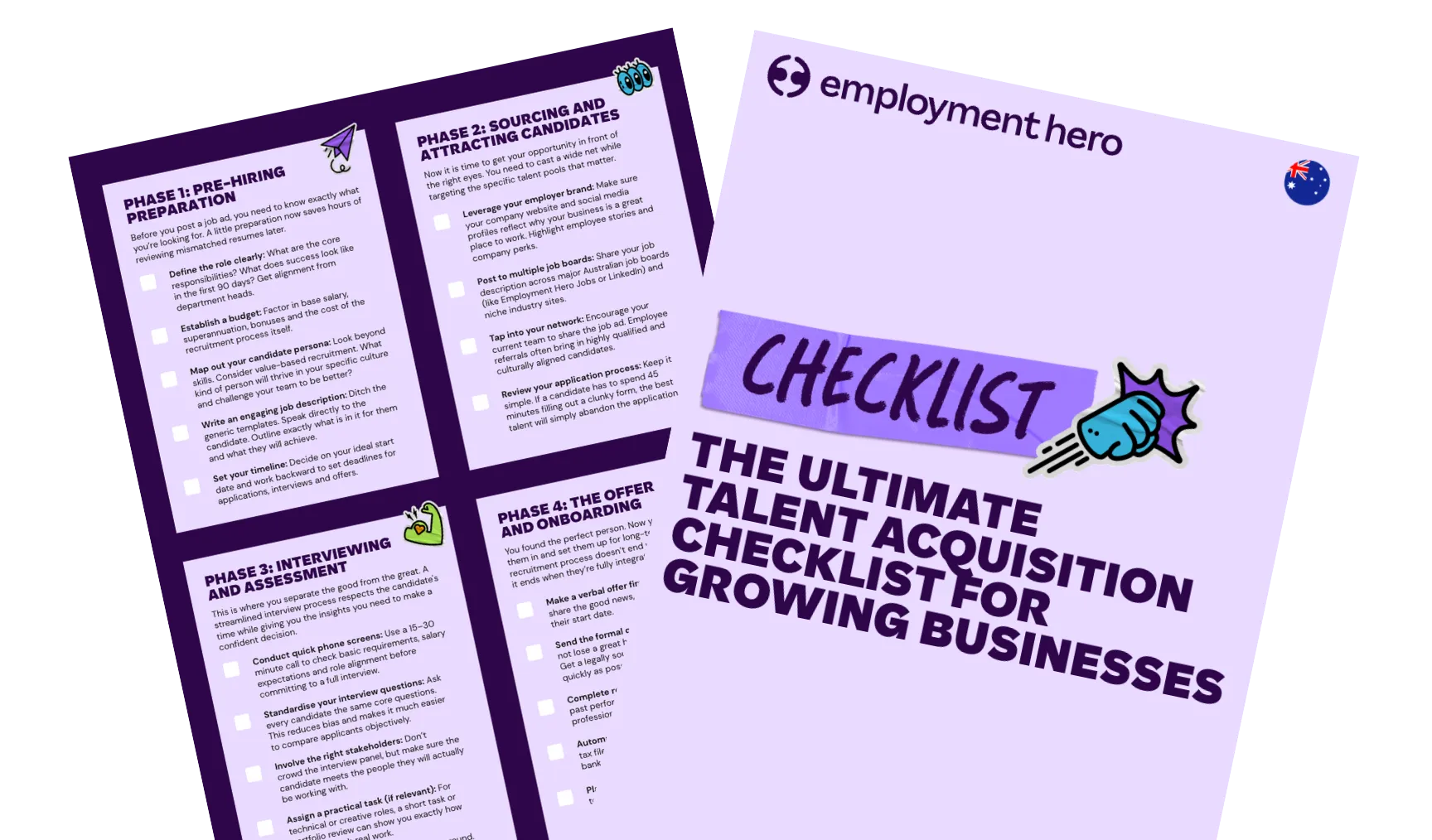
I can see yeah. Lot lots of really great questions just in terms of, like, what resources, checklists, things that are available to some of those who've joined the call today that might not necessarily be the kind of the experts in in in this field yet. We've actually got lots of resources that we can share.
So what we'll what we'll do is we'll link some of those into, I I guess, the email that that that follows today's session. Look. We could be here all day talking about, yeah, how how we can help you, but there's definitely a lot of resources that Employment Hero can offer. So thanks for thanks for highlighting.
Maybe maybe another question?
I am concerned around the AI video interview. It it can be confronting for the neurodivergent applicant. I feel like they could be excluded. Yeah.
Look. This is definitely something we we we do need to take into consideration. You know? Probably just a a firm kind of review and analysis of of people's applications.
And, look, if if a candidate or an applicant is transparent about kind of having, you know, some of some of these, you know, issues with with engaging, look, obviously, we would take that as, like, I guess, yeah, a considered approach.
Yeah. I I'm not too sure we kind of have anything kind of specific to to mention about that, Kate, but, look, probably a measured approach on that one.
Yeah. So, one of the things that we we've done is make sure that the expectation setting is very explicit. Nothing is a surprise. Nothing's like, I'm just dialing into this link, and I've got no idea what's gonna happen. We've been really kind of explicit about what happens when you join. You can do it in your own time frame, all of that. You like I said, you can rerecord responses and things, which really helps just the the absolute clarity and making sure that things are really certain before they dial in.
But, also, you know, connect with them when you send all of your candidates when you we when you kinda send out the AI link. And and there's that direct touch point. So if if they do have perhaps a concern, they're able to contact you and let you know. A way of maybe addressing that might be you might have an email that goes out along with your recruitment agent interview.
You know? If there's anything that we need to be aware of, that means that we need to amend the recruitment process, to be best suited for your needs, let us know. You know, please write back and and provide details, and then you can always amend from there. But to my knowledge, I don't think we've received one of those yet.
Good to know. Thanks. Thanks, Kate.
Gosh. Maybe maybe one final one before we quickly quickly wrap up today.
I find it hard to get alignment from hiring managers after we've set goals. Any tips here?
Yes. Yeah. I think a lot of it's about how you communicate the goals at the beginning of the year. So coming back to that framework, if you've got the big business goals and then how the recruitment goals ladder up, as soon as you've kind of set in place the the metrics and the strategy of your talent function for that year, I would always make sure that you go back and communicate that stakeholders right off the bat so that it's kind of constantly front of mind for them, and they know what it is that you're working towards.
But, also, I think it comes back to that point of having data and metrics and using that to inform the conversation with hiring managers. So when often when we're recruiting, for example, we would send really regular updates to the hiring managers minimum twice a week. Like, here's what's going on. Here's who's in pipeline.
Here's what we're doing. Here's all the different recruitment activity happening. And then at the end of the week, it might be a really good touch point each week to go, just as a reminder, these are the metrics we're tracking. This is where we're currently sitting, you know, and and any blockers and things.
So, like, keep bringing them back to the data, but also make sure that you communicate the strategy and the data with them at the start of the year when you set those metrics and and when you set that strategy. It might be sometimes that that maybe they're just not aware that that's been agreed on as a priority, or maybe they're not understanding how it ladders up to the bigger business goal. And, typically, if you're able to articulate that, they understand why those are the metrics you're going after and and why that's kind of the right thing for the business.
Fantastic.
Well, look, I think that probably concludes our our session today. Thank you so much everyone for for joining us. Really, really great q and a session as well, so really appreciate everyone's contribution there. Just so you know you so you know before logging off today, there will be a a survey that automatically launches after we end the webinar, so please do take some time to to fill that in for us. We would really, really be appreciative of that. We will also be sending out the additional resources along with the webinar recording after today's session.
So, yeah, thank you everyone once again for joining us, and we'll hope to see you next time.
Yeah. Thanks so much everyone for dialing in. Keep an eye out for that post session survey and and the follow-up email, and we'll make sure that we collect resources that go through the follow-up that are as relevant as possible based on people's questions and and where there was where there was more discussion today. But thanks, Jen.
Thanks, Kate. Bye, everyone.