

















Talent acquisition audit checklist
Published
Talent acquisition audit checklist
Published
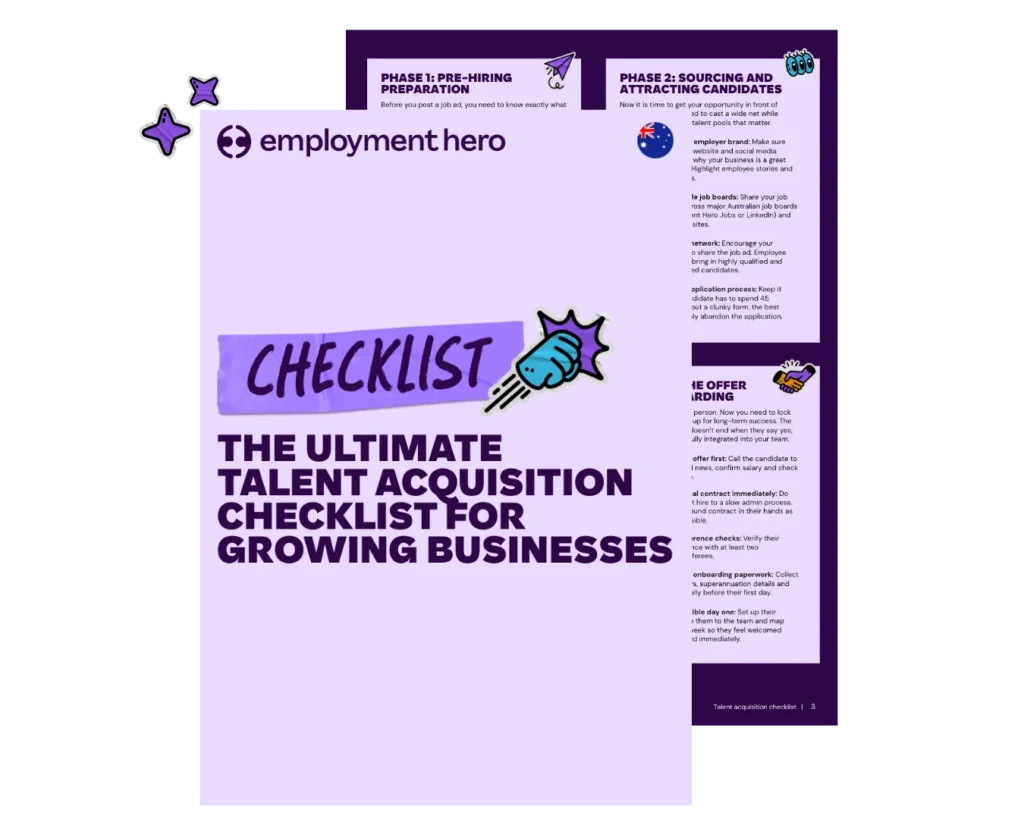
Hiring great people is one of the most powerful ways to grow your business, but it can also be one of the toughest. Our recent Recruitment Report found that attracting and retaining talent is a top challenge for 49% of businesses today. Between budget constraints, time pressure, and rising candidate expectations, it has never been harder to hire quickly, confidently, and in line with regulations.
If your hiring process feels sluggish or you’re losing out on top talent to competitors, it’s time to shake things up. You need a system that works for you, not against you. Enter the talent acquisition audit.
This guide will walk you through exactly how to review your current processes, spot bottlenecks and build a streamlined recruitment machine. You’ll learn how to cut down admin time, support better candidate experiences and manage compliance with ease.
What’s in the talent acquisition audit checklist?
We’ve put together this comprehensive talent acquisition checklist to help you streamline your recruitment process from start to finish. In here, we cover off everything you need to know about:
- Pre-hiring preparation
- Sourcing and attracting candidates
- Interviewing and assessment
- The offer and onboarding process

What is a recruitment audit?
A recruitment audit is a deep dive into your entire hiring process. It’s a systematic review of how you attract, screen, interview and hire candidates. Think of it as a health check for your recruitment strategy.
Instead of guessing why candidates drop out of your pipeline or why your time-to-hire is through the roof, an audit gives you hard data. It highlights what’s working perfectly and what needs a complete overhaul. From the first job ad to the final offer letter, a recruitment audit gives you a clear, objective view of your hiring process.
Why perform a recruitment audit?
Why dedicate time to auditing your recruitment? Because the cost of a broken hiring process is huge. Vacant roles cost you money and bad hires cost you even more.
Performing an audit helps you identify inefficiencies that are draining your resources. It allows you to eliminate redundant steps, reduce the administrative burden on your HR team and ultimately speed up your hiring cycle. An audit also helps you manage compliance with ever-changing employment laws, protecting your business from costly penalties. You get to stop putting out fires and start building a proactive, scalable talent strategy.
Key components of a recruitment audit
To get a true picture of your hiring process, you need to look under the hood. A thorough audit should cover several core areas:
- Sourcing strategies: Where are your candidates coming from and are they the right fit?
- Employer branding: How is your company perceived in the market?
- Candidate experience: Is your application process simple or a frustrating maze?
- Technology stack: Are your tools, like an Applicant Tracking System (ATS), speeding things up or slowing things down?
- Diversity and inclusion: Are your hiring practices fair and accessible to everyone?
- Metrics and reporting: Are you tracking time-to-hire, cost-per-hire and retention rates accurately?
Benefits of a recruitment audit
Taking a magnifying glass to your hiring process delivers serious rewards. First, it significantly cuts down your time-to-hire. By stripping away unnecessary interview rounds and manual admin tasks, you can secure top candidates before your competitors even make an offer.
Second, it boosts your bottom line. A more efficient process means less money wasted on ineffective job boards and external recruiters. Third, it drastically improves the candidate experience. When you make it easy and enjoyable for people to apply, you build a strong employer brand that naturally attracts better talent.
How to conduct a recruitment audit
Running an effective recruitment audit does not have to be a logistical nightmare. Break it down into manageable steps:
- Map your current process: Document every single step a candidate takes, from viewing an ad to signing a contract.
- Gather the data: Pull reports on your key metrics. Look at drop-off rates, source of hire and interview-to-offer ratios.
- Collect feedback: Ask recent hires, candidates who withdrew and your hiring managers about their experiences.
- Identify gaps: Compare your current process against your ideal state. Where are the bottlenecks?
- Develop an action plan: Prioritise the fixes that will have the biggest impact on your hiring speed and quality.

Common challenges and how to overcome them
Auditing your recruitment process might uncover some uncomfortable truths. You might find that your data is messy, spread across spreadsheets and emails. Overcome this by centralising your data into a single, reliable platform.
You may also face resistance from hiring managers who are used to doing things “the old way”. To tackle this, bring them into the audit process early. Show them the data. When they see how much time a streamlined process will save them, they’ll become your biggest advocates.
Finally, resource constraints can stall an audit so you want to start small. Audit one critical role or department first, prove the value and then roll it out across the business.
Future trends in recruitment audits
The way we audit recruitment is rapidly changing and the latest data backs it up. Our 2025 Recruitment Report revealed that 59% of businesses feel the pressure to cut operational costs while still delivering results. What’s more is that hiring processes need work, with only 6% of businesses rating theirs as excellent.
Unsurprisingly, AI and predictive analytics are now front and centre, empowering employers to anticipate future workforce needs, instead of simply reacting after the fact. Employment Hero’s AI Hiring tools uses your current workforce data and growth plans to forecast which roles you’ll need to fill and when, giving you the foresight to plan proactively instead of scrambling to backfill roles at the last minute.
Business leaders are also demanding more agility and real-time insight. Gone are the days of waiting for the yearly big audit, with the trend moving toward continuous mini-audits that enable you to make incremental improvements fast. Sophisticated, automated feedback loops keep your hiring approach sharp and responsive to shifting market needs, so your business is primed to attract and retain the right talent, even in a high-stakes economy.
How to use a talent acquisition audit checklist
A talent acquisition audit checklist is your roadmap. It stops you from getting overwhelmed and makes sure you don’t miss critical compliance checks or operational steps.
Start at the top of the funnel. Use the checklist to systematically evaluate your employer brand and job ads. Then, move down to screening, interviewing and onboarding. Treat the checklist as a living document. Tick off areas that are performing well and highlight sections that need immediate attention. Share it with your team so everyone understands exactly what is being measured and why.
The role of hiring managers in recruitment audits
Your hiring managers are on the front lines, making them crucial players in any recruitment audit. They experience the friction of a clunky process first-hand.
Bring them into the conversation. Ask them where they feel candidates are falling short or where the interview process drags on too long. Their insights are invaluable for identifying whether job descriptions actually match the day-to-day reality of the role. When hiring managers are actively involved in the audit, they’re far more likely to adopt the new, improved processes you implement.
Optimising your hiring process during an audit
Don’t wait until the audit is completely finished to start making improvements. If you spot a glaring bottleneck, like a redundant three-week wait between interview rounds, fix it immediately.
Use the audit as an opportunity to test new approaches. Try a different screening question, test a new hiring workflow or shorten your application form. Treat your hiring process like a product that needs continuous iteration. By optimising on the fly, you start reaping the benefits of the audit from day one.
HR audit essentials for recruitment
When we talk about essentials, managing compliance sits right at the top. Your recruitment audit must review how you handle candidate data, right-to-work checks and equal opportunity employment standards.
Are you storing resumes securely? Are your interview questions legally compliant? Do you have a consistent rubric for evaluating candidates to prevent unconscious bias? These are non-negotiable elements. Leaning on robust resources for recruitment compliance helps you manage these risks effectively and keeps your business on the right side of the law.
Evaluating and updating job descriptions
Most job descriptions are vague, uninspiring and fail to sell the opportunity. During your audit, pull out your most commonly used job descriptions and give them a ruthless review.
Speak directly to the candidate and clearly outline what success looks like in the first 30, 60 and 90 days. Make sure the language is inclusive and removes unnecessary barriers to entry. A great job description challenges top talent to step up and make an impact.
Streamlining your recruitment process for better results
Speed is your best friend in recruitment. Top candidates do not wait around for companies that take weeks to make a decision.
Streamlining means cutting the wait times. Do you really need four rounds of interviews for a junior position? Can a skills test replace a technical interview? Automate the admin heavy lifting, like interview scheduling and reference checking. The goal is to move candidates smoothly and swiftly from application to offer, giving them an exceptional experience while saving your team countless hours.
Recruitment audit best practices
To get the most out of your audit, stick to these proven best practices:
- Be objective: Rely on data, not gut feelings.
- Stay candidate-centric: Always view the process through the lens of the applicant. If it is frustrating for them, it is bad for your business.
- Audit regularly: A recruitment audit is not a one-and-done event. Make it a bi-annual or annual habit.
- Communicate changes: When you update a process based on audit findings, train your team thoroughly. A great process is useless if nobody follows it.
Managing job openings effectively
A chaotic approach to job openings leads to panicked hiring. Your audit should evaluate how you prioritise and manage vacant roles.
Do you have a clear approval process for new headcount? Are you clearly defining the urgency of each role? Implement a triage system for your job openings. Focus your resources on the roles that have the biggest impact on your company’s growth and revenue first. Clear management stops your HR team from burning out and keeps your business moving forward.
Leveraging job boards in recruitment audits
Are you throwing money at job boards without checking the return on investment (ROI)? An audit is the perfect time to evaluate where your best candidates are actually coming from.
Track the source of your most successful hires. You might find that a niche, industry-specific board yields better candidates than a massive generalist site. Stop wasting budget on channels that deliver high volume but low quality. Use data to find candidates exactly where they are already looking or take a look at Employment Hero Jobs.
Improving job postings for top talent
Top talent wants to know what is in it for them.
In your job ad, you want to highlight your culture, your flexibility and your growth opportunities upfront. Use an energetic, bold tone that reflects your employer brand. If you want to stand out in a crowded market, your job postings need to punch through the noise and grab attention instantly.
Defining and auditing job requirements
One of the biggest roadblocks to fast hiring is an unrealistic list of job requirements.
During your audit, challenge your hiring managers on their must-haves. Do they really need a degree or would three years of practical experience suffice?
Separate the absolute essential skills from the nice-to-haves. When you are hiring new employees, realistic and sharply defined requirements open up your talent pool and bring brilliant, diverse candidates into your pipeline faster.
Building a comprehensive audit checklist
Now it’s time to put it all together. Your comprehensive audit checklist should be your ultimate tool for continuous improvement.
Group your checklist into logical phases: Pre-hiring (strategy, job descriptions, sourcing), hiring (screening, interviewing, candidate experience) and post-hiring (onboarding, metrics, compliance). Keep it actionable.
Ready to stop struggling with broken recruitment processes? It is time to take control, cut out the admin and build a team that drives your business forward. When you need to find staff now, a well-audited, hyper-efficient hiring engine is exactly what will set you apart from the pack.
Disclaimer: The information in this guide and checklist is current as at 4 March 2026 and has been prepared by Employment Hero Pty Ltd (ABN 11 160 047 709) and its related bodies corporate (Employment Hero). The views expressed in this guide are general information only, are provided in good faith to assist employers and their employees and should not be relied on as professional advice. The Information is based on data supplied by third parties. While such data is believed to be accurate, it has not been independently verified and no warranties are given that it is complete, accurate, up to date or fit for the purpose for which it is required. Employment Hero does not accept responsibility for any inaccuracy in such data and is not liable for any loss or damages arising either directly or indirectly as a result of reliance on, use of or inability to use any information provided in this guide and checklist You should undertake your own research and to seek professional advice before making any decisions or relying on the information in this guide and checklist.
Register for the template
Related Resources
-
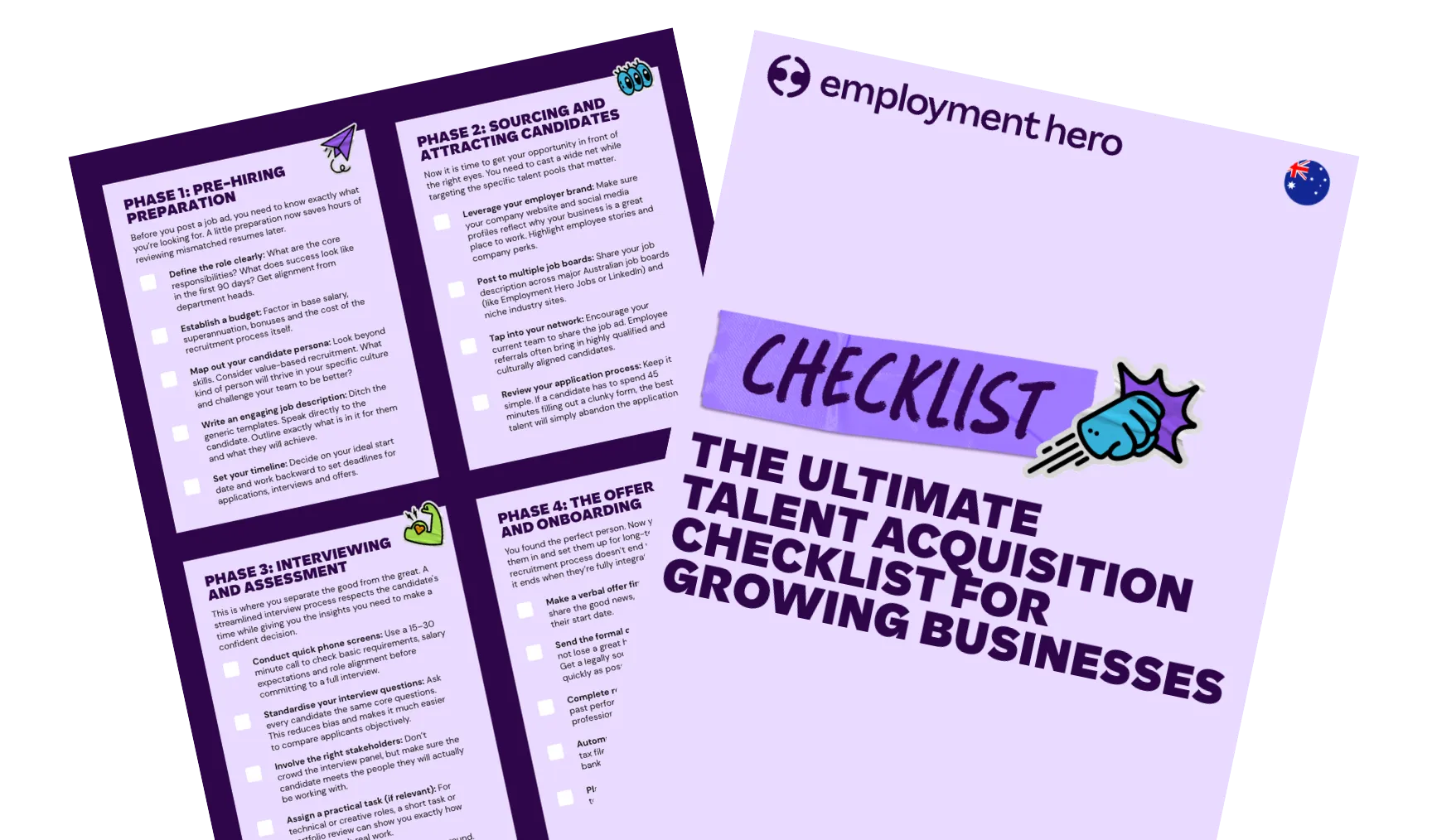 Read more: Talent acquisition audit checklist
Talent acquisition audit checklist
A talent acquisition audit is your secret weapon to cut costs, find better candidates and build the team of your…
-
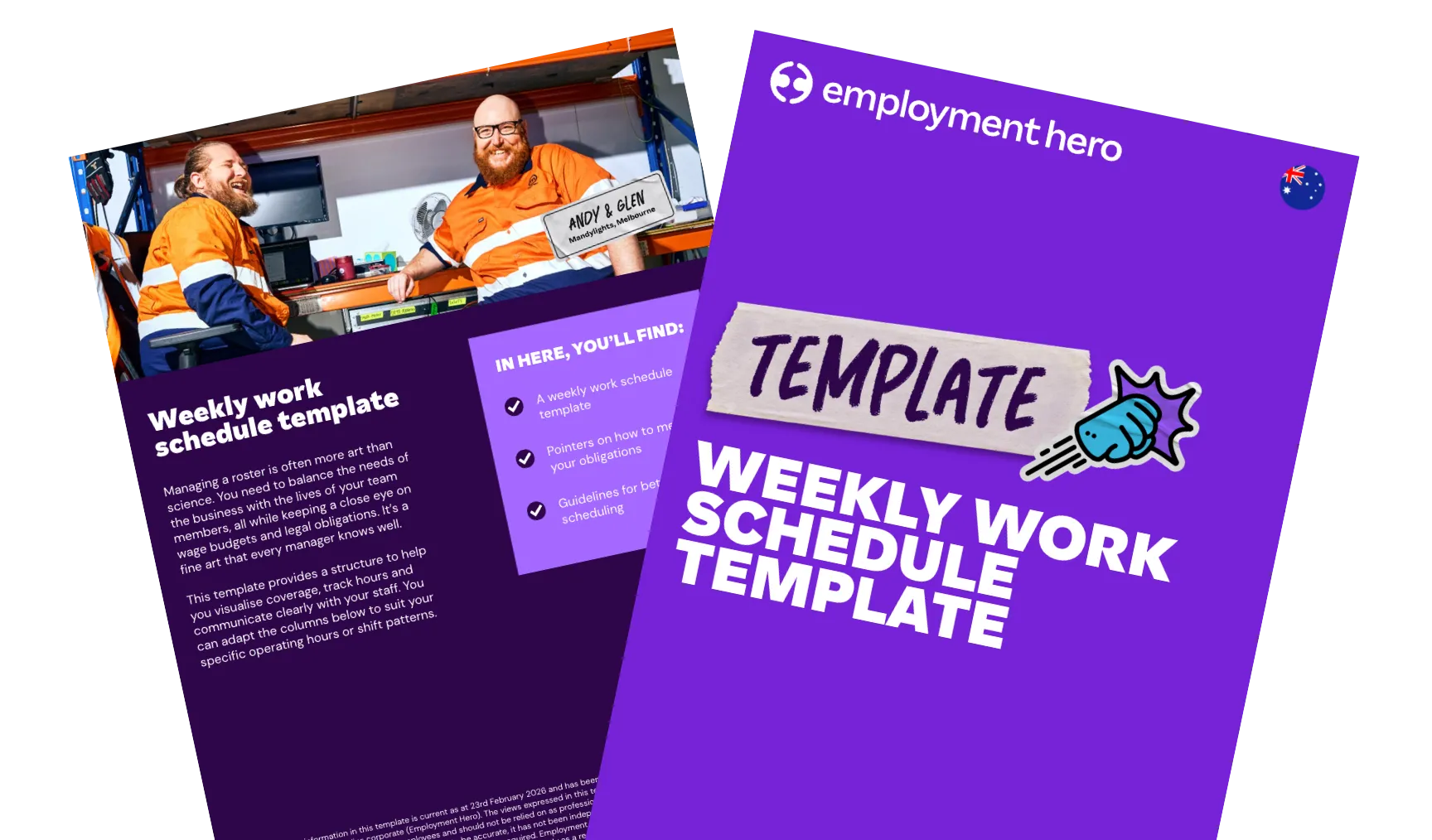 Read more: Designing an employee work schedule: template and guide
Designing an employee work schedule: template and guide
Learn how to create a flexible work schedule that can boost productivity among your employees.
-
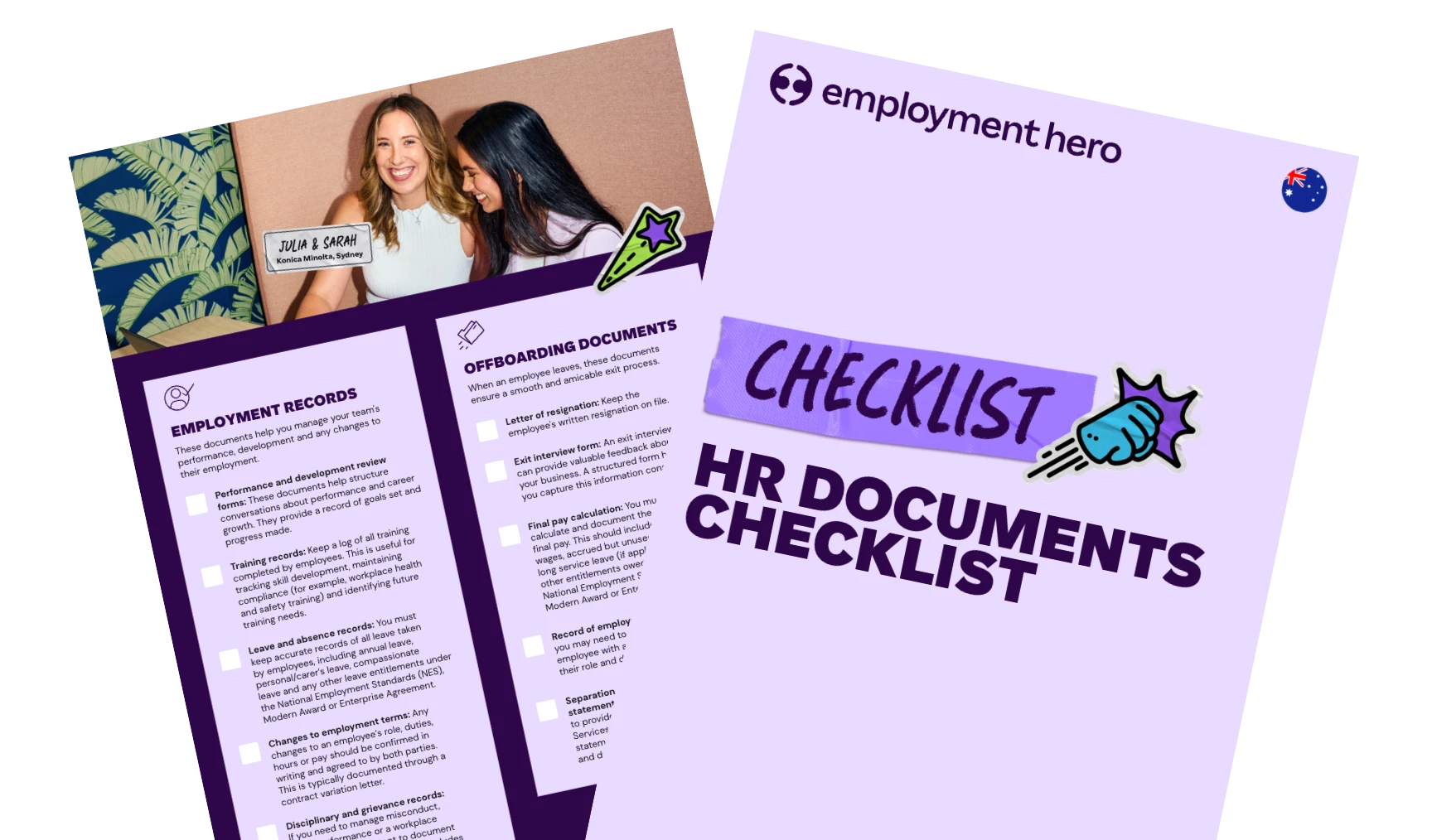 Read more: Essential HR documentation checklist for employee management
Essential HR documentation checklist for employee management
Use our HR documentation checklist to figure out what you’re missing, then download our free templates to close the gaps.

