 New Zealand
 United Kingdom
 Singapore
 Malaysia
 Canada (Français)

 Australia
The AI productivity gap: Why Australian small businesses can’t afford to wait

Contents
It’s 6pm. The office has gone quiet, but your to-do list hasn’t. The invoices still need chasing, the roster is half finished and the same customer question you’ve answered five times this week has just landed in your inbox again.
That’s a day most small business owners will recognise. Now, picture the same evening with invoice reminders sent automatically, the roster drafted in minutes and the customer question answered by a tool you already trust.
That’s the difference between a business that has started using AI and one that hasn’t.
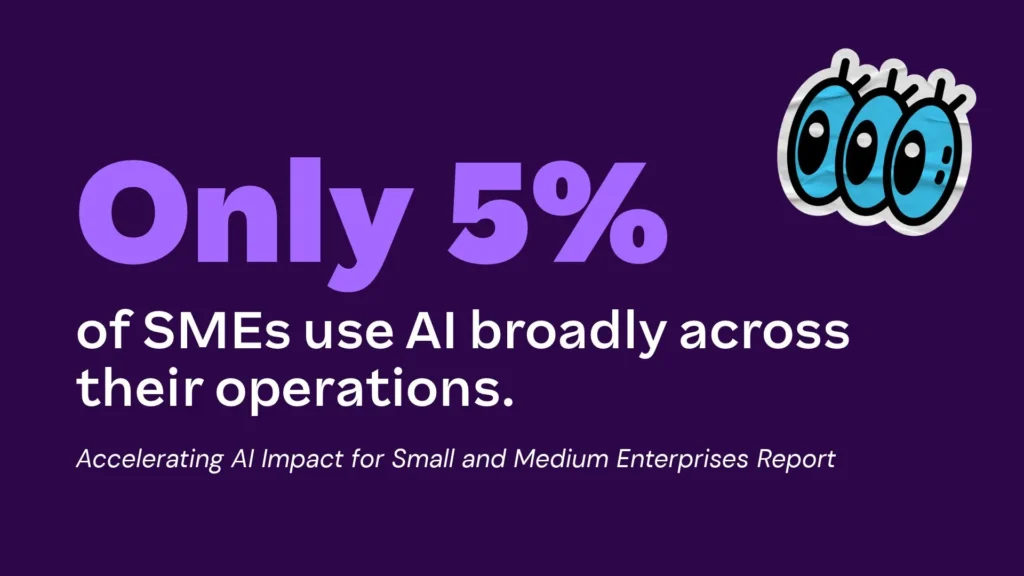
Across Australia, only 1 in 4 small and medium-sized businesses (SMEs) use AI at all, and just 5% use it broadly. More importantly, the businesses that have made the move are seeing results. According to our recent research produced in partnership with the Tech Council of Australia, Accelerating AI Impact for Small and Medium Enterprises, of the SMEs already using AI, 94% say it has lifted productivity.
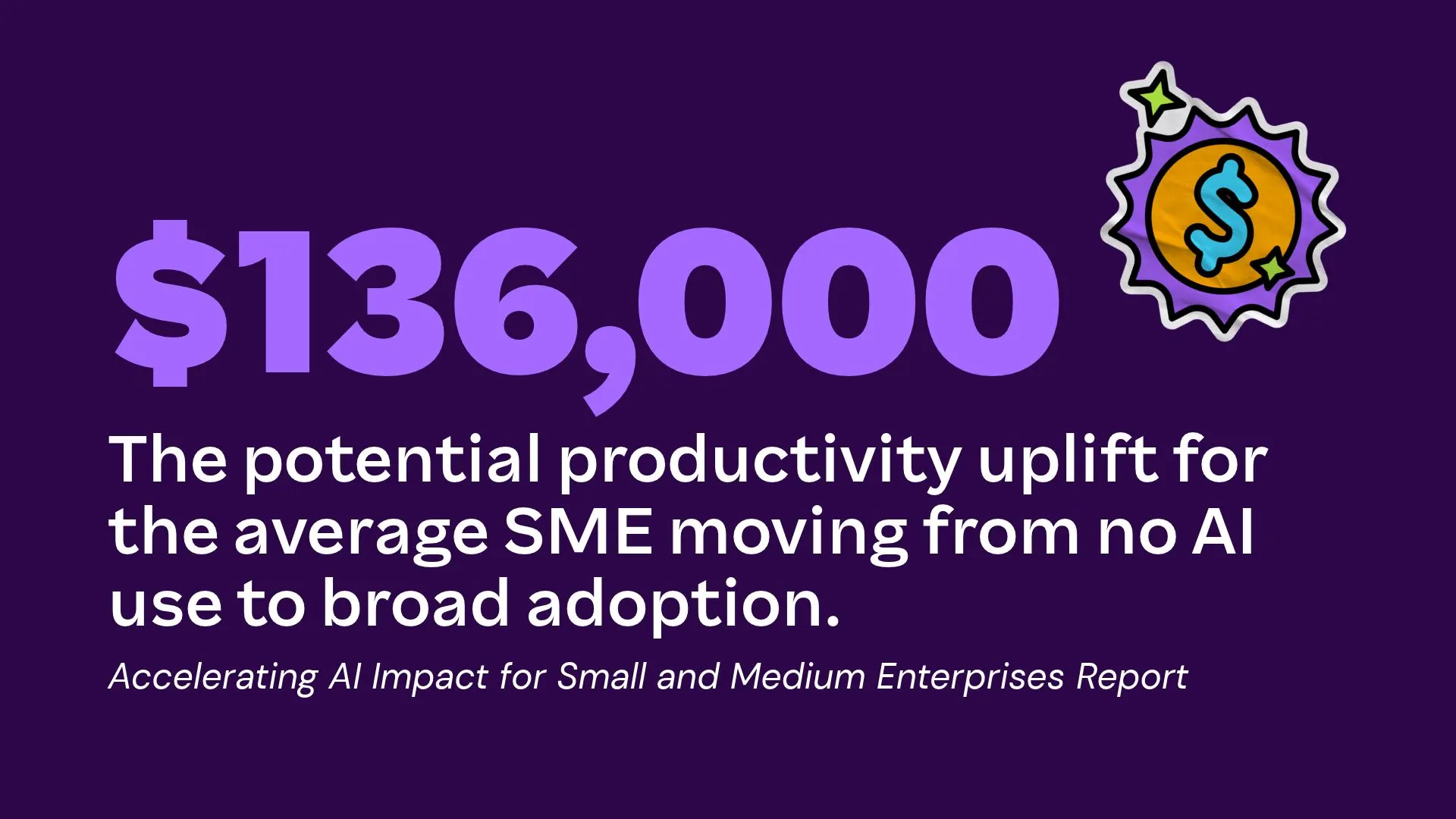
When embedding AI into a small business, the payoff is substantial. An average SME that moves from no AI use to broad adoption could see a productivity uplift worth $136,000 a year, while businesses that don’t fall further behind each year. The distance between AI adoption in SMEs and larger enterprises is also only getting wider.
This article draws on Accelerating AI Impact for Small and Medium Enterprises, research produced with the Tech Council of Australia, with Employment Hero as the foundation partner. It looks at where the opportunity for AI sits, what’s holding small businesses back and what you can do to start taking action.
What the data from the report shows
- Only 1 in 4 Australian SMEs currently use AI
- Only 5% of SMEs use AI broadly across their operations
- An average SME moving from no AI use to broad adoption could see a productivity uplift worth $136,000 a year
- AI adoption among regional SMEs is 16%, compared with 30% in metropolitan areas
- 94% of SMEs using AI report increased productivity
The productivity gap and what closing it’s worth
Productivity is simply how much value a business produces for every hour its people work. It’s also what pays for everything else such as wages, growth and the time you get back at the end of the day.
For every hour worked, an average SME produces about $14 less output than a large enterprise ($71 vs $85). Put another way, large enterprises produce about 20% more per hour. For one in three sectors, it exceeds 50%.
If AI were broadly adopted across the SME sector, it’s projected that average productivity could rise to around $96 an hour, which is above what large enterprises manage today. The research also estimates that SME AI adoption could unlock $93 billion in additional productivity, working out to about $136,000 per business each year.
Why most businesses are still on the sidelines
Only 1 in 4 Australian SMEs have some form of AI in use. Using an AI assistant to draft an email is a real-life use case. But broad adoption means AI is part of a regular process, like how invoices get chased, rosters get built or customer enquiries get answered. That’s where the time savings show up, not just on the days someone remembered to open the tool.
Larger enterprises are moving faster. Broad AI use among large enterprises sits at 16%, more than three times the 5% rate among SMEs. That gap is widening, and businesses that build AI into their operations now are creating a head start that gets harder to compete with.
Basic tools are doing most of the work
So where is the value coming from today? Mostly from the simplest tools. 86% of the value SMEs get from AI comes from basic generative AI assistants like the chatbot-style tools many people use to draft emails, summarise notes and answer quick questions. They’re a sensible starting point, but the benefits sit much further along the AI adoption curve.
The higher-value applications remain almost entirely untapped by small businesses. Predictive analytics uses past data to forecast what’s likely to happen next. AI agents can carry out a series of tasks with limited input. HR automation can take much of the admin out of onboarding and leave requests and demand forecasting helps you order stock before you run short.
The payoff can be huge for businesses that make the move. Among SMEs already using AI, 94% report higher productivity and 91% report improved revenue.
The gap is widening across regions and borders
The divide is geographic, too. Regional SMEs use AI at 16%, compared with 30% in metro areas. The businesses that stand to gain the most from productivity improvements are often the ones least likely to use it. If you run a regional business, that’s a reason to look at AI closely, not a reason to wait.
Australia also sits 22 percentage points below international peers on AI adoption. For an individual business, the more relevant comparison is with competitors, at home and overseas. Early movers build data assets and capabilities that are hard for latecomers to copy, so the gap compounds over time. Catching up later means there’s time spent rebuilding habits, retraining staff and reworking processes that are already set in their ways.
Put it all together and you get a two-speed economy. Enterprises are embedding AI, while most SMEs are still experimenting at the surface. If that continues, the productivity gap could harden into something structural, and competitors may start winning on speed and service before you’ve worked out why. The time to act is now, not in three years.
The skills gap and the wellbeing upside
Access to tools isn’t the main barrier. Less than 1% of SMEs have the capabilities to use AI optimally, which suggests most teams are working out AI on their own. You can buy every tool on the market and still get little back if nobody knows how to use it well. Skills, not software, are the binding constraint, and they’re the part of the transition owners can control most directly.
Good capability includes knowing which tasks suit AI, how to check its output and when a person needs to stay in the loop. Those are management skills as much as technical ones.
The benefits also reach your people. 64% of SME employees who use AI report a reduction of more than 20% in work stress and burnout. Like the productivity figures, that’s self-reported, but it’s a strong reason to take the human side of the change seriously. When AI takes the repetitive load off people, the work can feel less like a grind.

Where to start this quarter
You don’t need a big budget or a technology team to start embedding AI broadly into your business. You need one task, one clear measure and a few people willing to test what works. Here’s how you can.
- Start by timing one admin-heavy task, such as chasing invoices, building rosters or answering repeat customer questions. Record how long it takes each week. That number is your baseline and without it, you won’t know whether AI is saving time.
- Choose tools that work inside that process rather than sitting beside it. Basic assistants are a fine starting point, but the bigger gains come from AI that connects to your accounting or CRM software and does part of the job itself.
- Build skills before you buy more software. Pick one or two people to become AI champions, give them time to test tools and have them show the rest of the team. Short, regular practice will do more than a single workshop.
- Finally, set a few ground rules and check the results. A one-page guide should set out which tasks AI can help with and what customer or employee information must stay out of public tools. It should also name who checks AI output before it reaches a customer. Then ask your team a few simple questions about stress and workload before and after each change, and move to the next task once the first one saves consistent time.
Pick the task that’s costing you the most time and start this week. If you’d like help choosing where to begin, book a demo and talk it through with one of our business specialists.
Want to see how Employment Hero went AI-first?
In 2025, Employment Hero formally embraced AI as a strategic priority, changing how our entire team does their jobs day to day. It has everything we learned along the way, plus practical tools, tips and templates for you to get started. Download the AI Adoption Blueprint here.
Related Resources
-
Read more: The AI productivity gap: Why Australian small businesses can’t afford to wait
The AI productivity gap: Why Australian small businesses can’t afford to wait
Research shows Australian small businesses using AI are seeing productivity gains, while those that wait fall further behind.
-
 Read more: End-of-year exhaustion is real. Here’s how to actually rest over the holidays.
End-of-year exhaustion is real. Here’s how to actually rest over the holidays.
The Christmas break doesn’t always feel restorative. Here’s the science of why, and what to do differently to come back…
-
 Read more: What’s new at Employment Hero: Here’s our 2026 product recap
What’s new at Employment Hero: Here’s our 2026 product recap
Explore Employment Hero’s 2026 product updates: Hero AI, Recruitment Agent, HeroClear, Payroll Agent, HeroForce and Chat, built to make employment…


