 New Zealand
  United Kingdom
  Singapore
  Malaysia
  Canada (Français)
 Australia


EOFY HR and Payroll Checklist 2025/26
Published
EOFY HR and Payroll Checklist 2025/26
Published
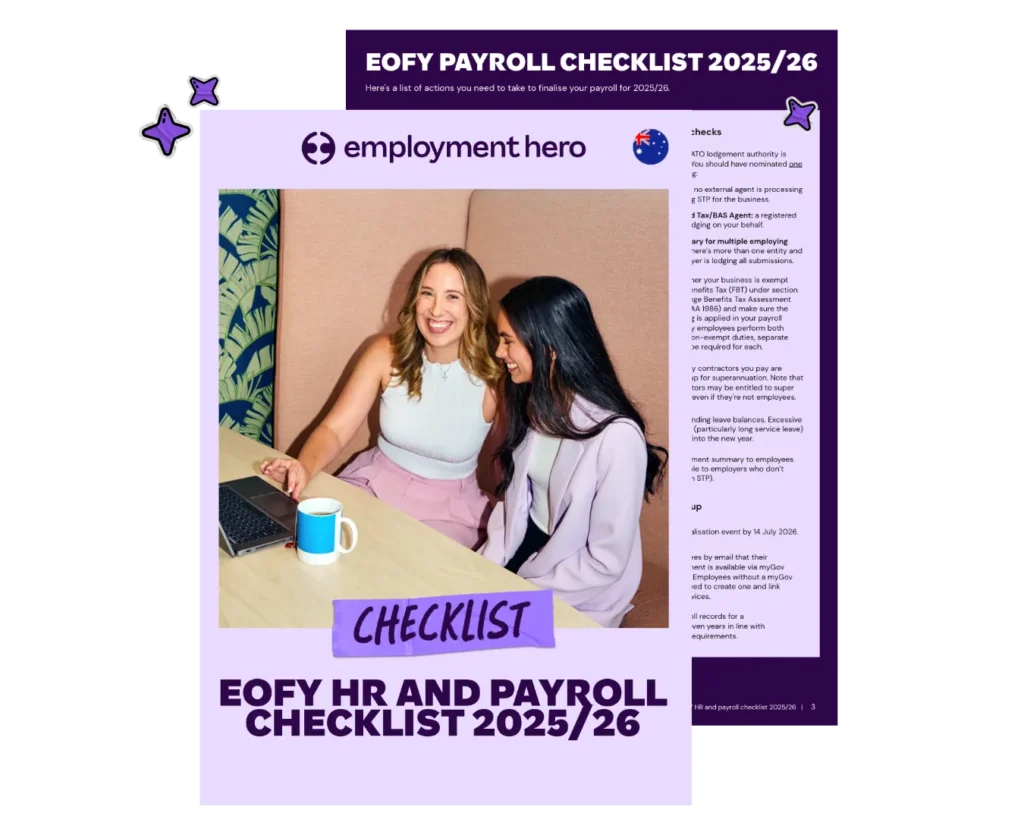
EOFY is one of those times of year where the to-do list feels never-ending. This year, there’s more on it than usual. From Payday Super kicking off on 1 July 2026 to award rate increases, 2025–26 brings some of the most significant changes Australian employers have seen in a while.
With the right checklist and a bit of time blocked out in your calendar, you can get on top of it. We’ve broken down everything you need to close out the financial year cleanly including what’s changed, what you need to do and when it needs to be done, so you can wrap up 2025/26 feeling organised and step into the new year ready to go.
What’s in this checklist?
Inside, you’ll find step-by-step guidance across five key areas:
- Finalising payroll: Everything you need to process, reconcile and lodge, including STP finalisation, FBT reporting and year-to-date reconciliation.
- Superannuation: How to confirm contributions are up to date, check for unpaid super and prepare for the biggest super shake-up in years with Payday Super starting 1 July 2026.
- Pre-lodgement checks: The less obvious things that catches employers out, from ATO lodgement authority settings to contractor super obligations and outstanding leave balances.
- Preparing for the new financial year: Updated tax tables, award rate increases, salary sacrifice reviews and what you need to have in place before your first pay run of 2026/27.
- HR and people management: A practical mid-year checkpoint covering compliance, policies, performance reviews, engagement and workforce planning for the year ahead.

What’s changed for EOFY 2025–26?
This isn’t a business-as-usual year. Some significant changes are landing right at the finish line. Here’s what you need to know before 30 June.
Payday Super: are you ready?
This is the big one. From 1 July 2026, superannuation must be paid on every payday, not quarterly. Contributions must reach the employee’s fund within seven business days of each pay run.
There’s another change for employers using the ATO’s Small Business Superannuation Clearing House, with it closing permanently on 1 July 2026. If that’s your current setup, you need to migrate to a SuperStream-compliant clearing house before 30 June and download your full transaction history before it disappears. Records will not be accessible after closure.
The employers who’ll feel this change most are those still running manual super processes. If that’s you, now is the time to change your processes and look into a solution like Employment Hero’s HeroClear.
Award rate increases: update before the first pay run
The Fair Work Commission’s Annual Wage Review decision typically lands in early June. Once it does, updated award rates and the national minimum wage apply from the first full pay period on or after 1 July 2026. That means you need to have your payroll updated before the first pay run of the new financial year, not after.
Monitor the Fair Work Commission website in June and action increases. Getting this wrong will mean that you end up underpaying your team.
Key EOFY dates for 2025–26
| Date | Obligation | Who it applies to |
| Early June 2026 | Fair Work Commission Annual Wage Review decision expected | All employers with award-covered or minimum wage employees |
| 30 June 2026 | Final date for super contributions to be tax-deductible in 2025/26 | All employers |
| 30 June 2026 | ATO Small Business Superannuation Clearing House closes permanently. You’ll need to move to a Payday Super-ready clearing house like HeroClear well before this date. | Employers currently using SBSCH |
| 1 July 2026 | Payday Super begins. Super must be paid on every payday Updated ATO tax withheld schedules take effect | All employers |
| 1 July 2026 | Award rate increases apply from first full pay period on or after this date | Employers with award-covered employees |
| 14 July 2026 | STP finalisation declaration deadline | All STP-reporting employers |
For the full calendar of important dates to be across in the lead up to EOFY, download our calendar here.

Make EOFY easier with Employment Hero
For payroll professionals and business owners, EOFY can feel like everything lands at once. Employment Hero’s Employment Operating System is built to take the pressure off by automating compliance tasks, flagging errors before you lodge and keeping your records in order all year so you’re never scrambling at the finish line.
Here’s a few ways how:
STP EOFY wizard: A guided workflow that walks you through your finalisation declaration, flags data errors before submission and lodges directly to the ATO in a few clicks.
Automatic compliance updates: Tax tables update at the start of each new financial year.
Payroll reconciliation tools: Built-in reports let you compare what was reported via STP against what was processed in your pay runs, with a variance report that highlights discrepancies before you finalise.
HeroClear: Employment Hero’s embedded clearing house, built for Payday Super. HeroClear automatically validates employee fund details, initiates payments and tracks every contribution in real time, so you can meet the seven-business-day requirement without adding hours of admin to your week.
Employee self-service: Employees access their payslips and leave balances directly through the platform, which means fewer EOFY queries in your inbox.
Ready to wrap up the year without the stress? Start with the checklist
Or speak with one of our business specialists to find out how Employment Hero can support your business through EOFY and beyond.
EOFY FAQs
The Australian financial year runs from 1 July to 30 June. The 2025/26 financial year ends on 30 June 2026.
Payday super is a legislative change that requires employers to pay superannuation contributions on every payday, instead of quarterly as previously required. Contributions must reach the employee’s superannuation fund within seven business days of each pay run.
Payday super begins on 1 July 2026. Employers should review their super payment processes and clearing house arrangements before 30 June to make sure they can meet the new requirements from day one.
Before 30 June 2026, employers should:
- Finalise and reconcile payroll for 2025/26.
- Confirm superannuation contributions are up to date and no amounts are at risk of missing the tax deductibility cut-off.
- Migrate away from the ATO’s Small Business Superannuation Clearing House if applicable.
- Review award rates and minimum wages ahead of 1 July increases.
- Confirm HR policies are current and compliant.
If you report through STP (which is now mandatory for all employers) you don’t need to issue individual payment summaries. Instead, employees access their Income Statement directly through myGov once you’ve lodged your finalisation declaration. The only exception is for employers who have a specific ATO exemption from STP reporting.
Under the Fair Work Act, employers are required to retain employee records including pay records, leave records and hours worked, for a minimum of seven years. This includes records for employees who have since left the business.
Payroll records should be stored securely and be accessible in the event of an ATO audit or Fair Work investigation. Employment Hero stores your payroll records digitally, making it easy to retrieve them when needed.
Single Touch Payroll (STP) is the ATO’s system for reporting employees’ payroll information including wages, tax withheld and super, directly to the ATO each time you run payroll. STP Phase 2 is now mandatory for all employers.
Disclaimer: The information in this checklist is current as at 13 April 2026, and has been prepared by Employment Hero Pty Ltd (ABN 11 160 047 709) and its related bodies corporate (Employment Hero). The views expressed in this checklist are general information only, are provided in good faith to assist employers and their employees, and should not be relied on as professional advice. The information is based on data supplied by third parties. While such data is believed to be accurate, it has not been independently verified and no warranties are given that it is complete, accurate, up to date or fit for the purpose for which it is required. Employment Hero does not accept responsibility for any inaccuracy in such data and is not liable for any loss or damages arising either directly or indirectly as a result of reliance on, use of or inability to use any information provided in this checklist. You should undertake your own research and seek professional advice before making any decisions or relying on the information in this checklist.
Register for the checklist
Related Resources
-
 Read more: AI skills assessment template for your team
AI skills assessment template for your team
Help your team build their AI skills. Download our free AI skills assessment template for managers and employees.
-
 Read more: The AI Adoption Blueprint
The AI Adoption Blueprint
What does it take to embed AI across an entire team? We’re sharing our training, our policies, and the lessons…
-
 Read more: Employment Essentials: AI Best Practices
Employment Essentials: AI Best Practices
Learn how to use AI in HR without creating privacy, compliance or employment risks in our latest webinar.


