

















Employee of the month program: Certificate and guide
Published
Employee of the month program: Certificate and guide
Published

Recognising your team’s hard work is one of the most powerful things you can do as a leader. It fuels motivation, reinforces great performance and builds a culture where people feel seen and valued. An employee of the month program is a classic, effective way to do just that. But running one that genuinely inspires people requires more than just picking a name out of a hat.
A well-designed program can transform your workplace by creating a fair, transparent and exciting process that highlights the behaviours you want to see more of.
We’ll show you how to build a program that actually works. We’ll cover setting fair criteria, avoiding bias and using it to strengthen your company culture. Let’s create a better way to recognise greatness.
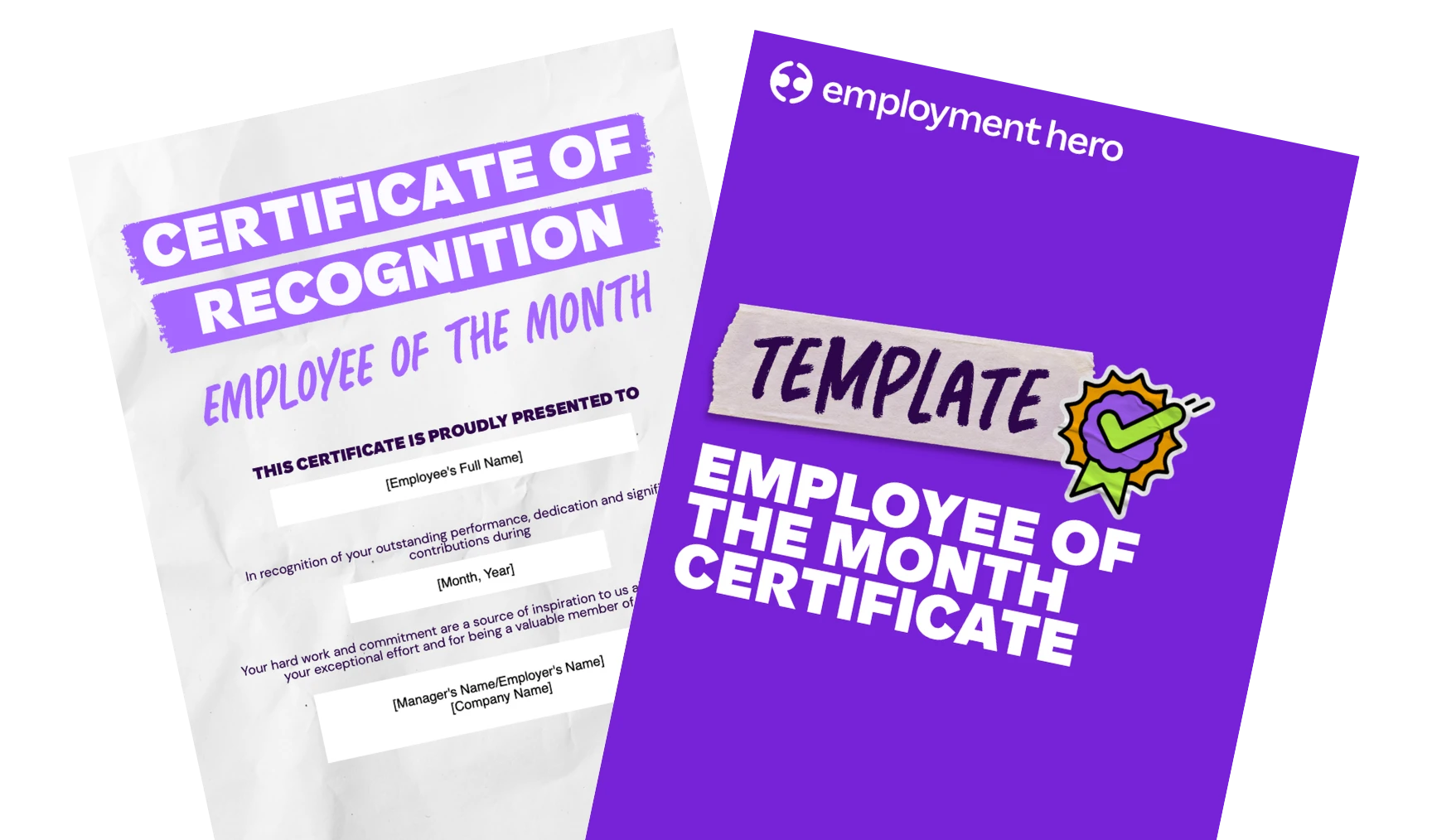
Download the employee of the month certificate by filling in your details on the right.
What is an employee of the month?
An employee of the month program is a formal recognition initiative where one employee is selected each month for their outstanding contributions. It’s a way to publicly celebrate individuals who go above and beyond, embodying the company’s values and driving success.
At its core, this program is a strategic tool for shaping your workplace culture. By recognising specific actions and behaviours, you send a clear message to the entire organisation about what excellence looks like. This helps align your team around shared goals and reinforces a high-performance mindset.
Employee of the month criteria
To make sure your program is fair and effective, you need clear, objective criteria. Vague standards lead to confusion and perceptions of favouritism. Your criteria should reflect the qualities that are most important to your business and its culture.
Think about what truly drives success in your organisation. Is it groundbreaking innovation, exceptional customer service or seamless teamwork? Define these behaviours clearly so everyone understands what they are aiming for.
Here are some core areas to consider for your criteria:
- Quality of work: Consistently delivering work that is accurate, thorough and meets a high standard.
- Consistency and reliability: Demonstrating dependability, meeting deadlines and taking ownership of responsibilities without constant supervision.
- Teamwork and collaboration: Actively supporting colleagues, sharing knowledge and contributing to a positive team environment.
- Innovation and problem-solving: Proactively identifying challenges, suggesting creative solutions and finding better ways to do things.
- Alignment with company values: Living and breathing the company’s core values through daily actions and decisions.
- Customer service excellence: Going the extra mile to make sure customers have a positive experience.
- Positive attitude and leadership: Inspiring others, maintaining a positive outlook and mentoring junior team members.

How to select an employee of the month
A transparent selection process is the foundation of a trusted employee of the month program. Employees need to believe that winners are chosen on merit, not office politics. A structured process removes ambiguity and helps give everyone a fair shot.
Here’s a step-by-step approach to building a fair selection process:
1. Nominations
Open up nominations to everyone. This can include managers, peers and even self-nominations. Create a simple nomination form that asks for the nominee’s name, the reason for the nomination and specific examples that align with the established criteria. Peer nominations are particularly powerful, as they give a 360-degree view of an employee’s impact.
2. Evaluation
Once the nomination period closes, a designated committee should review all submissions. This committee should ideally consist of a diverse group of people from different departments and levels of seniority, such as a mix of managers, HR representatives and previous winners.
3. Committee review
The committee evaluates each nomination against the predefined criteria. Using a scoring system or rubric can help keep the evaluation objective. The discussion should focus on the evidence provided in the nominations, not on personal opinions. After deliberation, the committee makes a final decision.
This structured approach makes sure the award is a meaningful recognition of achievement, not just a popularity vote.
Certificate and letter format for employee of the month
How you give the award matters as much as what’s on it. A professional certificate or a heartfelt letter makes the recognition feel significant. It becomes a tangible reminder of the employee’s achievement that they can display with pride.
Your certificate or letter should be personalised and specific. Avoid generic templates that feel impersonal. Instead, take the time to highlight exactly why the person won.
Here’s what to include:
- Company logo and branding
- Employee’s full name
- The title: “Employee of the Month”
- The month and year
- A personalised message: Write a few sentences detailing the specific achievements or qualities that led to them winning. Mention a particular project, an instance of great teamwork or how they embodied a company value.
- Signatures: Have it signed by the employee’s manager and a senior leader, like the CEO or department head. This shows that their contribution is recognised at all levels of the business.
Present the award publicly, for example, during a team meeting or a company-wide announcement. This amplifies the recognition and inspires others.

Investing in an employee of the month program is an investment in your people and your business. The ripple effects of consistent recognition extend far beyond the individual winner, shaping the entire employee experience.
When employees feel their efforts are noticed and appreciated, they’re more engaged, more productive and more likely to stay with your company long-term.
Here are the key business and cultural benefits:
- Boosts morale and motivation: Public recognition is a powerful motivator. It creates a positive buzz in the workplace and encourages a healthy sense of competition.
- Reinforces company values: By celebrating employees who exemplify your values, you make those values tangible and show what it means to live them day-to-day.
- Improves retention: Employees who feel valued are less likely to look for opportunities elsewhere. Recognition is a key driver of loyalty.
- Highlights role models: Winners become role models for their peers, setting a benchmark for what excellence looks like within your organisation.
- Strengthens culture: A culture of recognition is a culture of positivity. It fosters stronger relationships between managers and their teams and encourages everyone to celebrate each other’s successes.
Designing a fair employee recognition process
Fairness is non-negotiable. If your team suspects bias, the program will backfire, causing resentment and disengagement. Building a process that is equitable and transparent is essential for earning and maintaining trust.
Here’s how to design a process that everyone can get behind:
Avoid unconscious bias
Train your selection committee to recognise and challenge unconscious biases. For example, ‘recency bias’ might lead them to favour recent achievements over consistent performance throughout the month. Affinity bias might cause them to prefer people they have more in common with. Using a structured scoring rubric helps mitigate these biases.
Ensure equal opportunity
Make sure the criteria don’t unintentionally favour certain roles or departments. For instance, if ‘customer-facing interactions’ is a key criterion, employees in back-office roles might be at a disadvantage. Your criteria should be broad enough that anyone, regardless of their role, has a chance to win.
Promote transparency
Communicate the entire process clearly. Everyone should know what the criteria are, how to nominate someone and how the winner is selected. Announce the winner publicly and explain why they were chosen, connecting their achievements back to the specific criteria.
Rotate the selection committee
Regularly rotating members of the selection committee brings fresh perspectives and prevents any single group from having too much influence.
How financial incentives complement recognition
While public praise is powerful, pairing it with a tangible reward can elevate the experience. Financial incentives like gift cards, vouchers or a cash bonus show an extra layer of appreciation. They act as a concrete “thank you” for the employee’s hard work.
The key is to find the right balance. The primary focus should remain on the recognition of achievement itself. The financial reward is the cherry on top, not the main event. It complements the praise without overshadowing it.
Consider offering a choice of rewards. Some employees might prefer a voucher for their favourite restaurant, while others might appreciate a contribution to a professional development course. Giving them a choice makes the reward more personal and meaningful. Effective employee engagement software can help manage and distribute these rewards seamlessly.
Want to make recognition instant? Use our Recognition feed to give shout-outs that the whole company can celebrate. It centers around the company-wide feed where employees can publicly shout out colleagues for their hard work by tagging specific company values to give more context and meaning. Beyond just a “thank you,” oue platform allows for tangible rewards through Hero Points, which employees can redeem to purchase items in our marketplace with thousands of products. It’s the easiest and fastest way to give thanks.
The role of peer recognition in employee of the month awards
Manager-led recognition is important, but peer-to-peer recognition adds a whole new dimension. Colleagues often have the best insight into who is truly making a difference on the ground. They see the late nights, the collaborative spirit and the acts of support that managers might miss.
Incorporating peer nominations into your program makes it more inclusive and democratic. It empowers your team to actively participate in building a culture of appreciation. When an award is based on votes from colleagues, it often feels even more meaningful to the winner, as it’s a validation from the people they work with every day.
Encourage peer nominations by making the process simple. Use a dedicated channel on your communication platform or a simple online form. Celebrate not just the winners, but also those who take the time to nominate their colleagues, reinforcing the act of recognition itself.
Using monthly certificate templates for easy recognition
Consistency is key, especially as your company grows. Using a template for your employee of the month certificate creates a professional and uniform look every time. It saves time for your managers and HR team, allowing them to focus on the personalised message rather than the design.
Templates streamline the process and reinforce your brand identity. You can create a branded template that includes your company logo and colours, making the award instantly recognisable. Storing these templates in a central location within your HR software makes them easily accessible to managers across all teams and locations.
What to do when the same person wins multiple months
It’s a good problem to have; an employee so exceptional they keep winning. While their performance is worth celebrating, repeat winners can sometimes discourage others who may feel they don’t stand a chance. The goal is to keep the program motivating for everyone.
There are a few strategies you can use to handle this situation:
- Introduce a cool-down period: Implement a rule that an employee cannot win for a certain period (e.g. 6 or 12 months) after their last award. This gives others a chance to be recognised.
- Create a hall of fame: After an employee wins a certain number of times (e.g. three), they can be inducted into a hall of fame or given a more prestigious annual award. This honours their consistent excellence while opening up the monthly award to others.
- Broaden the recognition categories: Instead of just one employee of the month, consider introducing different categories each month, such as “Team player of the month,” “Innovator of the month” or “Customer champion.” This allows you to recognise different types of contributions.
The aim is not to penalise high performers but to spread the motivational benefits of recognition as widely as possible.
Celebrating great work beyond the award
The employee of the month award should be the pinnacle of your recognition efforts, not the only one. A strong culture of recognition is built on frequent, timely and authentic appreciation. Small, everyday gestures can be just as impactful.
Here are some ideas to celebrate great work beyond the formal award:
- Public shout-outs: Use team meetings or company-wide communication channels to give shout-outs to employees who have done great work.
- Small perks: A small gesture like a free lunch, a coffee voucher or finishing early on a Friday can be a great way to say thank you.
- LinkedIn recommendations: A public endorsement from a manager or senior leader on LinkedIn can be a powerful career booster.
- Thank-you notes: A simple, handwritten thank-you note can be incredibly meaningful in a digital world.
For more ideas to keep your team engaged, check out our comprehensive employee engagement guide.

Launching an employee of the month program from scratch
Ready to launch your own program? A successful rollout requires careful planning and clear communication.
Here’s a step-by-step guide to get you started:
1. Planning:
- Define your goals: What do you want to achieve with this program? (e.g. improve morale, reinforce values).
- Set the criteria: Work with leaders and employees to define fair and clear criteria.
- Design the process: Outline the nomination, selection and award process.
- Choose the rewards: Decide on the award and any accompanying incentives.
2. Communication:
- Announce the program: Launch the program with excitement. Explain its purpose, the criteria and how it will work.
- Educate managers: Make sure managers understand their role in promoting the program and nominating their team members.
- Make nominations easy: Provide clear instructions and easy-to-use tools for nominations.
3. Continuous improvement:
- Gather feedback: After a few months, ask for feedback from employees and the selection committee. What’s working? What could be improved?
- Analyse the results: Are you seeing a positive impact on engagement and morale? Is the program meeting its goals?
- Iterate and refine: Use the feedback to make adjustments. A great recognition program evolves with your company.
An employee of the month program can be a powerful statement about what your company values. It’s a chance to turn the spotlight on the people who are building your future and inspire everyone to new heights.
Ready to start recognising your heroes? Download our free employee of the month certificate template today.
Disclaimer: The information in this guide and template is current as at 4 March 2026 and has been prepared by Employment Hero Pty Ltd (ABN 11 160 047 709) and its related bodies corporate (Employment Hero). The views expressed in this guide and template are general information only, are provided in good faith to assist employers and their employees and should not be relied on as professional advice. The Information is based on data supplied by third parties. While such data is believed to be accurate, it has not been independently verified and no warranties are given that it is complete, accurate, up to date or fit for the purpose for which it is required. Employment Hero does not accept responsibility for any inaccuracy in such data and is not liable for any loss or damages arising either directly or indirectly as a result of reliance on, use of or inability to use any information provided in this guide and template. You should undertake your own research and to seek professional advice before making any decisions or relying on the information in this guide and template.
Register for the guide
Related Resources
-
 Read more: The SME guide to pay transparency
The SME guide to pay transparency
Are you ready for the end of pay secrecy? Download our free guide to navigate the legal shifts and cultural…
-
 Read more: Employee of the month program: Certificate and guide
Employee of the month program: Certificate and guide
Learn how to launch an employee-of-the-month program, recognise great work, motivate teams and use certificates and incentives effectively.
-
![Hospitality Industry (General) Award Summary [MA000009]](https://employmenthero.com/wp-content/uploads/2026/03/Award-Summary_Hospitality-Industry.webp) Read more: Hospitality Industry (General) Award Summary [MA000009]
Read more: Hospitality Industry (General) Award Summary [MA000009]Hospitality Industry (General) Award Summary [MA000009]
The Hospitality Award is designed to cover a wide range of job roles including chefs, wait staff, front office and…
