 New Zealand
  United Kingdom
  Singapore
  Malaysia
  Canada (Français)
 Australia




Employee Induction and Onboarding Checklist Template [Free Download]
Published
Employee Induction and Onboarding Checklist Template [Free Download]
A poor onboarding experience costs more than you think… lost productivity, early turnover and the time spent starting from scratch. This free onboarding and induction checklist gives HR teams, employers and hiring managers a clear, step-by-step framework to get every new hire off to the right start.
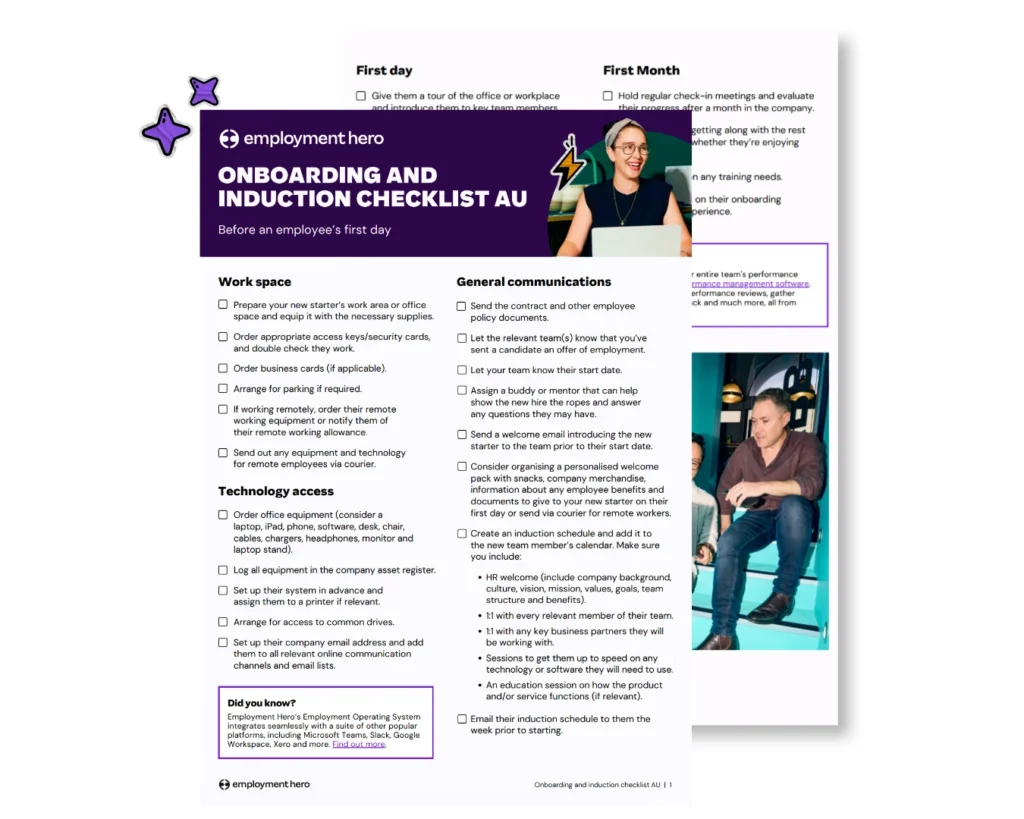
Using this employee onboarding and induction checklist, you can help new employees:
- Hit the ground running from day one, week one and beyond
- Set up their workspace, technology and communications
- Complete all mandatory Australian compliance documentation, including tax, superannuation and right-to-work checks
- Receive essential documents like the Fair Work Information Statement
- Stay on track with structured 30, 60 and 90 day performance check-ins
What’s included in the employee onboarding and induction checklist?
- Preparing your new starter’s workspace
- Making sure they have access to all the tools for their new job
- Providing them with important details of the company
- Introducing and welcoming new employees to their team members
Download the free checklist and get your next hire’s onboarding right from day one.
Who is this resource for?

HR professionals
If you’re managing an HR team, this checklist can slot straight into your existing onboarding process or serve as a base to pressure-test what you already have. Print it out or use it digitally, whichever works for your team.
Employers
Running a small to medium-sized business without a dedicated HR team? This checklist makes it easy to track every step of a new hire’s onboarding journey without anything slipping through the cracks.
Hiring managers
Even when HR or a senior leader handles the hire, day-to-day onboarding usually falls to the direct manager. This checklist helps you stay on top of the practical tasks and if you keep it somewhere accessible, it’s easy to share with other team members, divide up responsibilities and track progress without doubling up on work.

What is an induction process?
An induction process is how you get a new employee up to speed on your business and their role within it. It typically covers company culture, goals, plans, policies, team structure and role-specific information, building on anything they may have picked up during the recruitment process.
What is an onboarding process?
An onboarding process covers far more ground than most people realise. As an employer, it’s your job to set new starters up in the right systems, organise their equipment, introduce them to the team and establish clear goals from day one. It’s a broad process that touches every part of the employment experience.
What is the purpose of an onboarding checklist?
An onboarding checklist keeps everyone accountable across what can be a lengthy, multi-stakeholder process. Onboarding can stretch from before a new starter’s first day to well beyond their first three months, with tasks spread across you, the hiring manager and the employee themselves. A checklist makes sure nothing slips through the cracks.
What else should be considered in the onboarding process?
While onboarding checklists get specific about the tasks you need to complete during onboarding, here are a few things you should consider when onboarding new employees to create a meaningful and efficient process.
1. Your company culture
Employees are more likely to invest themselves personally in a company’s success if they feel aligned with the business. It’s essential to get your new employees involved in your company’s culture from day one.
The best way to do this is for new hires to spend time with employees from different areas of the business with various levels of seniority. Implementing an onboarding buddy system makes sure your new hire has someone to talk to, which is so important in the first nerve-wracking weeks of a new job.
2. Company mission and goals
If you want your new starter to embody the company’s mission, vision and values, then you need to share this as part of your onboarding process and show them where the business is headed.
It’s equally important for everyone to understand their own goals and how they relate to the big picture. Communicating the goals of their role during the onboarding process will help new hires focus their efforts on achieving them.
3. Introduction to key team members
Getting to know all the new faces and personalities in a business can seem daunting at first. Your role is to help new employees settle into their new team and get to know the clients, colleagues and managers they’ll work with to become recognised and integrate naturally.
4. Compliance and documentation
Getting the paperwork right during onboarding is a legal obligation. Australian employers must provide specific documents to every new hire before or on their first day, including the Fair Work Information Statement, a Tax File Number declaration and a superannuation standard choice form. Casual employees must also receive the Casual Employment Information Statement and anyone on a fixed-term contract must receive the Fixed Term Contract Information Statement.
Beyond the mandatory requirements, this is also the time to issue a signed employment contract, any relevant confidentiality agreements and your right to disconnect policy.
5. Sharing an employee handbook
Induction and onboarding can cause information overload for your new hire. While there’s a lot to be communicated, you should also consider distributing an employee handbook with all of the relevant information you’ve shared in the onboarding and induction process.
Having access to an employee handbook can take some of the pressure off having to retain such large amounts of information and allows a new employee to access important details in their own time.

Sections of this onboarding checklist
Good onboarding is a process that starts from before the new employee’s first day, up until three months into their role. Breaking it into sections makes it easier to work through and makes sure nothing gets missed at each stage. Here’s what each section covers and why it’s important for creating a great experience.
Pre-onboarding
Pre-onboarding covers workspace setup, technology access and initial communications before the employee’s first day.
The key decisions to make upfront include:
- Will they be working in-office, remotely or hot-desking?
- How will they communicate with their team and other departments from day one?
One step that’s easy to overlook is to send a start date reminder well before they arrive. It should include arrival time, who to report to and any documents or items they need to bring if you’re managing their employment manually. A small gesture in the form of a message goes a long way in reducing first-day nerves.
Technology access
Few things derail a first day faster than technology that isn’t ready. We cover everything needed to make sure a new starter’s tools, accounts and system access are sorted before they walk in the door.
First day
The first day sets the tone for everything that follows. Done well, it builds confidence and belonging, but when done poorly, it can leave a new hire feeling like an afterthought.
We walk through the key moments to get right from the welcome through to health and safety, the office tour and how you introduce them to the wider team.
First week
The first week is where a new hire starts to find their rhythm. This section in our checklist covers the social and practical elements that help them understand how the business operates, what’s expected of them and how they fit in.
First month
By the end of the first month, a new hire should be thinking more intentionally about their goals, any training needs and what success looks like during their probation period. This section in the onboarding and induction checklist helps make sure those conversations happen at the right time.

Sort all the paperwork before your new hire’s first day
To nail pre-onboarding compliance, work through these steps before day one.
- Complete pre-employment screening: Run any required background checks before the official start date so there are no delays once the employee is onboard.
- Verify the right to work: Confirm that the employee is legally entitled to work in Australia.
- Issue the right information statements. Employers must give every new employee one or more information statements depending on their employment type. You must provide the Fair Work Information Statement to all new employees before they start or as soon as practicable after they start. Casual employees must also receive the Casual Employment Information Statement and employees on fixed-term contracts must receive the Fixed Term Contract Information Statement before or as soon as possible after the start of employment.
- Collect the ATO Tax File Number (TFN) declaration: Collect the ATO Tax File Number (TFN) declaration from each new employee so you can apply the correct withholding rate from their first pay run.
- Provide the superannuation standard choice form: Under the stapled super fund rules, if an employee does not nominate a fund, you must request their existing stapled account details from the ATO.
- Set the employee up in your Single Touch Payroll (STP) enabled software before their first pay run.
- Finalise standard employment paperwork. This includes a signed employment contract and any relevant confidentiality agreements.
Prioritise regular check-ins
Feedback shouldn’t wait until something goes wrong. Check in regularly, not just to recognise good work, but to give your new hire the chance to course-correct early and build confidence in their role. Staying connected after the formal training wraps up is just as important as the training itself, as it shows your new hire that their growth and performance are an ongoing priority.
Don’t forget to ask for their feedback on the onboarding experience too. It’s one of the most effective ways to spot gaps and improve the process for the next person.
To keep the momentum going, set up structured 30, 60 and 90-day performance check-ins. These milestone conversations extend the onboarding timeline, create a sustained feedback loop and give both you and your new hire a clear framework for tracking progress and setting expectations well beyond day one.
Ready to get started? Download our onboarding and induction template now.
Onboarding FAQs
Hiring new staff can come with a mountain of onboarding paperwork. But that doesn’t mean your new starter’s first day should be all about filling in forms. To make sure your onboarding process helps set up your new starter for success, sort the paperwork quickly and efficiently with a paperless onboarding solution like Employment Hero. Completing all the paperwork days or even weeks before the new employee starts makes for a much more enjoyable day one.
New hires want clarity, connection and confidence. That means knowing what’s expected of them from day one, feeling welcomed by their team and having the tools and information they need to do their job without having to chase anyone for answers.
Onboarding is one of the earliest signals an employee receives about how a company treats its people. Structured introductions to leadership, clear goal-setting from day one and visible investment in a new hire’s development all drive engagement well before the probation period ends.
There are several ways for HR to evaluate the success of your program. Both qualitative and quantitative measurements can be used, so we’ve listed a couple to get you started:
- Employee feedback: Surveys are always a great option to gather valuable feedback. Some questions to ask could be surrounding role clarity, self-evaluation on their competency or company culture. Interviews are also useful for receiving detailed feedback from both new hires and those leaving the business.
- Retention rates: Ongoing measurement of turnover rates allows an organisation to compare with years past. High turnover could be a reflection of your onboarding process, with research revealing that one in four Australian new starters rated their onboarding experience as poor, a strong signal that most businesses still have room to improve.
- Performance and productivity goals: Agree on these early and make sure they’re time-bound. Clear goals give both you and your new hire a shared measure of success from the start.
Remote work has shifted from a perk to an expectation for a growing number of employees, which means organisations need an onboarding process that works just as well over a screen as it does in person.
The core principles still apply here. You want to make the new hire feel welcome, set clear expectations and give them the tools they need to hit the ground running. The difference with remote onboarding is that none of this happens organically. Every touchpoint needs to be intentional, from shipping equipment before day one to scheduling regular video check-ins throughout the first month.
In Australia, employers must give new employees the Fair Work Information Statement, and where applicable, the Casual Employment Information Statement or Fixed Term Contract Information Statement. You must also provide an ATO Tax File Number (TFN) declaration form and an ATO Superannuation standard choice form.
A start date reminder for a new hire should explicitly state their arrival time, who they need to report to and what documents they need to bring. Sending this communication a few days before they start helps reduce anxiety and makes sure they’re fully prepared for day one.
The key milestones to track during an employee’s first 90 days are structured 30, 60, and 90-day performance check-ins. These dedicated meetings allow managers to provide sustained feedback, address any early challenges and see if the employee is integrating well into the company culture and their role.
To set up an employee for tax and superannuation, you must collect a completed TFN declaration and a Superannuation standard choice form, then enter these details into your Single Touch Payroll (STP) enabled software. If the employee does not choose a super fund, you must request their stapled fund details from the ATO.
A workplace tour should include specific components like the employee’s immediate work area, the kitchen, meeting rooms and any other shared spaces. Showing new hires exactly where to find essential facilities helps them feel comfortable and confident navigating their new work environment.
Download your free onboarding and induction checklist
Everything covered in this article is built into our free onboarding and induction checklist, ready for you to use straight away. Whether you’re onboarding your first hire or refining a process that’s been running for years, it gives you a clear, step-by-step framework to follow from pre-onboarding through to the 90-day mark.
Download the free checklist and start your next hire off right.
Disclaimer: The information in this article and checklist is current as at 28 July 2026, and has been prepared by Employment Hero Pty Ltd (ABN 11 160 047 709) and its related bodies corporate (Employment Hero). The views expressed in this article and checklist are general information only, are provided in good faith to assist employers and their employees, and should not be relied on as professional advice. The Information is based on data supplied by third parties. While such data is believed to be accurate, it has not been independently verified and no warranties are given that it is complete, accurate, up to date or fit for the purpose for which it is required. Employment Hero does not accept responsibility for any inaccuracy in such data and is not liable for any loss or damages arising either directly or indirectly as a result of reliance on, use of or inability to use any information provided in this article and checklist. You should undertake your own research and to seek professional advice before making any decisions or relying on the information in this article and checklist.
Download the onboarding checklist
Related Resources
-
 Read more: AI skills assessment template for your team
AI skills assessment template for your team
Help your team build their AI skills. Download our free AI skills assessment template for managers and employees.
-
 Read more: The AI Adoption Blueprint
The AI Adoption Blueprint
What does it take to embed AI across an entire team? We’re sharing our training, our policies, and the lessons…
-
 Read more: Employment Essentials: AI Best Practices
Employment Essentials: AI Best Practices
Learn how to use AI in HR without creating privacy, compliance or employment risks in our latest webinar.


