 Australia
 New Zealand
 United Kingdom
 Singapore
 Malaysia
 Canada (Français)





What is a job analysis? Definition, 7 steps, example and template
-
Jessica Johnson

Contents
What is a job analysis?
A job analysis is a systematic process for collecting and evaluating information about a job: its duties, tasks, responsibilities, required competencies and working conditions. It analyzes the role, not the person doing it. Employers use the results to write job descriptions, recruit, identify training needs and review job classification. You can run one in seven steps, using interviews, questionnaires, observation, work logs or document review.
Key takeaways
- A job analysis studies the job, not the person. It’s the evidence base for job descriptions, hiring criteria and training plans.
- Job analysis, job description and job evaluation are three different things. The comparison table below shows how.
- You can complete one in seven steps. Gather information in more than one way where you can, then validate the findings with the employee and manager.
What information belongs in a job analysis?
A complete job analysis captures two things: the work itself and the requirements of the role. Use this checklist. The worked example and template further down use the same fields.
The work itself
- Job purpose
- Duties
- Tasks, including how often each is done and how important it is
- Responsibility and decision-making authority
- Reporting relationships
- Working conditions and job demands
Role requirements
- Knowledge
- Skills
- Abilities and competencies
- Education and certifications
- Tools and equipment
- Essential and non-essential requirements
Job analysis vs job description vs job evaluation
These three terms are often confused. Each does a different job.
| Term | What it does | Typical output |
|---|---|---|
| Job analysis | Gathers and evaluates information about the job | Documented findings on the work, its requirements and its working conditions |
| Job description | Documents the duties, responsibilities and requirements of the job | A written document used for job postings and role clarity |
| Job evaluation | Assesses the relative value of a job, typically for compensation or classification purposes | A job grade, ranking or classification |
In practice, the job analysis comes first. The Government of Canada’s Job Bank calls job analysis the first step in writing or rewriting a job description.
What is job analysis used for?
The findings give you one evidence base to draw on for several HR tasks. These are uses of the analysis, not parts of it:
- Writing accurate job descriptions and job postings
- Setting selection criteria for recruitment
- Planning onboarding and training
- Setting performance expectations
- Feeding a job evaluation, which can then inform compensation and classification
- Planning career development and succession
When should you conduct or update a job analysis?
There’s no set schedule. Run or refresh a job analysis when something changes, such as:
- Creating a new role
- Hiring for a role whose job description is outdated
- Major changes to duties, technology or workflow
- Restructuring a team
- Reviewing compensation or job classification
- Identifying training requirements
- Reviewing job requirements or working conditions
If none of these has happened, you don’t need to redo the analysis. Step 7 below covers setting a review date.
How to conduct a job analysis: Seven steps
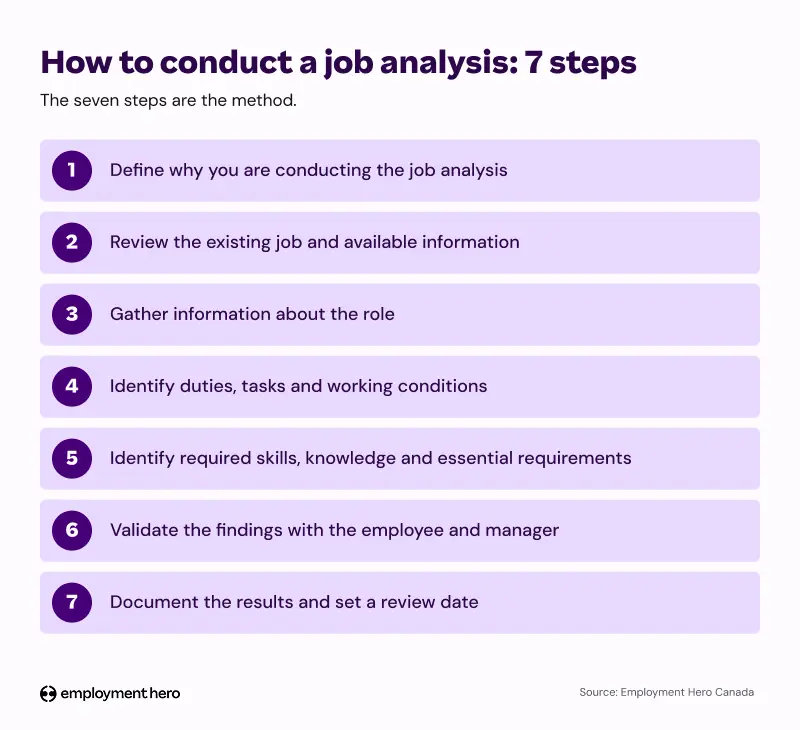
1. Define why you are conducting the job analysis
Start with the reason. A new hire, a restructure and a training review each need a different level of detail. Write the purpose in one sentence and decide which job, or which group of jobs, you’re analyzing. Also decide who leads it. In most small and mid-sized businesses that’s the HR lead or the hiring manager, with input from the person in the role and their manager.
2. Review the existing job and available information
Collect what already exists before you ask anyone anything: the current job description, any previous job postings, the org chart, performance standards, and any records of the tasks the role handles. Then check outside sources, so you’re not working from internal assumptions alone.
Canadian sources to check
- Job Bank (Government of Canada). Its employer guidance treats job analysis as the first step in writing a job description, and lists the National Occupational Classification (NOC) as a secondary source of job information.
- National Occupational Classification (NOC) (Employment and Social Development Canada and Statistics Canada). Canada’s national system for describing occupations. Use it to benchmark duties, responsibilities and occupational requirements. Check you’re using the current version.
- Occupational and Skills Information System (OaSIS). Built on the NOC. Each occupational profile lists skills, knowledge, abilities, work activities, work context and main duties, which map neatly onto the fields in your analysis.
Competitor job postings, LinkedIn and Indeed are useful as secondary market checks. They show how other employers describe similar roles, but they aren’t an authoritative source for what the job requires.
3. Gather information about the role
Ask the people closest to the work. That means the employee (or employees) doing the job, and their manager. A person who held the role before, or was promoted out of it, can also fill gaps. Use one or more of the methods below. Using two gives you a cross-check.
Job analysis methods: 5 ways to gather information
These are data-collection techniques inside the seven-step method, not a separate process.
| Method | What you do | Best used when | Main limitation |
|---|---|---|---|
| Interviews | Ask employees and supervisors a set list of questions, with follow-ups. Ask everyone the same core questions. | You need depth, or the role is professional or knowledge-based | Time-consuming. Relies on what people remember and choose to say |
| Questionnaires / surveys | Send structured or open-ended questions on paper or online, then combine the answers | Several people do the same role, or time is short | Answers can be incomplete or less than candid. You can’t probe |
| Direct observation | Watch the work being done and record the tasks | The work is physical, repetitive or follows a set cycle | People can change how they work when watched. Misses rare tasks and mental work |
| Work diary / log | Ask the employee to record tasks and timing over days or weeks | Day-to-day tasks vary and you need task frequency | Produces a lot of data that can be hard to interpret. Relies on self-reporting |
| Existing-document or secondary-source review | Review current job descriptions, org charts, performance standards, Job Bank and the NOC | You’re starting out, or the role is new | Can be outdated or generic. Doesn’t show how the role works in your business |
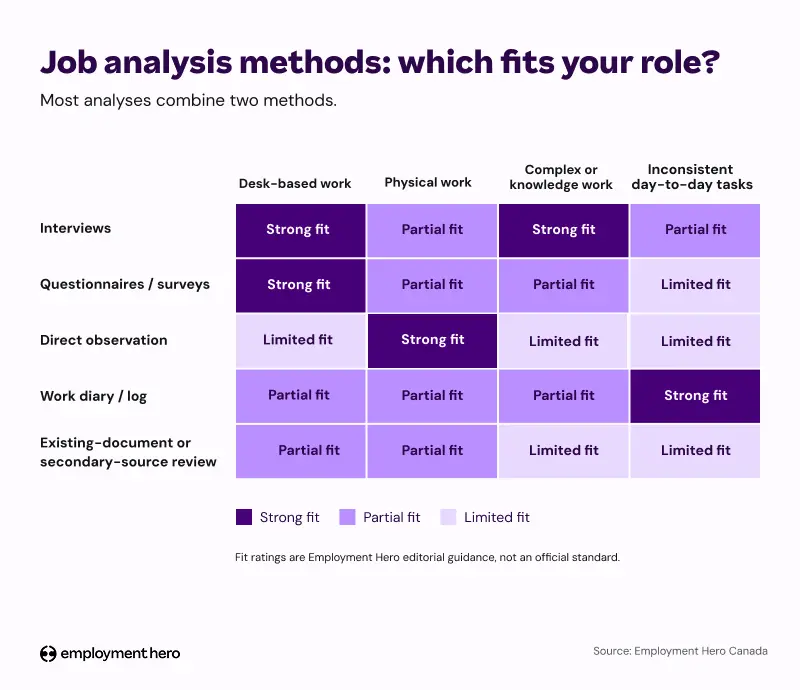
Which method should you use? This matrix summarizes the table above. Most analyses combine two methods, such as a questionnaire plus interviews.
| Method | Desk-based work | Physical work | Complex or knowledge work | Inconsistent day-to-day tasks |
|---|---|---|---|---|
| Interviews | Strong fit | Partial fit | Strong fit | Partial fit |
| Questionnaires / surveys | Strong fit | Partial fit | Partial fit | Limited fit |
| Direct observation | Limited fit | Strong fit | Limited fit | Limited fit |
| Work diary / log | Partial fit | Partial fit | Partial fit | Strong fit |
| Existing-document or secondary-source review | Partial fit | Partial fit | Limited fit | Limited fit |
Fit ratings are Employment Hero’s editorial guidance based on the method limitations above, not an official standard.
4. Identify duties, tasks and working conditions
Now organize what you’ve gathered into the work itself. Capture:
- Job purpose. Why the role exists, in a sentence or two
- Duties. The main areas of responsibility
- Tasks. The specific activities within each duty
- Task frequency and importance. How often each task happens and how much it matters if it isn’t done well
- Responsibility and decision-making authority. What the role decides alone, and what it escalates
- Reporting relationships. Who the role reports to, and who it works with
- Working conditions and job demands. The environment, schedule and any physical or cognitive demands
Describe the work in terms of results, not just methods. Job Bank gives a useful example: is the essential function moving a box from one part of the lab to another, or is it carrying the box? The first describes the result, so it leaves room for different ways of doing it.
5. Identify required skills, knowledge and essential requirements
Next, capture what someone needs to do the work. Capture:
- Knowledge
- Skills
- Abilities and competencies
- Education and certifications
- Tools and equipment
- Essential vs non-essential requirements
To decide what’s essential, ask which requirements are needed from day one, how often they’re used, and what happens if they’re missing. Job Bank suggests keeping the competency list short, at six to ten for a role, and separating what’s needed on day one from what can be learned on the job. Keep qualifications realistic. Setting them too high can screen out people who could do the work.
Essential duties and accommodation. Canadian human rights law requires employers to accommodate employees’ needs up to the point of undue hardship, and the ability to perform the essential duties of a job is a key consideration. Essential duties are the central or core aspects of the job. Your job analysis can help you separate them from marginal tasks. Rules vary by province and for federally regulated employers, so check with your legal or HR advisor before you rely on a job analysis for accommodation or hiring decisions. See the Ontario Human Rights Commission’s policy on the duty to accommodate for an example of a provincial approach.
6. Validate the findings with the employee and manager
Share your draft with the person in the role and their manager. Ask them to check three things: whether it’s accurate, whether anything is missing and whether the essential requirements are really essential. If they disagree, go back to your sources and resolve it. Validation is also how you catch the gap between what a role is meant to be and what it is in practice.
7. Document the results and set a review date
Write up the findings in one place, using the same fields every time. The template below gives you a ready-made format. Record the sources you used, who validated the analysis and when, and set a next review date. The date is a checkpoint, not a fixed schedule. Update the analysis sooner if any of the triggers listed above happen.
Job analysis example: payroll administrator
Illustrative example only. This role, company and the people in it are fictional.
Context: A 40-person Ontario company with one payroll administrator who handles payroll for the whole team.
| Field | Example |
|---|---|
| Job title | Payroll administrator |
| Department | Finance and administration |
| Reports to | Finance manager |
| Job purpose | Make sure all employees are paid accurately and on time, and that payroll deductions, remittances and year-end slips are handled correctly. |
| Main duties | Process each pay run. Maintain employee payroll records. Remit payroll deductions to the Canada Revenue Agency (CRA). Prepare Records of Employment (ROEs) and year-end T4 slips. Answer employee pay questions. |
| Tasks, frequency and importance | Review timesheets and prepare the pay run: every pay period, high. Remit source deductions to the CRA: on the CRA schedule, high. Set up new hires and process changes: as needed, medium. Prepare ROEs: as needed, high. Prepare T4 slips: once a year, high. Answer employee pay questions: most days, medium. |
| Decision-making authority | Can correct routine pay errors and approve standard adjustments. Escalates pay run sign-off, off-cycle payments, termination pay calculations and anything with legal uncertainty to the finance manager. |
| Required knowledge | Canadian payroll deductions (CPP, EI and income tax). Ontario employment standards basics for hours of work, overtime, vacation pay and public holiday pay. Payroll record-keeping requirements. |
| Required skills | Accurate data entry. Reconciliation. Clear written communication. |
| Required abilities / competencies | Attention to detail. Discretion with confidential information. Working to fixed payroll deadlines. Problem-solving. |
| Education / certifications | College diploma in accounting or business, or equivalent experience. A payroll designation, such as the Canadian Payroll Association’s Payroll Compliance Practitioner (PCP), is an asset. |
| Tools / equipment | Payroll software. Spreadsheet software. CRA My Business Account. Accounting software. Service Canada’s ROE Web. |
| Working conditions | Office-based, with hybrid work possible. Deadline pressure around pay dates and year-end. Handles sensitive personal and pay information. |
| Physical / cognitive requirements | Sustained screen work. Sustained concentration on numerical accuracy. |
| Essential requirements | Pay and remittances are accurate and on time. Information is kept confidential. Working knowledge of Canadian payroll deductions. Ability to use payroll software. |
| Non-essential requirements | A payroll designation. Experience with a specific payroll platform, which can be learned on the job. |
| Source(s) consulted | Interviews with the current payroll administrator and the finance manager. Existing job description. Job Bank and NOC occupational information for payroll roles. |
| Employee validation | Confirmed by the current payroll administrator, 8 October 2026 |
| Manager validation | Confirmed by the finance manager, 8 October 2026 |
| Analysis date | 8 October 2026 |
| Next review date | Set a date, or review sooner if duties, systems or reporting lines change |
Job analysis template
Copy and paste this into a document or spreadsheet and fill it in. It uses the same fields as the example above.
JOB ANALYSIS TEMPLATE
Job title:
Department:
Reports to:
THE WORK
Job purpose:
Main duties:
Tasks (with frequency and importance):
Decision-making authority:
Reporting relationships:
Working conditions:
Physical / cognitive requirements (where relevant):
ROLE REQUIREMENTS
Required knowledge:
Required skills:
Required abilities / competencies:
Education / certifications:
Tools / equipment:
Essential requirements:
Non-essential requirements:
VALIDATION
Source(s) consulted:
Employee validation (name, date):
Manager validation (name, date):
Analysis date:
Next review date:
Job analysis questionnaire
Use these questions with the employee, their supervisor, or both. They map to the template fields, so the answers drop straight in.
- What is the main purpose of this role?
- What are the main duties of the role?
- Which tasks do you do most often?
- Which tasks have the biggest impact on the business if they go well, or badly?
- What decisions does this role make, and which does it pass to someone else?
- What skills and knowledge does someone need on their first day?
- What can someone learn on the job?
- Which tools and systems does the role use?
- What are the working conditions and demands, such as environment, schedule or physical and mental demands?
- Which duties are essential to doing the job well?
Validation question: Is anything important about this role missing from the analysis above?
FAQs
A job analysis is a systematic process for collecting and evaluating information about a job, including its duties, tasks, responsibilities, required competencies and working conditions. It analyzes the job, not the person doing it. Employers use the results to write job descriptions, hire and plan training.
There are five common ways to gather information: interviews, questionnaires or surveys, direct observation, work diaries or logs, and review of existing documents or secondary sources such as Job Bank and the NOC. Most analyses use two or more. These are data-collection techniques inside the seven-step process.
Usually the HR lead or the hiring manager, with input from the employee in the role and their manager. In a small business that may be the owner or office manager. Whoever leads it should validate the findings with both the employee and the manager.
Update it when something changes, rather than on a fixed schedule. Common triggers are a new role, an outdated job description, major changes to duties, technology or workflow, restructuring, a compensation or classification review, and new training needs. Set a next review date when you finish, and revisit sooner if a trigger happens
A job analysis gathers and evaluates information about the job. A job description documents the duties, responsibilities and requirements of the job, and is usually written from the job analysis. A job evaluation is different again. It assesses a job’s relative value, typically for compensation or classification
Put your job analysis to work
Once your analysis is done, you can turn it into a job post and track applicants in one place. See how Employment Hero’s applicant tracking system helps you hire.
This article is general information, not legal advice. Employment rules vary by province and for federally regulated employers.
Sources
- Job Bank: Hire employees (Job analysis and writing job descriptions), Government of Canada
- National Occupational Classification (NOC), Employment and Social Development Canada
- Occupational and Skills Information System (OaSIS), Employment and Social Development Canada
- National Occupational Classification (NOC) 2021 Version 1.0, Statistics Canada
- Job analysis process, Recruitment and Selection, eCampusOntario (adapted from Introduction to Human Resource Management, First Canadian Edition, and Human Resources Management, 3rd Edition)
- Policy statement on the duty to accommodate under the Ontario Human Rights Code, Ontario Human Rights Commission
Disclaimer: The information in this article is current as at 12/10/26, and has been prepared by Employment Hero Pty Ltd (ABN 11 160 047 709) and its affiliates (Employment Hero). The views expressed in this article are general information only, are provided in good faith to assist employers and their employees, and should not be relied on as professional advice. Some information is based on data supplied by third parties. While such data is believed to be accurate, it has not been independently verified and no warranties are given that it is complete, accurate, up to date or fit for the purpose for which it is required. Employment Hero does not accept responsibility for any inaccuracy in such data and is not liable for any loss or damages arising directly or indirectly as a result of reliance on, use of or inability to use any information provided in this article. You should undertake your own research and seek professional advice before making any decisions or relying on the information in this article.
Related Resources
-
 Read more: Stat holidays in Saskatchewan 2026 and 2027: Dates and pay rules explained
Stat holidays in Saskatchewan 2026 and 2027: Dates and pay rules explained
Learn Saskatchewan’s statutory holiday rules, eligibility requirements, and holiday pay calculation methods for employers. Read the guide.
-
 Read more: Stat holidays in Manitoba 2027: List and employer pay rules
Stat holidays in Manitoba 2027: List and employer pay rules
Confused by the 5% holiday pay calculation or the first and last shift rule? Master Manitoba general holiday laws and…
-
 Read more: Statutory holidays BC 2027: Complete list and pay eligibility rules
Statutory holidays BC 2027: Complete list and pay eligibility rules
Struggling to calculate stat holiday pay in British Columbia? Master the 15/30 rule, check the 2027 calendar, and stay compliant.…