 Australia
  New Zealand
  Singapore
  Malaysia
  Canada (Français)
 United Kingdom






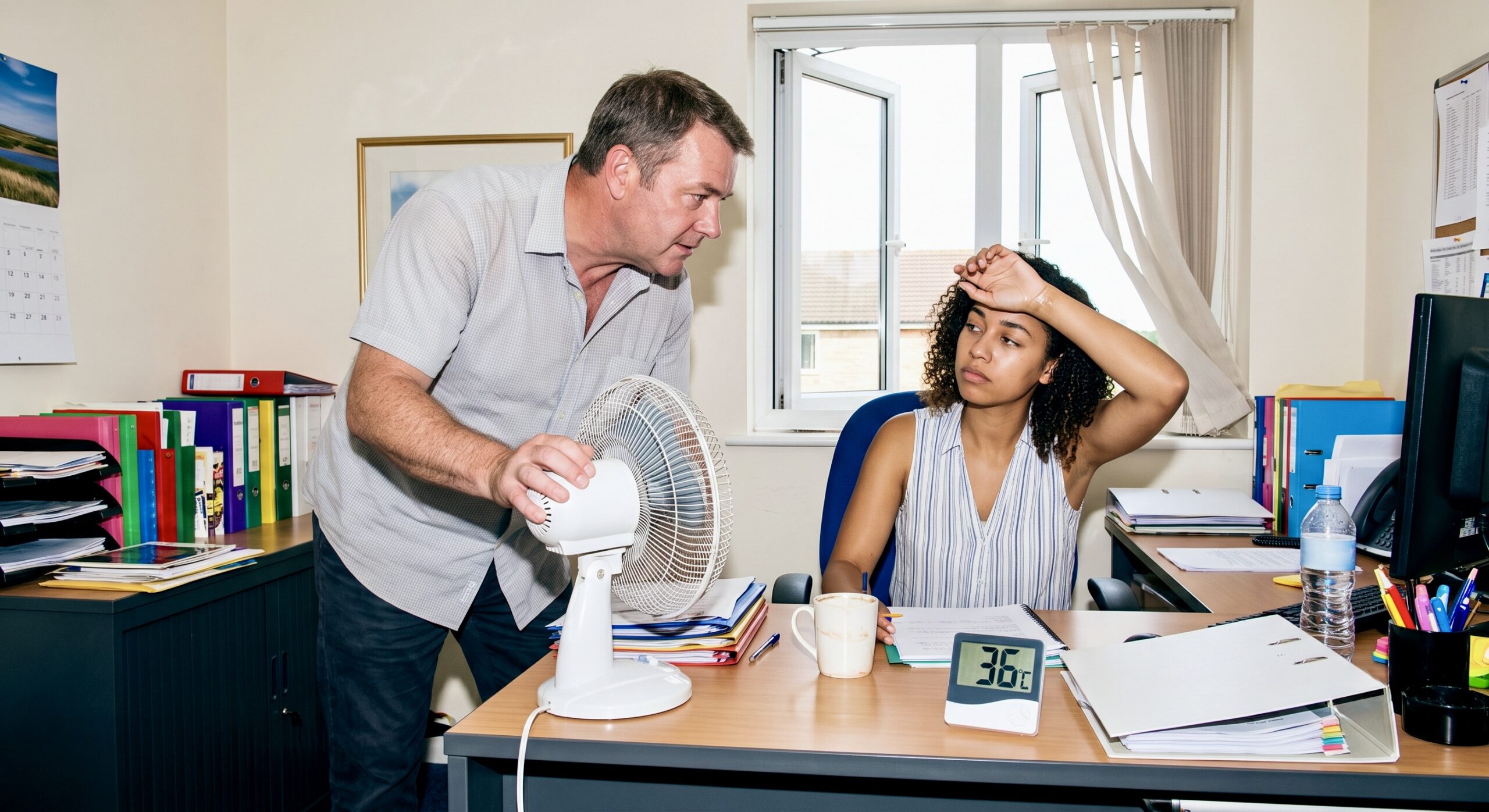
A cross-party group of MPs have thrown their support behind a bill that could pave the way for the UK’s first legal maximum working temperature, as another heatwave pushes temperatures to uncomfortable highs.
The Maximum Workplace Temperature Bill, presented to the House of Commons on 13 July by Green Party MP Hannah Spencer, would create an independent body to recommend a maximum safe working temperature and set out how it should be enforced. Backed by Labour Party MPs Rebecca Long-Bailey and Nadia Whittome, the SNP’s Graham Leadbitter, Plaid Cymru’s Liz Saville Roberts and Your Party leader Jeremy Corbyn, the proposed legislation aims to address an issue that’s becoming increasingly pressing as temperatures rise.
As things stand today, Britain regulates the cold but not the heat. There’s a recommended minimum of 16C, or 13C for strenuous work, and no upper limit at all: only a duty on employers to keep the temperature “reasonable.” A cross-party motion signed by Spencer and others calls that duty “impossible to enforce unless a worker is seriously injured or killed from heat stress.”
Spencer, who worked as a plumber before entering Parliament, has framed the gap through the jobs that feel it worst. “From bus and train drivers sweltering in cabins that are hotter than the soaring temperatures outside and bakers working in temperatures of over 40 degrees, to builders whose workplaces offer no respite from the heat, the government has a duty to protect all of us,” she said.
Why the UK Has No Legal Working Temperature
The lack of clarity around a maximum working temperature law isn’t for want of desire. Unions have wanted a ceiling for years, and the TUC’s figure is 30C, or 27C for strenuous work, with employers made to act once the thermometer passes 24C. In May the Government’s Climate Change Committee told ministers to bring in maximum-temperature rules for work, though they stopped short of naming a number.
That’s partly due to the difficulty of establishing a figure that covers all workplaces fairly. The Health and Safety Executive says no single figure can cover every workplace, because the heat is often thrown off by the work itself – e.g. in a bakery, a foundry or a commercial kitchen, rather than by the sun outside.
Many of those workplaces are small businesses. With SMEs making up around 60% of private-sector employment and 97.7% of hospitality firms being small businesses, any national limit would land largely on SMEs.
What a Maximum Working Temperature Would Mean for Employers
Other countries have already set limits. In Spain, the cap depends on the type of work, and staff can shift their hours during a heatwave to avoid the worst of the afternoon. Spencer has urged ministers to look at that approach rather than leave every employer to draw the line alone.
The cost of not doing so is already on the books. Hot days cost Great Britain an average of £1.2 billion a year in lost output between 1998 and 2021, and £5.3 billion in the worst year, according to the Office for National Statistics. Loughborough University research found productivity drops by an average of 35% across the workday at 35C and 50% humidity, rising to 76% at 40C and 70% humidity, a mark the UK has now cleared several times this summer.
How Hot Is Too Hot to Work – And Can Staff Refuse?
No legal number is coming this summer, so the responsibility sits where it always has: with the employer.
Specialist Employment Solicitor Elissa Thursfield points out that in spite of the lack of legislation around maximum working temperatures, employers – especially in small businesses – should remain vigilant:
“There’s a myth that because the UK has no maximum working temperature, employers can ignore the heat. That’s wrong. Every employer has a legal duty to keep the workplace at a reasonable temperature and to assess the risk to their staff.”
In addition to familiarising themselves with existing laws, Elissa adds that employers should be:
- Asking who’s exposed to the heat, for how long and what you can actually do about it
- Thinking about ventilation, relaxing the dress code and moving heavy work to cooler parts of the day
- Introducing more breaks and plenty of water
What Are Employers’ Legal Obligations in the Heat?
In addition to safety concerns for employees, employers too, face risks if they fail to introduce preventative measures in extreme weather conditions.
“No legal number doesn’t mean no legal risk,” says Elissa.
“If someone collapses with heat exhaustion and you can’t show you assessed the risk, you could be facing a personal injury claim, action from the Health and Safety Executive, or both. You don’t need an HR department for any of that. You just need to show you’ve thought about it, and if you employ five or more people, to write it down.”
“The one that catches small employers out is this: staff are legally protected if they refuse to work in conditions they reasonably believe are seriously dangerous. Discipline or sack someone for that and you could face an automatic unfair dismissal claim, and they don’t need two years’ service to bring it. A fan, a rota change and a written risk assessment cost a lot less.”
How Will Maximum Temperature Laws Impact SMEs?
The proposed bill is at the earliest possible stage at the time of writing, which means broader considerations – i.e. how a law of this nature will impact small-to-medium enterprises versus large businesses – should hopefully come into play.
Smaller businesses are the least equipped to manage the risk: only 21% train line managers to spot and handle health problems at work, against 76% of large employers, according to the Government. Most have no in-house HR or occupational health to run a heat risk assessment, and a small team has little room to send people home or move work to cooler hours without losing a day’s trade. It’s one more compliance question for small employers already tracking a full slate of new legislation.
As Elissa points out:
“If a maximum temperature comes in, the burden won’t fall evenly. A big employer can install air conditioning. A small business often can’t, and many don’t even own their premises. A café or workshop in a rented unit may need the landlord’s permission to make changes, and the tenant usually pays for improvements to a building they’ll eventually hand back.
“Any new law has to recognise that. If the only way to comply is expensive kit, small employers will be stuck between the law and their lease. There has to be room for practical fixes instead, like adjusted hours, rotating jobs and proper rest breaks in the shade.”
The same goes for workplaces with remote and hybrid policies.
“Homeworking is the tricky one”, Elissa points out.
“Your health and safety duty follows your employee home, but you can’t inspect their spare bedroom and you certainly can’t fit cooling in a house you don’t control. Realistically, it comes down to trust and common sense: a simple checklist the employee fills in, flexibility on hours, and the offer of a cooler place to work, like the office, if home isn’t workable.
“What you can’t do is ignore it because they’re out of sight. If a maximum temperature applied to homes in exactly the same way as workplaces, it would be close to unworkable, and that’s precisely what an independent review body would need to sort out.”
The record for 34C days has already gone, six days have topped 35C for the first time, and forecasters expect the heat to hold into midweek – and potentially beyond. The bill may not survive the parliamentary process, but employers who wait for a legal number will still have to answer for this week’s heat under the rules that already exist.