 Australia
  New Zealand
  Singapore
  Malaysia
  Canada (Français)
 United Kingdom




Half of Gen Z workers feel guilty using AI to produce work, even as employers increasingly indicate that they consider AI skills desirable, according to new research from Employment Hero.
The finding comes from The AI Paradox, a new report from Employment Hero’s charting how small businesses and their staff are adopting AI. Surveying 5,454 workers and 3,290 business leaders across the UK, Australia, Canada and New Zealand in April and May 2026, the study found that alongside those who feel guilty, 52% of Gen Z respondents said using AI to do part of their job feels like cheating.
For Ria Kaur, a university student and jobseeker, the discomfort is rooted in the existing stigma about her age group being workshy.
“As a Gen Z student experiencing the world of work through internships and placements, I see AI everywhere. But I also find that, in workplace situations, AI can feel like my dirty little secret.”
AI Skills Are Now a Hiring Requirement
Nearly two thirds (64%) of UK employers told Employment Hero that AI has changed what they look for when hiring and “AI skills” have entered the top five attributes they screen for, ranking above prior experience.
The market is clearly embracing those skills already. Analysis of around a billion job ads by multinational professional services network PwC found AI capability now commands a 34.2% wage premium in the UK, triple the figure recorded a year earlier.
Yet despite more than a third of Gen Z (37%) saying entry-level roles now specify AI knowledge, 23% don’t feel their skills are strong enough to compete for them. The result is a widening gap between what young workers are expected to do and their candidness about how they use these tools. The skills employers value most increasingly include fluency with AI, and Gen Z is responding: Employment Hero’s figures shows 58% say they feel positive about AI becoming a bigger part of their working life, against 25% who say they’re worried.
The Rise of Shadow AI
Without clarity, the use of AI is at risk of going under the radar. Four in ten (42%) Gen Z workers use AI without their employer’s knowledge, and the same proportion present AI-generated work as their own.
The instinct to hide that uncertainty isn’t irrational. A 2025 Duke University study of more than 4,400 people, published in the Proceedings of the National Academy of Sciences, found that employees who use AI are judged by colleagues as ‘lazier’ and ‘less competent’ and that managers who don’t use AI themselves were less likely to hire candidates who did. That perception holds regardless of the employees’ age, gender or occupation.
It’s a perspective Kaur feels familiar with. “I think this comes from the stigma around younger generations using AI, which becomes stronger in the workplace because of the frustrating idea that Gen Z are lazy, or that we do not know what real work is.
“If a young person uses AI at work, it can feel like people assume they are offloading the task or taking the easy way out. In reality, a lot of us are using it responsibly to understand a task, prepare for a conversation or make sense of something new – but I still feel like it has to be kept hidden.”
Why the Permission Gap Matters for Employers
While many workplaces do keep up with guidance, part of the problem from some is that a knowledge gap has opened up. The CIPD’s Autumn 2025 Labour Market Outlook found that 61% of UK employers now allow staff to use generative AI, but only 35% have provided any training or support to go with it.
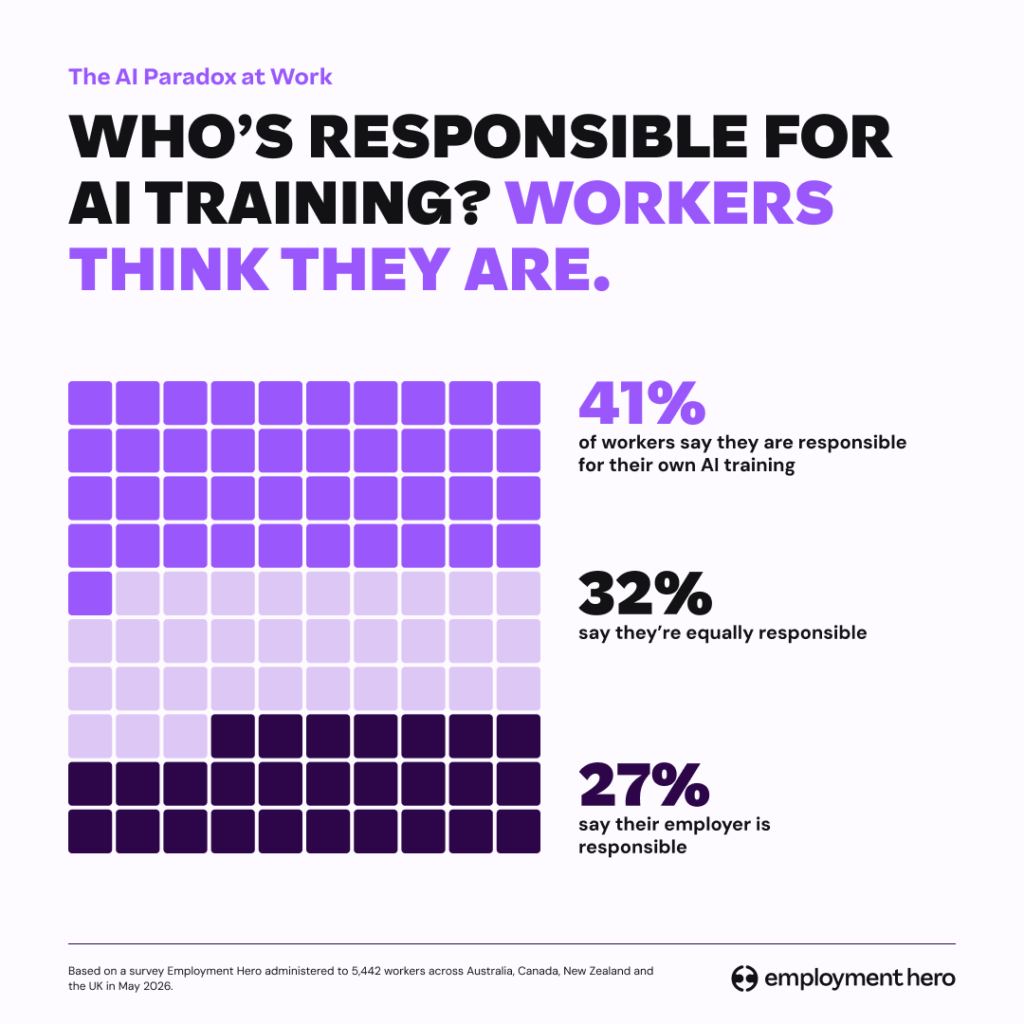
Kevin Fitzgerald, UK Managing Director at Employment Hero, said the mismatch is now a business risk.
“When half of Gen Z feel guilty using AI at work, and more than four in 10 are doing so without their employer’s knowledge, it shows that workplace norms have not yet caught up with employee behaviour.”
He added: “AI should not feel like cheating. It should feel like using any other tool that helps people do their jobs better.”
In order to tackle these issues, the practical fix appears to be less about the technology itself than about being explicit: clear rules on how AI can be used at work, training that turns permission into competence and managers who model the behaviour rather than penalise it.
With 81% of young workers already teaching themselves AI through social media, the capability is forming with or without a company’s blessing. Employers who set clear expectations now will watch that skill develop in the open, where they can guide it and measure its impact. Those who don’t will keep paying for work their most eager staff feel they have to hide.
To help employers adapt, Employment Hero has partnered with NoCodeLab to share practical tips on bringing AI use out into the open:
For business leaders:
- Think about what outcome you want to achieve and then start with your people, not your tools. Before choosing any AI platform, map where critical knowledge lives in your organisation. If key expertise exists only in certain people’s heads, that is both your biggest risk and your biggest AI opportunity.
- Give employees clear permission and clear guidelines to use AI openly. Shadow AI is a symptom of unclear governance, not a technology problem. A simple, honest policy removes the ambiguity that drives hidden use.
- Identify the processes where friction is highest. The most valuable AI implementations target the workflows that drain time or create bottlenecks. Think about the existing process – is it worth automating? Or can it be redesigned? That’s the real opportunity.
- Focus on your AI Advantage, not just AI adoption. Every competitor has access to the same tools. The organisations that pull ahead are those who encode their own expertise, judgement and ways of working into how they use AI. That cannot be bought off a shelf.
- Build AI capability from within. Rather than outsourcing AI implementation entirely, invest in developing your own people’s skills. The businesses that will lead are those whose teams can build, adapt and govern AI themselves.
For employees:
- Understand that your expertise is the asset. AI tools are widely available. What is not available to anyone else is your knowledge, your judgement and your experience. The goal is to encode that, not replace it.
- Be transparent about how you use AI. Using AI to do your job better is a professional skill. Sharing how you use it builds trust, normalises good practice and positions you as someone who is ahead of the curve.
- Think in terms of People, Process, Tools, Outcomes and Products. When considering where AI could help, start with the repetitive processes that slow you down, not just the obvious tools everyone else is using.
- Ask for structure, not just permission. Rather than waiting to feel allowed, ask your organisation for clear guidance and training. The best AI skills are built in the open, with proper guardrails.
- Own your output. AI is the assistant, you are the professional. Apply your critical thinking to everything AI produces and take full responsibility for the quality of what you deliver.