 Australia
  New Zealand
  United Kingdom
  Singapore
  Malaysia
  Canada (Français)





Whistleblower policy template and guide
Published
Whistleblower policy template and guide
Published
Every business owner, founder and HR manager wants to foster a culture of integrity and transparency for their employees and their business. A well-designed whistleblower policy is the cornerstone of this effort, providing a safe and confidential channel for individuals to report wrongdoing without fear of reprisal. Our comprehensive guide and customizable template are designed to help your organization establish a robust policy that supports compliance and promotes a strong ethical foundation, minimizing risk and building trust.
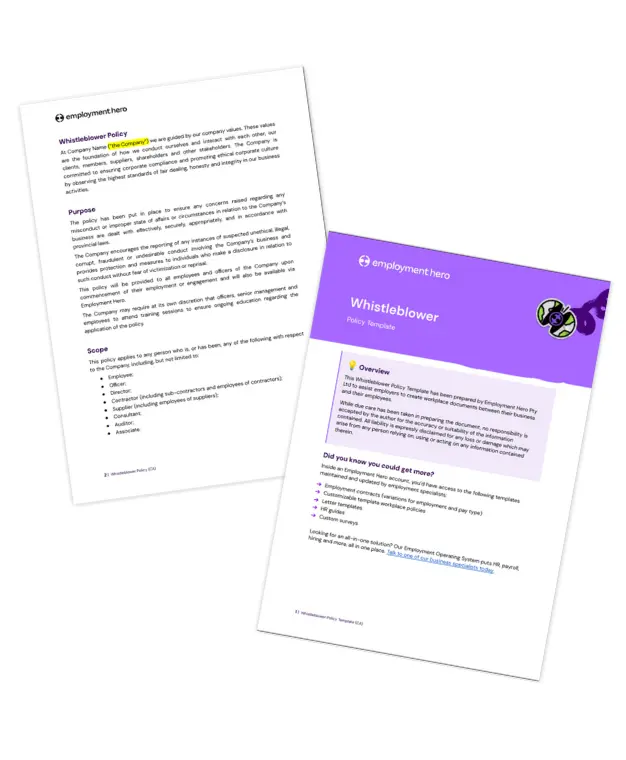
What is in this whistleblower policy template?
This comprehensive guide and template provide everything you need to implement a robust whistleblower policy for your Canadian organization. By downloading this resource, you’ll receive:
- A customizable policy template ready for immediate use.
- Clear explanations of key policy components, from reporting mechanisms to anti-reprisal provisions.
What is a whistleblower policy?
A whistleblower policy is a formal framework that allows individuals to report suspected wrongdoing within an organization in good faith, providing crucial protections against retaliation. It clearly outlines how concerns can be raised, the types of misconduct covered, the options for confidentiality or anonymity and the organization’s commitment to investigating all reports and safeguarding whistleblowers.
In Canada, these policies are essential for promoting trust and transparency across all sectors. They create a safe environment where employees, contractors and other stakeholders can speak up without fear of negative consequences.
Legal protections for whistleblowers in Canada
Canadian law offers important safeguards for whistleblowers. The Criminal Code prohibits employers from disciplining or disadvantaging an employee who reports wrongdoing to law enforcement.
Beyond this, federal statutes like the Public Servants Disclosure Protection Act provide specific protections for government employees. Several provinces, including Alberta, Saskatchewan, Manitoba, New Brunswick, Ontario and British Columbia, have their own legislation, particularly for public sector workers. Additionally, the Competition Act protects the confidentiality of whistleblowers during investigations of anti-competitive conduct, making it a powerful tool for maintaining fair markets.
Benefits of whistleblower policy
An effective whistleblower policy does more than just meet legal requirements – it promotes a strong and ethical organizational culture.
By creating a safe space for reporting, your organization can benefit from the early detection of misconduct, which can significantly minimize financial and reputational damage. When employees and other stakeholders see that your organization is committed to acting on reports and protecting those who speak up, it builds trust and can lead to improved employee retention.
How to make a whistleblower policy
Drafting an effective whistleblower policy involves a series of clear steps. Start by defining the scope of the policy, including who it covers (employees, contractors, third parties, etc.) and the types of misconduct that can be reported (e.g., fraud, harassment, illegal acts). You should also establish channels and procedures for external whistleblowers like residents, customers or contractors who witness misconduct. Categorizing reportable misconduct into specific buckets-such as accounting and finance issues versus governance and compliance issues-helps employees identify and report specific types of wrongdoing accurately.
Next, outline the reporting mechanisms, such as a hotline, email , web portal or third-party whistleblower platforms like ClearView Connects. Using external platforms rather than internal emails can help maintain an independent, 24/7 intake process, ensuring they provide options for confidentiality and anonymity. The policy should then describe the process for acknowledging reports, conducting fair and impartial investigations and communicating outcomes to the person who made the report. It’s vital to include strong anti-reprisal provisions and reference applicable legal protections to reassure potential whistleblowers. Finally, to ensure the policy’s success, emphasize the importance of training, accessibility and visibility across the entire organization.
Ensuring confidentiality and protection from reprisal
To guarantee the integrity of your policy, you must have clear provisions for confidentiality and protection. The policy should ensure that personal information is handled in accordance with privacy laws and that only designated individuals have access to a whistleblower’s identity.
It must explicitly state that whistleblowers are shielded from any form of retaliation, including demotion, harassment or termination. Clarify that legal and policy protections against reprisal should begin at the moment an employee seeks advice about a disclosure, not just after a formal filing. These reprisal protections also cover employees who simply cooperate in an investigation or actively decline to participate in suspected wrongdoing. However, it’s also important to make it clear that this protection applies only if the reports are made in good faith and with reasonable belief in the truth of the allegations.
Reporting and investigation process
Your policy should provide a detailed overview of the reporting process using numbered, step-by-step procedures. Clear timelines for providing updates and communicating outcomes are crucial:
- Submission: Offer multiple submission methods (e.g., hotline, email or web portal).
- Acknowledgment: Formally acknowledge reports within a specific timeline, such as five days.
- Investigation decision: Outline the steps for investigation, such as collecting evidence and conducting interviews, and decide whether to launch a full investigation within 20 days.
- Conclusion: Maintain fairness and transparency, concluding the investigation and communicating outcomes within 120 days.
Training and policy communication
A policy is only effective if people know it exists and understand how it works. You should regularly train employees and managers on the policy’s purpose, the reporting process and the protections available. Awareness efforts, such as internal campaigns and memos, help normalize the act of raising concerns and build confidence that employees will be safe if they use the policy.
Whistleblower policy template
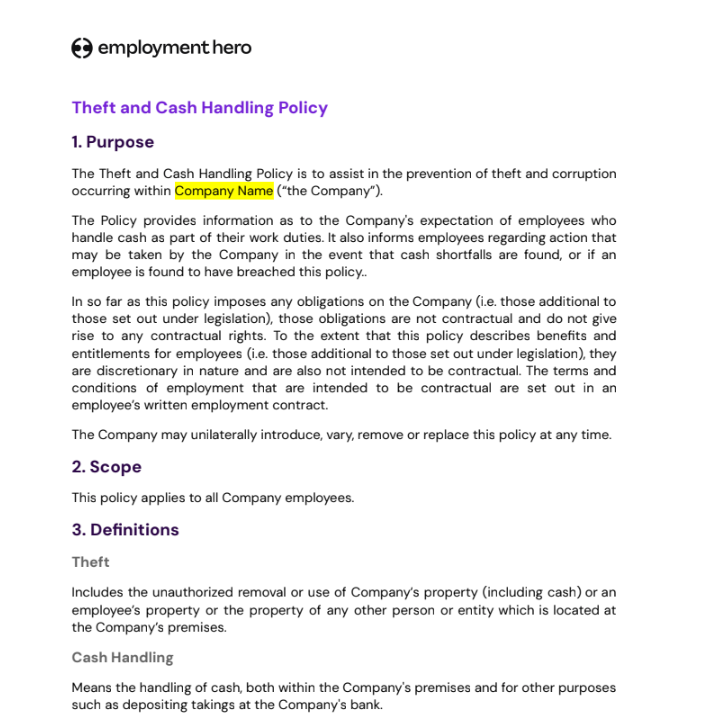
Here’s a preview of the policy template you can download and customize based on your requirements:
Best practices for whistleblower policies in Canada
The most effective whistleblower policies in Canada share several key principles. They prioritize confidentiality, impartial investigations and timely responses. They must also be aligned with all relevant Canadian legal standards and foster a culture of ethics where raising concerns is seen as a positive contribution, not a risk.
Fairness and transparency
A strong policy ensures fair treatment for both whistleblowers and those accused of misconduct. You should extend confidentiality protections explicitly to the persons who are the subject of the investigation, not just the whistleblower, to protect the reputation of accused individuals until investigations conclude. Investigations should incorporate principles of procedural fairness, with clear communication to all involved parties and thorough documentation of findings. This transparency builds trust in the process and helps ensure that the policy is not misused.
Policy oversight and continuous improvement
A policy is a living document that requires ongoing oversight. Assign a responsible officer or committee to monitor its implementation, track reports and review outcomes. Establishing a formal, confidential CEO complaint log helps you track reports, investigations and resolutions. This allows you to maintain records and summarize whistleblower complaints for executive or board of directors oversight. Periodic audits and trend analysis can help you identify blind spots and improve procedures over time, ensuring your policy remains relevant and effective as your organization evolves.
Download our whistleblower policy
Building a robust whistleblower program is an investment in your company’s integrity and long-term success. Our template and guide make it easy to create a policy that protects your people and your business.
Take the first step toward a more transparent and ethical workplace.
Frequently asked questions
A whistleblower policy serves as an alternative channel for situations involving a fear of reprisal, rather than acting as a primary complaint line. Standard HR grievances, such as individual incidents of workplace conflict, should go through regular management channels. However, if an issue involves systemic bullying or harassment, it can be considered gross mismanagement and elevated to a whistleblower complaint.
While policies strive to protect a whistleblower’s identity, strict anonymity during an investigation can sometimes hinder the ability to evaluate credibility or interview them effectively. A complainant’s identity might also become known due to factors entirely outside of the organization’s control, so it is important to set realistic expectations regarding absolute confidentiality guarantees.
Specific actions considered acts of reprisal include demotion, forced transfer, reduction in hours, termination and verbal or physical threats. Reprisal involves any negative action taken against an individual for reporting misconduct in good faith.
The information in this template is current as at 1 September 2025, and has been prepared by Employment Hero Pty Ltd (ABN 11 160 047 709) and its related bodies corporate (Employment Hero). The views expressed in this template are general information only, are provided in good faith to assist employers and their employees, and should not be relied on as professional advice. The Information is based on data supplied by third parties. While such data is believed to be accurate, it has not been independently verified and no warranties are given that it is complete, accurate, up to date or fit for the purpose for which it is required. Employment Hero does not accept responsibility for any inaccuracy in such data and is not liable for any loss or damages arising either directly or indirectly as a result of reliance on, use of or inability to use any information provided in this template. You should undertake your own research and to seek professional advice before making any decisions or relying on the information in this template.
Register for the template
Related Resources
-
 Read more: Stat holidays in Manitoba 2027: List and employer pay rules
Stat holidays in Manitoba 2027: List and employer pay rules
Confused by the 5% holiday pay calculation or the first and last shift rule? Master Manitoba general holiday laws and…
-
 Read more: Statutory holidays BC 2027: Complete list and pay eligibility rules
Statutory holidays BC 2027: Complete list and pay eligibility rules
Struggling to calculate stat holiday pay in British Columbia? Master the 15/30 rule, check the 2027 calendar, and stay compliant.…
-
 Read more: Statutory leave types in Canada 2026: An employer guide
Statutory leave types in Canada 2026: An employer guide
Mismanaging employee time off can lead to compliance risks and payroll errors. Master the rules for paid, unpaid, and statutory…