 Australia
  New Zealand
  Singapore
  Malaysia
  Canada (Français)
 United Kingdom




Future-proofing a business has never been about having a flawless long-term plan. For organisations navigating growth, setbacks and constant change, the difference between enduring and folding often comes down to something less glamorous: getting the right people in the right seats, making hard calls without hesitation and building a culture strong enough to absorb pressure from every direction.
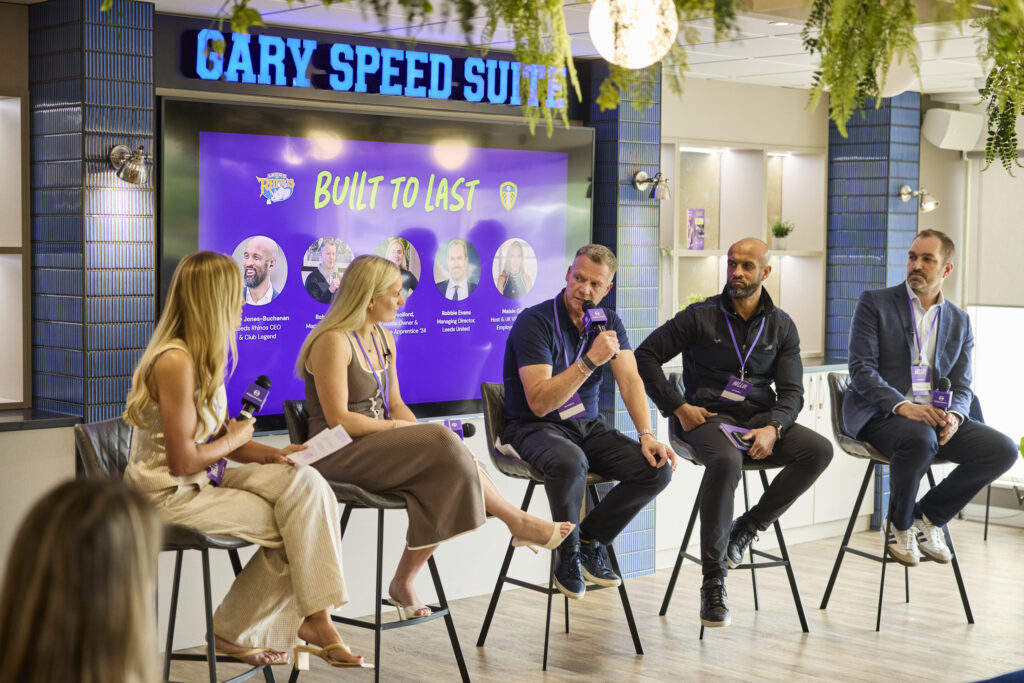
As part of the Built to Last event by Employment Hero, four leaders from Leeds recently gathered at Elland Road to share the decisions that shaped their businesses and the mistakes that taught them the most. Between them, they have launched during a pandemic, navigated toxic leadership hires, weathered relegation and scaled from 24 employees to thousands.
The panel brought together Robbie Evans, Managing Director of Leeds United Football Club; Rob Oates, Managing Director of Leeds Rhinos; Jamie Jones-Buchanan MBE, CEO of Leeds Rhinos and a club legend with 421 appearances; and Rachel Woolford, founder of boutique fitness brand North Studio and winner of BBC One’s The Apprentice in 2024. Their combined experience offers practical wisdom on long-term thinking, decisive leadership, values-driven hiring and building the kind of culture that outlasts any individual. As Evans puts it: “Run the company as though you run it forever.”
Run It Like You Own It Forever
Robbie Evans arrived at Leeds United three years ago after spending over a decade at a biotech scale tup that grew from 24 people to a 3,500-person publicly listed company. The experience shaped a leadership philosophy he now applies at Elland Road.
“Run the company as though you run it forever,” Evans says. “You want to make the right decision for the long term every time, you want to build the right culture or embrace the key parts of the culture that are there and think like a super long term vision.”
That doesn’t mean locking in rigid decade-long strategies. Evans argues the opposite is more useful. “The best ten year plan is a series of good two year plans because you’re going to turn that thing up anyways,” he explains.
His biotech career also produced one of the panel’s most striking data points on hiring. Over 13 years of rapid growth, underwent a significant restructure, hiring thousands of people.
That volume of hiring reshaped how he defines performance itself. “Finding good teammates is harder than finding good skills,” Evans says. “Performance is severely oversimplified as being good at the tasks of your job. Performance is doing your job and working as a team.”
For SMEs, relying on conventional performance metrics only tells half the story. An employee who delivers individually but undermines collaboration is, by Evans’ measure, underperforming.
The Five-Letter Word That Makes the World Go Round
Rob Oates has spent 24 years at Leeds Rhinos, building what is widely regarded as the strongest commercial operation in rugby league. His leadership philosophy starts with something he considers non-negotiable.
“[The] five letter word that makes the world go round,” Oates says is “not money, is it? It’s trust.”
That trust is maintained through consistency, care and longevity. The Rhinos’ management team has largely been in place for over a decade. Oates joined in 2003. Jones-Buchanan has been with the club for 30 years. Former CEO Gary Hetherington served for 32. “It’s the people who emphasise the family, the Rhinos family, the way in which we conduct ourselves,” Oates explains.
But Oates is equally candid about what happens when that trust breaks down. A few years ago, the club hired the wrong person into a senior leadership role. The consequences rippled across the entire organisation.
“The knock-on effect of poor leadership, and the ripples that that then sent through, sponsors, partners, fans, attendances, and everything that spins off match day … it was toxic,” Oates says.
The wrong leader had recruited an entire team around them, all of whom eventually had to leave. “You’re into maybe a two or three year cycle before you know what’s happened, before you’re back on a level keel,” he explains.
The experience crystallised a distinction Oates now considers essential for any business owner. “Leadership, getting people to want to do what needs to be done, is absolutely key in an organisation, as opposed to management, which is just getting people to do it,” he says. “We’d lost that. And it was a costly few years.”
Evans reinforced the point from his own experience on both sides of the problem. “The carrying cost is so high and you don’t realise how hard it is to recover or how much energy you’re losing to that,” he adds. “I’ve experienced that both as a hiring manager and as a more junior employee who experienced it above me.”
Be Decisive, Then Deal With the Consequences
Rachel Woolford opened North Studio in the middle of the pandemic, grew it into one of Leeds’ most recognised boutique fitness brands, then voluntarily left it for nine weeks to compete on The Apprentice. The experience stripped away any remaining instinct to hesitate.
“Being indecisive is still a decision and it can really slow the process down,” Woolford says. “If you make a decision, stick with it and then deal with the consequences after. I’m not saying be reckless.”
The principle was sharpened in the boardroom. Woolford was project manager twice and “lost” both times, but never feared being fired because she owned her decisions and refused to use anyone as a scapegoat. “If you’re a manager, you’re a leader, you’re a business owner, you can’t blame other people,” she says. “You own it at the end of the day.”
The more lasting lesson came from being forced to delegate. Before The Apprentice, Woolford ran payroll herself. It was, by her own account, a source of genuine dread.
“I literally had anxiety on the 28th of waking up because I knew how much money was going out,” she says. “My staff are amazing, by the way, they deserve every penny. But logging on was awful.”
With no phone and no contact for nine weeks, she had no choice but to hand it over. “I handed that over and I always thought I’ll just take that back on when I come back and I’ve never done it since,” Woolford says. “And it has taken such a weight off my shoulders.”
The nine weeks without contact proved something that no amount of advice could have. “I was forced to delegate. I didn’t have a choice,” she explains. “And then I came back and I realised that job could stay delegated.”
Woolford also echoes the panel’s consensus on hiring for character over credentials. “I will always take that person over somebody who might be top of the game in our industry, but has a bad attitude or there’s just something not quite right,” she says. “When you’ve got a good team, hold on to it and don’t underestimate how powerful that is.”
Nobody Cares How Much You Know Until They Know How Much You Care
Jamie Jones-Buchanan played 421 games for Leeds Rhinos across two decades before stepping into the CEO role in November 2024. His leadership philosophy is anchored by a concept he returns to repeatedly.
“Nobody cares how much you know until they know how much you care,” Jones-Buchanan says. He defines care through four qualities: courage, altruism, resilience and enjoyment. “Kevin Sinfield taught us all that with care for each other.”
The principle extends to how teams and organisations function at a structural level. “There’s about five or six million parts inside the average airplane but none of them can fly,” Jones-Buchanan says. “But when you bring them together, help them to understand their purpose, their job, then good things happen.”
When asked whether organisations should hire for values or skills, Jones-Buchanan is unequivocal. He frames his answer through The Wizard of Oz, a story he uses regularly with his teams.
“If the destination is the Emerald City, then the strategy is following the Yellow Brick Road,” he explains. “And the values are the fence that keeps everybody on the Yellow Brick Road.” Without those values, people get “dragged off into the poppies.”
The metaphor carries a deeper point about what leadership really requires. In the story, the Wizard cannot grant the characters what they want. Instead, he sends them on a mission that forces them to discover they already possess the qualities they thought they lacked. “What he did was he created the opportunity for them to go find what they already had, but they needed to get out of their comfort zone to find it,” Jones-Buchanan says. “And that’s leadership.”
His advice to business owners building teams is to prioritise shared values above all else. “If you want to make things happen, find people who are like you, want exactly the same thing, align in the values and go get after it and good things happen.”
Five Takeaways From the Panel
- Think long term, plan short term
The best 10-year plan is a series of good two-year plans. Set a vision that endures, then execute in focused cycles.
- A wrong leadership hire is the most expensive mistake a business can make.
The ripple effects travel through partners, staff, customers and culture. Recovery takes years, not months.
- Decisiveness beats perfection.
Indecision is still a decision. Owning the call and adjusting from there will always outperform waiting for certainty.
- Delegate before it feels comfortable.
The tasks founders cling to longest are often the ones most ready to hand over. Forced delegation frequently becomes permanent improvement.
- Hire for values, not just skills.
Skills can be taught. Being a good teammate cannot. Culture fit issues, not capability gaps, account for the vast majority of terminations.